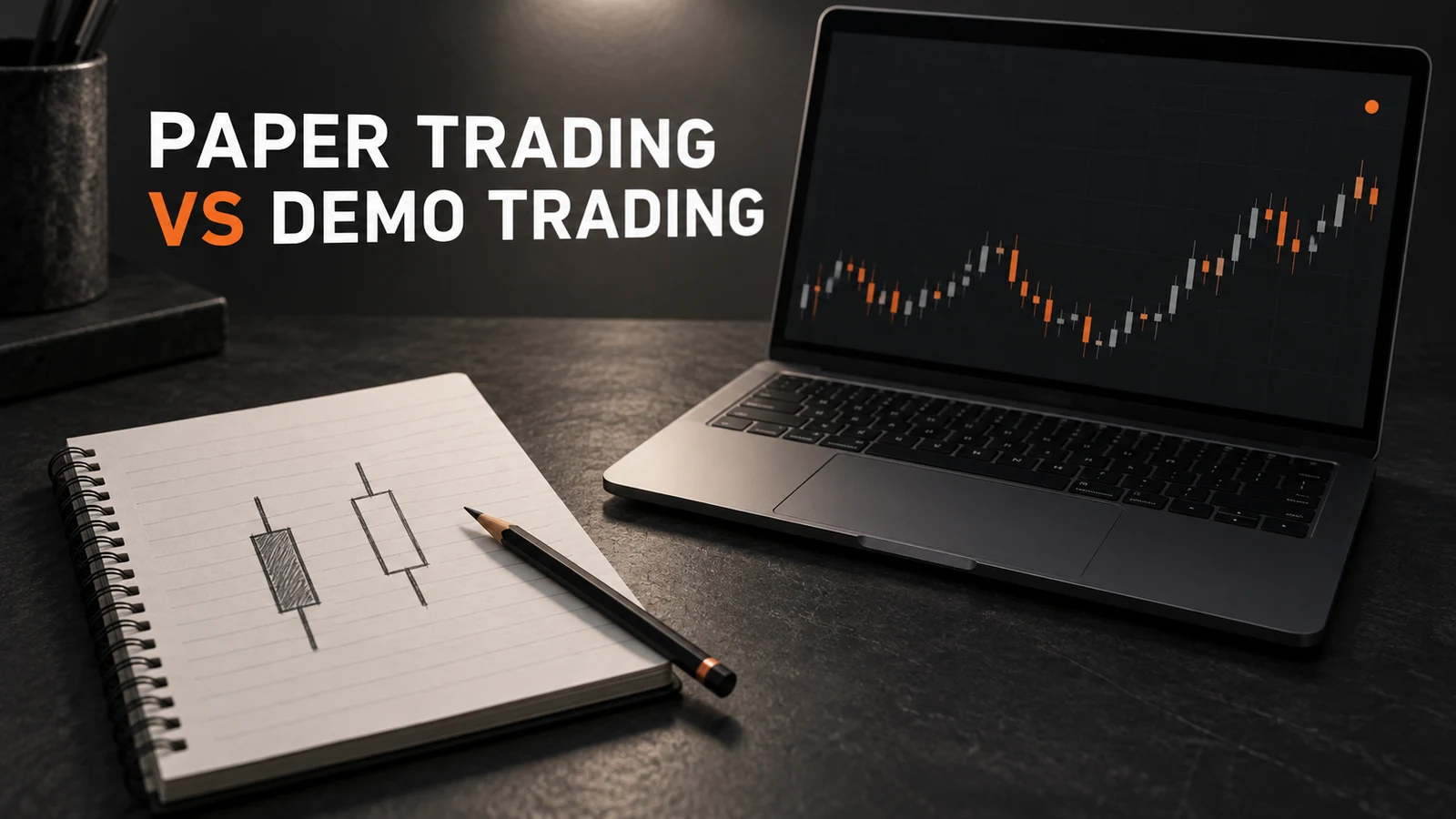



Paper trading usually records hypothetical trades manually, while demo trading uses a platform account with virtual funds and simulated order execution. Paper trading is useful for testing strategy logic; demo trading is better for practising order entry, position sizing and account rules. Neither method fully reproduces financial pressure or guarantees future results.
Paper Trading vs Demo Trading: Key Points
- Choose the method from the skill you need to test.
- Manual paper trading is strong for setup logic and deliberate review.
- Demo accounts are stronger for platform workflow and risk execution.
- Both can overstate results when costs and fills are unrealistic.
- Use a staged transition instead of jumping directly to a paid challenge.
Last AIFO FAQ review: . AIFO Free Trial facts below come from the current Free Trial FAQ.
The terms paper trading, demo trading, virtual trading and simulated trading are often used interchangeably. The useful distinction is operational: are you manually recording a hypothetical trade, or placing a simulated order through a platform?
Read the demo trading account guide for the complete demo scorecard. This page compares the two practice methods.
Definitions
Manual paper trading means writing down an entry, stop, target and position size without placing an order in a trading platform. The trade is later marked using observed prices.
Demo trading means placing simulated orders through a platform account funded with virtual money. The account records orders, positions, balance and equity automatically.
A charting platform may call its simulator “paper trading” even though it behaves like a demo account. Evaluate the functions rather than the label.
Manual Paper Trading
Manual paper trading slows the decision down. The trader must state the entry, invalidation and target before checking the outcome. This is useful during early strategy development because it exposes vague rules.
Its weaknesses are execution realism and hindsight bias. A trader can accidentally choose an ideal fill, ignore a spread or decide after the move that an entry would have been taken.
Platform Demo Trading
A demo account adds operational detail. The trader selects the symbol, volume and order type, places the stop and watches equity change. It can reveal platform mistakes that a notebook cannot.
Demo execution is still simulated. Fills, slippage, liquidity and emotional pressure may differ from a future account. Treat the result as practice evidence.
Paper Trading vs Demo Trading Comparison
| Dimension | Manual paper trading | Platform demo trading |
|---|---|---|
| Best purpose | Define and test setup logic | Practise execution and rules |
| Order workflow | Written or spreadsheet record | Simulated platform orders |
| Position sizing | Manual calculation | Calculated and entered into the platform |
| Fill realism | Weak unless assumptions are strict | More operational detail, still simulated |
| Automation | Usually unavailable | May allow platform tools, subject to provider rules |
| Feedback | Depends on disciplined journaling | Account history plus journal |
| Emotional pressure | Low | Low to moderate |
Execution and Data Differences
For manual paper trading, define a conservative fill rule before the sample begins. Record whether the spread, commission, swap and slippage are included. If the high or low only touches the entry price, do not automatically assume a perfect fill.
For a demo platform, record symbol specifications, server time and transaction costs. A visually identical chart can produce a different result when contract size or spread changes.
Psychology and Feedback
Manual practice can hide urgency because the trader is not clicking an order. Demo trading adds more real-time decisions but still has no direct financial consequence. Common distortions include:
- taking setups that would be avoided with money at risk;
- resetting the account after drawdown;
- increasing volume because virtual losses feel harmless;
- reviewing only the final balance rather than process quality.
Use the same written risk and stop rules intended for the next stage. The point is to practise behaviour, not to maximise a virtual return.
Choose by Practice Objective
| Objective | Start with | Move on when |
|---|---|---|
| Define a new setup | Manual paper trading | Entry, stop and exit rules are unambiguous |
| Learn a platform | Demo account | Orders and risk controls are placed without errors |
| Test prop firm rules | Rule-matched demo or free trial | The full sample has no hard-rule breach |
| Test automation | Backtest, then controlled demo | Forward behaviour matches the intended logic |
| Prepare for paid evaluation | Demo account with exact risk plan | Drawdown and behaviour remain stable through losses |
A Three-Stage Transition Plan
- Stage 1 — Paper: define one setup and record hypothetical entries without changing rules after the outcome.
- Stage 2 — Demo: use the platform, fixed risk and a personal daily stop. Record planned-versus-realised execution.
- Stage 3 — Rule rehearsal: reproduce the target, loss limits and trading-day structure of the intended account before paying.
Repeat a stage when the evidence is weak. Time spent repairing a practice process is usually cheaper than repeatedly buying an evaluation.
Using the AIFO Free Trial
The AIFO Free Trial FAQ states that all registered users are eligible and one demo account can be held at a time. It is simulation only, provides no profit sharing or funded account, has a 5% target and 5% Maximum Loss Limit, and may be frozen after 21 days without trading.
Use it to test the platform and rule process. Passing the trial is practice evidence, not a reward or guarantee of passing a paid challenge.
Frequently Asked Questions
Paper trading traditionally means recording hypothetical trades manually, while demo trading usually uses a platform account with virtual funds. Modern platforms sometimes use the terms interchangeably, so check what the tool actually does.
Neither is universally better. Manual paper trading is useful for early strategy logic and deliberate review; a platform demo is better for order entry, position sizing, timing and rule practice.
They can provide evidence, but neither proves future profitability. Data quality, execution assumptions, sample size, costs and trader behaviour can differ from a paid or live environment.
A beginner can first use manual paper trading to understand setup logic, then move to a demo account to practise the full platform workflow and risk controls.
Yes. The AIFO Free Trial FAQ describes it as a free simulation-only account for practising the environment and rules. It provides no profit sharing or funded account.
Move only after a meaningful sample shows stable risk, no hard-rule breach, controlled drawdown and consistent execution across wins and losses. A profitable week alone is not enough.