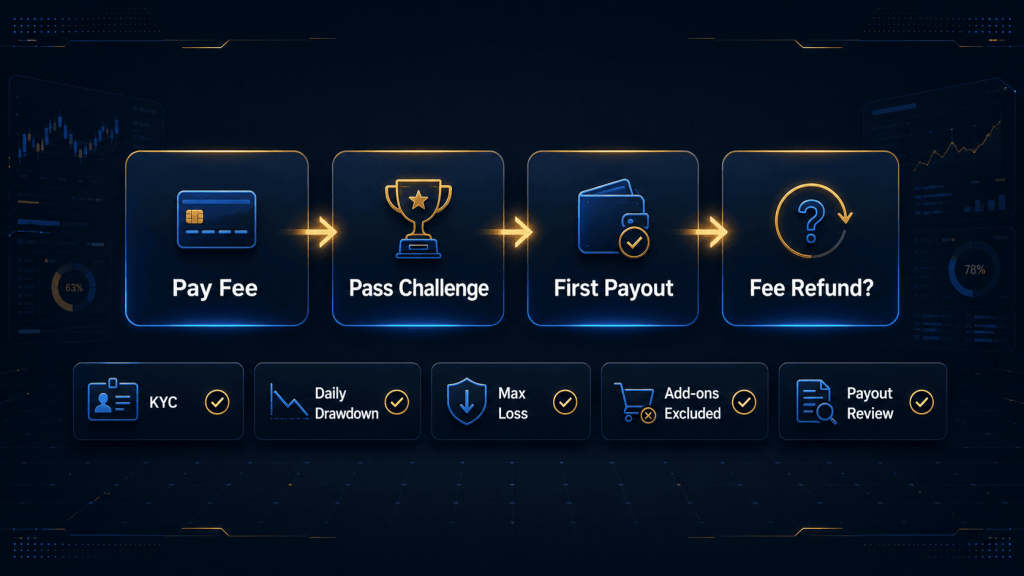



A free prop firm trial is normally a practice account, while a genuine free prop firm challenge should be a formal qualification route obtained without paying the usual challenge fee. Passing a free trial normally proves only that the trader completed the practice conditions. Passing a free challenge matters only when the offer terms define a real next stage, such as another evaluation, funded-style account or prize. Always check what happens after success, not just whether the first account costs zero.
This page answers the free challenge vs free trial decision only. For demo accounts, practice accounts and paper trading terminology, use Free Prop Firm Account: Demo, Practice and Paper Trading. For normal paid evaluation structures, use AIFO Account Models.
Last checked: . AIFO Free Trial structure, current account lineup and account rights were checked against the latest AIFO rule baseline. Current industry usage was reviewed against first-party free-trial documentation and current free-challenge offers.
Free Prop Firm Challenge vs Free Trial: The Direct Difference
The difference is not whether both accounts start at zero cost. The difference is whether successful performance creates a formal right to progress.
| Decision point | Free Trial | Free Prop Firm Challenge | Why it matters |
|---|---|---|---|
| Upfront cost | Normally zero | Zero, waived, earned or sometimes deferred | Zero upfront cost does not prove the entire route is free |
| Main purpose | Practice and account testing | Formal qualification or competition for a defined next stage | The purpose determines whether passing has procedural value |
| Account status | Practice / demo simulation | Formal evaluation, competition or promotional qualification account | The dashboard can look similar while account rights differ |
| Result after passing | Usually trial completion only | Should lead to a clearly stated next stage or prize if all conditions are met | This is the main distinction |
| Funded progression | Normally none from the trial itself | Possible only if explicitly defined in the offer | Never infer progression from the word “challenge” |
| Payout | Normally none | Depends on the next account or prize terms | Passing and receiving money are separate events |
FTMO provides a clear first-party example of the trial side of this distinction: its current Free Trial is described as a preparatory experience and does not create automatic eligibility for an FTMO Account. FTMO Free Trial guidance.
What Counts as a Free Prop Firm Challenge?
The phrase “free prop firm challenge” is used loosely. Before classifying an offer as genuinely free, identify when money becomes payable and what successful completion actually produces.
- True zero-fee evaluation: the trader enters a formal qualification account without paying the normal challenge fee, and the terms define progression after a compliant pass.
- Competition: entry may be free, but only top-ranked traders receive the listed challenge, funded opportunity or cash prize.
- Giveaway account: a trader receives a standard or promotional challenge through a campaign rather than buying it.
- Referral or loyalty reward: the challenge is free to the recipient but earned through another qualifying activity.
- Zero-upfront challenge: the trader pays nothing initially but may owe an activation or post-pass fee later.
- Refundable paid challenge: this is not free at entry. The trader pays first and may recover the fee only after a later condition is met.
The acquisition route and the account stage must be separated. A free competition can award a paid-style challenge. A free challenge can still require a later fee. A refundable challenge can eventually have zero net cost but still exposes the trader to upfront loss.
What Does a Prop Firm Free Trial Actually Give You?
A free trial should be evaluated as a practice product. Its value is the information generated before a formal account is purchased.
- Platform evidence: can you use the interface, order types and account tools correctly?
- Rule evidence: can you operate inside Daily Loss and Maximum Loss without constantly approaching the limits?
- Strategy evidence: do your usual stops, holding periods and trade frequency fit the programme?
- Behaviour evidence: does a target cause overtrading or larger positions?
- Readiness evidence: can you complete the simulated process using repeatable risk rather than one exceptional trade?
A free trial becomes weaker evidence when its rules differ materially from the paid programme. A smaller target, missing commissions, different phase count or different drawdown method can make a practice result look more transferable than it really is.
For a deeper practice framework, use the prop firm demo and paper trading guide.
What Happens After You Pass?
The post-pass event is the fastest way to distinguish practice from real qualification.
| Free offer type | Typical result after success | Main hidden condition | Question to ask before starting |
|---|---|---|---|
| Free Trial | Trial completes, closes or can be repeated | No automatic funded progression | Does passing create any contractual next-stage right? |
| True free evaluation | Progression under the normal evaluation terms | Review, KYC or later-stage requirements | Which exact account is issued after approval? |
| Zero-upfront challenge | Trader may progress after paying a later activation fee | Cost appears after the pass | What amount becomes payable and at which stage? |
| Competition | Only eligible leaderboard winners receive the prize | Leaderboard behaviour and prize restrictions | Is the prize cash, a challenge or funded-style access? |
| Giveaway | Winner receives the stated promotional account | Promotional account rules can differ from standard checkout | Which normal rulebook applies to the prize? |
| Refundable paid challenge | Fee may be refunded after a later eligible milestone | Failure leaves the original payment unrecovered | Which event triggers the refund? |
If the offer cannot explain the next account, required payment and rulebook after success, the word “challenge” provides very little useful information.
Where Does the AIFO Free Trial Fit?
AIFO currently offers a Two-Step Free Trial. It is a simulation for practising the AIFO trading environment and Two-Step rules, not a free formal route into an AIFO simulated funded account.
All AIFO account types—including Free Trial Accounts, Challenge Accounts and Funded Accounts—operate in a simulated trading environment using virtual funds only.
| Account point | AIFO Free Trial | Current AIFO Account Model | Why the difference matters |
|---|---|---|---|
| Entry fee | No challenge fee for the Free Trial | Depends on selected account and checkout | The trial removes purchase risk while practising |
| Structure | Two-Step Free Trial using the current Two-Step rules | Instant, 1-Step, 2-Step or Sprint | A Free Trial result should not be applied automatically to another model |
| Accounts available | One Free Trial account per user under the current FAQ | Depends on normal programme and account purchase conditions | The Free Trial should be used as a deliberate practice attempt |
| Time limit | No time limit under the current FAQ | Depends on the selected programme | Practice can focus on process rather than speed |
| Profit sharing | None | Relevant only after eligible simulated funded-account progression and applicable payout conditions | Trial profit is not withdrawable profit |
| Simulated funded-account progression | None from the trial itself | Eligible evaluation accounts can progress after completing the applicable stages and review | Passing the Free Trial is preparation rather than qualification |
| Completion | Account closes after Phase 2 is completed | Formal account follows the selected programme progression rules | The trial does not carry its account rights into another stage |
Check the current AIFO Free Trial FAQ before starting. Traders considering a paid evaluation should then compare the current AIFO account models rather than assuming the Two-Step trial represents every AIFO programme.
How Do You Check Whether a “Free” Prop Firm Offer Is Worth Using?
A free offer is clear enough only when the trader can describe the entire account path before placing the first trade.
- What is free? The trial, the evaluation, the competition entry or the final account?
- What account stage starts first? Practice, evaluation, competition or funded-style access?
- What happens after passing? Does the account close, progress or trigger a payment?
- Is a later fee required? Check activation, platform, upgrade and verification charges.
- Which rules apply? Confirm profit targets, drawdown, trading days and prohibited methods.
- Does profit have economic value? Determine whether the stage has any profit-share or payout rights.
- Does KYC apply? A prize or progression can still depend on identity and country eligibility.
- Is the offer temporary? Competition, campaign and giveaway conditions can expire quickly.
Do not call an offer “free funded trading” simply because there is no payment on the first screen.
Should You Choose a Free Challenge or a Free Trial?
Choose based on the question you need the account to answer.
- Choose a Free Trial when you need to test the platform, rules, strategy fit or your own discipline before paying.
- Choose a genuine free challenge when you specifically want a formal qualification opportunity and the next-stage rights are clearly documented.
- Choose a competition when you understand that funding or account access depends on leaderboard placement rather than simply reaching a target.
- Avoid a “free” offer when the mandatory post-pass fee, account issued after success or payout conditions are unclear.
- Return to practice when the main goal is still learning execution rather than qualifying for another account stage.
Complete beginners should start with prop trading practice before a paid challenge. Traders who already have a tested process can move on to the formal AIFO challenge model comparison.
Frequently Asked Questions
A Free Trial is normally a practice account with no automatic funded progression. A genuine free prop firm challenge should be a formal qualification route obtained without paying the normal entry fee and should clearly define what happens after a compliant pass.
Normally no. A free trial is generally designed for practice rather than formal qualification. Funded progression exists only when the programme terms explicitly state that completing the account creates that next-stage right.
Not necessarily. Some zero-upfront challenges charge an activation, upgrade or post-pass fee later. Check the full payment path rather than only the initial checkout amount.
No. The current AIFO Free Trial is a Two-Step simulation used for practice. It provides no profit sharing or simulated funded-account progression, and the trial account closes after Phase 2 is completed.