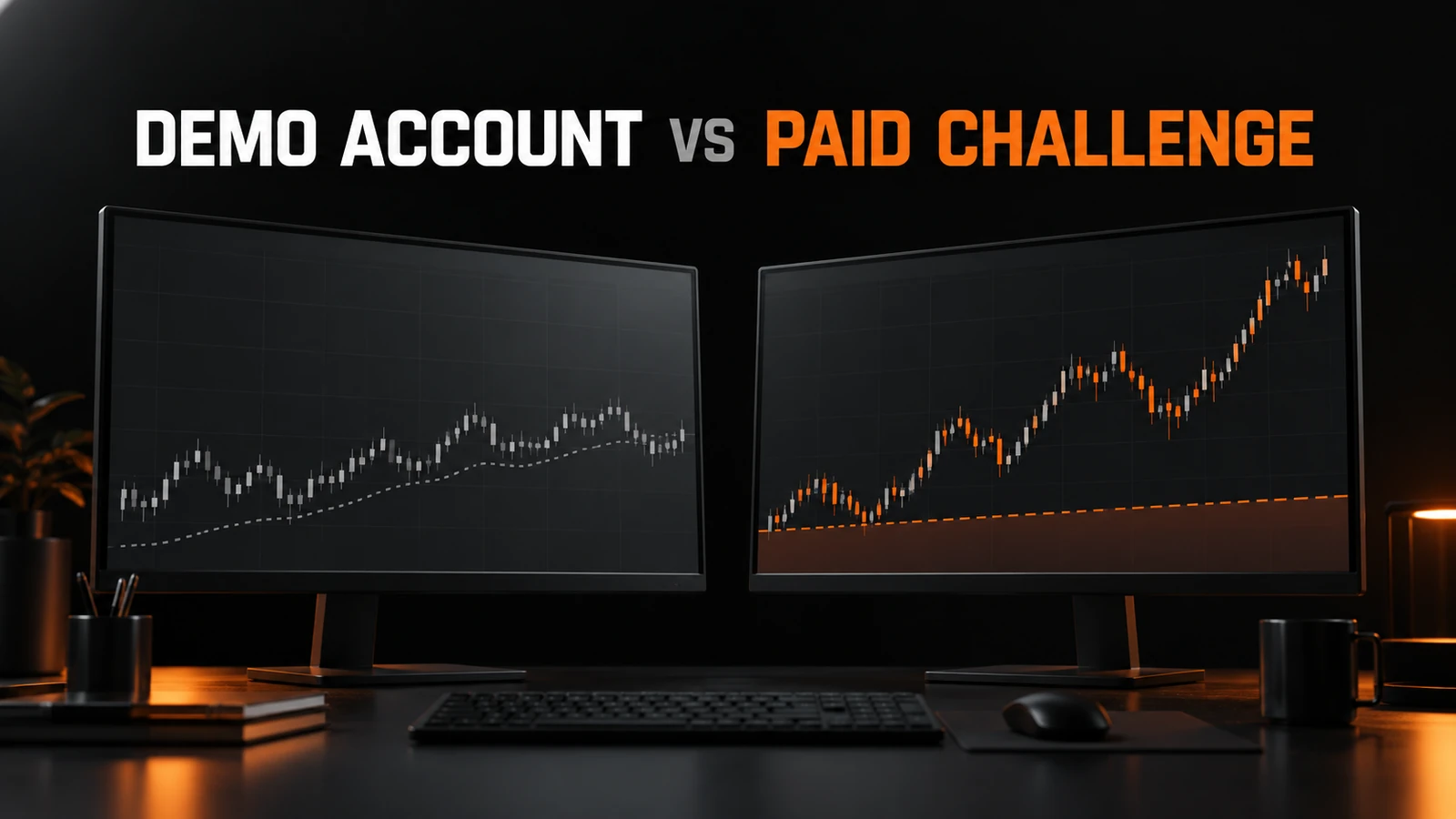



A prop firm demo account is for practice; a paid challenge is an evaluation with account-specific objectives, loss limits, review conditions and possible progression. The platform may look similar, but payment, eligibility and payout expectations create different decision pressure. Use demo trading to prove rule-compatible behaviour before paying, not as a guarantee that the challenge will be passed.
Demo Account vs Paid Challenge: Key Points
- Similar screens do not create identical conditions or behaviour.
- A demo tests process; a challenge tests process under eligibility pressure.
- Demo profit is not payout-eligible profit.
- Use the same written strategy and planned risk in both environments.
- Move to paid only after a meaningful, rule-compliant sample.
Last AIFO FAQ review: . AIFO Free Trial facts below come from the current Free Trial FAQ.
A trader can use the same strategy on the same-looking platform and still behave differently once an account fee, evaluation result or possible payout matters. That is why a profitable demo sample should be treated as preparation evidence, not a pass prediction.
Read the demo trading account guide for the generic definition and practice scorecard. This page focuses on the decision to move from a prop firm trial environment to a paid evaluation.
Prop Firm Demo Account vs Paid Challenge
| Dimension | Demo or free trial | Paid challenge |
|---|---|---|
| Primary purpose | Practise platform, strategy, risk and rules | Meet the selected evaluation objectives without a rule breach |
| Money paid | Usually no account fee for the trial | Requires the applicable checkout payment |
| Funds | Simulated | Evaluation environment; check the firm’s exact account description |
| Progression | Normally none unless explicitly stated | May progress after objectives, rule compliance and review |
| Payout | No payout entitlement | Challenge profit is not automatically withdrawable; funded-stage rules apply after progression |
| Psychological pressure | Lower because a reset or virtual loss has limited consequence | Higher because fee, failure and future eligibility matter |
| Best use | Find process weaknesses before purchase | Execute the already-tested process |
Rules and Objectives
A demo may copy part of a challenge structure, but the trader must verify whether the target, loss calculations, trading days, holding permissions, automation rules and platform settings truly match the paid account under consideration.
Create a rule map with five columns:
- profit objective;
- Daily Loss calculation and reset;
- Maximum Loss percentage and drawdown type;
- minimum trading days or time window;
- strategy and account restrictions.
If the demo does not reproduce one item, label it clearly. Do not assume that passing a looser simulation proves readiness for a tighter paid model.
Market and Platform Conditions
Two accounts can use the same platform while having different symbol names, contract sizes, spreads, commission, leverage, server time or available markets. Before the first paid trade, compare the symbol specification and recalculate the position size.
Also test the operational workflow: login, server selection, stop placement, pending orders, partial closes and account-history export. The MT5 vs cTrader vs MT4 guide explains why platform capability does not override the account rules.
Psychological Differences
A paid challenge adds three pressures:
- Sunk-cost pressure: the trader may force trades to justify the fee.
- Target pressure: a visible objective can encourage larger size or lower-quality setups.
- Loss aversion: the trader may move a stop, avoid a valid trade or revenge trade after a loss.
The solution is not to remove emotion completely. It is to pre-commit to behaviours that remain valid when emotion changes: fixed setup criteria, planned risk, a personal daily stop and a rule that prohibits size increases after losses.
Eligibility and Payouts
Demo profit is a practice result. It is not payout-eligible and does not create a claim against the provider. A paid evaluation also does not mean that evaluation-stage profit is automatically withdrawable. The trader must complete the applicable progression and later meet the funded account’s payout conditions.
The current AIFO Free Trial FAQ is explicit: the account is simulation only, offers no profit sharing or funded account and closes automatically after the 5% trial target is passed. Use that result to review the process, not as a reward expectation.
Run a Paired Demo-to-Challenge Test
Before buying, complete a practice block with the exact strategy and risk intended for the challenge. Then compare planned and realised behaviour:
| Metric | Plan | Demo result to record |
|---|---|---|
| Risk per trade | Fixed amount or percentage | Average, maximum and number of deviations |
| Personal daily stop | Maximum session loss or loss count | Number of times trading continued beyond it |
| Setup quality | Written A/B criteria | Share of trades meeting all criteria |
| Maximum drawdown | Budget inside account limit | Observed drawdown and remaining safety margin |
| Trade frequency | Normal opportunity range | Forced trades taken because activity was slow |
| Review completion | Journal after every session | Missing screenshots or unexplained trades |
If the demo only passes because of one oversized winner, repeated resets or ignored violations, the paid account is not ready. Repair the process and repeat the block.
How Long Should You Test?
Use evidence rather than a fixed calendar answer. The sample should include:
- enough trades to estimate win rate and average payoff without relying on one result;
- at least one normal losing sequence;
- more than one market condition;
- no hard-rule breach;
- stable planned-versus-realised risk;
- a complete journal that another reviewer can follow.
A trader who takes two valid setups per week needs a longer calendar period than a strategy that produces multiple independent setups per day. The required evidence, not impatience, sets the test length.
Readiness Thresholds Before Paying
- The strategy is written and has a positive tested expectancy.
- Normal drawdown fits inside the selected account with a safety margin.
- No position was sized before the stop distance was known.
- The trader stopped when the personal daily limit was reached.
- The platform, symbols and server time were checked.
- The current FAQ for the selected account was read directly.
- The fee can be treated as a cost, not as money that must be recovered quickly.
Frequently Asked Questions
A demo account is a practice environment with simulated funds and no payout entitlement. A paid challenge is an evaluation governed by the selected firm's objectives, loss limits, review and progression conditions. Payment and eligibility pressure can change trader behaviour even when the platform looks similar.
Demo results can show whether the strategy and risk process are compatible with the rules, but they cannot guarantee a pass. Execution, market conditions, emotional pressure and decision quality can change in a paid evaluation.
Use the demo to rehearse the intended paid-account risk plan, then reduce risk if the real account has less remaining loss room, different execution or stronger behavioural pressure. The account's current risk budget always controls the final size.
Test until you have a meaningful sample that includes wins, losses and different market conditions, with no hard-rule breach and controlled risk. A calendar target alone is not enough.
No. The AIFO Free Trial FAQ states that the account is for simulation only and provides neither profit sharing nor a funded account. It closes automatically after the trial target is passed.
Compare the exact account model, profit target, loss calculations, drawdown type, minimum trading days, platform and symbol settings, permitted trading methods, review conditions and payout requirements.