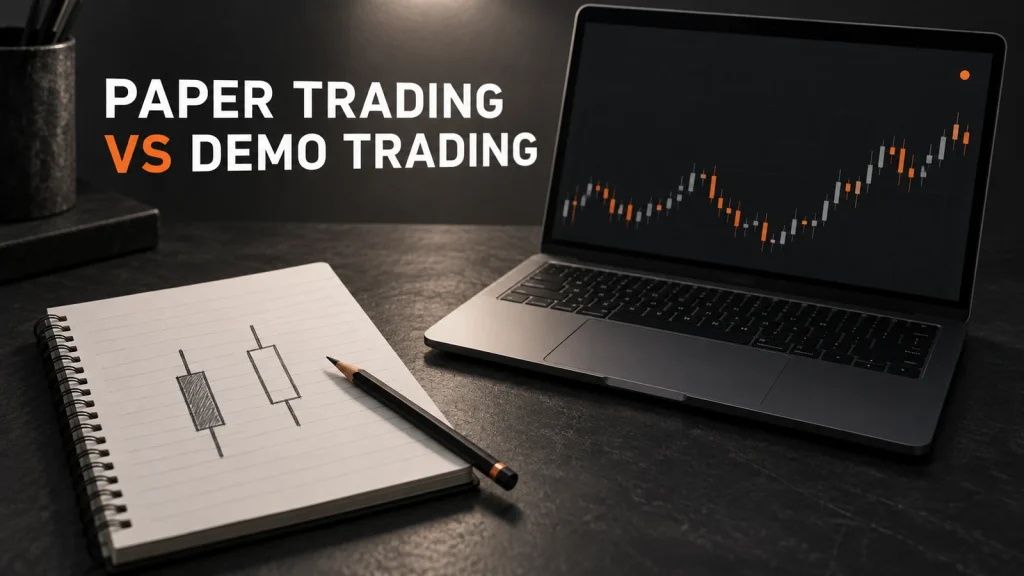



A demo trading account is a practice environment that uses simulated funds so you can learn the platform, test a strategy and measure risk discipline without putting personal capital at risk. It is useful for process validation, but it cannot fully reproduce the emotions, liquidity, slippage or decision pressure of trading with real financial consequences.
Demo Trading Account: Key Points
- Use demo trading to test a process, not to chase a virtual balance.
- Track risk, drawdown and rule adherence alongside profit.
- Make the practice conditions resemble the account you may trade next.
- Move on only when behaviour remains stable through losing periods.
- AIFO Free Trial is simulation only and does not create a funded account or profit split.
Last AIFO FAQ review: . AIFO Free Trial facts below come from the current Free Trial FAQ.
Demo trading is most valuable when it answers a specific question. Can the strategy identify the same setup repeatedly? Does the stop placement produce controlled losses? Can the trader follow a daily stop after two losing trades? A rising demo balance does not answer those questions by itself.
This guide explains what a demo trading account can teach, what it cannot reproduce and how to build a practice plan that supports a future funded account application or challenge. If your main question is the difference between a free practice account and a paid evaluation, continue to the prop firm demo account vs paid challenge comparison.
What Is a Demo Trading Account?
A demo trading account is an account with virtual funds used to practise trading in a simulated market environment. The platform may resemble a live trading terminal, and the trader can normally place orders, set stop-loss and take-profit levels, monitor open positions and review account history.
The word demo describes the funding and practice context. It does not guarantee that every provider uses identical pricing, spreads, execution or product access. Before comparing results, record the platform, symbols, server time, leverage, trading costs and any account rules applied to the simulation.
How Simulated Trading Works
The platform converts an order into a simulated position and updates its profit or loss as the quoted market price changes. When the position closes, the result changes the virtual account balance. This creates a useful feedback loop for learning order entry, position sizing and trade management.
However, a simulated fill is not a promise that a future order will receive the same execution. Market depth, latency, slippage and price gaps can affect real outcomes. Treat a demo fill as practice data and keep a margin of safety inside any loss rule.
| Area | Demo can help test | Important limitation |
|---|---|---|
| Platform workflow | Order tickets, stop placement, chart layout and account history | A paid account may use different symbols, specifications or server settings |
| Strategy logic | Whether written entry and exit conditions can be followed | A small sample can make a weak strategy look stronger than it is |
| Position sizing | Risk amount, stop distance and planned exposure | Simulated execution may not match future slippage or gaps |
| Rule discipline | Daily stops, maximum-loss awareness and trade limits | No real payment or payout pressure is present |
| Psychology | Patience, routine and response to a losing streak | Virtual losses rarely create the same emotional response as money at risk |
What Demo Trading Can Teach
1. Platform fluency
A trader should be able to choose the correct symbol, order type and volume without guessing. Practise modifying a stop, closing part of a position and checking current equity before these actions carry financial consequences.
2. Strategy repeatability
Write the setup definition before the session. After each trade, mark whether it met every entry condition. This separates a repeatable process from trades that only looked attractive in hindsight.
3. Risk control
Calculate the money risk before every order. Compare planned and realised risk, then check how a normal losing sequence affects daily and total drawdown. The risk-per-trade guide explains why a fixed 1% assumption may be too large for a rules-based account.
4. Review habits
A demo journal should record the reason for entry, invalidation point, planned reward-to-risk, result in R, screenshot and process grade. The journal is useful even when the trade loses because it reveals whether the loss came from the strategy or from execution outside the plan.
What a Demo Account Cannot Reproduce
A demo account cannot prove that you will make the same decisions when fees, a paid challenge, payout eligibility or personal capital are involved. It may also produce different fills from a future account. The main limitations are:
- Lower emotional cost: a virtual loss is easier to accept, so demo discipline may overstate real discipline.
- Execution differences: spreads, slippage, gaps and liquidity may change the realised result.
- Weak incentives: traders may restart an account or ignore a breach instead of analysing it.
- Overfitting: a strategy can look excellent in one market regime and fail when conditions change.
- No payout evidence: demo profit is not payout-eligible profit and does not create a withdrawal right.
Build a Four-Stage Demo Practice Plan
- Stage 1 — Platform control: place, modify and close test orders correctly. Confirm symbol details and server time.
- Stage 2 — Strategy sample: trade one written setup without changing its definition after each result.
- Stage 3 — Risk simulation: apply the same risk per trade, personal daily stop and maximum drawdown budget planned for the next account.
- Stage 4 — Behaviour test: continue through a losing streak without increasing size, revenge trading or abandoning the journal.
Do not reset the demo merely because the equity curve becomes unattractive. A drawdown period contains the most useful evidence about whether the process is ready for tighter rules.
Demo Trading Scorecard
| Metric | Question | Readiness signal |
|---|---|---|
| Rule adherence | Were all hard and personal limits respected? | No hard-rule breach in the review sample |
| Setup purity | How many trades met the written setup? | The large majority are planned setups, not impulse trades |
| Risk variance | How far did realised risk deviate from planned risk? | Deviations are small, documented and corrected |
| Maximum drawdown | Did the worst decline fit inside the intended account buffer? | Normal drawdown leaves a meaningful safety margin |
| Losing-streak behaviour | Was size increased after losses? | Risk stayed stable or decreased |
| Journal completion | Were screenshots and process grades recorded? | The sample can be audited without relying on memory |
There is no universal number of demo trades that proves readiness. The sample should be large enough to include winning trades, losing trades and more than one market condition. If every result came from one unusually favourable week, continue testing.
How the AIFO Free Trial Works
According to the current AIFO Free Trial FAQ, all registered users are eligible to apply and each user can hold one demo account at a time. The account is for simulation only. It does not provide profit sharing or a funded account.
The FAQ lists a 5% Maximum Loss Limit and a 5% profit target. There is no time limit, although the account may be frozen after 21 days without trading. Once the target is passed, the trial account closes automatically.
That makes the Free Trial useful for learning the process and checking whether your risk plan fits a rules-based environment. It should not be presented as a cash reward or guaranteed path to funding.
Frequently Asked Questions
A demo trading account is a simulated account that lets a trader practise placing and managing trades without risking personal capital. Prices, fills and trading conditions may be simulated, so demo results should be treated as practice evidence rather than proof of future live performance.
No. A demo can teach platform use, setup selection, position sizing and rule discipline, but it cannot fully reproduce the emotional pressure, liquidity effects, slippage or personal consequences of trading with money at risk.
Use it until the strategy has a meaningful sample of rule-compliant trades and the process remains stable across wins, losses and different market conditions. A fixed number of days is less useful than evidence such as rule adherence, maximum drawdown and execution consistency.
Track planned risk, realised risk, setup type, entry and exit quality, reward-to-risk, maximum drawdown, losing streak, rule violations and whether each trade followed the written plan.
No. The AIFO Free Trial is a simulation-only account. The AIFO FAQ states that it does not provide profit sharing or a funded account and closes automatically after the trial target is passed.
The AIFO Free Trial FAQ states that all registered users are eligible, with one demo account available at a time. It has no time limit but may be frozen after 21 days without trading.