



A prop firm consistency rule measures how concentrated a trader’s profit is, but the formula and affected account stage are account-specific. Under the latest AIFO audit, 1-Step and 2-Step accounts do not require a Consistency Score. AIFO Instant requires the maximum single-day profit to be less than 20% of total profit in the payout period. AIFO Sprint requires the largest single-trade profit to be less than 20% of total profit.
Start with the prop firm challenge rules guide to understand how concentration rules differ from Daily Loss and Maximum Loss limits. Then confirm the selected AIFO model on the AIFO Models page and use the AIFO trading rules for the current account-specific wording.
Last checked: . This article follows the latest AIFO rule audit. It does not apply one Consistency Score, payout buffer or concentration threshold to every AIFO account.
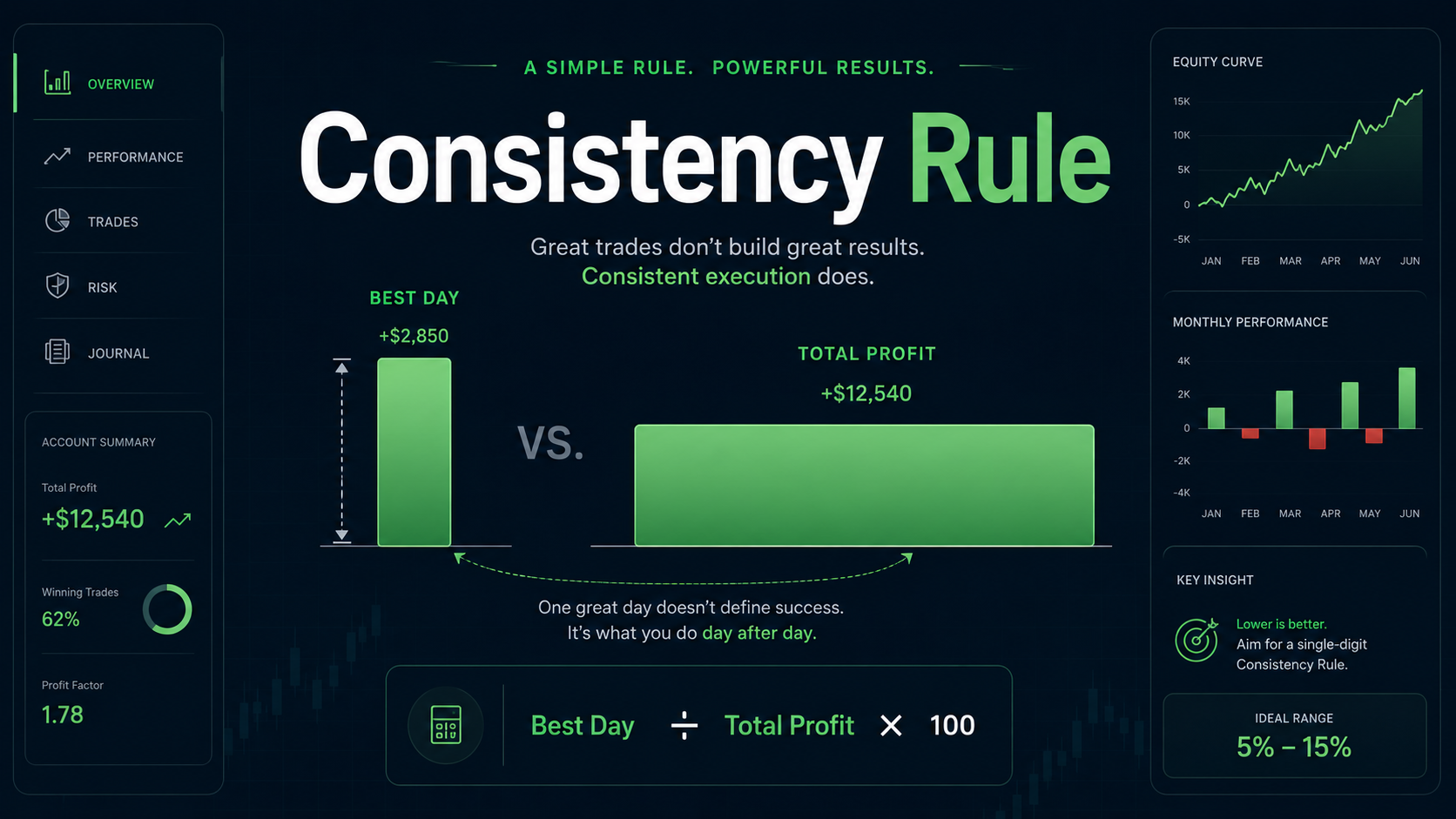
Quick Answer
- Meaning: a consistency rule measures how much of total profit came from a defined winning result.
- Common day-based formula: highest single-day profit ÷ payout-period profit × 100.
- AIFO 1-Step and 2-Step: no Consistency Score requirement.
- AIFO Instant: the maximum single-day profit must remain below 20% of total payout-period profit.
- AIFO Sprint: the largest single-trade profit must remain below 20% of total profit.
- Main mistake: using one model’s formula or threshold for another model.
What Is a Consistency Rule in Prop Trading?
A consistency rule is a profit-concentration condition. It checks whether one day, one trade or another defined result accounts for too much of the total profit used in the calculation.
This differs from a loss rule. A Daily Loss Limit checks losses within the applicable trading day. A Maximum Loss Limit checks the account’s overall loss boundary. A consistency or concentration rule examines where profitable performance came from.
| Rule type | What it checks | Possible consequence |
|---|---|---|
| Daily Loss Limit | Whether the day’s equity or balance reaches the account’s daily boundary | The account may breach its risk rules |
| Maximum Loss Limit | Whether equity or balance reaches the account’s overall static or trailing boundary | The account may breach even after earlier profits |
| Consistency or concentration rule | Whether one defined profitable result represents too much of total profit | Payout eligibility or another account-specific condition may remain unmet |
A profitable account is not automatically payout-ready. The trader must meet only the conditions that actually apply to that account model.
How Is a Consistency Ratio Calculated?
A common day-based formula is:
Day concentration ratio = highest single-day profit ÷ total profit in the stated period × 100
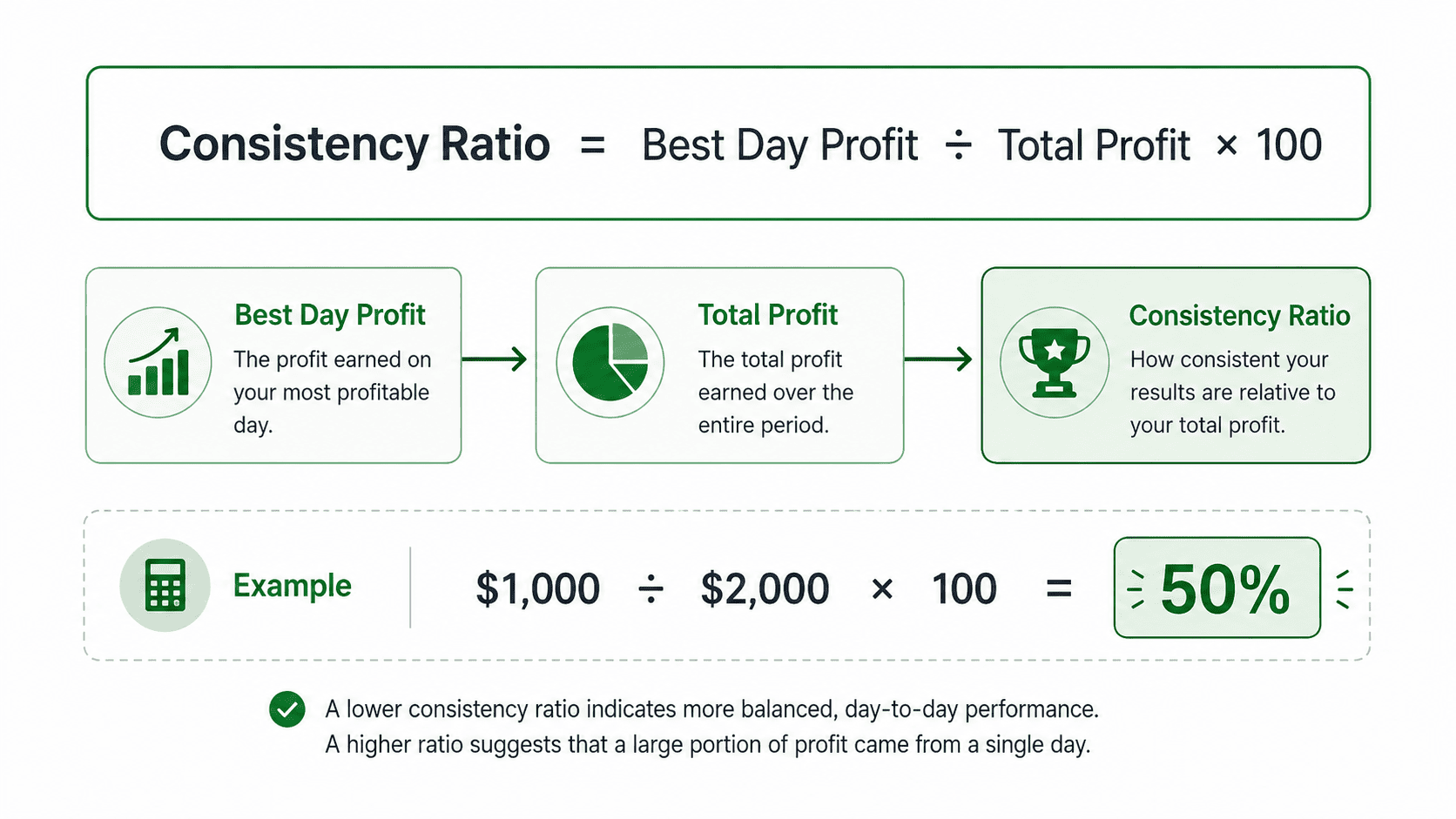
If the highest single-day profit is $900 and total payout-period profit is $5,000, the ratio is 18%.
$900 ÷ $5,000 × 100 = 18%
For a rule requiring the result to remain below 20%, 18% satisfies the numerical threshold. A result of exactly 20% does not satisfy wording that says “less than 20%.”
Six Questions to Answer Before Calculating
- What is the numerator? Highest single-day profit, largest single-trade profit or another defined result?
- What is the denominator? Total net profit, payout-period profit or another figure?
- What period applies? Evaluation, current payout cycle or the account’s full history?
- Where does a trading day begin and end? Use the account’s stated server-day boundary.
- Is the threshold strict? “Less than 20%” excludes exactly 20%.
- What happens if the condition is not met? Check the account’s current payout and closure rules instead of assuming a universal consequence.
Current AIFO Consistency and Concentration Rules
| AIFO account | Current requirement | Calculation focus | $5,000 profit example |
|---|---|---|---|
| 1-Step | No Consistency Score requirement | No formal best-day percentage for profit-split eligibility under the audited 1-Step rules | No consistency ceiling should be calculated |
| 2-Step | No Consistency Score requirement | No formal best-day percentage for profit-split eligibility under the audited 2-Step rules | No consistency ceiling should be calculated |
| Instant | Maximum single-day profit must be less than 20% of total profit within the payout period | Highest profitable day ÷ total payout-period profit | The highest day must be less than $1,000 |
| Sprint | Largest single-trade profit must be less than 20% of total profit | Largest winning trade ÷ total profit | The largest winning trade must be less than $1,000 |
Use the current AIFO Sprint FAQ for Sprint-specific concentration and payout rules. Do not reuse retired product URLs.
Previous Step-account and Instant consistency thresholds that conflict with the table above are not part of the latest audited rules and must not remain in this article.
AIFO Instant Consistency Example
Assume an Instant account has $5,000 total profit in the current payout period:
- Highest single-day profit: $900
- Total payout-period profit: $5,000
- Single-day concentration: 18%
$900 ÷ $5,000 × 100 = 18%
The result is below 20%. If the highest day were $1,000, the ratio would be exactly 20%, which would not meet a requirement stated as less than 20%.
A Loss Can Make the Ratio Worse
Suppose the same account later loses $500. Total payout-period profit falls to $4,500, while the highest profitable day remains $900.
$900 ÷ $4,500 × 100 = 20%
The trader did not create a larger winning day, but the ratio moved from 18% to 20% because the denominator decreased. This is why taking weak trades merely to repair a ratio can create additional risk.
AIFO Sprint Largest-Trade Example
Sprint measures the largest single-trade profit rather than the highest profitable day. Assume total profit is $5,000 and the largest winning trade produced $800.
$800 ÷ $5,000 × 100 = 16%
The result is below 20%. Several trades closed on the same day do not change the fact that Sprint’s audited rule focuses on the largest single trade. Sprint permits one payout, the payout request must be made within 30 days and the account closes after payout.
How Can a Consistency Rule Affect Payout Risk?
A concentration rule can leave visible profit ineligible for payout until the account-specific requirement is met. The exact effect depends on the selected model; there is no universal AIFO consistency consequence.
For Instant, payout review also includes other account-specific conditions. The minimum payout is $100, a 2% profit buffer based on the initial balance must be retained, and a full payout closes the account. These Instant conditions must not be copied to 1-Step, 2-Step or Sprint.
For 1-Step and 2-Step simulated funded accounts, there is no Consistency Score requirement. The default profit split is 80% and may increase up to 95% through the AIFO Scaling Plan. The minimum payout is $100 and the standard cycle is 14 days. No mandatory 2% payout buffer applies to those two models.
Read the prop firm payouts guide and the official AIFO payout process before requesting a withdrawal.
Common Consistency-Rule Mistakes
| Mistake | Why it is wrong | Better check |
|---|---|---|
| Applying a 30% score to 1-Step or 2-Step | The latest audit states that neither model requires a Consistency Score | Follow the current programme-specific payout rules |
| Using 15% for Instant | The latest audited Instant best-day threshold is below 20% | Use highest single-day profit divided by total payout-period profit |
| Tracking days for Sprint | Sprint focuses on the largest single-trade profit | Track the largest winning trade against total profit |
| Treating 20% as acceptable | The audited wording is less than 20% | Keep the calculated result strictly below the boundary |
| Repairing a ratio with weak trades | Losses reduce total profit and can make the ratio worse | Take only trades permitted by the tested plan |
| Applying a universal payout buffer | The audited 2% buffer is specific to Instant | Check the selected account’s payout conditions |
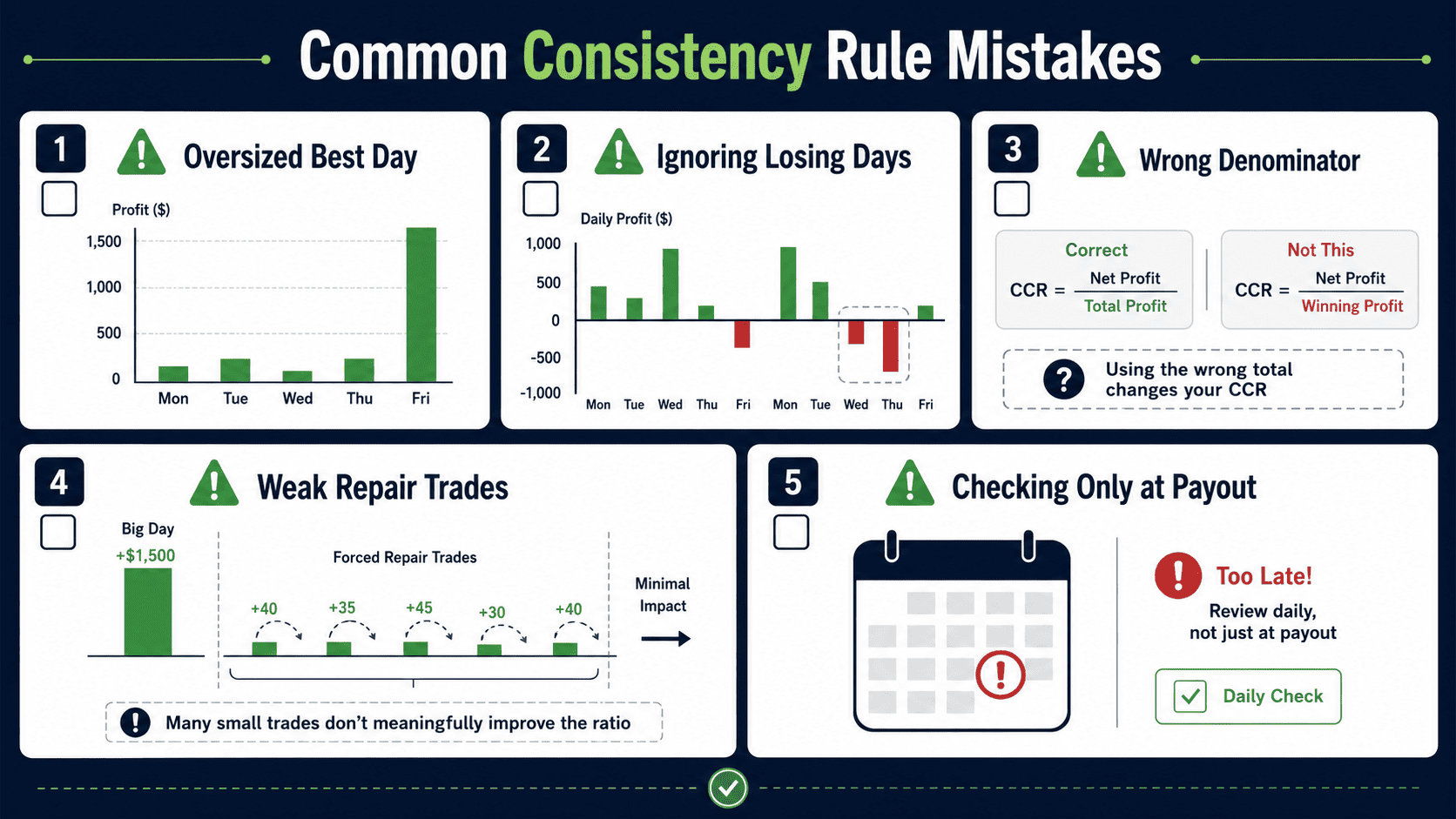
How to Manage Profit Concentration Without Damaging the Account
- Confirm the formula before trading. Identify whether the model measures a day or a trade.
- Use an internal concentration warning. Leave room below a strict account threshold instead of aiming at the boundary.
- Reduce risk after a strong result. Protect the denominator and the account’s loss room.
- Recalculate after a loss. A smaller denominator can increase the concentration percentage.
- Do not manufacture repair trades. A trade that exists only to change a ratio may add more risk than useful profit.
- Keep rules separate. Track the Daily Loss Limit, Maximum Loss method, concentration condition and payout requirements independently.
A complete risk management strategy for avoiding challenge failure should include the selected account’s actual concentration rule when one applies.
Frequently Asked Questions
A consistency rule measures whether one defined result, such as a profitable day or winning trade, represents too much of total profit. The numerator, denominator, period and threshold depend on the account model.
No. The latest audited rules state that AIFO 1-Step and 2-Step accounts do not require a Consistency Score. Do not apply the former 30% statement to either model.
The maximum single-day profit must be less than 20% of total profit within the payout period. A result of exactly 20% does not satisfy a rule requiring the percentage to remain below 20%.
The largest single-trade profit must be less than 20% of total profit. This is a trade-based calculation, not the Instant single-day calculation.
Yes. If total profit is the denominator, a loss can reduce that denominator while the highest profitable day or largest winning trade remains unchanged. The resulting concentration percentage can therefore increase.
No. The mandatory 2% profit buffer in the latest audit applies to Instant accounts. It must not be presented as a universal rule for 1-Step, 2-Step or Sprint.
Confirm the correct account-specific formula, leave room below any strict threshold, reduce risk after a strong result and recalculate after losses. Do not take weak trades merely to repair the ratio.