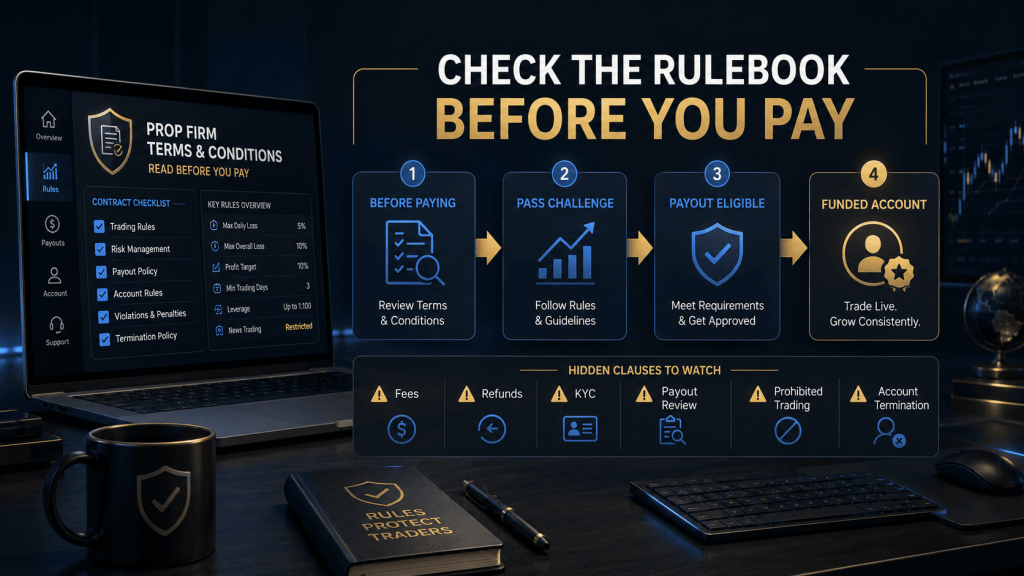



Some prop firms allow news trading, but “allowed” is not a complete rule. Opening, closing, modifying, holding and triggering pending orders can be treated differently, and the rule may change by account stage, instrument or restricted window. Start with the prop firm challenge rules guide to understand how news execution interacts with drawdown, trading restrictions, consistency and payout review. Then verify the current firm-specific wording before placing a trade. For an AIFO account, check the live AIFO trading rules and any account-specific documentation.
Do prop firms allow news trading during high-impact events?
Some do. Some do not. The better answer is that prop firms allow different actions around news: opening, closing, modifying, holding or triggering orders.
A trader who asks only “is news trading allowed?” is already asking the question too loosely. The firm may not care that you watched CPI at the correct time. It cares what your order did inside the restricted window.
That is the part that causes disputes. A trader sees no ban on holding through news, places a stop order nearby, then the stop triggers inside the restricted period. From the trader’s view, the market closed the trade. From the firm’s view, an execution happened during the window.
So the first rule is blunt. Do not read the headline. Read the action list. Before placing a trade, write down five fields: account stage, restricted window, affected instruments, permitted order actions and profit treatment.
News trading and news holding are not the same rule
News trading means you can act during the release. News holding means you may keep a position that was already open before the release. Those two permissions have different risk profiles.
Holding through news is passive exposure. Trading during news is active execution during the thinnest and fastest part of the move.
This difference matters because many prop firm rules are built around execution, not exposure. The firm may allow a position to stay open but still ban market orders, limit orders, stop orders, take-profit triggers or position reductions during the event window.
That creates a hard execution choice. If you hold into the event, you may not be allowed to manage the trade during the first reaction. If you do manage it, the account may be flagged. If you do nothing, the price may run through your intended risk.
This is why news holding is not a free pass. It shifts the burden onto position size and pre-event planning. The same logic applies to overnight and weekend holding rules, because permission to hold does not remove the drawdown or gap-risk problem.
What usually counts as a high-impact news event?
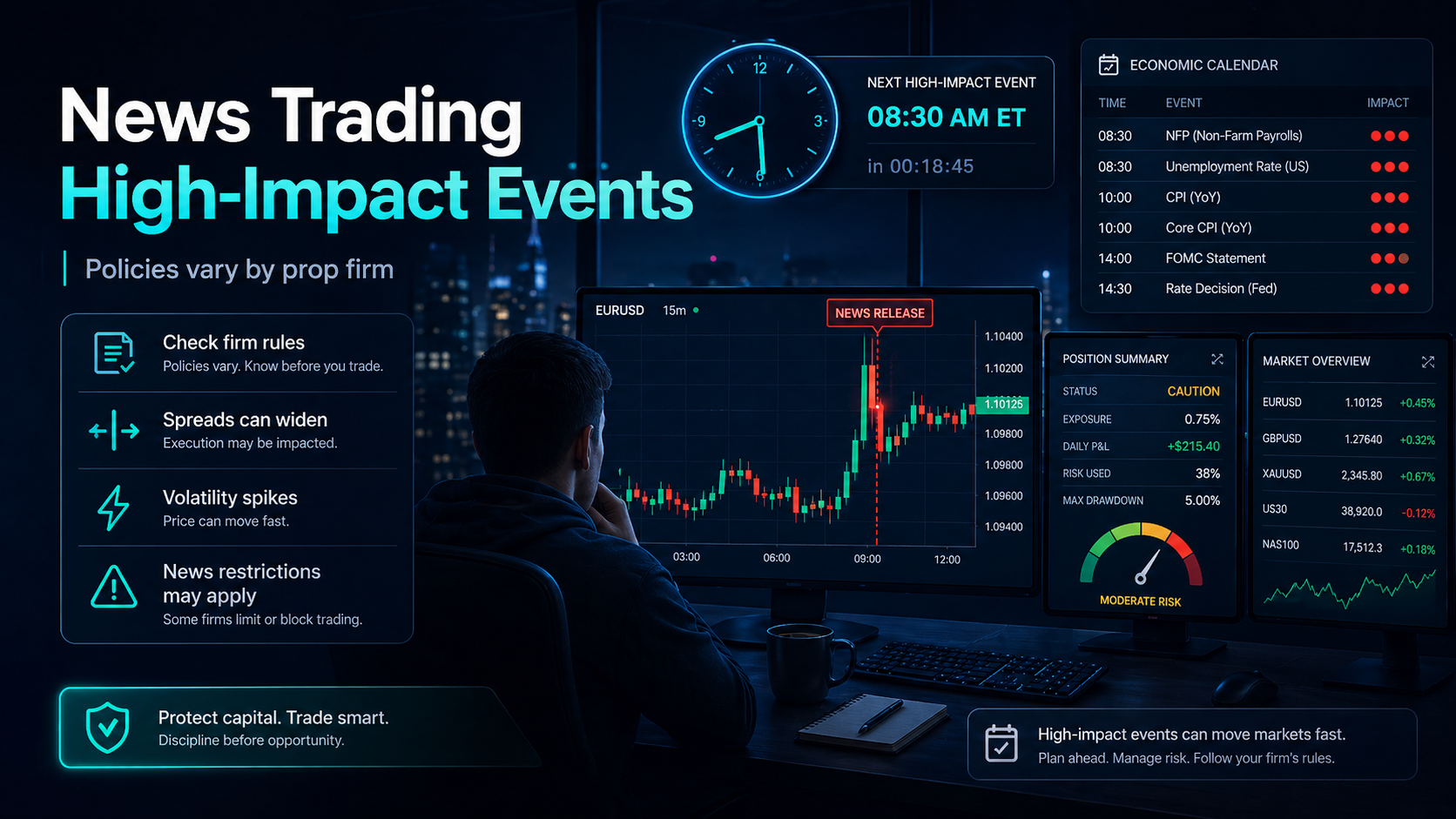
High-impact news usually means scheduled macro releases or central bank events that can move currencies, indices, metals, oil or rates within seconds. Typical examples include NFP, CPI, interest rate decisions, FOMC statements, GDP, unemployment data and central bank press conferences.
The affected instrument matters. A US CPI release can affect USD pairs, gold and US indices. A crude oil inventory report may affect oil products more directly.
Do not assume the economic calendar colour alone is enough. Some firms use a specific restricted-events list. Some use a third-party calendar. Some apply the rule only to instruments linked to the event. Some apply it more broadly.
The safest workflow is to check five things before the session starts:
- which calendar or restricted-event list the firm uses;
- the event time after converting it to the firm’s server time;
- the affected instruments or asset groups;
- the restricted period before and after the release;
- whether opening, closing, modifying, SL/TP triggers and pending-order activation are treated differently.
For AIFO, verify the current server-time reference instead of relying on your local clock. Save the event time and rule version before trading.
The news trading rule matrix traders should use
A clean news rule is not one sentence. It is a matrix. If the firm does not make the matrix clear, the trader has to build it before placing a trade.
Use the table below before trading any high-impact release inside a prop firm account.
| Rule area | Question to ask | Common trader mistake | Execution consequence |
|---|---|---|---|
| Opening trades | Can I enter a new position during the restricted window? | Entering seconds before the release because the setup is “prepared”. | The trade may be treated as a news violation even if it wins. |
| Closing trades | Can I manually exit during the window? | Closing a winner inside the restricted period. | Profit may be removed, or the account may be reviewed. |
| Pending orders | Do stop orders, limit orders, SL and TP triggers count as execution? | Leaving orders near price and assuming “I did not click”. | A triggered order can still count as a banned action. |
| Holding positions | Can I hold an existing trade through the release? | Confusing holding permission with active trading permission. | The position may stay open, but management may be restricted. |
| Account stage | Are evaluation and funded-stage rules the same? | Passing a challenge with news entries, then repeating them after funding. | The same behaviour may become non-compliant later. |
| Instrument link | Does the rule affect only targeted instruments? | Trading a related pair or index without checking the mapping. | The trade may fall inside the affected asset list. |
| Profit treatment | Does profit from a restricted-window trade count? | Thinking a winning trade automatically moves the account closer to payout. | The profit may be deducted while losses still remain yours. |
| Conduct review | Could the pattern look like gambling, latency abuse or one-sided betting? | Using oversized all-or-nothing exposure around one release. | The account may face restriction, review or closure. |
Why prop firms restrict news trading
Prop firms restrict news trading because high-impact releases can break normal execution assumptions. Stops slip. Spreads widen. Pending orders fill badly. A small planned loss can become an account-level problem in seconds.
This is not only about protecting the firm. It is about whether the trade result looks like repeatable trading or event gambling.
A prop account is not judged like a personal retail account. In a personal account, you can decide to gamble around FOMC and accept the damage. In a prop account, the firm is judging whether your behaviour fits its risk model.
News events are where weak behaviour becomes visible fast. Oversized trades. Bracket orders placed on both sides of price. Reaction trades fired into the first spike. Stops moved after the release. Multiple correlated positions all pointed the same way.
Those actions may look clever for ten seconds. They can look terrible in a risk review.
This is where restricted trading language matters. A trade can be profitable and still be treated as poor conduct if the risk pattern is not sustainable.
Why a winning news trade may still not count
A winning news trade is not automatically payout-ready profit. If an order was opened, closed, modified or triggered inside a restricted window, the written rules may allow the firm to exclude the profit, review the account or leave payout eligibility unmet. Check the exact consequence instead of assuming every firm applies the same penalty.
That asymmetry feels harsh to traders, but it is the rule logic. The firm is saying: “You can lose from this behaviour, but you cannot use restricted-window profit to prove skill.”
This is the part many traders miss after a fast CPI win. They see the account target hit. The firm sees a profit source that broke the timing rule.
The same issue can appear during payout review. If one news trade creates most of the account gain, the account may face a profit-shape problem even without a direct news breach. A consistency rule can turn a profitable account into an account that still needs cleaner distribution.
That creates a nasty path. The trader wins the event, reaches the target, then has to keep trading to make the result acceptable. Extra trading after a big win is often where the account gives money back.
So do not ask only whether the trade can win. Ask whether the profit can survive review. For the full payout framework, read prop firm payout rules before treating event profit as withdrawable.
How high-impact news breaks drawdown control
News trading compresses the time between entry, error and breach. During normal sessions, a bad trade may give you time to reduce risk. During a major release, the account can move from safe to failed before you can react.
The danger is not only being wrong. It is being filled worse than the loss you planned.
That is why the drawdown model matters. A tight daily loss rule gives little room for spread expansion and slippage. A trailing maximum loss model can punish a fast give-back after a profitable run. A position that looks small before the release can become too large once the market prints through the expected stop.
Before trading news, read daily drawdown vs max drawdown like a survival map. The calendar tells you when volatility may arrive. The drawdown rule tells you how much of that volatility the account can take.
Most traders size from the chart. In a prop account, size from the breach line. That is why a risk management strategy for challenge failure has to be written before the release, not after the first slippage event.
How order execution changes around news
Execution quality changes sharply around high-impact events. Market orders can slip. Stops can fill through their level. Limit orders can miss the move or fill just before a reversal.
That is why “I had a stop” is not enough. A stop is an instruction, not a guarantee of the price you wanted.
During fast releases, the trader faces two separate risks. First, the market risk: price goes against the position. Second, the execution risk: the order fills at a worse level than the risk model assumed.
The second risk is often the one that kills prop accounts. A trader calculates a 0.5% loss, gets a fill closer to 1.2%, then hits the daily limit. The strategy may still be sensible outside news. Inside news, the fill path destroys it.
Review order execution and account types before using a news strategy. The same signal can behave very differently across platforms, instruments and account structures. Platform choice can add another layer, so compare MT5 vs cTrader vs MT4 for prop traders if your news plan depends on fast order handling.
How to trade around news without damaging the account
The safest news plan starts before the event. Once the release hits, the market is too fast for vague rules.
For a prop account, a news plan should define what you will do and what you refuse to do.
- Check the firm’s restricted window in server time.
- Remove pending orders that could trigger inside a banned period.
- Reduce size if you hold through the release.
- Avoid bracket structures unless the firm clearly permits them.
- Do not stack correlated positions across the same event.
- Know whether profit from the trade can count towards payout.
- Stop trading after the event if the account is emotionally stretched.
This is not about being timid. It is about staying tradeable.
A trader who cannot leave an event alone will eventually trade the account like a lottery ticket. That may pass once. It does not make the method cleaner.
How AIFO Traders Should Verify News-Event Rules
Last checked on : AIFO’s public rules state that abnormal volatility or major market events may receive additional review or temporary execution-related handling. The public rules page does not currently state a separate minute-by-minute news window for opening, closing, modifying or triggering orders.
Do not infer a specific news-trading permission from the fact that overnight or weekend holding may be allowed. Before a major release, check the live AIFO trading rules, the restricted-trading FAQ and the server-time reference. If your required action is not clearly covered, confirm it with AIFO support and keep a dated copy of the response.
The normal account controls still apply during news: daily loss, maximum loss, trade risk, consistency, conduct review and payout eligibility. Use the AIFO payout process before treating event-driven profit as withdrawable.
Verification note: Rules can change. Save the public rule version, account model and date checked before trading a major event.
Alpha Insight: the news rule is really a profit-quality rule
The calendar is visible. The real judgement sits underneath it.
A high-impact news trade is not judged only by its outcome. It is judged by the way the outcome was produced.
A clean pre-positioned trade with small size, a defined thesis and enough drawdown room is one thing. A max-size reaction trade fired into the first spike is another. Both may show profit on the screen. They do not carry the same rule risk.
This is why lists of “prop firms that allow news trading” are weak by themselves. The better decision is made by matching the account to your normal trade path. Use the same logic you would use when choosing a prop firm. If your strategy needs event execution, choose a rule set that truly allows event execution. If the rule only allows holding, do not pretend it allows reaction trading.
The strongest news trader is not the one who clicks fastest. It is the one whose account can survive the release, the fill, the review and the payout path.
That is also where many bad deal warning signs appear. Vague news rules, unclear event lists, hidden payout deductions and broad conduct language can turn a profitable event trade into a dispute.
FAQ: Prop firm news trading during high-impact events
Some prop firms allow news trading, some restrict it, and some allow only news holding. The exact answer depends on the firm, account type, trading stage, instrument and restricted-window rules.
News trading means opening, closing or adjusting trades during the news event. News holding means keeping an existing position open through the event without taking new execution actions inside the restricted window.
Some firms allow existing trades to be held through major releases, but they may still ban new entries, exits, stop-loss triggers, take-profit triggers or pending order activation during the restricted window.
They restrict it because high-impact news can create slippage, spread widening, liquidity gaps and fast drawdown breaches. The firm is also judging whether the profit path looks sustainable rather than like event gambling.
No. A winning trade may still fail review if it was opened, closed or triggered inside a restricted window. Some firms remove the profit, delay payout review or require more trading before the result is accepted.
Size from the breach line, not the account label. The position should still survive slippage, spread expansion, a worse-than-planned stop fill and the daily or maximum loss rule after the release.