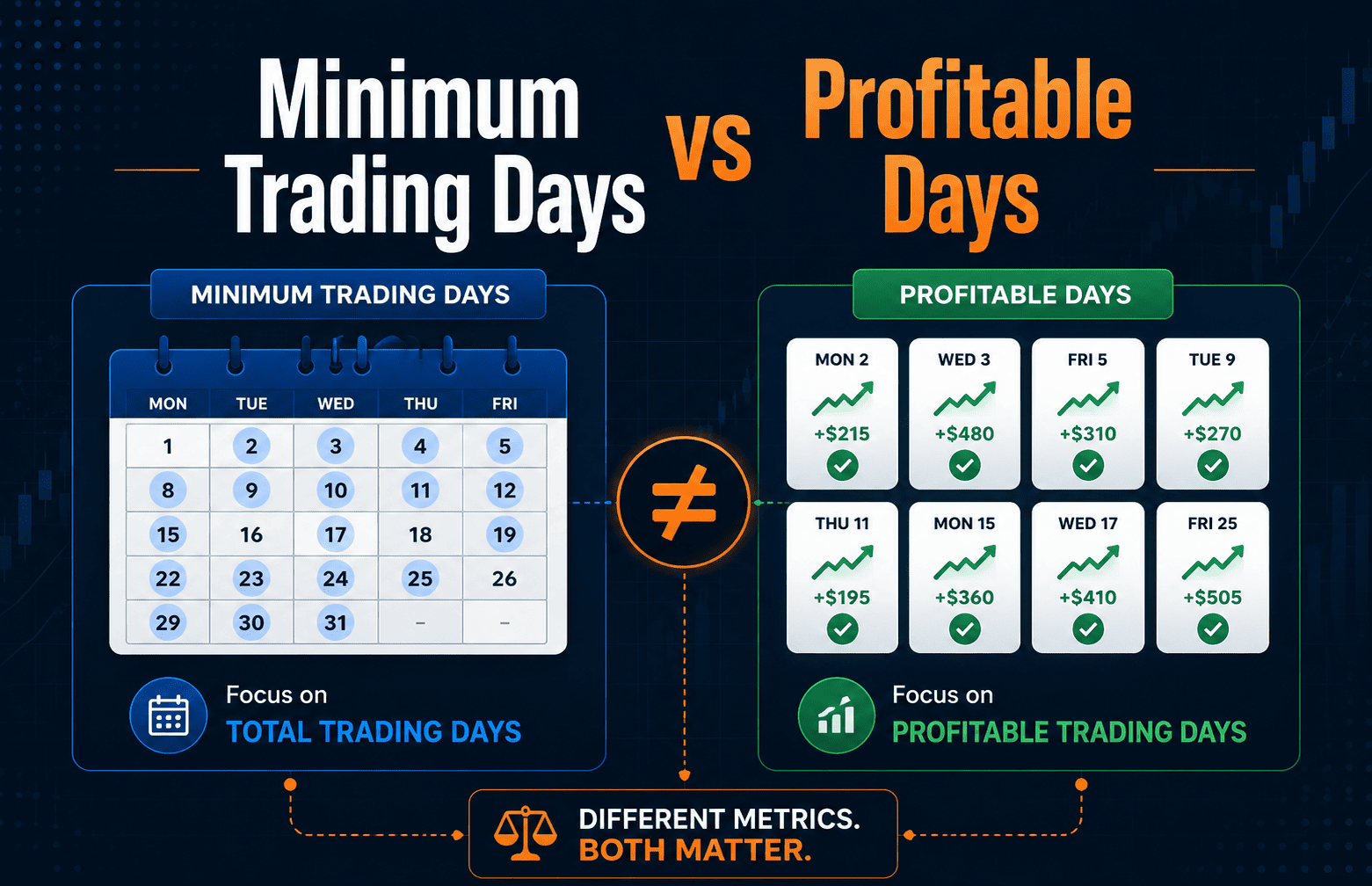



Minimum trading days, profitable or valid days, consistency rules and payout eligibility are separate account conditions. A minimum trading-day rule normally measures activity across separate trading days. A profitable or valid-day rule requires a day to meet a stated formula. A consistency rule measures how concentrated profit is. Payout eligibility is a later account and withdrawal check. Completing one condition does not automatically complete the others.
Use the prop firm challenge rules guide as the parent rule map. Then verify the selected account’s trading-day boundary, qualifying activity, profit threshold, calculation base and applicable stage in the current rules.
Last checked: . AIFO’s current rule baseline requires at least 2 trading days for 1-Step and at least 3 trading days for 2-Step. It does not state that those days must each make 0.5%, so readers should not treat 0.5% as a current AIFO valid-day requirement.
Minimum Trading Days vs Profitable Days vs Consistency vs Payout Eligibility
These conditions can appear on the same account, but they answer different questions. Do not use one completed dashboard item as proof that every requirement has been satisfied.
| Rule or condition | Primary question | When it may be checked | What satisfies it | What it does not prove |
|---|---|---|---|---|
| Minimum trading days | Did the trader complete activity on enough separate rule-defined days? | Usually during an evaluation phase | Qualifying activity on the required number of separate trading days | That every day reached a profit threshold |
| Profitable or valid days | Did each required day meet the programme’s stated profit or account-state formula? | During an evaluation or another specified stage | The required number of days meeting the exact published formula | That profit distribution passes a consistency rule |
| Consistency rule | Is profit too concentrated in one day or trade? | During account monitoring or payout review | A day-profit or trade-profit ratio within the account’s permitted threshold | That the minimum trading-day count is complete |
| Payout eligibility | Can the account submit and pass a payout request? | After the relevant payout conditions become available | Eligible profit, compliant account status, completed checks and valid payout details | That passing an evaluation automatically produces a payout |
What Counts as a Trading Day?
A trading day usually counts when qualifying trading activity occurs inside the firm’s defined trading-day window. The exact answer depends on the current rules for the selected account.
The activity does not automatically need to be profitable. That is why a minimum trading-day rule is different from a profitable or valid-day rule.
The time boundary matters. A trade opened before the rule-defined cutoff and closed afterward may not count the way the trader expects. Some firms count opened activity, while others look at closed trades or end-of-day account state.
Do not assume that holding one position for several days creates several trading days. A challenge may require separate qualifying activity on separate days. Swing traders should confirm this before purchasing an account.
| Question | What to verify | Why it matters |
|---|---|---|
| What defines the day? | The firm’s current server, platform or rule timezone | A local calendar day may overlap two firm-defined trading days. |
| What activity qualifies? | Opening a trade, closing a trade, realised P&L or another stated event | A position can exist without creating the required qualifying activity. |
| Does holding count repeatedly? | Whether an unchanged overnight position creates another day | Calendar duration is not automatically a trading-day count. |
| Which stage uses the rule? | Evaluation, funded account, payout period or another stage | A requirement may stop or change after progression. |
When the rule depends on server time, verify the current clock instead of relying on local midnight. The AIFO server-time FAQ is the existing verification entry for an AIFO account.
What Counts as a Profitable or Valid Day?
A profitable or valid day counts only when it satisfies the exact formula attached to the selected programme. Some firms use a fixed profit threshold. Others define a valid day through different activity, balance, equity or account-state conditions.
Do not assume that 0.5% is a universal industry requirement or an AIFO requirement. Before deciding that a day counts, confirm all of the following:
- Trading-day boundary: when the firm’s day begins and ends;
- Qualifying event: whether a trade must be opened, closed or both;
- Profit threshold: the exact percentage or cash amount, if any;
- Calculation base: initial balance, start-of-day balance, closing balance, equity or another stated value;
- P&L treatment: whether floating P&L, commissions and swaps are included;
- Account stage: evaluation, funded account, payout period or another specified stage.
| Scenario | Does it count? | Reason | Safer rule reading |
|---|---|---|---|
| One small trade closes in profit | It may count as activity but not as a profitable day. | The result may be below a stated profitable-day threshold. | Check whether the selected account states a minimum daily profit. |
| The account has floating profit at cutoff | It depends on the formula. | The rule may use closed profit, balance, equity or another reference. | Confirm whether open P&L is included. |
| One trade remains open for several days | Not automatically. | Several calendar days do not necessarily create several qualifying days. | Check whether each day needs new opened or closed activity. |
| The day is green but below a stated threshold | It may fail a profitable-day rule. | Positive P&L in plain language may still be below the rule formula. | Convert the confirmed percentage into a cash amount before trading. |
| Profit occurs after the cutoff | It may count for the next trading day. | The platform or rule date may differ from the trader’s local date. | Plan with the firm’s confirmed clock. |
Current AIFO Trading-Day Rules by Account
AIFO does not use one universal day-count structure across every account. The current baseline distinguishes the 1-Step and 2-Step evaluation requirements from Instant and Sprint conditions.
| AIFO account | Current trading-day or time rule | Related rule | Do not assume |
|---|---|---|---|
| 1-Step Challenge | At least 2 trading days before progression | 10% target, 3% Daily Loss Limit and 6% Static Maximum Loss Limit | The baseline does not state that each day must make 0.5% or be a profitable day. |
| 2-Step Challenge | At least 3 trading days before progression | 8% Phase 1 target, 5% Phase 2 target, 5% Daily Loss Limit and 10% Static Maximum Loss Limit | The current baseline does not state a 0.5% valid-day threshold. |
| Instant | No evaluation minimum-day requirement is stated in the current baseline. | Maximum single-day profit must be below 20% of total payout-period profit. | The 1-Step or 2-Step minimum trading-day count does not automatically apply. |
| Sprint | The 24-hour countdown starts when the first trade opens. The first trade must be placed within 48 hours after purchase. | The largest single-trade profit must be below 20% of total profit. Only one payout is available. | Do not convert the evaluation minimum-day rules into a Sprint requirement. |
Before trying to complete a remaining day, check the AIFO trading rules, the confirmed programme page for the selected account and the active dashboard.
What to Do After Hitting the Profit Target Early
Once the profit target is reached, the job changes. The trader should protect the account while completing any remaining requirements.
| Post-target situation | Main risk | Weak response | Cleaner response |
|---|---|---|---|
| Target reached but minimum days remain | Unnecessary trades create fresh drawdown exposure. | Keep normal size just to finish the count. | Reduce risk and take only valid setups. |
| A profitable-day threshold remains | Small trades may not count, while forced size can threaten the account. | Force the required profit on a weak setup. | Wait for a normal setup and cap downside tightly. |
| A consistency ratio is near its limit | Additional concentrated profit may delay eligibility. | Add random trades only to change the ratio. | Read the consistency rule guide before adding exposure. |
| Only one day remains | The trader treats the final day as a formality. | Open a careless trade to complete the dashboard item. | Use a pre-planned risk cap and a normal setup. |
| The first attempt approaches the Daily Loss Limit | A second attempt may breach the account. | Re-enter only to make the day count. | Stop and protect the existing progress. |
Use how to pass a prop firm challenge as the wider plan. Reaching the target without creating a repair problem is more important than completing a dashboard item quickly.
Alpha Insight
The hidden pressure is extra trading after the account is already close to completion. Before the target, the account needs controlled progress. After the target, it needs protection. A day-count requirement should not turn into unnecessary drawdown exposure.
Common Trading-Day Mistakes
Using local time instead of the rule-defined clock
The firm’s trading day may not match the trader’s local day. Activity near a cutoff can land in a different count period than expected.
Counting floating profit as confirmed qualifying profit
A floating green position may not satisfy a rule based on closed profit. Even where equity is considered, costs or a later pullback can change the result.
Assuming every green day is a valid day
A green day and a valid day are not always the same. Apply only the threshold and formula explicitly stated for the selected account.
Using outdated AIFO 0.5% wording
The current AIFO rule baseline does not state a 0.5% profitable-day threshold for 1-Step or 2-Step. It confirms at least 2 trading days for 1-Step and at least 3 trading days for 2-Step.
Mixing evaluation days with payout eligibility
Completing minimum trading days does not automatically unlock a payout. A payout review may use separate profit, compliance, identity and account-specific consistency conditions.
How Day Counts Relate to AIFO Payout Rules
AIFO 1-Step and 2-Step funded accounts have no Consistency Score requirement under the current baseline. Their default profit split is 80%, potentially rising to 95% through the Scaling Plan, with a $100 minimum and a standard 14-day payout cycle.
AIFO Instant uses a separate rule: maximum single-day profit must be below 20% of total profit within the payout period. It also requires a $100 minimum payout and a 2% profit buffer after a payout if the trader wants to continue using the account.
Sprint uses the largest single-trade profit, not a profitable-day count, as its concentration measure. The largest single-trade profit must remain below 20% of total profit. Sprint permits one payout only.
Review the AIFO payout process and the selected account rules instead of carrying an evaluation day count into payout planning.
Final Checklist Before Completing the Remaining Days
| Check | Question to answer | Why it matters |
|---|---|---|
| Rule type | Is this a minimum trading-day rule or a profitable or valid-day rule? | Activity and qualifying profit are different tests. |
| Threshold | Does the selected account state a required daily percentage or cash amount? | A positive result may not meet a stated threshold. |
| Calculation base | Which balance, equity or account value controls the calculation? | The required cash amount depends on the rule formula. |
| P&L treatment | Does the rule use closed profit, floating P&L, commissions or swaps? | The displayed green result may not equal the qualifying result. |
| Time boundary | What clock defines the trading day? | Late activity can count for a different day. |
| Account stage | Does the rule apply during evaluation, funded trading or payout review? | The same account can use different conditions at different stages. |
| Account exception | Is this 1-Step, 2-Step, Instant, Sprint or another firm’s special model? | A rule from one model must not be copied into another. |
| Risk cap | What is the maximum personal risk while completing the remaining days? | Extra days should not endanger clean progress. |
Run a prop firm challenge checklist before starting the account and again after reaching the profit target.
FAQ
Minimum trading days normally measure qualifying activity across separate rule-defined days. Profitable or valid days require those days to meet a stated profit or account-state formula. Consistency measures profit concentration, while payout eligibility determines whether a payout request can proceed.
It may count when the selected account requires only qualifying activity. It may not count when the rule requires a closed trade, a minimum profit or another account-state condition. Check the exact definition, stage and trading-day boundary before relying on a small trade.
Not automatically. Several calendar days do not necessarily create several qualifying trading days. The answer depends on whether the account counts opened activity, closed activity, realised profit or another event on each rule-defined day.
AIFO 1-Step requires at least 2 trading days before progression, while 2-Step requires at least 3 trading days. The current rule baseline does not state that each of those days must make 0.5%. Instant does not use those evaluation minimum-day requirements, and Sprint instead uses a 24-hour countdown beginning with the first trade.
That condition is not stated in the current AIFO rule baseline. The confirmed requirement is at least 2 trading days for 1-Step and at least 3 trading days for 2-Step. Traders should verify the live rules and dashboard before treating any daily profit threshold as applicable.
Reduce risk and treat the remaining days as account protection rather than extra profit opportunity. Wait for normal setups, avoid increasing size and stop when another trade would threaten the Daily Loss or Maximum Loss boundary.
No. Minimum trading days may belong to evaluation progression, while payouts use separate account, profit, compliance, identity and consistency conditions. AIFO 1-Step and 2-Step funded accounts have no Consistency Score requirement, while Instant and Sprint use their own profit-concentration rules.