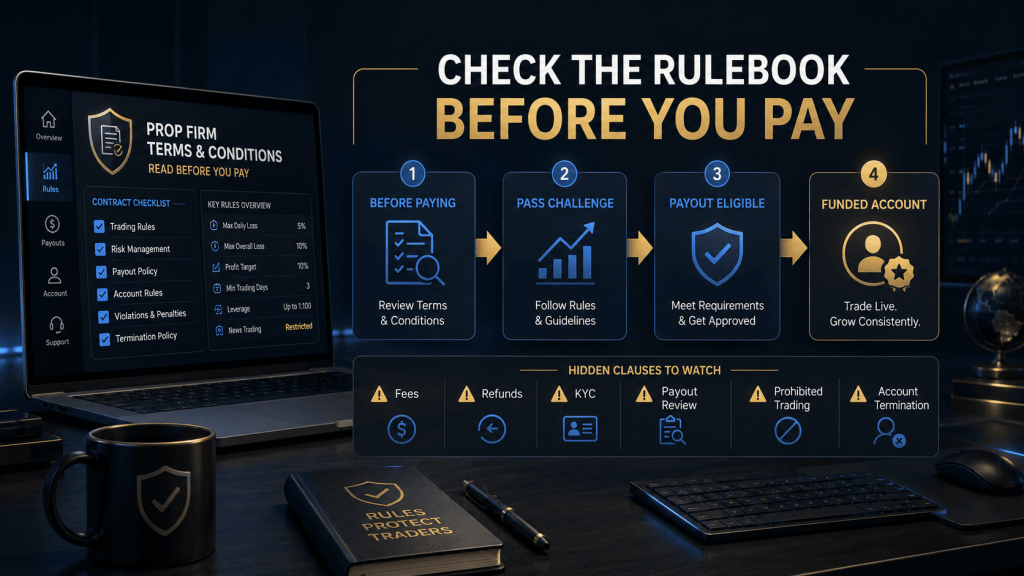



Prop firm challenge rules are the conditions used to decide whether an account can progress, remain active and qualify for a payout. They normally include a profit target, Daily Loss and Maximum Loss limits, trading-day or time requirements, strategy restrictions, consistency conditions and payout checks. These rules work together: reaching a target does not cancel a loss limit, passing an evaluation does not automatically approve a funded account, and positive profit does not by itself guarantee a payout.
Prop Firm Challenge Rules: Key Takeaways
- Read the rules as a stack, not as isolated percentages. A valid result must satisfy every applicable objective, risk, conduct and review condition.
- Separate three checkpoints: evaluation completion, funded-stage account compliance and payout eligibility.
- Daily Loss and Maximum Loss are different controls. One governs the current trading day; the other governs the broader account lifecycle.
- Rules are model-specific. A condition on an Instant or Sprint account must not be assumed to apply to 1-Step or 2-Step.
- Use the current model FAQ before trading. For AIFO accounts purchased before 1 September 2026, the 1-Step, 2-Step and Instant FAQs state that the parameters displayed on the Dashboard prevail.
Last rule review: . AIFO rule figures were checked against the relevant model and topic FAQs.
A funded account challenge is not one test. It is a sequence of decisions: whether the trader completed the evaluation, whether the account remained compliant during review, and whether the resulting profit meets the payout conditions.
This guide is the central rules hub. Use it to identify the controlling rule, then open the linked FAQ or the dedicated guide before making a trading decision. For deeper explanations, compare Daily Loss and Maximum Loss, prop firm consistency rules and first-payout requirements.
Rules at a Glance
The easiest way to understand trading challenge rules is to place them in the order in which they affect the account.
| Rule layer | What it controls | Question the trader must answer | Typical failure point |
|---|---|---|---|
| Qualification | Profit target, phases, minimum trading days or time window | What must be completed before review begins? | Target reached, but the time or trading-day condition is incomplete |
| Daily risk | Loss allowed within the current account day | What is today’s equity floor, and when does it reset? | Floating loss, commission or swap pushes equity through the daily boundary |
| Account risk | Static or trailing Maximum Loss boundary | How far can the account fall over its full lifecycle? | The trader sizes from nominal account value instead of remaining headroom |
| Trading conduct | EA eligibility, order behaviour, holding and prohibited strategies | Is the method allowed on this exact account and stage? | The platform accepts an order, but the behaviour is not rule-compliant |
| Profit quality | Consistency or profit-concentration test | Does one day or one trade contribute too much of the total profit? | The target is reached, but the profit distribution is ineligible |
| Payout review | Account status, KYC, open orders, minimum amount and model-specific conditions | Is the account payout-ready rather than merely profitable? | A request is submitted with an open position, unresolved review or unmet condition |
A trader therefore passes through three separate gates:
- Evaluation gate: complete the target, phase, trading-day and risk requirements.
- Funded-stage gate: keep following the active loss and conduct rules after progression.
- Payout gate: meet the account-status, verification, profit-quality and request conditions.
The word pass should always be followed by another question: pass which gate?
Current AIFO Programme Rules From the FAQ
Compare the current AIFO 1-Step FAQ, AIFO 2-Step FAQ, AIFO Instant FAQ and AIFO Sprint FAQ.
| Model | Target and path | Loss controls | Trading days or window | Consistency or concentration | Payout points in the FAQ |
|---|---|---|---|---|---|
| 1-Step | One evaluation phase; 10% Profit Target | 3% Daily Loss; 6% Static Maximum Loss | At least 2 trading days before progression | No Consistency Score requirement | $100 minimum; standard 14-day cycle; default 80% split, with up to 95% through the Scaling Plan |
| 2-Step | Step 1: 8%; Step 2: 5% | 5% Daily Loss; 10% Static Maximum Loss | At least 3 trading days before progression | No Consistency Score requirement | $100 minimum; standard 14-day cycle; default 80% split, with up to 95% through the Scaling Plan |
| Instant | Immediate access without a traditional evaluation phase | 3% Daily Loss; 5% high-water-mark Maximum Loss capped at initial balance; open-position floating loss must not exceed 2% of initial balance | Immediate access without a traditional evaluation phase | Highest-profit day must be less than 20% of total profit in the payout period | $100 minimum; payout on demand when eligible; default 70% split, with up to 95% through the Scaling Plan; retain a 2% buffer to continue or take a full payout and close the account |
| Sprint | 3% target in a 24-hour challenge; one payout only | 2% Static Maximum Loss; total floating loss must not exceed 1% of initial balance | First trade within 48 hours of purchase; that trade starts the continuous 24-hour window and selects the only permitted instrument; one open position at a time | Largest single-trade profit must be less than 20% of total profit | 90% split at 3% to below 6%; 95% early-payout tier at closed net profit of at least 6%; request within 30 days after settlement; account closes after its one payout |
Do not move a rule from one row to another. The Instant test uses the highest-profit day, while Sprint uses the largest single trade. The Instant payout buffer is not a universal AIFO rule. Sprint’s one-position and one-instrument conditions should not be applied to 1-Step or 2-Step.
Profit Targets Control Progression, Not the Whole Result
A profit target defines an objective for a stage. The basic calculation is:
Profit Target Amount = Initial Account Balance × Target Percentage
On a hypothetical $100,000 account, a 10% target represents $10,000. That calculation identifies the objective, but it does not answer whether the account is compliant. The loss limits, minimum trading days, trading conduct and review status remain separate.
How the target works by AIFO model
- 1-Step: the FAQ sets a 10% target in one evaluation phase. After completion, the evaluation period is reviewed before funded status is approved.
- 2-Step: the FAQ sets 8% in Step 1 and 5% in Step 2. Completing Step 1 advances the account to Step 2; completing the second target is followed by a review.
- Instant: the FAQ describes immediate access without a traditional evaluation phase. Payout eligibility depends on the active risk, consistency and payout conditions rather than a challenge-style target.
- Sprint: the FAQ sets a 3% target within the 24-hour window. A closed net profit of at least 6% creates an early-payout route with the higher stated split, subject to the other conditions.
Reaching a target with an open loss, a rule violation or an unmet timing condition does not erase the problem. Treat the target as one required field in the account record, not as a finish button.
Daily Loss and Maximum Loss Rules
Daily Loss and Maximum Loss answer different risk questions:
- Daily Loss: how low can equity go during the current account day?
- Maximum Loss: how low can balance or equity go over the account’s broader lifecycle?
The same trade can be safe under one boundary and fail under the other. Monitor both.
How AIFO Daily Loss Is Calculated
The AIFO Daily Loss FAQ states that the calculation uses the previous day’s closing balance or equity, whichever is higher, and includes commission and swap fees. The practical floor can be expressed as:
Daily Loss Floor = Higher of Previous-Day Closing Balance or Previous-Day Closing Equity × (1 − Daily Loss Rate)
| Model and example | Calculation | Daily equity floor |
|---|---|---|
| 1-Step: previous close balance $105,000; equity $107,000; 3% limit | $107,000 × 97% | $103,790 |
| 2-Step: previous close balance $105,000; equity $107,000; 5% limit | $107,000 × 95% | $101,650 |
| Instant: previous close balance $100,000; equity $99,000; 3% limit | $100,000 × 97% | $97,000 |
Floating and realised P&L both matter to equity. An overnight position can also change the next day’s risk picture. The AIFO Daily Loss FAQ gives an example in which a closed $2,000 gain and a $6,000 unrealised loss leave the current day at −$4,000, but carrying the trade beyond the reset can create a breach on the new day.
Read Daily Loss reset time before holding a position across the account-day boundary. The AIFO Server Time FAQ states that AIFO uses GMT+3 for trade records, execution and time limits.
Static vs High-Water-Mark Maximum Loss
A static boundary stays anchored to the initial account size. A high-water-mark boundary can move upward when the account reaches a new equity high.
| Model | Structure | Hypothetical example | What the trader must monitor |
|---|---|---|---|
| 1-Step | 6% Static Maximum Loss | $100,000 initial balance → $94,000 static floor | Balance and equity must remain above the model’s breach boundary |
| 2-Step | 10% Static Maximum Loss | $100,000 initial balance → $90,000 static floor | Growth does not move the stated static floor upward |
| Instant | 5% high-water-mark Maximum Loss, capped at initial balance | $100,000 initial balance and $102,000 HWM → $97,000 floor; if HWM reaches $106,000, the floor caps at $100,000 | Highest historical equity, current equity and the separate 2% floating-loss condition |
| Sprint | 2% Static Maximum Loss | $100,000 initial balance → $98,000 static threshold | Account equity and the separate 1% total floating-loss condition |
Nominal account size is not usable loss room. A $100,000 label does not mean the trader can lose $100,000; the relevant number is the distance between current equity and the applicable rule boundary.
Use risk per trade in a prop firm challenge to translate that distance into a smaller personal operating limit. A personal stop should normally sit inside the firm’s hard boundary, leaving room for spread, commission, swap and slippage.
Trading Days and Time Limits
Trading-day rules prevent a trader from treating one profitable event as a complete evaluation. Time-window rules do the opposite: they create a fixed deadline. The selected model determines which pressure applies.
| Model | FAQ requirement | Planning implication |
|---|---|---|
| 1-Step | At least 2 trading days before progression | Do not treat a first-day target hit as immediate completion |
| 2-Step | At least 3 trading days before progression | Plan the phase around valid setups rather than forcing the target early |
| Instant | Immediate access without a traditional evaluation phase | Plan around the active risk, consistency and payout conditions |
| Sprint | First trade within 48 hours of purchase; first trade starts a continuous 24-hour challenge | Check market hours and holidays before purchase because the countdown does not pause during closures |
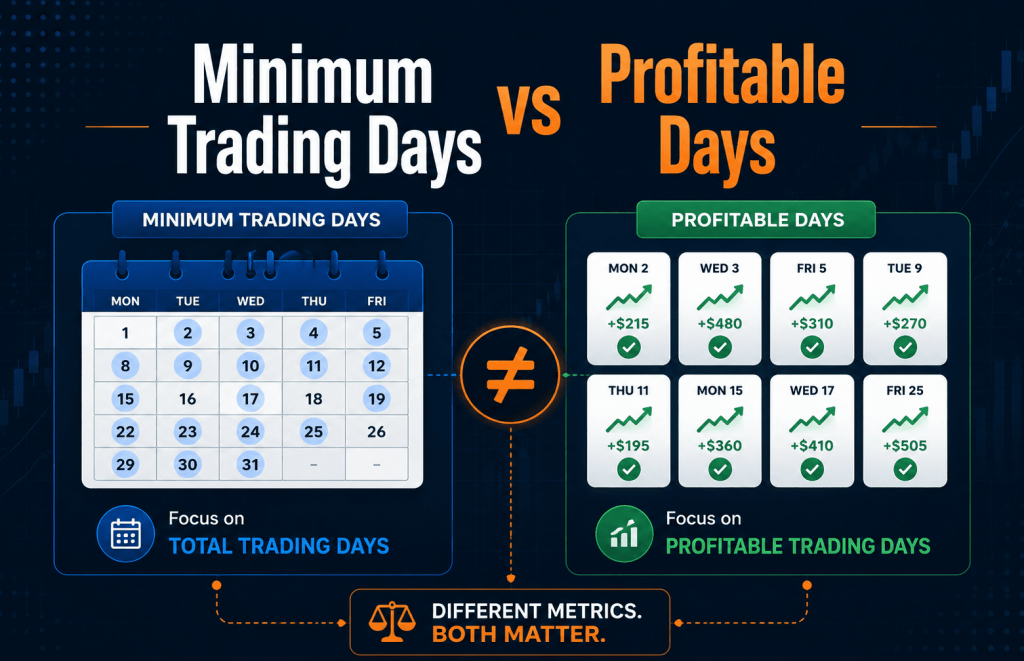
A trading day is not automatically a profitable day. Unless the selected FAQ defines a profitability threshold for a day, do not create one. Read the full distinction in minimum trading days versus profitable days.
Consistency and Strategy Restrictions
A consistency rule tests the distribution of profit. A strategy restriction tests how the result was produced. Both can matter even when the account balance is positive.
Consistency and concentration must be model-specific
| Model | Current FAQ condition | Correct unit to track |
|---|---|---|
| 1-Step | No Consistency Score requirement | Not applicable; other rules still apply |
| 2-Step | No Consistency Score requirement | Not applicable; other rules still apply |
| Instant | Maximum single-day profit as a share of total payout-period profit must be less than 20% | Highest-profit day ÷ total payout-period profit |
| Sprint | Largest single-trade profit must be less than 20% of total profit | Largest closed-trade profit ÷ total profit |
“Less than 20%” does not include exactly 20%. More importantly, the Instant numerator is a day while the Sprint numerator is a trade. Combining the two formulas produces the wrong answer.
EA permission is not platform-wide permission
The AIFO EA FAQ permits Expert Advisors on 1-Step and 2-Step Challenge accounts and their corresponding funded accounts after passing. It also states that excessive order traffic, challenge-passing bots, rule circumvention, exploitative tools, public third-party EAs, shared EAs and identical or substantially similar strategies across accounts can lead to warnings, rejection or termination.
That means “MT5 can run an EA” and “this account permits this EA behaviour” are different statements. Verify both the eligible account and the strategy-specific restrictions before switching automation on.
Restricted trading can override a profitable result
The AIFO restricted-trading FAQ lists conduct that can trigger warnings, restrictions, profit confiscation or account closure. Its examples include excessive leverage or margin use, gambling behaviour, high-frequency trading, excessive sub-one-minute scalping, copy trading, cross-account or group hedging, arbitrage, grid trading, delayed-data exploitation, one-sided betting, account cycling and platform exploitation.
Do not reduce this section to a list of banned strategy names. The practical test is whether the method is original, repeatable, compliant with the account limits and consistent with the FAQ’s risk standards.
News, Overnight and Weekend Trading
High-impact news can create faster price movement, wider spreads and slippage. Position size and remaining loss headroom should be set before the event rather than adjusted after volatility begins.
For holding, the AIFO overnight and weekend FAQ states that positions may be carried beyond the trading day, subject to risk rules and the single-trade risk limit. The model-specific Sprint FAQ is narrower: Sprint positions must be closed before weekends and public holidays, while cryptocurrency instruments are exempt from that closure condition and follow their market hours.
Use the specific Sprint rule when trading Sprint rather than applying the general holding rule to every model.
- Check whether the position will cross the GMT+3 account-day reset.
- Recalculate the next day’s Daily Loss floor before carrying floating P&L.
- Leave room for gaps, wider spreads, swap and worse-than-planned execution.
- For Sprint, check the weekend/public-holiday closure condition and the continuous countdown.
Read the detailed guides to news trading during high-impact events and overnight and weekend holding.
Passing a Challenge vs Payout Eligibility
Passing and payout are not synonyms. They occur at different points and answer different questions.
| Checkpoint | What must be true | What it does not guarantee |
|---|---|---|
| Evaluation objective reached | Applicable target and timing conditions are complete without a disqualifying breach | Automatic account issuance before review |
| Funded-stage account active | Account remains within its ongoing loss and conduct rules | That every positive balance is immediately withdrawable |
| Payout request eligible | Compliant account, permitted profit, completed KYC, no open positions or pending orders, minimum amount and model-specific conditions | Approval if verification or compliance review identifies an unresolved issue |
The AIFO payout FAQ requires the account to be compliant, profit to come from permitted activity, KYC to be complete, and all positions and pending orders to be closed before a payout request. It states a $100 minimum payout and temporarily disables trading while the request is reviewed.
Payout route by model
- 1-Step and 2-Step: the FAQ states a standard 14-day payout frequency when the requirements are met.
- Instant: payout on demand is available after the Instant conditions are met. A 2% buffer must remain if the trader wants to continue the account; a full payout closes the account and cannot be reversed.
- Sprint: the request must be submitted within 30 days after settlement. Each account has one payout, and the account closes after completion.
A useful operating rule is to stop trading when the account enters payout preparation. Close the intended trading cycle, confirm the profit-quality calculation, remove open and pending orders, complete verification and then submit the request. Continuing to trade after the account is ready can introduce a new breach or change the consistency result.
For the wider workflow, read how prop firm payouts work and why prop firm payouts get denied.
How the Rules Interact: Four Short Examples
Example 1: The target is reached too early
A 1-Step trader reaches the 10% target on the first trading day. The result may satisfy the profit objective, but the FAQ requires at least 2 trading days before progression. The trader should not force unnecessary size on the second day; the task is to complete the remaining condition while protecting the account.
Example 2: A profitable close changes tomorrow’s Daily Loss floor
A trader closes the day with higher equity than balance. Because the AIFO daily calculation uses the higher previous-day closing value, the next day’s floor can move upward. An overnight pullback that looked acceptable under yesterday’s room may threaten the new-day boundary.
Example 3: An Instant account is profitable but not payout-ready
An Instant trader has positive total profit, but the best day contributes 24% of payout-period profit. The model FAQ requires the highest-profit day to remain below 20%. The account can be profitable while still failing the current payout concentration test.
Example 4: A Sprint target is reached with the wrong profit shape
A Sprint account reaches 3%, but one trade contributes exactly 20% of total profit. The FAQ requires the largest single trade to account for less than 20%, so exactly 20% does not satisfy the condition. Target achievement and payout eligibility remain separate.
Rule Comparison Checklist
Use this checklist before buying a funded account challenge, before the first trade and again before requesting a payout.
Before purchase
- Which model and phase am I buying?
- What purchase date and rule version will apply?
- What is the target, and is it calculated from closed profit?
- How many trading days or how much elapsed time is required?
- Is Daily Loss based on balance, equity or the higher of the two?
- When does the account day reset, and which server time controls it?
- Is Maximum Loss static, trailing or high-water-mark based?
- Does touching the boundary count as a breach?
- Does a consistency test use a day, a trade or another numerator?
- Are EAs permitted on this exact model and account stage?
- Are holding, news-event, instrument or order-action restrictions clear?
- What payout minimum, timing, buffer and account-closure conditions apply?
Before each trading day
- Record previous-day closing balance and equity.
- Calculate today’s Daily Loss floor using the correct model percentage.
- Record the current Maximum Loss floor and remaining headroom.
- Check server time, market holidays and high-impact events.
- Set a personal daily stop inside the firm’s hard boundary.
- Confirm that the planned strategy and tools remain eligible.
Before payout
- Recalculate any consistency or concentration condition.
- Confirm the account has no violation or pending review issue.
- Close all open positions and remove pending orders.
- Complete KYC and verify the payout destination.
- Confirm the minimum amount and model-specific waiting period or window.
- For Instant, decide whether to retain the 2% buffer or take a full payout and close the account.
- For Sprint, submit within the stated 30-day post-settlement window.
Compare AIFO Rules Before You Start
Open the FAQ for the exact model you are considering, save the rule version and convert each hard limit into a smaller personal operating limit.
Open the AIFO Help Center or use the AIFO Trading Rules hub to navigate to the relevant topic. The FAQ remains the rule source for the figures in this article.
Final Takeaway
Prop firm challenge rules are a connected system. The profit target controls progression, Daily Loss controls the current day, Maximum Loss controls the account lifecycle, conduct rules control how the result is produced, and payout rules control whether eligible profit can be requested.
For AIFO, do not trade from a remembered percentage or a different model’s rule. Use the current model FAQ, the relevant topic FAQ and the parameters attached to the purchased account. Passing becomes much clearer when the trader treats evaluation, funded-stage compliance and payout readiness as three separate checkpoints.
Frequently Asked Questions
Prop firm challenge rules are the profit, loss, timing, conduct, consistency and review conditions used to decide whether an account can progress, stay active and qualify for a payout. All applicable rules must be satisfied together.
The AIFO 1-Step FAQ states a 10% Profit Target, 3% Daily Loss, 6% Static Maximum Loss and at least 2 trading days. It states that no Consistency Score applies and that the funded-account payout cycle is normally 14 days with a $100 minimum.
The AIFO 2-Step FAQ states an 8% target in Step 1 and a 5% target in Step 2, with 5% Daily Loss, 10% Static Maximum Loss and at least 3 trading days before progression. It states that no Consistency Score applies.
AIFO Instant provides immediate access without a traditional evaluation phase. Its FAQ states a 3% Daily Loss, a 5% high-water-mark Maximum Loss capped at the initial balance, a 2% open-position floating-loss limit and a highest-profit-day requirement below 20% of payout-period profit.
The AIFO Sprint FAQ states a 3% target in a 24-hour challenge, a 2% Static Maximum Loss, a 1% total floating-loss limit, one permitted instrument and one open position at a time. The largest single-trade profit must be below 20% of total profit, and the account has one payout.
No. Passing an evaluation, maintaining a funded-stage account and qualifying for a payout are separate checkpoints. AIFO’s payout FAQ also requires a compliant account, permitted profit, completed KYC, no open positions or pending orders and all model-specific payout conditions.
The general AIFO holding FAQ allows overnight and weekend positions subject to risk rules. The model-specific Sprint FAQ requires positions to be closed before weekends and public holidays, except for cryptocurrency instruments trading under their market hours.
The AIFO EA FAQ permits Expert Advisors on 1-Step and 2-Step Challenge accounts and their corresponding funded accounts. EAs must follow the order-volume, originality and prohibited-strategy conditions stated in the FAQ.
Use the current model-specific AIFO FAQ and the relevant topic FAQ. For accounts purchased before 1 September 2026, the 1-Step, 2-Step and Instant FAQs state that the parameters displayed on the Dashboard prevail.