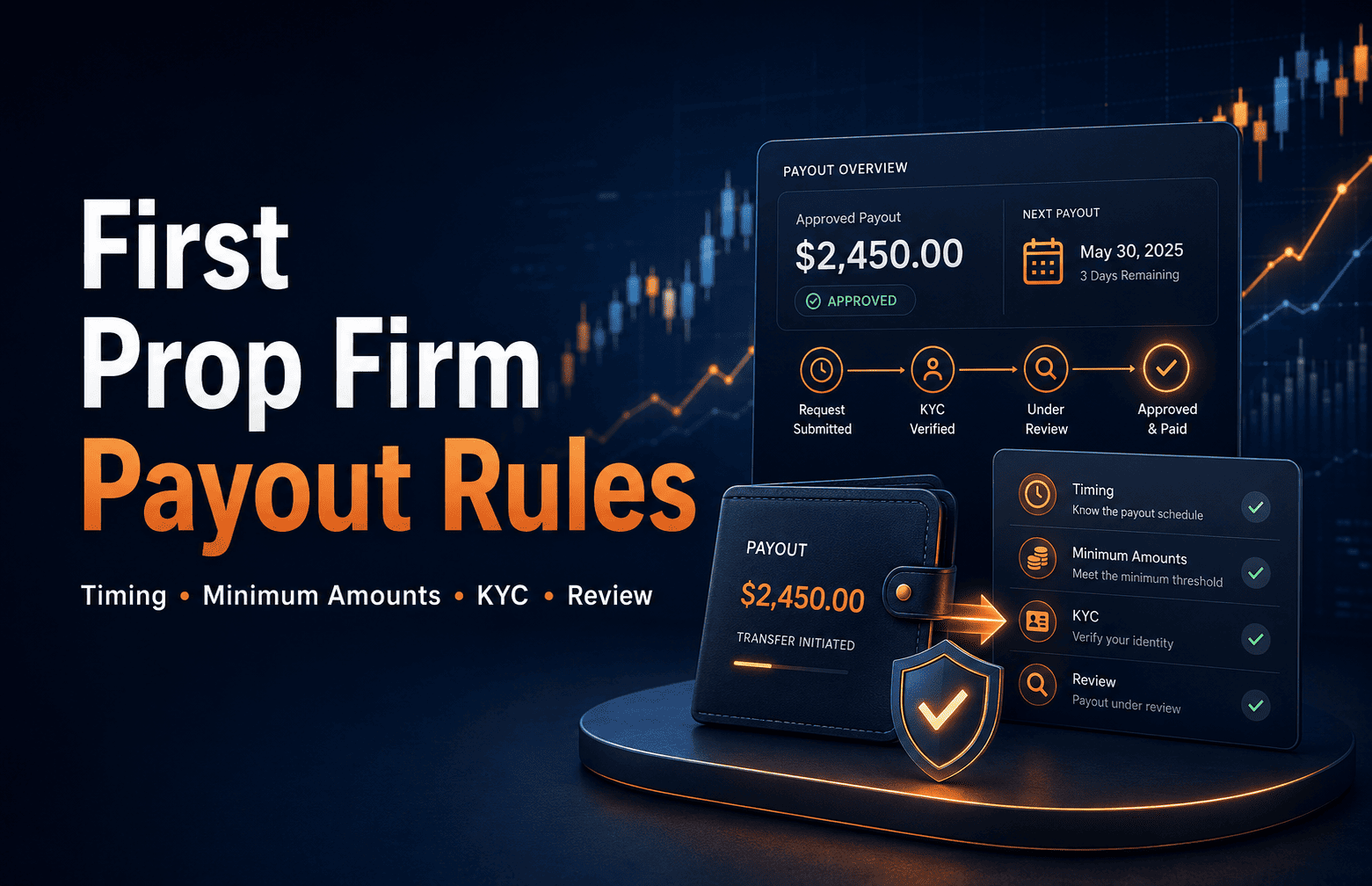



First payout rules determine when displayed profit becomes requestable, approved and finally settled. A positive account balance is not enough by itself. Traders must check the selected programme’s timing, minimum amount, consistency, risk, KYC, account-status, payment-detail and payout-buffer requirements.
The first payout has several separate stages. A trader can be profitable but not yet eligible, eligible but still under review, or approved but waiting for the payment channel to complete settlement.
This guide is part of the Prop Firm Payouts Hub. Use it to prepare for the first request and use why prop firm payouts get denied if a request is delayed, returned or rejected.
Last rule review: . For AIFO accounts purchased before 1 September 2026, the challenge parameters displayed on the Dashboard apply.
First Payout Workflow
| Stage | Account status | Trader action | Evidence to save |
|---|---|---|---|
| 1. Before eligibility | Profit may be visible, but one or more programme conditions remain incomplete | Record the earliest request date, minimum amount and account-specific requirements | Programme, account stage, start date and rule version |
| 2. Pre-request check | The account appears eligible but has not submitted a request | Check KYC, payment details, risk history, consistency and requested amount | Dashboard, trade history and payout calculation |
| 3. Submitted | The request exists but has not been approved | Preserve the account state and respond to legitimate review requests | Submission confirmation, amount and destination details |
| 4. Approved | The firm has approved a payout amount | Confirm the approved amount and resulting account status | Approval notice and payment reference |
| 5. Settled | The approved amount has reached the receiving method | Recalculate the remaining account room before trading again | Receipt, account balance and post-payout loss floor |
Track Three Different Payout Clocks
“First payout time” can describe three different periods. Combining them creates unrealistic expectations.
| Clock | Starts when | Ends when | Possible extension |
|---|---|---|---|
| Eligibility clock | The programme’s specified starting event occurs | The first valid request can be submitted | Incomplete timing, profit, risk or account-stage requirements |
| Review clock | A valid request is submitted | The firm approves, returns or denies the request | Compliance review, account verification or unusual account activity |
| Settlement clock | The approved payment enters the selected channel | The receiving account records the payment | Payment-channel limitations or incorrect receiving details |
A published processing period is not the same as a guaranteed receipt time. Record the request date, approval date and settlement date separately.
Dashboard Profit Is Not the Same as Settled Payout
- Displayed profit: the current simulated trading result shown on the account.
- Payout-eligible profit: profit that satisfies the applicable programme conditions.
- Payout-available amount: the amount that can be requested after any account-specific restriction or retained amount.
- Submitted amount: the trader’s request, which is not yet an approval.
- Approved payout: the amount accepted after review.
- Settled payout: the amount received through the selected payment channel.
A profit split applies to eligible and approved profit. It does not determine timing, verification status or settlement speed. Read how prop firm profit splits work for the percentage calculation.
Current AIFO First Payout Rules
All AIFO account types, including Challenge and Funded Accounts, use virtual funds in a simulated trading environment. A payout is based on eligible simulated trading performance. The displayed account balance is not transferred to the trader.
| Programme | First-request structure | Consistency requirement | Buffer or closure rule |
|---|---|---|---|
| 1-Step funded account | $100 minimum; standard 14-day payout cycle | No Consistency Score requirement | No mandatory 2% buffer in the account-specific rule |
| 2-Step funded account | $100 minimum; standard 14-day payout cycle | No Consistency Score requirement | No mandatory 2% buffer in the account-specific rule |
| Instant | Payout on demand after all applicable risk, consistency, KYC, account-status and payout conditions; $100 minimum | Maximum single-day profit must be below 20% of total profit within the payout period | Retain 2% of initial account balance to continue; a full payout closes the account permanently |
| Sprint | One payout; request within 30 days after settlement | Largest single-trade profit must be below 20% of total profit | Account closes after its one payout |
The default profit split for AIFO 1-Step and 2-Step funded accounts is 80% and can increase up to 95% through the Scaling Plan. Their current rules do not require a Consistency Score.
For 1-Step and 2-Step accounts, an eligible Fast Payout add-on may shorten the default funded-account cycle to 24 hours after the first profit split. The first profit split still requires the standard 14-day waiting period. Sprint does not support this add-on.
Instant has no traditional evaluation profit target. It allows payout on demand only after the applicable conditions are met. “Instant” describes the account-access route and does not mean all displayed profit can be withdrawn immediately.
Sprint is a 24-hour challenge with a 3% target. Closed net profit of at least 3% but below 6% can qualify for a one-time 90% payout. Closed net profit of at least 6% can qualify for an early 95% payout. The request must be submitted within 30 days after settlement, and the account closes after payout.
Use the AIFO payout process, AIFO payout rules and AIFO trading rules for the current account-specific workflow.
AIFO Minimum, Maximum and Processing Times
- General minimum payout: $100.
- General maximum per request: $10,000.
- General processing period: usually 1–3 business days.
- Sprint processing period: one business day, excluding additional account checks or compliance review.
General processing may take longer because of compliance review, account verification, payment-channel limitations or further review of unusual account activity. Complete and save payment details correctly before requesting. Incorrect information may delay the payout or cause funds to be returned.
KYC and Account Verification
KYC connects the trading account, account holder and payout destination. The exact documents and verification steps depend on the firm’s current process, so the first-payout checklist should not rely on assumptions from another provider.
For AIFO Instant, the approved payout wording expressly requires all applicable risk, consistency, KYC, account-status and payout conditions to be met. Review the current AIFO KYC page when completing the process.
| Check | Question | Evidence |
|---|---|---|
| Account identity | Do the trading profile and verified account holder match? | Profile and completed verification status |
| Payment details | Are all destination fields complete and saved correctly? | Confirmation page without exposing credentials |
| Service eligibility | Is the account holder eligible to use the service? | Account and verification result |
| Review request | Was any additional account or compliance information requested? | Official support or verification message |
Risk and Consistency Review
A payout review can examine whether the account remained inside its loss limits and other programme conditions. A later recovery does not erase an earlier boundary event.
| Programme | Daily Loss Limit | Maximum Loss Limit | Additional payout-related condition |
|---|---|---|---|
| 1-Step | 3% | 6% Static | No Consistency Score |
| 2-Step | 5% | 10% Static | No Consistency Score |
| Instant | 3% | 5% Trailing from HWM, capped at initial balance | Floating loss not above 2% of initial balance; best day below 20% |
| Sprint | Programme-specific 24-hour structure | 2% Static | Total floating loss not above 1%; largest trade below 20% |
Read Daily versus Maximum Drawdown before recalculating account room.
The Payout Buffer Is Not Universal
The mandatory AIFO 2% retained-profit buffer applies to Instant Accounts. After a payout, an Instant account must retain profit equal to at least 2% of the initial account balance if the trader wants to continue using it.
An Instant trader may request a full payout, including the buffer. That choice permanently closes the account.
Do not add this buffer to 1-Step, 2-Step or Sprint. The current account-specific rules do not establish the same mandatory 2% retained-profit condition for them. Review the AIFO payout buffer page before choosing an Instant request amount.
First Payout Checklist
- Confirm the programme and current account stage.
- Use the correct rule version for the account purchase date.
- Record the earliest eligible request date.
- Check the $100 minimum and $10,000 general maximum per request.
- Confirm the applicable profit split.
- Complete any applicable KYC and account-verification requirements.
- Complete and save payment details correctly.
- Check the full balance, equity and loss-limit history.
- Do not apply a Consistency Score to 1-Step or 2-Step funded accounts.
- For Instant, verify the below-20% best-day rule and 2% payout buffer.
- For Sprint, verify the below-20% largest-trade rule and 30-day request window.
- Save the dashboard, calculation and request confirmation.
After the Request Is Submitted
Do not assume that submission equals approval or that approval equals settlement. Preserve the account state and follow the current instructions shown for the request.
| Request state | Action | Do not assume |
|---|---|---|
| Submitted | Save the requested amount, account state and destination details | The request has already been approved |
| Additional review | Respond through the official verification or support route | Every review finishes within the general processing period |
| Approved | Confirm the approved amount and payment reference | The payment has already reached the receiving method |
| Settled | Recalculate the account’s post-payout risk room and status | The remaining account has the same loss room as before |
Final Takeaway
The first payout is a sequence, not a single click. Separate eligibility, submission, review, approval and settlement. Use the selected programme’s rules instead of applying one consistency formula, buffer or timing promise to every account.
At AIFO, the current paths are Instant, 1-Step, 2-Step and Sprint. All use simulated trading with virtual funds. The minimum payout is $100, general requests are normally processed within 1–3 business days, and account-specific conditions determine when profit becomes payout-eligible.
Frequently Asked Questions
The timing depends on the programme. AIFO 1-Step and 2-Step funded accounts use a standard 14-day payout cycle. Instant permits payout on demand after all applicable conditions are met. Sprint permits one payout under its programme-specific settlement and 30-day request rules.
The current AIFO minimum payout amount is $100. The general maximum is $10,000 per payout request. Traders should calculate the eligible amount under their selected programme before submitting.
No. AIFO 1-Step and 2-Step funded accounts have no Consistency Score requirement. Instant and Sprint use their own separate profit-concentration rules.
No. The mandatory 2% retained-profit buffer applies only to Instant Accounts. A full Instant payout including the buffer permanently closes the account. The buffer must not be added to 1-Step, 2-Step or Sprint.
AIFO requests are generally processed within 1–3 business days. Sprint has a programme-specific one-business-day processing period, excluding additional account checks or compliance review. Verification, compliance or payment-channel issues can extend processing.
No. Approval means the request passed the applicable review. Settlement occurs when the approved payment reaches the trader’s receiving method. Payment-channel limitations or incorrect details can affect the settlement stage.
No traditional evaluation profit target is specified for AIFO Instant. A payout may be requested on demand only after all applicable risk, consistency, KYC, account-status and payout conditions are met.