


A prop firm payout is not simply account profit multiplied by the advertised profit split. The usable payout depends on payout-eligible profit, account status, consistency, buffer rules, review, identity or payment checks, withdrawal timing and the conditions attached to the exact account model. Use the AIFO payout rules for current account-specific conditions and the AIFO payout process for the request-to-release workflow.
Choose the Payout Question You Need to Solve
This page is the payout education hub. Open the detailed guide that matches your current decision or problem:
- Prop firm profit splits explained — compare the percentage, eligible profit, caps, add-ons and conditions behind the headline split.
- First payout rules — check timing, identity verification, review, minimum withdrawal, payment details and post-withdrawal account impact.
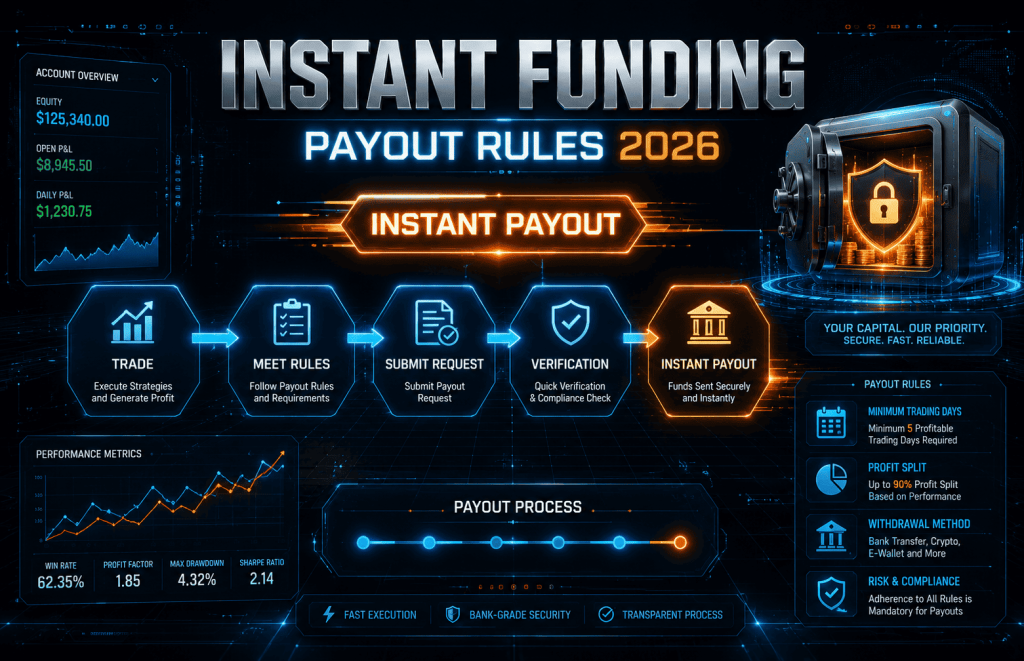
- Instant funding payout rules — separate instant account access from actual payout eligibility and payout-on-demand conditions.
- Why prop firm payouts get denied — diagnose rule, consistency, verification, payment, prohibited-activity and account-review problems.
What Determines a Prop Firm Payout?
The practical payout path has four separate layers:
- Account profit: the profit currently displayed on the trading account.
- Payout-eligible profit: the amount that satisfies the account’s buffer, consistency, review and withdrawal conditions.
- Trader profit split: the percentage applied to the payout-eligible amount.
- Final settlement: the approved amount delivered through the selected payout method.
A large account profit does not prove that the same amount is immediately withdrawable. Compare the complete payout path together with prop firm challenge costs, because a low purchase fee does not compensate for an unclear withdrawal process.
How Prop Firm Profit Splits Actually Work
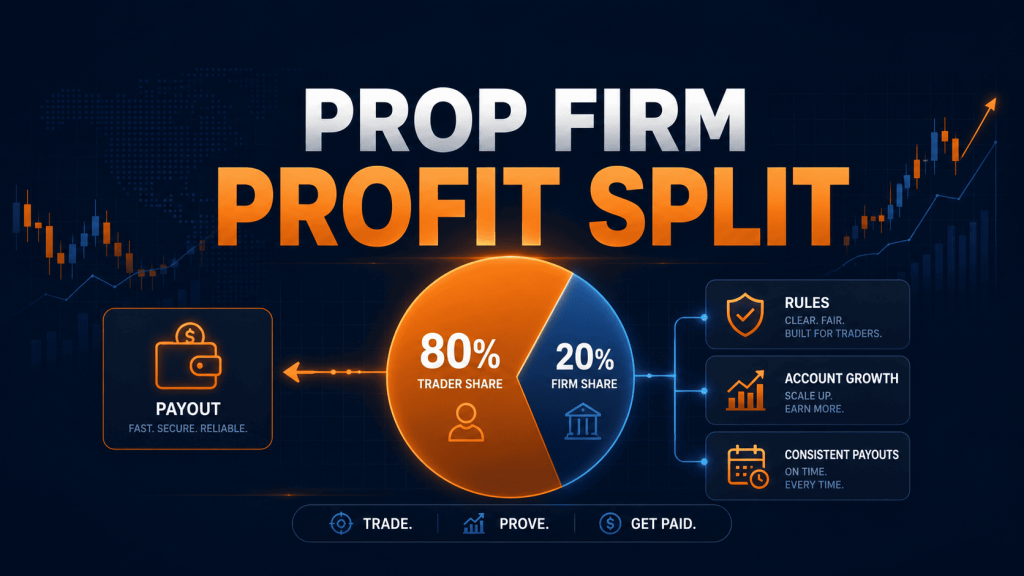
A profit split is the percentage applied after the account’s payout-eligible amount has been determined. It is not automatically applied to every dollar displayed as trading profit.
Trader payout = payout-eligible profit × trader profit split
| Payout-eligible profit | Profit split | Amount paid to trader | What the example does not include |
|---|---|---|---|
| $5,000 | 80% | $4,000 | Buffer, caps, payment costs or account-specific restrictions |
| $5,000 | 90% | $4,500 | Buffer, caps, payment costs or account-specific restrictions |
| $5,000 | 95% | $4,750 | Buffer, caps, payment costs or account-specific restrictions |
The same headline percentage can produce different usable payouts when two accounts have different buffers, caps, review gates or withdrawal conditions. For the dedicated percentage and account-comparison guide, read prop firm profit splits explained.
Why the advertised split can be misleading
The advertised split is the number traders remember. The payout system is the number traders live with.
A high split can still produce a poor payout experience if the account has hidden friction.
Look for these conditions before treating a high split as better:
- minimum withdrawal amount;
- payout frequency;
- payout review window;
- consistency score requirement;
- profit buffer or safety cushion;
- withdrawal caps;
- full-withdrawal account closure rules;
- KYC or payment-channel restrictions.
This is the trap in many “best payout” comparisons. They rank a 95% or 100% split as if it were cash in the trader’s wallet. It is not. It is a percentage applied after rules.
A new funded trader should treat any very high split as a prompt to read more, not less. This is part of what to check before choosing a prop firm, because payout clarity is one of the first signs of whether the account is trader-friendly or just well-marketed.
What is the difference between gross profit and payout-ready profit?
Gross profit is what the account shows before payout rules finish their work. Payout-ready profit is the part that can actually move through review and withdrawal.
This difference is one of the most underpriced risks in funded trading.
A trader can generate profit and still be blocked from payout because the account is not review-ready. The issue may be consistency. It may be a rule violation. It may be incomplete eligibility. It may be a payout buffer.
The AIFO payout process frames this correctly: payout is a sequence, not a button. The account must satisfy the relevant eligibility, consistency, review, compliance, payout-destination and withdrawal conditions before release. Before submitting a first request, use the first payout rules checklist. If a request is delayed or rejected, use why prop firm payouts get denied to identify the missing gate.
That means the funded trader should stop thinking in one number.
| Profit layer | What it means | Trader mistake | Execution consequence |
|---|---|---|---|
| Open profit | Unrealised profit on active positions | Treating it as withdrawable | A reversal can erase it before payout logic begins |
| Closed profit | Realised account gain after trades close | Assuming closed means payout-ready | Rules may still block or reduce the request |
| Eligible profit | Profit that satisfies account and withdrawal conditions | Ignoring consistency or review status | Payout may be delayed or denied |
| Buffered profit | Profit left in the account to keep risk room after withdrawal | Trying to drain the account completely | The account may lose protection or close under full-withdrawal rules |
| Approved payout | The amount released through an approved payout method | Confusing approval time with settlement time | Payment arrival may still depend on the rail used |
How the AIFO Payout Buffer Changes the Real Withdrawal Amount
Last checked on : the AIFO payout buffer FAQ states that traders must retain a profit buffer equal to 2% of the initial account balance when requesting a withdrawal. It also states that withdrawing the full profit, including the required buffer, automatically closes the account.
Payout-available profit = account profit − required payout buffer
Example:
- Initial account balance: $100,000
- Required 2% buffer: $2,000
- Account profit: $7,000
- Payout-available profit before the split: $5,000
| Profit split | Calculation | Amount paid to trader | Amount retained as buffer |
|---|---|---|---|
| 80% | $5,000 × 80% | $4,000 | $2,000 |
| 90% | $5,000 × 90% | $4,500 | $2,000 |
| 95% | $5,000 × 95% | $4,750 | $2,000 |
The profit split is applied to the payout-available amount, not automatically to the entire account profit. A trader who wants to withdraw the retained buffer should first understand that a full withdrawal can close the account.
Verification note: Check the live payout FAQ, official payout rules and exact account model before submitting a request. Buffer and withdrawal conditions can change.
Why some firms can advertise 95% or 100% profit splits
A very high profit split does not mean the firm has no way to make money. It means the firm’s revenue model is wider than the split.
This is where trader discussions often get messy. They see a 100% split and assume the offer is impossible. Sometimes the offer is weak. Sometimes the economics sit somewhere else.
A modern prop firm may earn money from challenge fees, reset fees, subscriptions, platform access, spread or commission layers, partner revenue, trader lifecycle value or selective live-risk routing. The split is only the funded-stage revenue line.
The article on how prop firms make money goes deeper into that model. The short version is simple: front-end access fees arrive early, while profit-split revenue arrives later from retained traders.
That is why a high split can be rational if the firm has enough revenue quality elsewhere. It can also be a warning sign if the rules are vague, the payout caps are tight, or the business depends on constant new challenge buyers.
Do not judge the split alone. Judge the engine behind it.
Is a 90% split better than an 80% split?
A 90% split is better only when the payout path is equally clean. If the 90% account has more conditions, slower payout review, tighter withdrawal rules or harsher drawdown treatment, the extra 10% may not be worth much.
This is the decision most new funded traders miss.
Compare the account like an operator, not a buyer staring at a discount banner. Ask:
- Does the higher split require an add-on?
- Does the add-on change refund or challenge economics?
- Does the account have a consistency rule?
- Is there a minimum payout threshold?
- Does the firm cap first withdrawals?
- Can a full withdrawal close the account?
- Are payouts tied to account stage or scaling level?
If the answer to several of these is unclear, the split is not yet comparable.
This is the same logic used when choosing a prop firm. The best-looking product is not always the best account for the trader’s actual withdrawal path.
It is also where why some prop firms are bad deals becomes relevant. A firm can be legitimate and still offer a payout structure that pushes the wrong behaviour.
Does Instant Funding Mean Instant Payout?
No. Instant funding describes how the trader receives account access. It does not prove that every dollar of profit is immediately withdrawable.
An Instant account can still use account-specific withdrawal conditions, consistency checks, buffer rules, review, payment verification and payout timing. Use the instant funding payout rules guide when comparing an Instant account with a challenge-based account.
Check the exact program page and official payout rules before treating “instant”, “fast payout” or “payout on demand” as automatic access to cash.
How consistency rules affect profit split
A consistency rule can make a profitable account less payout-ready. It does not always reduce the stated split, but it can delay when the trader can receive that split.
This matters more for new funded traders than they expect.
A strong single day may look like success on the dashboard. The payout review may see profit concentration. Now the trader has to keep trading to make the result cleaner. That creates fresh drawdown risk after the account is already in profit.
The consistency rule should be read as part of payout planning, not just challenge planning.
A trader chasing a bigger payout can accidentally create a worse payout path. One oversized winner may feel good. It may also force extra trading before the split can be collected.
What New Funded Traders Should Compare Before Choosing a Payout Model
New funded traders should compare the payout system, not just the split. A lower headline split with clear withdrawal rules can be stronger than a higher split with conditions that keep moving.
Use this framework before buying a challenge or upgrading a funded account.
| Factor | Why it matters | What a clean version looks like | Warning sign | Detailed guide |
|---|---|---|---|---|
| Standard split | Shows what most new funded traders actually start with | Clear 80%, 85% or 90% terms | Only the highest upgraded split is advertised | Profit split explained |
| Upgrade path | Shows whether higher splits are earned or purchased | Transparent add-on or scaling terms | Split increase depends on vague “review” language | AIFO payout rules |
| Payout frequency | Affects cash flow and trader behaviour | Defined request windows and review steps | Fast payout claim with unclear approval conditions | First payout rules |
| Buffer | Separates gross profit from withdrawable profit | Buffer amount and example calculation shown | Trader discovers the buffer only at withdrawal | AIFO payout buffer |
| Consistency | Can delay payout after a large single-day gain | Formula is visible before trading | Rule is broad enough to reject almost any profit shape | Consistency rule |
| Review process | Decides whether the account activity is accepted | Clear reasons for review and delay | Open-ended review with no practical explanation | Why payouts get denied |
That table is less exciting than a 95% badge. It is more useful.
The same payout model should also be tested against your risk process. If the trader keeps pushing trades only to make a payout “worth it”, the issue is not the split. It is weak account-state control. Review a risk management strategy for challenge failure before treating payout size as the next trading target.
Alpha Insight: the split is the percentage, not the payout
The cleanest payout question is not “What split do I get?” It is “What profit survives the rule book before the split is applied?”
This is the gap in most payout content.
The trader looks at 90%. The firm looks at eligibility, review, buffer, consistency, payment route and account status. Those are not side details. They are the payout system.
A high split on weak eligible profit is not a high payout. A lower split on clean, review-ready profit may be better in real trading life.
This also connects to the question of do prop firms use real money. Real payouts and live execution are different layers. A trader can receive a real payout from a simulated funded environment, yet still need to pass the firm’s payout controls before that money is released.
For a new funded trader, the priority is simple: protect the account, keep the profit clean, understand the buffer, then apply the split. The percentage comes last.
FAQ: Prop firm payouts and profit splits
There is no universal industry standard. Use the profit split shown for the exact account model and check whether it applies to gross profit, net profit, payout-eligible profit or payout-ready profit. A higher percentage can still produce a lower usable payout when buffer, caps, consistency, review or withdrawal conditions are stricter.
No. The split is usually applied to eligible payout-ready profit, not every dollar shown on the account. Buffer rules, consistency checks, review status, withdrawal limits and payment conditions can change the final amount available for payout.
No. A 95% split is only better if the payout path is clean. An 80% split with clear rules, fast review and no hidden friction can be more useful than a higher split tied to caps, delays or unclear conditions.
A payout buffer is profit that must remain in the account when a withdrawal is requested. It helps preserve post-withdrawal drawdown room, so the trader does not remove too much profit and leave the account too close to a breach line.
A 100% split can be funded by a wider business model, including challenge fees, resets, subscriptions, platform fees, spread or commission layers, scaling terms or selective live-risk routing. The trader should still check caps, conditions and payout eligibility.
They should compare payout frequency, minimum withdrawal, buffer rules, consistency requirements, review process, full-withdrawal rules, payment methods and the exact conditions for upgrading to a higher split.