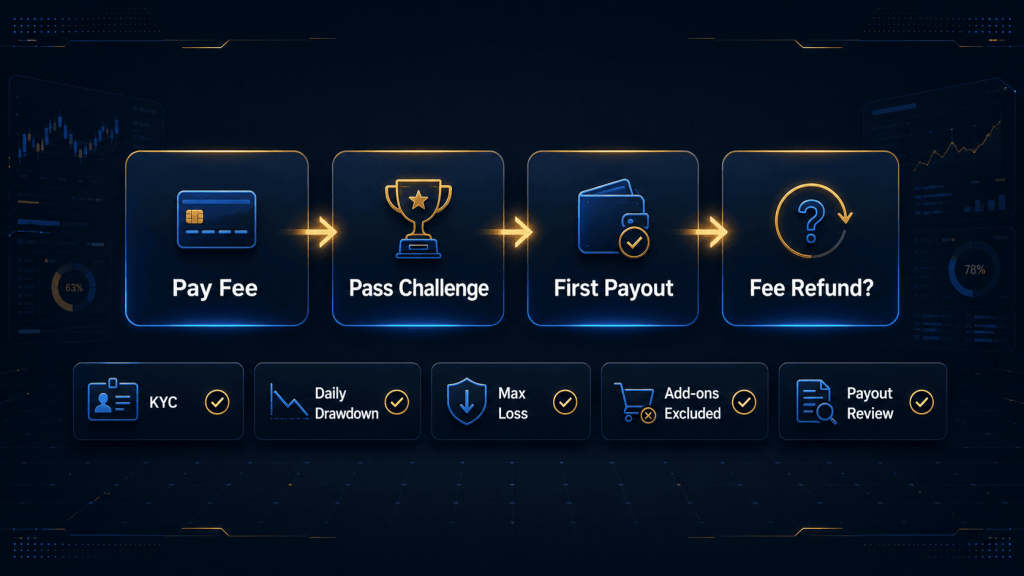



A funded trading account cost is the expected amount a trader spends to enter a programme and reach the first approved payout, not the balance displayed on the account. Include the net entry fee, permitted add-ons, retry probability, spreads, commission, slippage, swap, recurring tools and payout friction. The lowest checkout price is not automatically the lowest total cost.
Funded Account Cost: Key Takeaways
- The nominal account size is a simulated balance, not the fee or cash owned by the trader.
- Compare the net checkout price only after verifying discount and add-on eligibility.
- Expected retry cost can be larger than the first fee for strategies with a poor rule fit.
- Spreads, commission, slippage and swap reduce the margin available before a breach or payout.
- Use total cost to first clean payout as the main comparison metric.
Reviewed September 22, 2026. AIFO-specific statements were checked against the live Trading Rules and September 2026 rules update; traders should still confirm the checkout price before purchase.
How Much Does a Funded Trading Account Cost?
There is no single funded account price. The amount depends on the account size, programme design, discount, optional features, probability of another attempt and the trading and payout costs incurred after checkout.
The visible challenge fee is only the first cost. It tells you what you pay to enter the account, not what it costs to reach a clean payout.
This article is the Cost Hub inside the prop firm decision framework. Use the AIFO Best Prop Firm Decision Center for the wider commercial comparison, then use this page to calculate the real cost behind challenge fees, discounts, spreads, slippage, retries and payout friction.
Last checked: . AIFO’s current account routes are Instant, 1-Step, 2-Step and Sprint. All accounts use simulated trading and virtual funds.
| Cost layer | What traders usually compare | What they should compare instead | Why it matters | Detailed guide |
|---|---|---|---|---|
| Entry fee | Sticker price or promo price | Final checkout cost after a confirmed discount, currency, tax and eligible add-ons | The paid amount can differ from the banner price | This article |
| Account model | Account size | Instant, 1-Step, 2-Step, Sprint or another confirmed route | Each model prices a different kind of pressure | Compare the current model rules before choosing |
| Usable drawdown | Headline balance | Daily loss, maximum loss, static or trailing logic and failure buffer | The account label is not the tradable risk room | Drawdown rules |
| Trading cost | Fee only | Spread, commission, slippage, swap and platform execution | Execution cost is paid inside every trade | Order execution and account types |
| Payout friction | Profit split | First payout timing, KYC, review, model-specific buffer rules, open positions and settlement | Dashboard profit is not automatically withdrawable cash | Prop firm payouts |
Funded Account Cost vs Displayed Account Size
A 100K account label does not mean the trader buys or owns $100,000. It is the simulated balance used to calculate objectives, position exposure and loss limits. Three numbers must be separated:
| Number | What it means | How to use it |
|---|---|---|
| Displayed account size | Simulated balance used by the programme | Do not treat it as cash value |
| Usable loss allowance | Room between the starting/equity reference and the loss limit | Compare it with the fee and strategy drawdown |
| Total expected cost | Fee, retries, tools, execution and payout friction | Use it to compare routes on an economic basis |
Public 100K Challenge Fees: Useful, but Incomplete
The 100K account is a useful benchmark because many serious traders compare firms at that level. It still does not tell the full story.
A lower 100K fee can sit behind harder targets or tighter drawdown. A higher fee can be better if the rule path and payout route are cleaner.
| 100K cost field | Why it matters | What to compare before buying |
|---|---|---|
| Final checkout fee | Promos, discounts, currencies and add-ons can change the real entry cost | Live checkout price and date checked |
| Model type | Instant, 1-Step, 2-Step and Sprint accounts price different forms of pressure | Target sequence, evaluation phases and post-pass workflow |
| Usable drawdown | The $100K label is not the risk budget | Daily loss, maximum loss and drawdown calculation method |
| Fee-to-drawdown ratio | A low fee can still buy expensive usable room | Effective fee per $1,000 of maximum drawdown |
| Payout path | First payout conditions can change the real value of the account | KYC, minimum payout, any model-specific buffer, open positions and review process |
For the dedicated account-size calculation, read How Much Does a 100K Funded Account Cost?. That guide explains fee-to-drawdown ratio, refund versus discount math, hidden execution costs and first payout pressure for 100K accounts.
Discounts, Refunds and Promo Codes: When a Lower Price Is Real Value
A discount is useful only if it reduces the cost of a rule set you would buy anyway. A discount on the wrong account is still a bad purchase.
Discount first, decision second is backwards. Decide the account model first. Apply any verified discount last.
| Price term | What traders think it means | What it really changes | Risk check before paying | Related guide |
|---|---|---|---|---|
| Discount or promo code | The firm is cheaper | The first checkout amount may be lower | Confirm the final checkout price and whether eligible add-ons change the total | Cheapest prop firms |
| Seasonal sale | This is the best time to buy | The clock creates urgency | Do not buy before reading payout, breach and refund rules | Choosing checklist |
| Affiliate code | The account has better value | The checkout price changes, not the account quality | Separate the discount from rule clarity and payout reliability | Payout proof verification |
| Refundable fee | The challenge is effectively free if you pass | The fee may return only after a qualifying payout or account event | Check whether refund means cash, credit, hub balance or payout add-on | Refundable challenge fees |
| Reset discount | Trying again is cheap | The same failure can be bought again | Diagnose the failed attempt before paying for another one | Why traders fail challenges |
For low-budget traders, the separate guide to cheapest prop firms under $100 is the better fit. This page is about full cost, not the lowest entry ticket.
Spreads, Slippage and Commission: The Hidden Cost Inside Every Trade
Spreads, slippage and commission are not side details. They are trading costs paid inside the account. They reduce net profit, increase break-even distance and can move the account closer to daily or maximum loss limits.
| Execution cost | Where it appears | Who feels it most | Cost question before buying | Related guide |
|---|---|---|---|---|
| Spread | Every entry and exit | Scalpers, gold traders and high-frequency intraday traders | Are spreads raw plus commission, all-in, typical, live or only ideal examples? | Scalping prop firms |
| Commission | Per lot, per side, per contract or built into spread | High-volume traders and no-commission account buyers | Does the commission saving justify any higher account fee? | Compare commission with the all-in spread cost |
| Slippage | Stops, market orders, news, fast candles and thin liquidity | News traders, gold traders, index traders and tight-stop systems | Can a realistic worse fill push the trade beyond your personal stop? | Measure realistic slippage in the sessions you trade |
| Swap and rollover | Overnight positions, weekend exposure and session rollover | Swing traders and multi-day strategies | Does swap, rollover or gap risk affect daily loss or payout state? | Swing trading prop firms |
| Platform delay | Slow connection, dashboard lag, server delay or unstable setup | Fast-entry traders and platform-sensitive strategies | Has the platform been tested before the paid attempt? | Order execution and account types |
| Partial fills or rejections | Thin liquidity, futures contracts, fast instruments and volatile symbols | Futures, metals, indices and news traders | Can the real fill differ from the planned risk? | Futures challenge guide |
A firm can advertise a fair challenge fee and still be expensive to trade if execution conditions are poor for your strategy. A low spread on one major FX pair does not prove good conditions across indices, metals, crypto, futures or minor pairs.
The Real Total Cost Formula
Expected total cost to first clean payout = net entry fee + (retry probability × retry fee) + recurring tools/data + execution cost + payout friction.
Example: a $300 net fee, a 40% chance of one $300 retry, $40 of tools and $60 of expected execution drag produces an expected pre-payout cost of $520. This is an illustration, not an AIFO price quote.
The real total cost is the cost to reach a clean, eligible payout. That is the number traders should compare.
Real total cost = entry cost + expected retry cost + recurring fees + after-pass fees + execution cost + payout friction.
| Formula component | What to include | Why traders miss it | How to reduce it |
|---|---|---|---|
| Entry cost | Challenge fee after a verified discount, currency and checkout conditions | Traders compare pre-discount and post-discount prices badly | Use final checkout, not banner pricing |
| Expected retry cost | Resets, repeat purchases, failed attempts and behaviour loops | Failure feels separate from pricing | Stop after failure and diagnose the rule breach before rebuying |
| Recurring fees | Subscriptions, monthly fees, data or platform fees | The first month looks cheap | Estimate the number of billing periods needed to pass or reach payout |
| After-pass fees | Activation, verification, funded-stage, platform or data charges | They appear after the challenge | Read the funded-stage path before buying |
| Execution cost | Spread, commission, slippage, swap and order-quality drag | They do not appear in checkout | Test your strategy in the actual products and sessions |
| Payout friction | Minimum withdrawal, review, consistency where applicable, model-specific buffers, KYC and payment fees | Traders treat profit as withdrawable too early | Read the payout rules for the exact model before sizing for a target |
That formula is not perfect. It is still better than sorting firms from low fee to high fee and pretending the job is done.
Payout Friction: The Cost After the Target Is Hit
A challenge is not finished when the dashboard is green. The account still has to become payout-ready. AIFO’s standard payout minimum is $100, the standard funded-account cycle is 14 days and approved payouts are usually processed within 1–3 business days. Eligible 1-Step and 2-Step accounts may use the Fast Payout add-on; the first payout still requires the initial 14-day wait, and later eligible cycles may shorten to 24 hours after the first profit split. Sprint has its own one-payout terms and does not support add-ons.
| Payout friction | What it changes | Cost if ignored | Detailed guide or page |
|---|---|---|---|
| First payout timing | When a valid request can start | The trader keeps trading while waiting and creates new risk | First payout rules |
| KYC and payment route | Whether approved profit can be paid to the correct recipient | Clean trading is delayed by documents, payment mismatch or unsupported routes | AIFO KYC guide |
| Consistency or best-day rule | Whether profit distribution is payout-ready for that model | One oversized day can require more trading or make a request ineligible | Consistency rule |
| Model-specific buffer | Whether profit must remain after withdrawal | Applying a buffer to every model produces the wrong payout calculation | AIFO Instant payout buffer |
| Payout review | Whether trade history, rules, account state and payout destination are approved | Dashboard profit becomes review profit, not cash | Why payouts get denied |
Use the AIFO payout process as the correct habit. It separates eligibility, account review, approval and final receipt. That separation is where many traders misread cost.
AIFO in Context: Where Pricing Is Actually Strong
AIFO does not need to claim it is the cheapest firm in every row. That claim would break the moment a competitor runs a promo code. The cleaner point is pricing efficiency: model separation, rule visibility and payout-process clarity make cost easier to calculate.
AIFO’s current routes are Instant, 1-Step, 2-Step and Sprint. The important comparison is not the model name alone. It is the target, loss method, trading-day or time requirement, payout eligibility and add-on eligibility attached to that model.
| AIFO route | Current core rules | Cost consequence | Official reference |
|---|---|---|---|
| 1-Step | 10% target, 3% Daily Loss, 6% Static Maximum Loss, minimum 2 trading days and no consistency rule | One evaluation phase, but the target and loss limits still determine usable risk | AIFO account models |
| 2-Step | 8% Phase 1 target, 5% Phase 2 target, 5% Daily Loss, 10% Static Maximum Loss, minimum 3 trading days and no consistency rule | Two phases may take longer, but the wider static loss room changes the fee-to-drawdown calculation | AIFO trading rules |
| Instant | 3% Daily Loss, 5% trailing high-water-mark loss capped at the initial balance, total floating loss no greater than 2% of the initial balance and best day below 20% of payout-period profit | There is no evaluation target, but rule pressure starts immediately; a 2% profit buffer applies after payout, and a full payout closes the account | AIFO Instant Funding |
| Sprint | 3% target within 24 hours, 2% Static Maximum Loss, total floating loss no greater than 1%, first trade within 48 hours, one open position and largest single trade below 20% of total profit | Speed is part of the product; it supports one payout and does not support add-ons, so its fee cannot be compared with a standard multi-payout route by account size alone | See the current AIFO Rules page and the AIFO Sprint FAQ for the live Sprint product rules. |
The default funded-account profit split is 80% and can reach 95% where the applicable terms allow it. Sprint instead uses a one-payout structure: 90% when the qualifying closed net profit is at least 3% but below 6%, or 95% for the early-payout threshold at closed net profit of at least 6%. The Sprint payout request must be made within 30 days, and the account closes after payout.
Optional add-ons are available only for eligible 1-Step, 2-Step and Instant purchases. Sprint does not support add-ons. EA use is limited to 1-Step and 2-Step challenge accounts and their corresponding simulated funded accounts. These differences belong in the real-cost calculation because they change which tools and payout options the fee actually buys.
For broader selection, read choosing a prop firm. Fee only matters after the account fits the trader.
Which Cost Matters Most by Trader Type?
Different traders pay different hidden costs. A scalper pays through spread, commission and slippage. A swing trader pays through swap, holding risk and gap exposure. A beginner often pays through resets.
| Trader type | Most dangerous cost | Why | Better buying rule | Next guide |
|---|---|---|---|---|
| Scalper | Spread, commission and slippage | High frequency makes small costs compound | Test execution before chasing low challenge fees | Best prop firms for scalping |
| News trader | Slippage and rule review | Fast fills can become payout disputes | Read news rules before trading events | News trading rules |
| Swing trader | Swap, weekend exposure and daily reset | Multi-day trades carry cost and path risk | Check overnight, weekend and payout-state rules | Best prop firms for swing trading |
| Beginner | Resets and repeat purchases | The same mistake gets bought again | Use a trial and a written risk plan first | Beginner suitability |
| Low-budget trader | Discount traps and payout minimums | The cheapest entry may not reach payout efficiently | Compare cost to first clean payout, not fee alone | Cheapest prop firms |
| Instant buyer | High upfront cost and strict payout conditions | Access is faster, but rule pressure starts immediately | Do not buy instant access as practice | Best instant funding prop firms |
How to Compare Prop Firm Challenge Costs Properly
Use the sales page last. Start with the account path. The correct order is model, rules, execution, payout, then fee. The wrong order is discount, account size, then rules after purchase.
- Choose the model type: Instant, 1-Step, 2-Step, Sprint or another confirmed route.
- Compare daily loss, maximum loss and the exact drawdown calculation.
- Check profit targets, trading days or time windows, and any consistency, best-day or largest-trade rule.
- Check spread, commission, slippage, swap, platform and product conditions.
- Estimate retry risk from your real last 20–50 trades.
- Add resets, subscriptions, activation, data fees and only the add-ons available to that model.
- Read payout rules, any model-specific buffer, review and KYC requirements.
- Only then decide whether the fee is fair.
That sequence blocks most bad purchases. It also explains why one trader may prefer a one-phase route, another may choose a classic 2-Step evaluation, another may pay more for Instant and another may choose Sprint’s short time window. The account path decides value.
Related Cost Guides
- Are prop firm challenge fees really refundable? — refund, fee-back, hub credit, payout and KYC conditions.
- How much does a 100K funded account cost? — fee-to-drawdown ratio, hidden execution costs and first payout math.
- Cheapest prop firms — low-cost challenges, payout safety and hidden retry risk.
- Commission vs raw spreads — compare the all-in execution cost instead of relying on one advertised number.
- Slippage cost in prop trading — test how poor fills can turn planned risk into rule pressure.
Most traders do not need a cheaper challenge. They need to know what the fee actually buys.
Compare model type, drawdown room, execution cost and payout path before judging any fee.
Alpha Insight: Cheap Fees Can Hide Expensive Behaviour
The cheapest challenge is not the one with the lowest entry fee. It is the one that does not make you buy the same mistake twice.
A cheap account can make a trader casual. A big discount can create urgency. A tight spread can look good until slippage appears during the one session the trader actually trades. A high profit split can distract from a payout rule that delays the first withdrawal.
Good pricing analysis is risk accounting.
AIFO’s strongest cost position is not that every fee is always the lowest. It is that pricing can be read alongside current model definitions, visible trading rules and a documented payout process. That gives traders a cleaner way to judge value.
Frequently Asked Questions
There is no universal price. Calculate the net entry fee, permitted add-ons, expected retry cost, spreads, commission, slippage, swap and payout friction. The displayed account balance is not the amount the trader pays or owns.
The real cost is the expected amount spent from registration to the first approved payout. A practical formula is net entry fee plus expected retry cost plus recurring tools and data plus execution cost plus payout friction.
No. The 100K label normally describes the simulated account balance used for rule calculations. The checkout fee and usable loss allowance are separate numbers.
No. A discount has value only when the final checkout price, eligible account type, refund conditions, expiry and add-on treatment are verified. A low first fee can still be expensive if it increases retry or execution cost.
Yes. They change realised profit and loss, move the effective break-even point and can turn a small rule-compliant margin into a breach. Compare them together with commission and swap.
Not necessarily. The better comparison is total cost relative to usable drawdown, rule fit, execution conditions and the probability of reaching a clean payout.
Multiply the fee for another attempt by the estimated probability that a retry will be needed. Add that expected amount to the net entry fee and the other cost categories.
Check the live checkout price and current Trading Rules for Instant, 1-Step, 2-Step and Sprint. Compare each route separately because loss limits, consistency conditions, add-ons and payout mechanics differ.