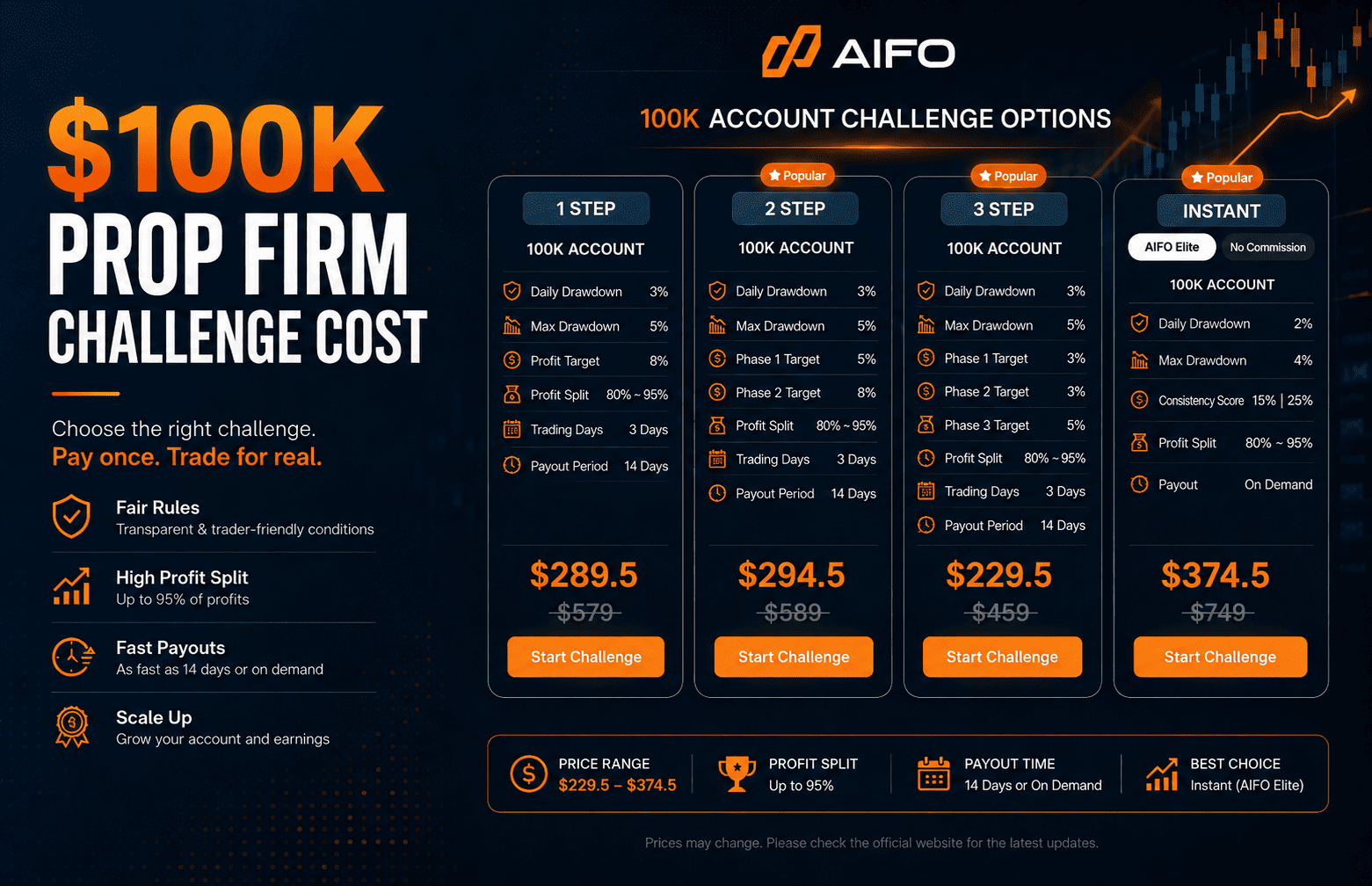



The price of a 100K prop firm account cannot be determined from account size alone. Use the final amount shown at checkout, then compare it with the selected programme’s targets, usable loss room, trading costs, retry risk and payout conditions. The 29 September 2026 AIFO FAQ review does not provide an approved current 100K checkout price, so this article does not publish an unverified price.
A 100K label describes the account reference size used for trading and rule calculations. It does not mean the trader receives a $100,000 cash transfer.
Use the prop firm challenge cost guide for the general framework. This page applies that framework to a $100,000 account reference.
Last rule review: . Programme rules below come from the current AIFO FAQ articles. Prices and promotions are excluded unless confirmed at the live checkout.
How Much Does a 100K Prop Firm Account Cost?
The current price is the final amount displayed for the selected programme at checkout. A dated article price can become inaccurate when promotions, account options or commercial terms change.
Record these fields before comparing offers:
| Field | What to record |
|---|---|
| Programme | Exact account model shown at checkout |
| Nominal size | $100,000 |
| Listed price | Price before any discount |
| Discount | Code, percentage and eligibility conditions |
| Final price | Amount payable after the discount |
| Currency | Checkout currency and any conversion cost |
| Add-ons | Selected options and additional price |
| Tax or payment fee | Any amount added before payment |
| Verification date | Date and time the checkout was checked |
Final checkout cost = listed price − valid discount + add-ons + tax or payment fees + currency-conversion cost.
Do not subtract a possible future payout, reward or refund from today’s cost unless the current terms establish that the benefit is guaranteed and immediately usable.
AIFO 100K Rule References
The current AIFO model FAQs confirm the percentages below. The account-currency amounts show how those percentages translate on a $100,000 reference. They do not confirm current checkout availability or price.
| Programme | Target | Daily Loss reference | Maximum Loss reference | Other key condition |
|---|---|---|---|---|
| 1-Step | 10% = $10,000 | 3% = $3,000 | 6% Static = $6,000; fixed loss floor at $94,000 | At least 2 trading days; no Consistency Score |
| 2-Step | Phase 1: 8% = $8,000; Phase 2: 5% = $5,000 | 5% = $5,000 | 10% Static = $10,000; fixed loss floor at $90,000 | At least 3 trading days; no Consistency Score |
| Instant | No traditional evaluation target | 3% = $3,000 reference | 5% Trailing based on HWM; capped at initial balance | Floating loss must not exceed $2,000; best day below 20%; retain $2,000 buffer after payout |
| Sprint | 3% = $3,000 reference | Use Sprint-specific risk rules | 2% Static = $2,000; equity must remain above $98,000 | Total floating loss not above $1,000; 24-hour challenge and one payout |
Sprint is shown as a rule translation. Confirm whether the desired account size is offered at checkout, and review the current AIFO Sprint FAQ for Sprint-specific conditions.
Compare the current programme descriptions on the AIFO account models page and verify the governing values in the AIFO Trading Rules and Dashboard.
The Entry Fee Is Only the First Cost
| Cost layer | What it measures | How to estimate it |
|---|---|---|
| Entry fee | Amount paid to activate the selected route | Use the final checkout amount |
| Usable loss room | Distance to the nearest Daily or Maximum Loss boundary | Translate the applicable percentage into account currency |
| Execution cost | Spread, commission, swap and slippage | Average cost per trade multiplied by expected trade count |
| Retry cost | Expected cost of another attempt | Entry fee multiplied by estimated additional attempts |
| Add-on cost | Optional account features purchased at checkout | Add only selected and eligible options |
| Payout friction | Time and conditions between profit and eligible withdrawal | Review minimum payout, cycle, consistency and buffer |
Expected route cost = checkout cost + execution cost + expected retry cost + eligible add-ons + other unavoidable payment costs.
Fee-to-Loss-Room Ratio
A useful comparison divides the entry fee by the programme’s initial Maximum Loss reference:
Fee-to-loss-room ratio = final checkout cost ÷ initial Maximum Loss amount
Suppose a programme costs $300:
| Initial Maximum Loss amount | Illustrative fee | Fee-to-loss-room ratio |
|---|---|---|
| $2,000 | $300 | 15.00% |
| $5,000 | $300 | 6.00% |
| $6,000 | $300 | 5.00% |
| $10,000 | $300 | 3.00% |
This ratio does not rank account quality by itself. Static and trailing loss limits behave differently, and a separate floating-loss rule can become the nearest boundary. Use the ratio only after matching the rules.
1-Step 100K Cost Context
The current AIFO 1-Step rules define:
- a 10% profit target, equal to $10,000 on a $100,000 reference;
- a 3% Daily Loss Limit, equal to a $3,000 reference amount;
- a 6% Static Maximum Loss Limit, with a fixed $94,000 floor;
- at least 2 trading days before progression;
- no Consistency Score requirement for the corresponding funded account;
- an 80% default profit split that may increase to 95%;
- a $100 minimum payout and standard 14-day payout cycle.
The static floor does not rise when the account reaches a new equity high and remains unchanged after payout. Compare current 1-Step choices in the 1-Step challenge guide.
2-Step 100K Cost Context
The current AIFO 2-Step rules define:
- an 8% Phase 1 target, equal to $8,000 on a $100,000 reference;
- a 5% Phase 2 target, equal to $5,000;
- a 5% Daily Loss Limit, equal to a $5,000 reference amount;
- a 10% Static Maximum Loss Limit, with a fixed $90,000 floor;
- at least 3 trading days before progression;
- no Consistency Score requirement for the corresponding funded account;
- an 80% default profit split that may increase to 95%;
- a $100 minimum payout and standard 14-day payout cycle.
The 2-Step route requires two target phases but provides a wider current static Maximum Loss percentage than 1-Step. Compare current options in the 2-Step challenge guide.
Instant 100K Cost Context
For a $100,000 reference, the current AIFO Instant rules translate as follows:
- 3% Daily Loss reference: $3,000;
- 5% Trailing Maximum Loss based on highest historical equity;
- the trailing loss floor never decreases and is capped at the initial $100,000 balance;
- floating loss must not exceed 2% of initial balance, equal to $2,000;
- maximum single-day profit must remain below 20% of total payout-period profit;
- minimum payout: $100;
- required retained profit buffer: 2% of initial balance, equal to $2,000;
- a full payout including the buffer permanently closes the account.
Instant does not use a traditional evaluation target, but its trailing loss floor, floating-loss cap and payout buffer add account-management constraints. Review the Instant drawdown guide before comparing its fee with an evaluation route.
Sprint Cost Context
Sprint uses a separate 24-hour rule set with a 3% target, 2% Static Maximum Loss and total floating loss not exceeding 1% of initial balance. The first trade must be opened within 48 hours of purchase, starts the countdown and determines the only permitted instrument. Only one position may be open at a time.
Sprint allows one payout and then closes. A result of at least 3% and below 6% at settlement can qualify for a 90% profit split. Closed net profit of at least 6% can qualify for a 95% early payout. The payout request must be made within 30 days after settlement.
The standard seven-day no-trading refund does not apply to Sprint, and Sprint is excluded from the add-on promotion described in the current Add-ons FAQ. These differences must be included when calculating route value.
Discount, Refund and Reward Are Different
| Term | When it affects cost | Required evidence |
|---|---|---|
| Discount | Reduces the amount payable at checkout | Final checkout total |
| Refund | Returns payment only if stated conditions are met | Current refund rule and proof of eligibility |
| Reward or credit | Reduces effective future cost only when actually issued and usable | Current campaign terms |
| Payout | Distributes payout-eligible profit | Programme-specific payout approval |
AIFO’s standard refund applies when the trader has not started trading and submits the request within 7 days of payment. It does not apply to Sprint. A potential refund should not be presented as an automatic discount.
Add-Ons Can Change the Checkout Cost
The current Add-ons FAQ states that add-ons are available only for 1-Step, 2-Step and Instant. Sprint is excluded.
Before selecting an add-on, record:
- the additional checkout price;
- the programmes eligible for the add-on;
- which rule or payout condition it changes;
- whether the benefit begins immediately or after a condition;
- whether the add-on affects refund eligibility;
- the break-even improvement required to justify the cost.
Do not add an unavailable option to the comparison merely because an older article or checkout once displayed it.
Execution Costs Inside a 100K Account
Spread, commission, swap and slippage reduce account profit and loss room. These costs matter even though they are not part of the entry fee.
Estimated execution cost = average cost per completed trade × expected number of trades
A trader making 200 short-duration trades may pay more execution cost than a trader making 20 longer-duration trades. Compare the cost during the actual symbol and trading session.
- Compare commission with the effective spread paid by the strategy.
- Estimate the effect of slippage in the actual market and session.
- Review how order execution affects performance.
- For short-duration strategies, use the scalping prop firm guide.
Retry Risk Can Dominate the Total Cost
A cheap attempt becomes expensive when the trader repeatedly fails and repurchases. Estimate the expected number of paid attempts instead of assuming the first account will reach payout.
Expected purchase cost = fee per attempt × expected paid attempts
| Fee per attempt | Paid attempts | Total purchase cost |
|---|---|---|
| $250 | 1 | $250 |
| $250 | 2 | $500 |
| $250 | 3 | $750 |
| $250 | 4 | $1,000 |
The figures are illustrative and are not AIFO prices. The calculation shows why a smaller or more suitable account can cost less overall than a large account repeatedly purchased without a tested plan.
Payout Conditions Affect Effective Value
A payout should be included in cost analysis only after applying the selected programme’s conditions.
| Programme | Payout condition relevant to cost |
|---|---|
| 1-Step | $100 minimum, standard 14-day cycle, 80% default split up to 95%, no Consistency Score |
| 2-Step | $100 minimum, standard 14-day cycle, 80% default split up to 95%, no Consistency Score |
| Instant | $100 minimum, best day below 20%, retain $2,000 on a 100K reference to continue |
| Sprint | One payout, 90% or 95% split depending on closed net profit, request within 30 days |
General AIFO payouts have a $100 minimum and a $10,000 maximum per request and are generally processed within 1–3 business days. Programme-specific rules may define a different route. Additional account or compliance checks can extend processing.
Read the first payout rules and prop firm payout guide before calculating break-even value.
How to Compare 100K Routes
- Record the live final checkout price for each available 100K option.
- Remove any programme or account size not currently offered.
- Translate Daily and Maximum Loss percentages into dollars.
- Identify whether Maximum Loss is static or trailing.
- Record targets, minimum trading days and concentration rules.
- Estimate execution cost for the actual strategy.
- Estimate retry cost using a realistic number of attempts.
- Add only eligible add-ons selected at checkout.
- Apply the correct refund and payout rules.
- Compare total expected cost with usable, rule-compliant account room.
The prop firm due-diligence checklist can be used for the final decision.
100K Account Checklist
- I verified that the selected 100K option is currently offered.
- I recorded the final checkout price and date.
- I did not reuse a price from an older article.
- I translated the current programme rules into dollar amounts.
- I calculated the nearest loss boundary.
- I included spread, commission, slippage and swap.
- I estimated the cost of additional attempts.
- I added only currently eligible add-ons.
- I applied the programme-specific consistency and payout rules.
- I understand that 100K is the account reference size, not a $100,000 cash transfer.
Final Takeaway
A 100K prop firm account does not have one reliable universal price. The current cost is the verified checkout total for the selected programme. The better comparison measures that price against loss room, targets, execution cost, retry risk and payout requirements.
For AIFO, use the current 1-Step, 2-Step, Instant and Sprint rules separately. Do not restore a discontinued product, apply the Instant payout buffer to every programme or publish an older checkout price as current.
FAQ
The current cost is the final amount shown at checkout for the selected 100K programme. The 29 September 2026 AIFO FAQ review does not provide an approved current 100K price, so an older article price should not be treated as current.
No. The $100,000 figure is the account reference size used for trading and rule calculations; it is not a $100,000 cash transfer to the trader.
On a $100,000 reference, AIFO 1-Step has a $10,000 profit target, $3,000 Daily Loss reference and $6,000 Static Maximum Loss reference with a fixed $94,000 floor. At least 2 trading days apply, and the corresponding funded account has no Consistency Score requirement.
On a $100,000 reference, AIFO 2-Step has an $8,000 Phase 1 target, $5,000 Phase 2 target, $5,000 Daily Loss reference and $10,000 Static Maximum Loss reference with a fixed $90,000 floor. At least 3 trading days apply.
AIFO Instant has a $3,000 Daily Loss reference, a 5% HWM-based Trailing Maximum Loss and a $2,000 floating-loss limit on a $100,000 reference. The best day must remain below 20% of payout-period profit, and $2,000 must remain as the Instant profit buffer after payout if the account is to continue.
No. The standard refund is available only when the trader has not started trading and submits the request within 7 days of payment. It does not apply to Sprint, so it should not be treated as an automatic discount.
The current Add-ons FAQ states that only 1-Step, 2-Step and Instant are eligible for the add-on promotion. Sprint is excluded. Add-on cost should be included only when the selected programme and option are currently eligible.
Compare the verified checkout price with the applicable Maximum Loss amount, target structure, trading days, execution costs, expected retry cost and payout conditions. A lower entry fee is not better value when the rules do not fit the trader’s normal strategy.