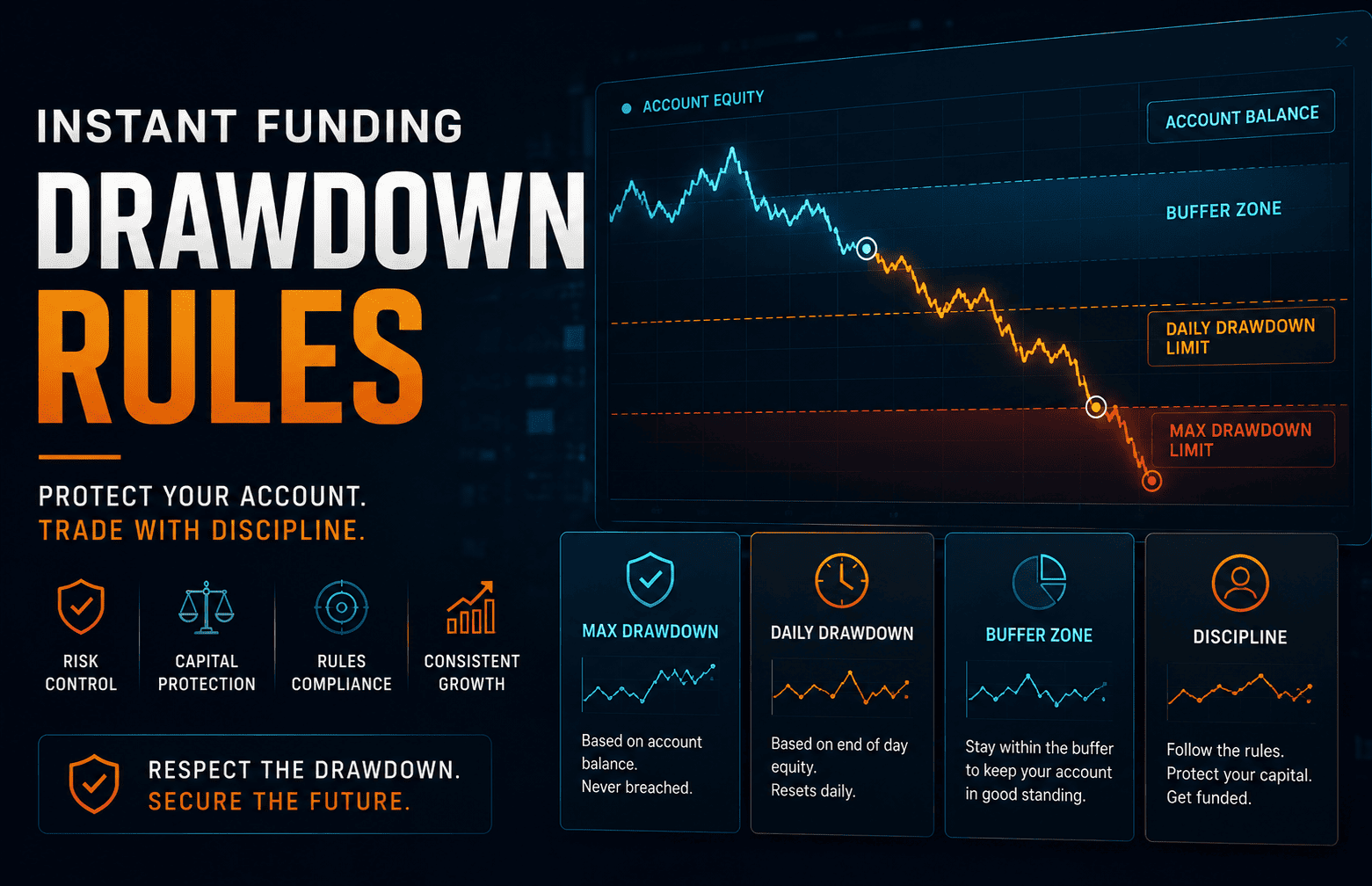



AIFO Instant uses a 3% Daily Loss Limit, a 5% Trailing Maximum Loss Limit based on the account’s highest historical equity, and a separate floating-loss limit of 2% of the initial account balance. The trailing Maximum Loss Limit rises with a new high-water mark, never moves down and is capped at the initial account balance. Payout eligibility also requires the maximum single-day profit to remain below 20% of total profit for the payout period, a minimum payout of $100 and a retained profit buffer equal to 2% of the initial account balance.
Instant access does not remove the risk engine. Daily loss, trailing maximum loss, floating loss, profit concentration and the payout buffer can each become the nearest active boundary.
Start with the AIFO Instant Funding programme for the account path. Use this guide to understand how the rules interact before the first trade, during account growth and after a payout.
Last rule review: . AIFO-specific figures below follow the latest approved Instant rules. For accounts purchased before 1 September 2026, use the challenge parameters displayed on the Dashboard.
AIFO Instant Drawdown Rules at a Glance
| Rule | Current requirement | What it controls |
|---|---|---|
| Trading environment | Simulated trading using virtual funds | The account is not a live-money brokerage account |
| Daily Loss Limit | 3% | The permitted loss for the applicable trading day |
| Maximum Loss Limit | 5% Trailing, based on the highest historical equity or HWM | The account’s lifecycle loss floor |
| Trailing cap | The Maximum Loss Limit never decreases and is capped at the initial account balance | How the loss floor changes after new equity highs |
| Floating-loss limit | Open floating loss must not exceed 2% of the initial account balance | The maximum permitted floating loss on a trade |
| Profit concentration | Maximum single-day profit must be below 20% of total profit in the payout period | Whether profit is distributed sufficiently for payout eligibility |
| Minimum payout | $100 | The minimum amount for a payout request |
| Profit buffer | Retain at least 2% of the initial account balance after payout | Whether the account can remain available after a payout |
| Full payout | Withdrawing all available profit, including the buffer, closes the account permanently | The consequence of choosing the full-payout route |
These rules operate together. Passing one test does not override another. An account can have room under the Daily Loss Limit but still violate the floating-loss limit, or it can remain profitable but fail the payout-period concentration test.
Instant Funding Drawdown Is an Account-State Map
The headline account balance is not the same as usable risk. Usable room is the distance between current equity and the nearest active limit.
| Boundary | Common mistake | Pre-trade check |
|---|---|---|
| 3% Daily Loss Limit | Treating the full percentage as normal working risk | Set a personal daily stop before the firm limit |
| 5% Trailing Maximum Loss | Calculating risk only from the initial account balance | Identify the current HWM and current loss floor |
| 2% floating-loss limit | Assuming the daily rule is the only open-trade limit | Calculate the floating loss at the stop, including execution costs |
| Best-day rule | Letting one strong day dominate payout-period profit | Track the best day as a percentage of current total profit |
| 2% payout buffer | Assuming every dollar of dashboard profit is withdrawable while keeping the account | Separate retained buffer from payout-request profit |
For general definitions, read the daily, maximum and trailing drawdown guide. The rest of this article focuses on the Instant-specific rule stack.
How the 3% Daily Loss Limit Affects Trading
The Daily Loss Limit controls how much adverse movement the account can tolerate during the applicable trading day. A 3% hard limit should not become the trader’s daily risk budget. Normal slippage, commissions, spread expansion and overlapping exposure can make a planned stop more expensive than expected.
A practical personal stop should sit inside the official boundary. The gap between the personal stop and the firm limit protects the account from execution differences and calculation mistakes.
| Initial account size | 3% reference amount | Risk-management use |
|---|---|---|
| $10,000 | $300 | Official percentage reference, not a recommended daily risk amount |
| $25,000 | $750 | Leave room for costs and open-position movement |
| $50,000 | $1,500 | Use a lower personal daily stop |
| $100,000 | $3,000 | Do not treat the full amount as available risk |
| $200,000 | $6,000 | Control correlated positions as one exposure |
The table multiplies initial account size by 3% only to show scale. It does not replace the live Dashboard calculation or define how every intraday component is measured. Check the AIFO Daily Loss Limit and the account Dashboard before trading.
How the 5% Trailing Maximum Loss Limit Works
AIFO Instant uses a 5% Trailing Maximum Loss Limit based on the account’s highest historical equity, also called the high-water mark or HWM.
- When the account reaches a new equity high, the Maximum Loss Limit moves upward.
- When equity later falls, the Maximum Loss Limit does not move back down.
- The trailing Maximum Loss Limit is ultimately capped at the initial account balance.
- If account balance or equity reaches the Maximum Loss Limit, the account is considered failed.
This mechanism makes retained profit important. Early gains can raise the loss floor, so a later giveback may have less room than the original account balance suggests.
Why the HWM Matters
The HWM records the highest historical equity reached by the account. A new high can tighten the account’s effective room because the trailing floor moves upward and does not reverse. The cap prevents that floor from moving above the initial account balance.
Before opening a trade, identify the current HWM and current Maximum Loss Limit shown by the approved account source. Do not calculate from memory. Read the AIFO Maximum Loss Limit FAQ for the governing rule.
The Separate 2% Floating-Loss Limit
In an AIFO Instant Account, the floating loss must not exceed 2% of the initial account balance. This rule is separate from the 3% Daily Loss Limit and 5% Trailing Maximum Loss Limit.
On a $50,000 account, 2% of the initial balance equals $1,000. That reference does not mean $1,000 is sensible normal risk. It is a hard boundary that the open trade must stay below.
When planning the trade, estimate potential floating loss at the stop plus spread, commission and realistic slippage. If the trade can approach the 2% boundary during normal market movement, position size is too large.
Which Rule Is the Nearest Boundary?
The active constraint can change during the life of the account:
- Before the first trade: compare the Daily Loss Limit, trailing Maximum Loss Limit and floating-loss cap.
- After a loss: recalculate remaining room before taking another normal setup.
- After a new equity high: confirm whether the trailing loss floor moved upward.
- After a strong profit day: update the best-day percentage for the payout period.
- Before payout: calculate how much profit must remain as the 2% buffer.
- After payout: calculate the remaining distance to every active risk boundary before trading again.
The correct position size comes from the nearest boundary, not from the largest percentage shown in the rules.
Profit Concentration and Payout Readiness
AIFO Instant applies a payout-period profit concentration rule. The maximum single-day profit as a percentage of total profit must remain below 20%.
The calculation is:
Best-day percentage = highest single-day profit ÷ total payout-period profit × 100
Suppose the highest-profit day is $400:
| Total payout-period profit | Highest-profit day | Best-day percentage | Result |
|---|---|---|---|
| $1,600 | $400 | 25% | Not below 20% |
| $2,000 | $400 | 20% | Still not below 20% |
| $2,100 | $400 | 19.05% | Below 20% |
The rule uses “below 20%,” so exactly 20% does not pass the stated threshold. Review the consistency-rule guide and track the ratio throughout the payout period.
The 2% Instant Profit Buffer
When requesting an AIFO Instant payout and keeping the account available, the account must retain a profit buffer equal to at least 2% of the initial account balance.
| Initial account balance | Required 2% buffer |
|---|---|
| $10,000 | $200 |
| $25,000 | $500 |
| $50,000 | $1,000 |
| $100,000 | $2,000 |
| $200,000 | $4,000 |
The minimum payout amount is $100. A trader may instead request a full payout of available profit, including the buffer, but that choice closes the account permanently and the account cannot be restored.
The buffer rule is specific to AIFO Instant. Do not apply it automatically to other AIFO programmes. Before submitting a request, check the AIFO payout buffer FAQ, the AIFO payout process and the Instant Funding payout guide.
How Payout Changes Post-Payout Risk
A payout removes profit from the account. The retained 2% buffer helps keep the Instant account available, but it should not be treated as trading risk. The trader still needs room for the 3% Daily Loss Limit, the 5% trailing Maximum Loss floor and the 2% floating-loss limit.
Before requesting a payout, write down:
- current balance and equity;
- current HWM and Maximum Loss Limit;
- total profit for the payout period;
- highest single-day profit and its percentage of total profit;
- the required 2% retained buffer;
- the requested payout amount;
- the expected post-payout balance and remaining trading room.
If the resulting account would require unusually small error tolerance, reduce the payout request or pause trading until the plan is clear. The largest available payout is not automatically the best account-management decision.
Instant Drawdown Risk Before and After Payout
| Stage | Primary check | Stop if |
|---|---|---|
| Before first trade | Current daily, trailing and floating-loss room | The account boundaries cannot be calculated |
| After each loss | Remaining personal daily risk and current Maximum Loss room | The next normal loss would approach a firm boundary |
| After a new high | Updated HWM and trailing Maximum Loss Limit | The plan still uses the previous loss floor |
| Before payout | Best-day percentage, $100 minimum and 2% buffer | Any applicable payout requirement is unmet |
| After payout | Post-payout balance, equity and distance to every boundary | The retained balance cannot support the strategy’s normal risk |
How to Size Trades Under Instant Rules
Start with the nearest active breach line and work backwards:
- Record the current account balance, equity, HWM and Dashboard loss limits.
- Calculate remaining room to the 3% Daily Loss Limit.
- Calculate remaining room to the current 5% trailing Maximum Loss floor.
- Calculate 2% of initial account balance for the floating-loss boundary.
- Choose a personal stop that remains safely inside all three boundaries.
- Divide personal trade risk by stop distance to determine position size.
- Reduce size for correlated exposure, spread expansion and expected slippage.
The risk-per-trade guide provides a framework for choosing a personal risk amount. The daily loss reset guide explains why account-clock awareness also matters.
Common Instant Funding Drawdown Mistakes
- Using outdated percentages: continuing to trade from an older 2% daily rule instead of the current 3% Daily Loss Limit.
- Using discontinued account variants: applying older account-specific 5% or 4% Maximum Loss figures instead of the current 5% HWM-based Instant rule.
- Ignoring the trailing floor: assuming Maximum Loss room remains unchanged after a new equity high.
- Ignoring open loss: checking only closed trades while floating loss approaches 2% of initial balance.
- Using an obsolete concentration test: tracking a 15%/25% formula instead of the current single-day-below-20% rule.
- Forgetting strict inequality: assuming exactly 20% passes when the rule requires below 20%.
- Withdrawing the buffer unintentionally: requesting the full available profit without recognising that the account will close.
- Treating the buffer as risk capital: risking the amount that must remain after payout.
For payout-review problems beyond drawdown, see why prop firm payouts get denied.
AIFO Instant Pre-Trade Checklist
- I confirmed that my account uses the rules shown on the current Dashboard.
- I recorded the 3% Daily Loss Limit.
- I recorded the current 5% HWM-based Trailing Maximum Loss Limit.
- I calculated the 2% floating-loss boundary from the initial account balance.
- My personal daily stop sits inside every applicable firm boundary.
- I included spread, commission and slippage in the planned loss.
- I am tracking the highest-profit day against total payout-period profit.
- I understand the $100 minimum payout and 2% retained profit buffer.
- I understand that a full payout including the buffer permanently closes the account.
Final Takeaway
AIFO Instant is a simulated immediate-access model, but it remains a rule-bound account. The trader must manage a 3% Daily Loss Limit, a 5% Trailing Maximum Loss Limit based on HWM, a 2% floating-loss limit, a best-day result below 20% of payout-period profit and an Instant-specific 2% payout buffer.
The safest approach is to calculate the nearest boundary before every trade and again before every payout. Growth, a new HWM and a withdrawal can all change the amount of practical room available.
Related Guides for Instant Funding Drawdown
- Daily Drawdown vs Maximum Drawdown
- Daily Loss Reset Time
- Risk Per Trade in a Prop Firm Account
- Instant Funding Payout Rules
- Consistency Rules
- Why Payouts Get Denied
FAQ
AIFO Instant uses a 3% Daily Loss Limit and a 5% Trailing Maximum Loss Limit based on the account’s highest historical equity or HWM. The trailing loss floor never decreases and is capped at the initial account balance. Floating loss must not exceed 2% of the initial account balance.
The 5% Maximum Loss Limit follows the account’s highest historical equity. It moves upward when the account reaches a new high-water mark, never moves downward when equity falls and is ultimately capped at the initial account balance.
Yes. AIFO Instant has a separate rule stating that floating loss must not exceed 2% of the initial account balance. A trade can therefore violate the floating-loss rule even when the account has not reached its Daily Loss Limit or Trailing Maximum Loss Limit.
The maximum single-day profit as a percentage of total profit within the payout period must be below 20%. Exactly 20% does not satisfy a rule that requires the result to be below 20%.
To continue trading after an Instant payout, the account must retain a profit buffer equal to at least 2% of the initial account balance. The minimum payout amount is $100. The 2% buffer is specific to Instant and should not be applied automatically to other AIFO programmes.
A trader may request a full payout of available profit, including the required buffer. A full payout permanently closes the account, and the account cannot be restored after it is closed.
Calculate the remaining room to the Daily Loss Limit, current Trailing Maximum Loss floor and 2% floating-loss boundary. Set a personal risk limit inside the nearest boundary, include trading costs and slippage, and reduce size when positions are correlated.