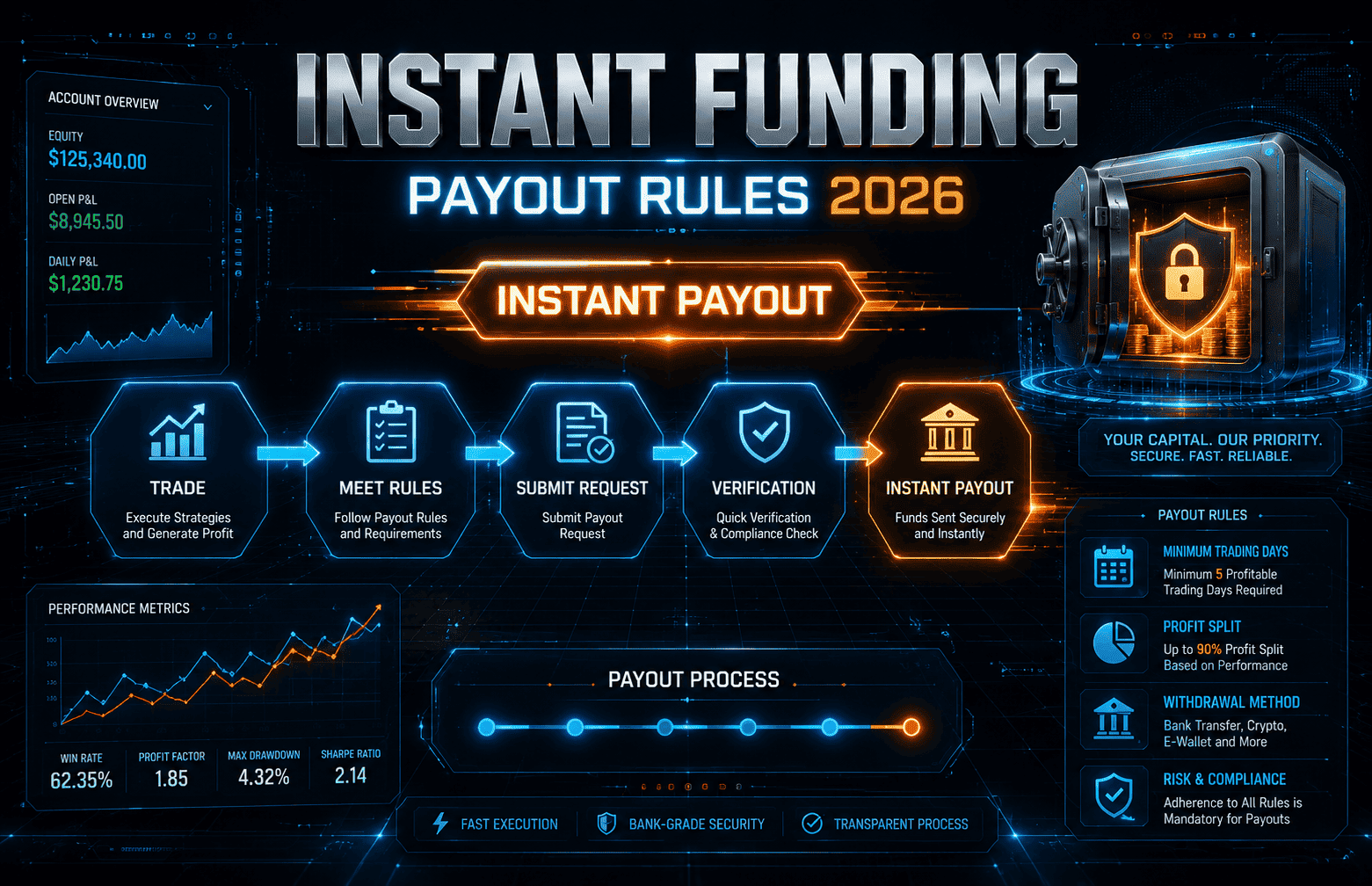



Instant access does not mean instant cash. AIFO Instant accounts use virtual funds in a simulated trading environment. A trader may request a payout on demand only after all applicable risk, consistency, KYC, account-status and payout conditions are met. The current minimum payout is $100, the maximum per request is $10,000, and payout requests are generally processed within 1–3 business days.
Last FAQ review: . AIFO-specific payout, risk and account-continuation statements below come from the current Instant FAQ and payout FAQ.
This article is the Instant-account child guide inside the prop firm payouts hub. Use the Hub for the wider payout framework, the first payout rules guide for the general first-withdrawal workflow, and this page for the rules that apply specifically to AIFO Instant accounts.
Instant Funding Payout Timeline: From Profit to Settlement
Instant funding payout rules work as a sequence. Passing one stage does not automatically satisfy the next one.
| Stage | What must be true | Trader action | What can stop the process |
|---|---|---|---|
| 1. Instant account access | The simulated account is active under the selected Instant terms | Save the account rules and Dashboard parameters | Assuming immediate access removes risk or payout conditions |
| 2. Build compliant profit | Trading remains within the Daily Loss, Maximum Loss, floating-loss and conduct rules | Monitor balance, equity, floating P&L and the High-Water Mark | A rule breach can invalidate the account even when it shows profit |
| 3. Meet payout eligibility | The best-day consistency limit and all other applicable payout conditions are satisfied | Calculate eligible profit for the current payout period | Treating all displayed profit as immediately withdrawable |
| 4. Complete KYC and payout setup | Identity and receiving details meet the applicable requirements | Complete verification and check every payment field | Incomplete verification or incorrect receiving details |
| 5. Calculate the request | The request is at least $100, no more than $10,000, and leaves the required 2% buffer if the account is to remain active | Separate retained buffer from the amount requested | A request outside the limits or a miscalculated buffer |
| 6. Submit and pass review | The account activity, request and payout destination pass the applicable checks | Save the confirmation and answer official verification requests | Compliance review, account verification or unusual-activity review |
| 7. Approval and settlement | The approved amount is released through the selected payment channel | Confirm receipt and recalculate the remaining account position | Payment-channel limitations or additional review can extend processing |
The request date, approval date and final settlement date are different events. “Payout on demand” describes when an eligible request may be submitted; it is not a promise that cash will arrive immediately.
Current AIFO Instant Rules That Affect a Payout
The current Instant model has no traditional evaluation phase or stated traditional evaluation profit target. Direct access does not remove the account’s risk and payout controls.
| Rule | Current AIFO Instant requirement | Payout relevance |
|---|---|---|
| Trading environment | Simulated trading using virtual funds | A payout is a rules-based profit-sharing outcome, not withdrawal of a live brokerage balance |
| Daily Loss Limit | 3% | The account must stay within the applicable daily risk boundary |
| Maximum Loss Limit | 5% trailing, calculated from the highest historical equity or High-Water Mark | The loss floor rises with a new equity high, never moves down, and is capped at the initial account balance |
| Floating loss | Must not exceed 2% of the initial account balance | Open-trade risk remains relevant even if the closed balance is profitable |
| Best-day consistency | Maximum single-day profit must be less than 20% of total profit in the payout period | A profit total can exist without yet satisfying payout-period consistency |
| Minimum payout | $100 | A request below this amount is not eligible |
| Maximum per request | $10,000 | The submitted amount must stay within the general payout limit |
| Profit buffer | 2% of the initial account balance after each payout | The buffer must remain if the trader wants to continue using the account |
| Full payout | A trader may request all available profit | Taking the full amount closes the account permanently |
| Processing time | Generally 1–3 business days | Compliance, verification, payment-channel or unusual-activity reviews can extend the timeframe |
Use AIFO Instant Funding for the account path, AIFO trading rules for current risk boundaries, AIFO payout rules for payout terms, and the AIFO payout process for the request workflow.
How the 5% Trailing Maximum Loss Works
The Instant Maximum Loss Limit is calculated from the account’s highest historical equity, also called the High-Water Mark. When equity reaches a new high, the loss floor moves upward. It never moves back down and stops rising once it reaches the initial account balance.
| Example state | Highest historical equity | 5% amount based on initial balance | Maximum Loss floor |
|---|---|---|---|
| Account starts | $10,000 | $500 | $9,500 |
| Equity reaches a new high | $10,300 | $500 | $9,800 |
| Equity reaches $10,500 | $10,500 | $500 | $10,000 |
| Equity rises above $10,500 | Above $10,500 | $500 | Remains capped at $10,000 |
If balance or equity reaches the active Maximum Loss Limit, the account is considered failed. The current Dashboard should be treated as the operational reference for the account’s live threshold.
Best-Day Consistency: Why Total Profit Is Not Enough
For the Instant Plan, the largest single-day profit must represent less than 20% of total profit during the payout period.
Best-day percentage = highest single-day profit ÷ total payout-period profit × 100
| Example | Best day | Total profit | Result |
|---|---|---|---|
| A | $180 | $1,000 | 18% — below 20% |
| B | $200 | $1,000 | 20% — not below 20% |
| C | $240 | $1,000 | 24% — above the limit |
The rule uses a strict “less than” condition. Exactly 20% does not satisfy a requirement written as <20%. Traders should recalculate the ratio using the complete payout-period total before submitting a request.
Payout Buffer: Calculate the Retained Amount First
An Instant account must retain a profit buffer equal to 2% of the initial account balance after each payout if the trader wants to continue using the account.
Required profit buffer = initial account balance × 2%
| Example field | Amount | Calculation |
|---|---|---|
| Initial account balance | $10,000 | Starting account size |
| Required buffer | $200 | $10,000 × 2% |
| Available profit before the request | $700 | Illustrative amount |
| Profit remaining after retaining the buffer | $500 | $700 − $200 |
This example isolates the buffer calculation. The actual payout remains subject to the account’s applicable profit split, eligibility result and review. A trader may instead request a full payout of available profits, but doing so closes the account and it cannot be restored.
Minimum, Maximum and Processing Time
The general AIFO payout limits apply alongside the Instant-specific buffer and consistency rules:
- Minimum payout: $100.
- Maximum per payout request: $10,000.
- General processing time: 1–3 business days.
- Possible extensions: compliance reviews, account verification, payment-channel limitations or additional review of unusual account activity.
Payment details should be completed and checked before submission. Incorrect information can delay payment or cause funds to be returned.
Instant Funding Payout Review: What to Prepare
A payout review considers more than the final profit number. The safest preparation is to preserve a clear record of the account rules, trading results and request calculation.
| Review area | What to check | Evidence to retain |
|---|---|---|
| Account version | The applicable Instant terms and Dashboard parameters | Account confirmation and dated rule copy |
| Risk limits | 3% Daily Loss, 5% trailing Maximum Loss and 2% floating-loss limit | Account statement and Dashboard status |
| Consistency | Best single day is less than 20% of payout-period total profit | Daily profit breakdown and calculation |
| Payout amount | $100 minimum, $10,000 maximum and the 2% retained buffer | Written request calculation |
| Identity and account status | Applicable KYC and account-status conditions are complete | Verification confirmation and current account status |
| Receiving details | Recipient and payment information are correct | Saved details and request confirmation |
Use why prop firm payouts get denied if a request is blocked, returned or sent for additional review.
Alpha Insight
The hidden risk is payout pressure. As a trader approaches eligibility, it becomes tempting to take an unnecessary trade to increase the request or repair a consistency ratio. That trade may expose the account to the Daily Loss, trailing Maximum Loss or floating-loss limit.
Plan the withdrawal before that pressure appears. Know the required buffer, the best-day ratio, the amount you intend to request and the point at which you will stop trading.
How to Plan the First Instant Withdrawal
1. Record the rules before trading
Save the account version, Dashboard parameters and current rule pages. Accounts purchased before 1 September 2026 may show earlier parameters on the Dashboard.
2. Track risk and consistency together
Monitor the Daily Loss Limit, the active High-Water Mark floor, floating loss and the best-day percentage. Profit is not payout-ready if any applicable condition remains unmet.
3. Calculate the buffer before choosing an amount
Start with 2% of the initial account balance. Decide whether the account should remain active after the payout. If it should, do not request the retained buffer.
4. Check the request limits
Confirm that the request is at least $100 and no more than $10,000. Check the receiving details before submission.
5. Stop adding risk once the path is clean
An extra trade taken only to make a payout larger is not a trading setup. Protecting a compliant request can be more valuable than increasing the displayed profit.
Run a pre-trading checklist even for an Instant account. No traditional evaluation phase does not mean no preparation.
Red Flags in Instant Funding Payout Claims
| Red flag | Why it matters | What to verify |
|---|---|---|
| “On demand” presented as immediate cash | Eligibility, review and settlement are separate stages | The exact conditions that open the request |
| A traditional evaluation target added to Instant | The current Instant rules do not specify one | The current account terms and Dashboard |
| $200 shown as the minimum | The current minimum is $100 | The amount accepted by the current payout workflow |
| Old 15% or top-two-day consistency wording | The current Instant best-day limit is less than 20% | The current payout-period calculation |
| The 2% buffer treated as optional while keeping the account | Instant accounts must retain it after payout to continue trading | Whether the planned request leaves the required amount |
| No warning about a full payout | Requesting all available profits closes the account | Whether continuing the account matters to the trader |
| A guaranteed processing promise | The general 1–3 business-day timeframe can be extended | Compliance, verification and payment-channel status |
Final Pre-Withdrawal Check
- The account is within the 3% Daily Loss Limit.
- The account is above the active 5% trailing Maximum Loss floor.
- Floating loss does not exceed 2% of the initial balance.
- The best single day is less than 20% of payout-period total profit.
- The request is between $100 and $10,000.
- The account will retain a 2% buffer unless a full payout and account closure are intended.
- KYC, account status and receiving details meet the applicable conditions.
Once those items are clear, submit the request through the official workflow and keep the confirmation. Treat 1–3 business days as the general processing period, not an unconditional arrival guarantee.
FAQ
AIFO Instant payout rules determine when profit from a simulated Instant account can be requested. The current rules include a 3% Daily Loss Limit, a 5% trailing Maximum Loss Limit based on the High-Water Mark, a 2% floating-loss limit, a best single day below 20% of payout-period total profit, a $100 minimum payout and a 2% profit buffer.
No. Payout on demand means an eligible trader may submit a request once all applicable risk, consistency, KYC, account-status and payout conditions are met. Requests are generally processed within 1–3 business days, but compliance, verification, payment-channel or unusual-activity reviews can extend the timeframe.
The current Instant rules set a 3% Daily Loss Limit and a 5% trailing Maximum Loss Limit calculated from the highest historical equity. The trailing floor never decreases and is capped at the initial account balance. Floating loss must not exceed 2% of the initial account balance.
The maximum single-day profit must represent less than 20% of total profit within the payout period. A result of exactly 20% does not satisfy a rule written as less than 20%.
The minimum payout amount is $100, and the maximum amount per payout request is $10,000. Payment details should be completed and checked before submission to reduce the risk of delays or returned funds.
After each payout, an Instant account must retain a profit buffer equal to at least 2% of the initial account balance to continue trading. A trader may request a full payout of available profits, but the full payout closes the account permanently.
No traditional evaluation profit target is specified in the current Instant rules. Traders may request a payout on demand after meeting all applicable risk management, consistency, KYC, account-status and payout conditions.