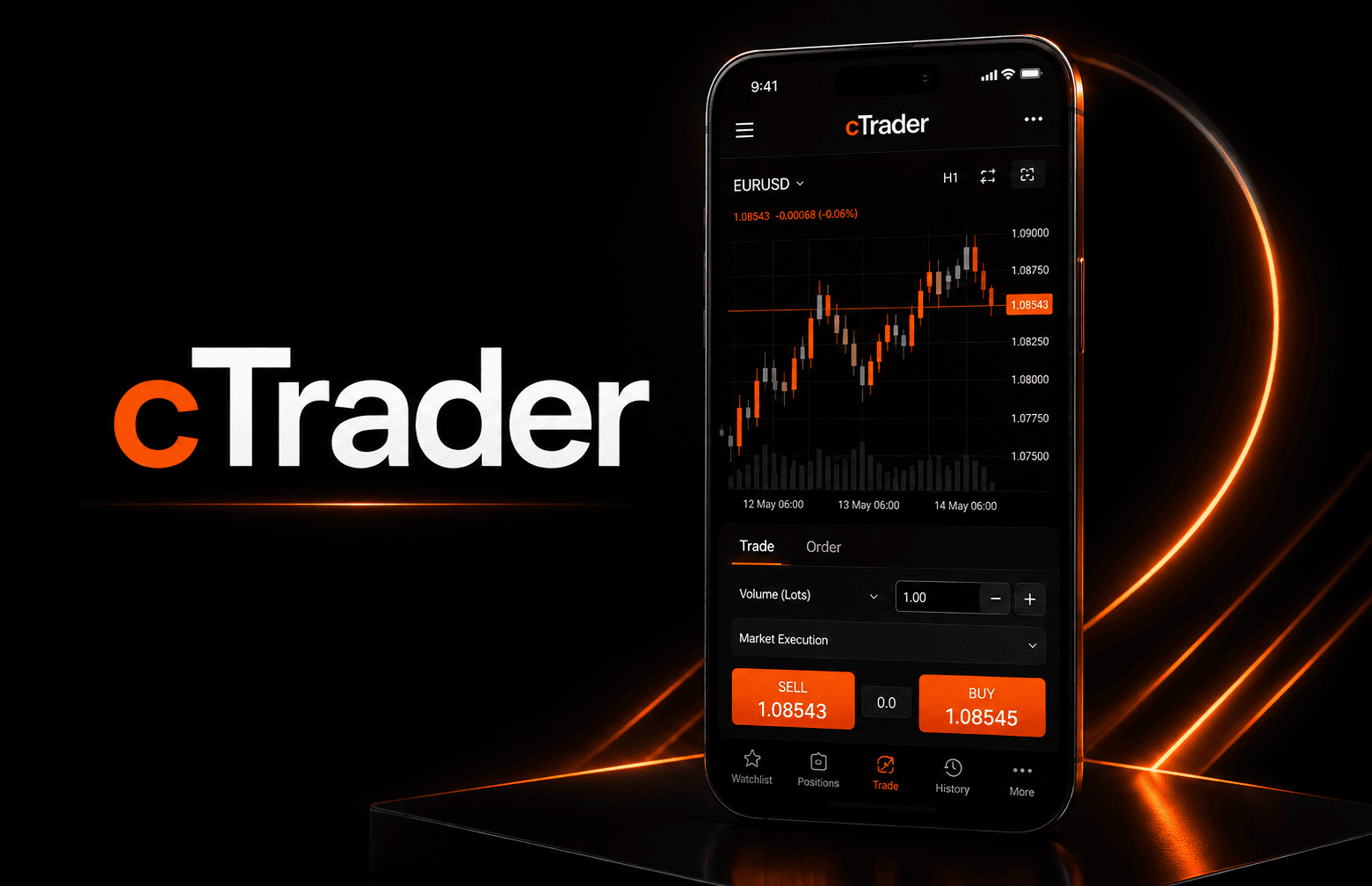



A cTrader prop firms list should be filtered by programme, region and account stage, not by a platform logo alone. FTMO, Fintokei, FundingPips, The5ers, Alpha Capital and FundedNext currently provide verifiable cTrader access, but the conditions differ sharply. Some firms add a platform fee, cap cTrader account sizes, restrict new US clients, block cBots or copy trading, or move a later account stage to MT5. Compare the exact checkout route, trading costs, automation permission, copy rules and funded-stage continuity before paying. cTrader can suit manual and algorithmic traders, yet the prop firm’s rulebook still controls what the platform may actually be used for.
Traders checking AIFO’s current platform access should use the prop firm trading platform page. This comparison focuses on external firms that currently offer cTrader and on the restrictions attached to that access.
Platform availability, fees and trading permissions can change. The details below were last checked on 5 August 2026 and should be confirmed on the exact programme page and live checkout before purchase.
cTrader Prop Firms: Quick Picks
FTMO offers the cleanest broad cTrader route in this group, while Fintokei is attractive where the trader wants the same platform price across most eligible plans. FundingPips, The5ers, Alpha Capital and FundedNext remain valid choices, but each adds a stage, region, fee or automation condition that can change the fit.
The table is a decision guide rather than a claim that one firm is best for every cTrader user.
| Firm | Best for | cTrader cost | Automation and copy position | Main platform restriction |
|---|---|---|---|---|
| FTMO | Broad cTrader access across mainstream evaluation routes | No separate recurring cTrader fee stated | cTrader Automate is available; strategy rules still apply | Refund treatment differs between 1-Step and 2-Step routes |
| Fintokei | Traders wanting cTrader at the same price as other platforms on most plans | Usually no platform price difference on eligible plans | Self-built automation can be permitted; copied or uncontrolled systems face restrictions | Slim is an MT5-only exception |
| FundingPips | Traders comparing several evaluation models and platform choices | Programme and checkout dependent | Owned systems may be allowed; inbound external copying is restricted | A later Prime account stage can be MT5 only |
| The5ers | Non-US traders who want cTrader and can accept a small platform surcharge | $10 added to the programme fee | EAs can be permitted within strategy and ownership limits | US clients use TradingView rather than cTrader |
| Alpha Capital | Manual cTrader traders outside the current US restriction | Confirm the final checkout price | EA functionality and copy trading are not available on cTrader accounts | New US customers cannot select cTrader |
| FundedNext | Manual traders using cTrader account sizes up to 50K | $25 non-refundable platform fee | Automated and algorithmic trading are not allowed on cTrader accounts | 100K and 200K cTrader accounts are unavailable; new US access is restricted |
cTrader Prop Firms Compared
The six firms below provide different versions of cTrader access. The strongest fit comes from matching the platform to the exact programme, planned strategy and later account stage.
Read the cost, automation and stage caveat for each firm before treating cTrader availability as a buying reason.
FTMO
Best for: Traders who want cTrader across established one-step and two-step evaluation paths without a separate recurring platform charge.
Why it fits: FTMO allows cTrader to be selected for its 1-Step and 2-Step challenges and for the later FTMO Account. The platform is available on desktop, web and mobile, while cTrader Automate supports C# and Python workflows.
Main caveat: Platform choice does not make the account economics identical. The FTMO 2-Step fee can be refunded with the first reward after successful progression, while the 1-Step fee is not refundable.
Rule check: Confirm the selected challenge type, current instrument costs, automation rules and any difference between Standard and Swing conditions before paying.
Avoid it if: Your cost comparison assumes every FTMO route refunds the entry fee or uses the same holding conditions.
Fintokei
Best for: Traders who want cTrader without a separate platform price increase on most eligible programmes and who can document control of their own automated system.
Why it fits: Fintokei states that most plans keep the same price and trading conditions across MT4, MT5 and cTrader. It also allows personally owned or customised automated systems when the trader retains control over the method.
Main caveat: Platform access is programme specific. The Slim plan is an MT5-only exception, and cTrader symbol naming can differ from the naming shown on other platforms or account stages.
Rule check: Confirm the exact programme, symbol suffixes, automation ownership requirements and funded-stage instrument list.
Avoid it if: You rely on a third-party black-box bot, copied signals or an off-the-shelf system that you cannot explain or control.
FundingPips
Best for: Traders who want to compare cTrader across several evaluation structures and can verify where the platform changes later in the account path.
Why it fits: FundingPips presents cTrader alongside MT5 and other supported platforms across its public account range. It also permits certain personally owned automated systems, subject to proof of ownership and strategy restrictions.
Main caveat: cTrader availability at purchase does not prove every later stage remains on cTrader. FundingPips states that its Prime Account is MT5 only, which can alter a trader’s tools, symbols and automation path after progression.
Rule check: Check the exact programme stage, final platform, commission schedule, swap treatment, EA ownership evidence and external-copy restrictions.
Avoid it if: Your strategy depends on cTrader throughout the whole lifecycle and you are not willing to move a later stage to MT5.
The5ers
Best for: Non-US traders who prefer cTrader and accept a clearly stated platform surcharge.
Why it fits: The5ers offers cTrader to eligible non-US clients and permits EAs under defined strategy restrictions. The extra cTrader cost is visible rather than hidden inside an unclear checkout adjustment.
Main caveat: Selecting cTrader adds $10 to the programme fee. US clients use TradingView instead, so platform access changes with location rather than trader preference alone.
Rule check: Confirm current regional eligibility, the $10 platform charge, EA ownership, prohibited arbitrage or high-frequency methods and the platform used after progression.
Avoid it if: You are in the United States, require a zero-surcharge platform choice or use a restricted latency-based system.
Alpha Capital
Best for: Manual cTrader users outside the current US restriction who do not need cBots or platform-based copy trading.
Why it fits: Alpha Capital lists cTrader beside MT5, DXtrade and TradeLocker, giving eligible traders a direct platform choice at account setup.
Main caveat: cTrader access does not include the platform’s full automation and copy feature set under Alpha Capital’s rules. EA functionality is unavailable on cTrader accounts, and copying to or from cTrader is not permitted.
Rule check: Confirm regional access, the live checkout price, manual-only execution expectations, symbol costs and any permitted external trade-management tools.
Avoid it if: Your strategy depends on cBots, copied trades or a cTrader account opened as a new US customer.
FundedNext
Best for: Manual cTrader traders who want an account no larger than 50K and accept a separate non-refundable platform fee.
Why it fits: FundedNext provides an official cTrader account route and account-specific login support. The platform choice is available for eligible clients before the first trade is placed.
Main caveat: cTrader carries a $25 non-refundable fee and is capped at 50K. FundedNext also states that automated or algorithmic trading is not allowed on cTrader accounts, and new US customers cannot buy cTrader accounts under the current regional policy.
Rule check: Confirm account size, regional eligibility, platform fee, manual-trading restriction and whether a platform change remains possible before placing the first order.
Avoid it if: You need a 100K or 200K cTrader account, automated execution or refundable platform pricing.
What Does cTrader Control, and What Does the Prop Firm Control?
cTrader supplies the trading software, order workflow and optional automation or copy technology. The prop firm still controls the account model, price feed, costs, available symbols, risk rules and which platform features may be used.
This split explains why two cTrader prop firms can feel like different products even when the interface looks the same.
| Decision area | cTrader provides | The prop firm decides | What to verify |
|---|---|---|---|
| Order entry | Market, limit, stop and stop-limit order workflows | Available symbols, volume limits and execution environment | Order types permitted on the exact account |
| Trading cost | Display of bid, ask, commission and trade history | Spread feed, commission, swap and mark-up | Total round-turn cost on planned symbols and sessions |
| Automation | cBots, C# and Python development tools | Whether cBots, EAs or external tools are permitted | Ownership, strategy and hosting restrictions |
| Copy trading | Integrated cTrader Copy technology | Whether copying to or from the prop account is allowed | Signal source, account ownership and payout-review rules |
| Risk display | Positions, orders, equity and account history | Daily loss, maximum loss and dashboard calculations | Server time, reset time and equity calculation method |
| Account progression | A platform environment for the current login | Whether evaluation and funded stages stay on cTrader | Stage-by-stage platform continuity |
The practical differences between the leading platforms are covered in MT5 vs cTrader for prop traders. Traders who need MetaTrader-specific account options can also compare the best MT5 prop firms.
How Do cTrader Fees Change the Real Cost of a Prop Account?
The base challenge fee is only the first cost. A platform surcharge, non-refundable add-on, different commission model or forced platform change can alter the account’s real value.
Compare costs at the exact account size and stage rather than assuming every platform option shares one checkout price.
- Platform surcharge: The5ers adds $10 for cTrader, while FundedNext charges a $25 non-refundable cTrader fee.
- Account-size restriction: FundedNext caps cTrader at 50K, so a trader comparing 100K routes must use another platform or firm.
- Refund treatment: A refundable evaluation fee does not automatically make a separate platform charge refundable.
- Commission and spread: The same interface can carry different symbol costs at different firms.
- Swap and swap-free access: Platform choice may affect whether a swap-free add-on is available on the selected programme.
- Stage migration: A move from cTrader to MT5 can create retraining, code-conversion and execution-testing costs even when no new platform fee appears.
Forex traders should compare platform cost alongside the wider account rules in the list of best forex prop firms. A cheaper cTrader checkout can still be poor value when its daily-loss room, commission or later-stage platform does not fit the strategy.
Can You Use cBots and Copy Trading with a cTrader Prop Firm?
cTrader supports cBots and an integrated copy system, but those technical features do not create permission on a prop account. Each firm can allow, limit or block automation and copied trades.
Treat cBots, external trade managers and copy trading as three separate rule checks.
- Self-built cBot: Confirm that personal source code or a customised system is allowed and that proof of ownership can be supplied.
- Third-party bot: Check whether the firm permits commercial tools, black-box systems or only risk-management utilities.
- Inbound copy: Confirm whether trades may be copied from a personal account, signal provider or another prop account.
- Outbound copy: Check whether the cTrader account may act as the source account for other accounts.
- Cloud execution: Confirm that cloud-hosted cBots are permitted and do not breach device, IP or strategy rules.
- Identical trade patterns: Understand how the firm reviews account mirroring, group trading and repeated third-party strategies.
Alpha Capital and FundedNext place clear limits on automation through their cTrader routes. Fintokei, The5ers and FundingPips can permit owned systems under specific conditions. FTMO provides cTrader Automate access, but the trading method still needs to comply with the account rules.
Before deploying code, compare the wider prop firm EA rules. A platform that can run a bot is not the same as a programme that permits the bot’s strategy.
Alpha Insight
cTrader support is not a yes-or-no feature. The product being purchased is the combination of platform, programme, region, account stage and strategy permission. A firm can display a cTrader logo while adding a non-refundable fee, limiting account size, blocking cBots, excluding new US clients or moving a later stage to MT5. The real platform check must follow the whole account path rather than stop at the checkout screen.
Does the Funded Stage Stay on cTrader?
Not always. Platform continuity must be checked from evaluation through funded or reward stages because a later-stage change can affect symbols, automation, trade history and execution testing.
A trader who passes on cTrader may still face a different operating path after progression.
| Stage check | Question to ask | Trading consequence | Red flag |
|---|---|---|---|
| Checkout | Is cTrader available for this exact programme and account size? | Determines the initial platform, fee and symbol set | The firm advertises cTrader but the selected account cannot use it |
| Evaluation | Are cBots, copy tools and all planned instruments allowed? | Changes the method used to reach the target | Technical access exists but the rulebook blocks the strategy |
| Funded or reward stage | Does the account remain on cTrader with the same instrument setup? | A platform change can alter costs and code compatibility | The later platform is not disclosed before purchase |
| Payout review | How are automated or copied trade patterns reviewed? | Execution that passed platform checks may still fail a conduct review | Rules use broad wording with no account-specific examples |
| Scaling | Does cTrader remain available after account growth or plan changes? | The trader may need to rebuild the workflow later | Larger account sizes silently remove the platform option |
Execution should also be retested after any platform or stage change. The guide to prop firm execution quality explains why identical strategy rules can still produce different outcomes when the feed, commission or order handling changes.
Who Should Choose a cTrader Prop Firm?
cTrader fits traders who value its order interface, multi-device access, depth-of-market tools or cBot environment and can find a programme that permits their workflow. It is less suitable when the chosen firm limits account size, region, automation or funded-stage continuity.
The platform should follow the strategy rather than become the reason to accept a poor account model.
| Trader profile | cTrader fit | First rule check | Avoid if |
|---|---|---|---|
| Manual intraday trader | Strong when order entry and chart workflow suit the trader | Spread, commission and permitted order behaviour | The platform surcharge outweighs the workflow benefit |
| Scalper | Potentially strong with suitable fill quality and no minimum-hold restriction | Execution cost, latency-sensitive rules and payout review | The strategy relies on prohibited tick or latency methods |
| cBot developer | Strong only where personal automation is expressly permitted | Source ownership, cloud use and prohibited-strategy wording | The firm offers cTrader but blocks automated trading |
| Copy trader | Limited because platform capability and prop permission often differ | Inbound and outbound copy rules | The trade source or account ownership cannot be verified |
| US trader | Firm specific | Current regional platform access | The chosen firm directs US clients to another platform |
| Large-account buyer | Firm specific | Maximum cTrader account size and scaling path | cTrader disappears above the intended account tier |
Checklist Before Buying a cTrader Prop Firm Account
Confirm the exact product rather than the firm’s general platform list. The correct check follows the account from checkout through evaluation, funded stage and payout review.
Use this checklist before paying the fee.
- Select the exact programme and size. Do not assume cTrader is available across every model or account tier.
- Confirm regional eligibility. Platform access can differ for new US clients and other restricted locations.
- Price the platform choice. Add any cTrader surcharge or non-refundable fee to the base challenge cost.
- Check account-stage continuity. Ask whether the funded, reward, Prime or scaled account remains on cTrader.
- Separate cBots from copy trading. Permission for one does not prove permission for the other.
- Read ownership rules. Keep evidence for personally built or customised automated systems.
- Verify account-size limits. A platform available at 25K or 50K may disappear at 100K or 200K.
- Compare all-in trading cost. Review spread, commission, swap and platform charges together.
- Check symbol naming and availability. Suffixes and instrument lists can change by platform or stage.
- Test execution again after progression. A clean evaluation environment does not prove identical funded-stage fills.
- Save the current rules. Keep the platform, automation and copy-trading pages used for the purchase decision.
FAQ
cTrader availability can differ by firm, programme, account size and region. These answers cover the checks most likely to change a prop trader’s platform decision.
Live rules should still be confirmed before purchase.
Verified examples include FTMO, Fintokei, FundingPips, The5ers, Alpha Capital and FundedNext. Availability can vary by programme, account size, region and account stage.
cTrader can suit traders who prefer its order interface, depth-of-market tools or cBot workflow. MT5 may provide a wider prop-firm selection and broader support for existing Expert Advisors. The better choice depends on the exact programme rules and strategy.
Some do. The5ers currently adds $10 for cTrader, while FundedNext charges a $25 non-refundable cTrader fee. Other firms may include cTrader without a separate platform charge on eligible plans.
Only when the firm’s rules permit automated trading on that cTrader account. Some firms allow personally owned systems with restrictions, while others provide cTrader for manual trading only.
Access is firm specific. Alpha Capital, The5ers and FundedNext currently apply cTrader restrictions to new or existing US clients, so the regional policy must be checked on the exact purchase date.
AIFO’s current public trading-platform hub is centred on MetaTrader 5 rather than cTrader. Check the live AIFO platform page before purchase because supported platforms can change.