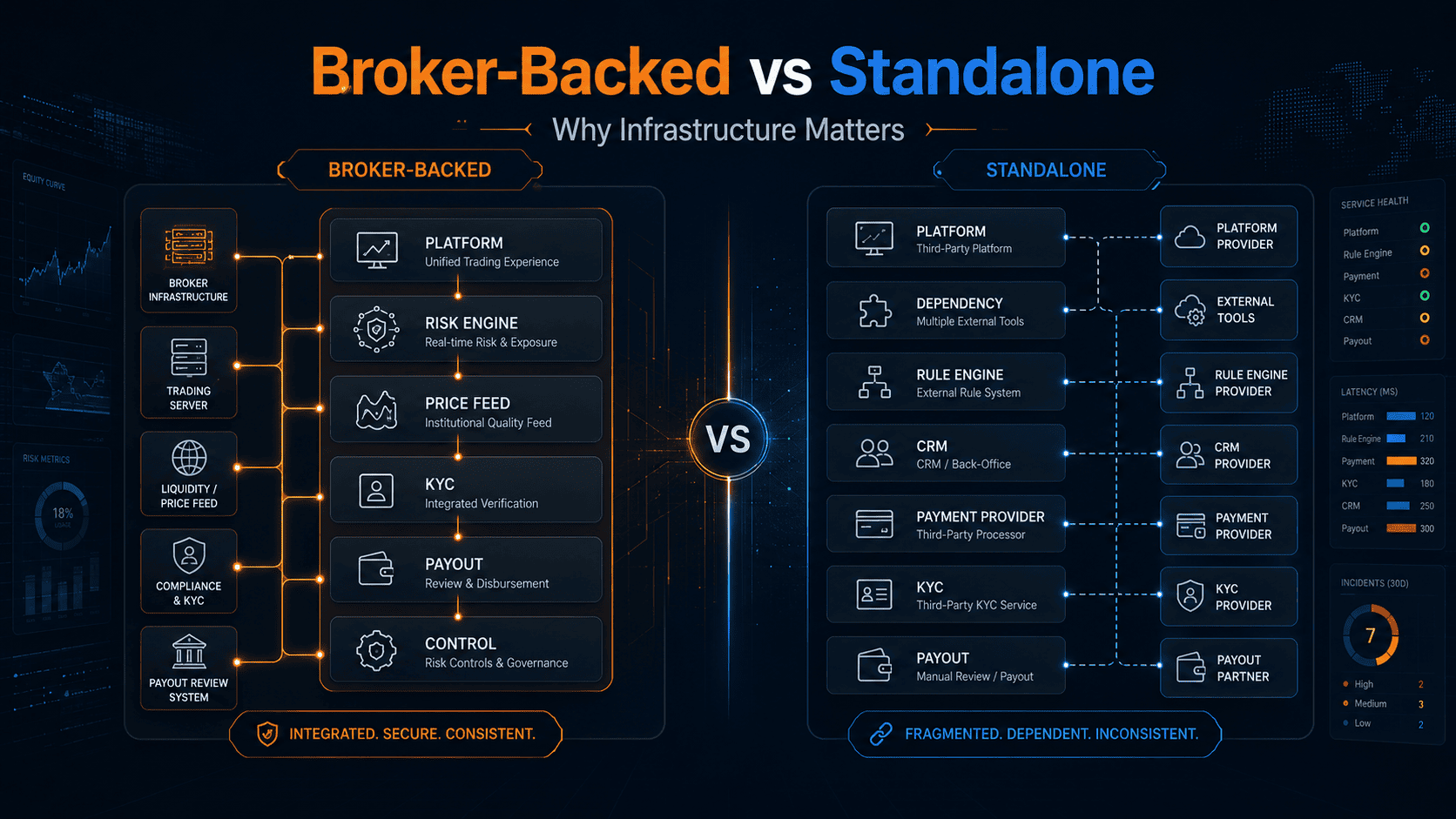



Broker-backed prop firms are not automatically safer than standalone prop firms. Broker backing may mean shared ownership, shared infrastructure, a broker feed, payment support or only a commercial relationship. The real test is who controls the contracting entity, platform, price feed, rule engine, dashboard, KYC, payments, payout review, outage handling and migration policy.
Broker-Backed vs Standalone Prop Firms: The Direct Answer
This article is the infrastructure child guide inside the Prop Firm Market Research Hub. Use the Hub for the full industry structure, and use this page to test whether a firm’s infrastructure can support clean execution, consistent rule calculation and reliable payout operations.
| Model | What it can mean | What it does not prove | Trader’s real question | Related guide |
|---|---|---|---|---|
| Broker-backed prop firm | The prop brand may share ownership, systems, pricing, support, payment rails or operational resources with a broker or broker group | It does not automatically prove regulation, live execution, client-money protection or payout reliability | Which legal entity sells the service, and which systems actually control the account? | Real payout vs real execution |
| Standalone prop firm | The prop firm is independently owned and uses vendors for platform, pricing, CRM, payments, KYC or dashboard infrastructure | It does not automatically mean weak infrastructure or poor payout operations | Which vendors are critical, and what happens if one of them fails? | Order execution |
What Does “Broker-Backed Prop Firm” Actually Mean?
A broker-backed prop firm usually has common ownership, group control, shared infrastructure or a formal operating link with a brokerage. The phrase is not a standard legal category, so traders need to identify the exact relationship rather than rely on the badge.
| Broker-backed relationship | What it may look like | Trader check |
|---|---|---|
| Common ownership | A holding company owns both the broker and the prop assessment brand | Check whether the contract is with the broker or a separate assessment company |
| Shared platform or server | The prop firm uses broker-linked servers, platform access, back office or market data | Check whether platform records, dashboard records and rule records stay aligned |
| Shared payment or compliance support | The group uses common payment processors, KYC tools, fraud checks or finance operations | Check which entity reviews payout and which entity receives funds |
| Commercial supplier relationship | The prop firm uses a broker’s feed, platform setup or liquidity relationship without shared ownership | Check whether the relationship is contractual support or actual legal backing |
The contract matters more than the logo. Check which company sells the challenge, which company provides the trading environment, which company reviews payouts, and which entity receives your personal and payment data. Those roles may be split across a group.
What Is a Standalone Prop Firm?
A standalone prop firm is independently owned from the broker, liquidity venue or technology providers that support its accounts. Standalone ownership does not mean standalone technology.
| Standalone infrastructure layer | Common vendor dependency | Trader risk if weak |
|---|---|---|
| Trading front end | MT5, cTrader, DXtrade, Match-Trader, TradeLocker or another platform provider | Platform removal, migration, login issues or execution workflow changes |
| Back-end and dashboard | CRM, account engine, dashboard provider or custom integration | Balance, equity, rule status or payout eligibility may not sync cleanly |
| Price feed and symbols | Broker feed, data vendor or platform-side symbol configuration | Spread, contract value, server time or trading-hour differences can change strategy results |
| KYC and payments | Payment processor, bank rail, crypto processor, identity provider or fraud tool | Payouts can slow down even when trading performance is clean |
| Support and continuity | Helpdesk software, external support team, vendor status pages and internal escalation rules | Outages, migrations or payout delays become hard to resolve |
A standalone firm can be excellent if it governs its vendors well. It can be fragile if platform, payment, data and dashboard responsibilities are unclear.
Broker-Backed vs Standalone Prop Firms: Infrastructure Comparison
Broker-backed firms often begin with more in-house operating capacity, while standalone firms usually depend on a wider supplier network. Neither model guarantees good execution, stable account data, fair enforcement or a clean payout process.
| Decision area | Broker-backed model | Standalone model | What the trader should verify | Why it matters |
|---|---|---|---|---|
| Legal structure | Broker and prop brand may share a group while using separate companies and contracts | The prop company contracts directly with traders and separately with its suppliers | Named contracting entity, governing terms, complaints route and scope of any authorisation | The legal counterparty decides the contract, not the marketing badge |
| Trading platform | May reuse a group platform, broker server or existing back office | Usually licenses a third-party platform or combines several providers | Current platform access, account types, maintenance policy, migration history and support ownership | Platform change can affect open trades, trade history, EAs, server time and payout review |
| Price feed and symbols | May draw on the broker group’s market data and symbol configuration | May receive pricing from a broker, platform vendor or independent data source | Spread, commission, symbol specifications, trading hours, swaps and data consistency | Same strategy can behave differently on a different server or symbol setup |
| Risk-rule engine | Can use existing broker risk systems, a prop-specific engine or both | Usually relies on a platform module, CRM integration or custom rule service | Daily reset time, equity calculation, trailing logic, open-trade treatment and breach evidence | Drawdown rules are code before they become account breaches |
| Account provisioning | May connect onboarding, platform creation and monitoring inside one group | Often links checkout, CRM, platform and dashboard through APIs | How quickly account status syncs and which record controls a dispute | Dashboard mismatch can change what the trader thinks is still allowed |
| KYC and payments | May use group banking, identity, fraud and finance processes | Usually contracts with external payment and identity providers | Payment recipient, refund route, identity requirements, restricted regions and payout operator | Clean trading can still be delayed by payment or identity infrastructure |
| Payout review | May benefit from larger finance and compliance teams, but prop review rules may remain separate | Can be efficient with clear workflows, though staffing and cash planning may be more concentrated | Eligibility rules, review triggers, payment methods, account data used and dispute process | Payout reliability is an operations function, not just a profit split number |
| Supplier concentration | Fewer external hand-offs may reduce friction, but one group-wide failure can affect several services | More suppliers can create integration risk, while provider diversity can reduce a single point of failure | Fallback arrangements, status communication, data portability and continuity plans | Infrastructure is only as strong as the weakest critical dependency |
| Change risk | Group strategy, acquisitions or product consolidation can alter the prop offering | Platform, broker or payment contracts can force migrations or rule changes | Notice periods, treatment of open accounts, preserved conditions and trader remedies | Trader protection during change is more important than the ownership label |
The useful comparison is not “broker equals safe” versus “independent equals risky”. It is control, dependency, disclosure and trader impact.
Which Infrastructure Layers Actually Affect Traders?
Traders feel infrastructure through pricing, order handling, rule calculations, account access and payout review. A familiar prop firm trading platform is only the visible layer; the back end decides whether the account state remains accurate under pressure.
| Infrastructure layer | What it controls | Trader failure path | Detailed guide or page |
|---|---|---|---|
| Market data and symbols | Price source, spread, commission, swaps, contract size, trading hours and symbol settings | The same strategy behaves differently across servers or symbol configurations | Order execution |
| Platform and back end | Trading screen, dashboard, account identifier, balance, equity, commissions and closed-trade data | Platform and dashboard disagree on account state or remaining loss room | MT5 vs cTrader |
| Risk engine and rule timing | Reset time, reference balance, open-position treatment, trailing method and phase-specific limits | The trader breaches a rule that was calculated differently from expectation | Drawdown rules |
| Payments and identity checks | KYC, fraud review, account ownership, payment rails, payout details and regional access | Clean trading is delayed by payout destination, KYC or payment-provider friction | First payout rules |
| Monitoring and support | Account surveillance, rule evidence, support tickets, escalation, incident notices and correction paths | The trader cannot resolve an outage, dashboard error or payout dispute clearly | Why payouts get denied |
| Business continuity | Fallback platforms, replacement data sources, payment alternatives and migration policy | A vendor failure or migration changes account conditions without clear protection | Market structure |
Ask what happens when a platform vendor, data source, broker connection or payment provider becomes unavailable. The answer reveals whether the firm has a continuity plan or merely a collection of contracts.
Does Broker Backing Mean Regulated, Live, or Protected?
No. A regulated broker can sit in the same group while the challenge agreement is issued by a separate assessment company. The trader may still use a simulated account and may not receive brokerage-client protections for the assessment service.
Last checked on : AIFO’s General Terms state that its services include simulated trading, that demo account funds are fictitious, and that trading performed through the services is not real financial market trading unless expressly stated otherwise.
| Marketing label | What it may suggest | What it does not automatically prove | What to verify |
|---|---|---|---|
| Broker-backed | The prop firm may have access to broker infrastructure or group resources | That the challenge service itself is regulated brokerage service | Contracting entity and scope of any regulatory authorisation |
| Broker feed | The account may use broker-like market data or pricing | That every trader order is routed into live market exposure | Whether orders are simulated, copied, hedged or routed live |
| Live prices | The platform may show market-linked prices | That the account itself is a live brokerage account | Account environment and terms disclosure |
| Group compliance | The group may have KYC, fraud, finance or legal operations | That the prop programme gives the same protections as brokerage clients | Which entity provides the service and handles disputes |
Live-looking prices do not prove live order routing. A simulated environment can use external market data and reproduce broker-like trading conditions without sending each order to a counterparty. That can still support a valid evaluation product, but it is a different claim from direct market execution.
Alpha Insight: Dependency Concentration Matters More Than the Ownership Badge
The hidden pressure is dependency concentration, not ownership alone. A broker-backed firm can fail at the prop layer if its rule engine, payout review or assessment entity is weak. A standalone firm can remain stable if it controls its data, keeps workable fallback providers and can migrate without changing trader outcomes.
The strongest structure keeps the trader’s account state consistent across platform, dashboard, rules, support and payout review.
How Infrastructure Changes Trading Outcomes
Infrastructure becomes a trading constraint when a strategy is sensitive to timing, pricing, automation or account-state calculations. The more precise the strategy, the less useful a broad trust label becomes.
| Trader type | Infrastructure sensitivity | Failure path | Specialist guide |
|---|---|---|---|
| Scalpers and short-duration intraday traders | Symbol settings, spread, commission, slippage, order speed and rapid rule updates | A small pricing or dashboard delay changes risk per trade or remaining daily-loss room | Scalping prop firms |
| News and volatility traders | Spread expansion, triggered orders, event timestamps, news windows and rule-engine timing | The written rule and the technical enforcement do not match during a fast event | News trading rules |
| Swing traders | Server time, daily reset, swap, weekend closure, gaps and open-position payout handling | Overnight or weekend exposure creates rule pressure despite a valid trade thesis | Swing trading prop firms |
| EA, API and multi-account traders | Platform continuity, automation permission, ownership rules, account migration and copy detection | The platform can support the tool while the account rules reject the behaviour | EA-friendly prop firms |
| Traders approaching payout | Trade record, rule status, identity checks, payout destination, eligible profit and review notes | A clean trading month becomes a difficult payout path because systems disagree | First payout rules |
Judge the stack against the failure path your method is most likely to encounter. Infrastructure matters only when it is mapped to actual trader behaviour.
How to Test a Prop Firm’s Infrastructure Before Buying
Start with documents and operational checks, not the backing label. A useful prop firm due diligence process should map each claim to a legal entity, a system owner and a trader consequence.
| Infrastructure test | Question to answer | Block purchase if |
|---|---|---|
| Contracting entity | Who is the company named on checkout, terms, invoice, privacy notice and support identity? | The firm cannot identify the legal counterparty |
| Broker-backed meaning | Is the relationship ownership, common control, shared infrastructure, brokerage access or supplier agreement? | The label is used without explaining the actual relationship |
| Account environment | Is the trading environment simulated, monitored, copied, hedged or live-routed? | The firm uses words like funded, capital or live without defining the stage |
| Platform and back end | Who provides platform, dashboard, account creation, data sync and incident handling? | Support cannot say which record controls a dispute |
| Price and symbol setup | How are spreads, commission, swaps, trading hours, contract sizes and restrictions configured? | Symbol details are vague or different across pages |
| Rule engine | How are reset time, equity reference, trailing method, open-trade treatment and phase differences calculated? | The firm cannot give worked examples |
| Outage and migration policy | What happens during platform outage, server change, vendor loss or account migration? | There is no notice, account protection or open-position treatment policy |
| KYC and payouts | Who runs identity checks, review, payout destination checks, payment methods and escalation? | The payout operator and review entity are unclear |
| Fallback plan | What happens if a broker, platform, data or payment relationship ends? | The firm has no continuity answer beyond “support will help” |
Infrastructure Red Flags
| Red flag | Why it matters | Safer action |
|---|---|---|
| Legal entities are unclear | The trader may not know who provides the service or who handles disputes | Do not pay until the contracting company is clear |
| Broker regulation is borrowed in marketing | A broker licence may not cover the challenge or assessment service | Check the exact regulated entity and product scope |
| Rule calculations conflict | Daily loss, equity, trailing drawdown or open-trade treatment may be unclear | Ask for worked examples before trading |
| Platform migration is vague | Open trades, history, EAs, server time and payout timing can be affected | Save trade records and ask for migration terms before buying |
| Support cannot identify the controlling system | Disputes become hard when platform, dashboard and internal logs disagree | Avoid firms that cannot explain evidence hierarchy |
Which Model Is Better for Traders?
Neither model wins automatically. Broker-backed firms often have broader operating resources, while standalone firms may have more freedom to select vendors and change products. The better firm proves control where the strategy is sensitive and gives the trader a clear contract, rule path and payout process.
| Trader priority | What to focus on | Why ownership label is not enough |
|---|---|---|
| Scalping | Data, symbol settings, transaction costs and rule-engine speed | Broker backing does not guarantee stable scalping conditions |
| Swing trading | Reset time, open-equity treatment, swaps, gaps and weekend handling | Standalone or broker-backed can both fail if open-equity rules are hostile |
| Automation or copy trading | Platform continuity, permissions, account ownership and migration risk | Tool permission is a rule issue, not just a platform issue |
| Payout reliability | KYC, account review, payment method, payout operator and evidence standards | A large group can still apply separate prop payout rules |
| Business stability | Legal separation, financial operations, incident history and supplier concentration | The trader is exposed to the weakest critical dependency |
Related Market Structure Guides
- How the prop firm market works — full market ecosystem and infrastructure map.
- Prop firm market size 2026 — market-size claims, traffic, account counts and revenue estimates.
- How prop firms make money — challenge fees, payouts, retention and lifecycle economics.
- Do prop firms use real money? — simulated vs live account layers.
- Are prop firms legit? — trust signals, scam red flags and shutdown risk.
FAQ
Not automatically. Broker-backed firms can have more operating resources, but broker backing is not a safety guarantee. Check the contracting entity, simulated or live disclosure, rule engine, payout process, dashboard authority, continuity plan and dispute process before judging either model.
No. A broker-backed programme may still use simulated accounts with external market data. The terms should state whether orders are simulated, copied, hedged or routed live. Real-looking prices and real payout workflows do not automatically prove live execution.
A broker in the group may be regulated, while the assessment company and challenge service may sit outside that broker’s regulated activities. Verify the legal entity, product scope, regulatory permission and whether the specific service you are buying is covered.
Yes. Independent firms can license mature platforms, server-side risk systems, payment tools and identity services. The key questions are integration quality, data control, supplier concentration, fallback arrangements and how the firm communicates incidents or migrations.
Check the contracting company, broker relationship, account type, platform provider, price and symbol settings, rule calculation, dashboard synchronisation, payout operator, incident policy, migration policy and provider fallback plan.
The ownership structure matters less than feed consistency, transaction costs, rule-engine timing, automation permissions, platform uptime and migration policy. Test those conditions on the exact account model you plan to trade.
Read AIFO’s Terms, Trading Platform page, Rules and Payout Process together. The Terms explain the simulated nature of the services, the Platform page shows the current MT5 access path, the Rules explain account limits, and the Payout Process explains review and payout workflow.