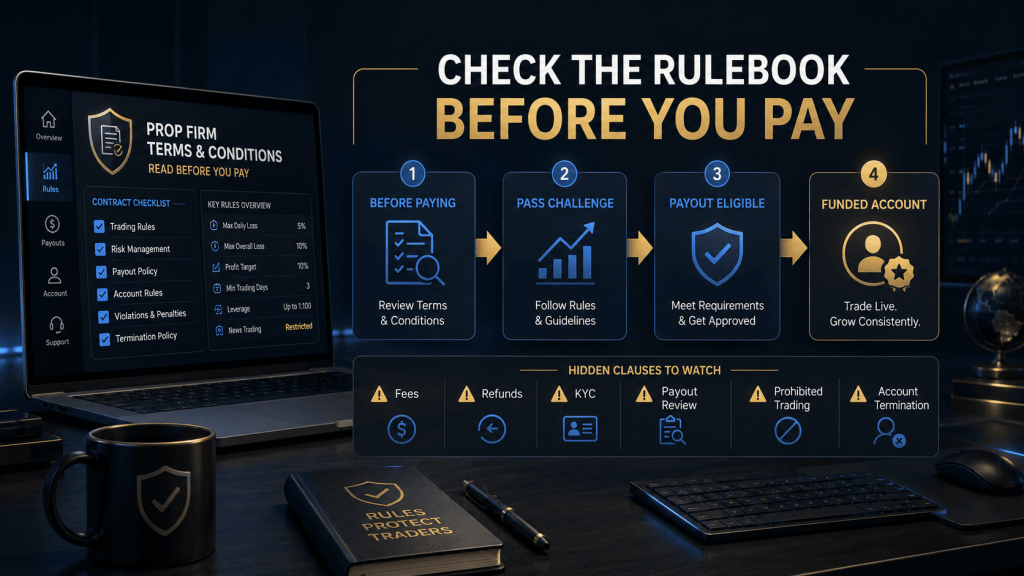



Most retail prop firms do not start by giving traders direct live capital to execute in the market. Many accounts are simulated or monitored, while payouts can still be real if the trader meets the firm’s rules. “Funded” should be read as a conditional account status, not proof that every order is live-routed. Use this page as the simulated-vs-real child guide inside the What Is Prop Trading? Hub.
Do Prop Firms Use Real Money? The Direct Answer
The clean answer is: sometimes, but not always in the way traders imagine. A firm may pay real rewards while the trader is still operating in a simulated account environment. A firm may also selectively route, hedge or copy certain trader flow later. Those are different layers.
This topic becomes confusing because traders often treat “real money” as one question. It is actually four questions:
| Layer | What it means | Can it be real while other layers are not? | Why traders confuse it | Detailed guide |
|---|---|---|---|---|
| Real payout | Money actually approved and received by the trader | Yes | Traders assume a real payout proves live execution | Prop firm payouts |
| Simulated account environment | The account uses demo or simulated trading conditions while performance is monitored | Yes | Some traders think simulated always means fake in every sense | Funded trader account |
| Real market execution | Orders are routed into live markets, copied into live exposure or hedged by the firm | Yes | “Funded” is often mistaken for direct live execution | Order execution |
| Real capital allocation | The firm assigns actual balance-sheet risk or live exposure to the trader’s flow | Yes | Often not disclosed clearly or happens only after more performance evidence | Prop firm market structure |
If you do not separate those layers, the whole topic stays blurry. For the firm-level definition, read what a prop trading firm is. For the account-structure angle, read prop firm account vs retail account.
How Most Online Prop Firms Structure the Journey
Most retail prop firm journeys are staged. The trader first enters a rule-controlled environment, then proves behaviour, then may become eligible for payout, and only later may the firm decide whether any flow deserves live allocation or routing.
| Stage | What the trader sees | What may be real | What may still be simulated or controlled | Trader mistake |
|---|---|---|---|---|
| Evaluation or challenge | Profit target, daily loss, max loss, trading rules and dashboard balance | The fee paid by the trader and the rule contract | The account capital and trading environment may be simulated | Thinking a challenge account is the same as live firm capital |
| Verification or funded-style access | More serious account status, payout potential and stricter review | Approved rewards may be paid if conditions are met | The account may still be simulated or internally monitored | Thinking “funded” means every order is now live-routed |
| Payout review | Withdrawal request, KYC, trade history review and payout destination checks | Received payout can be real money | Approval depends on rules, consistency, buffer and account status | Confusing dashboard profit with payout-ready profit |
| Selective routing or live allocation | Possible copied flow, hedged exposure, live allocation or internal risk adjustment | Some trader flow may be exposed to real market risk | Selection criteria may be internal, limited or not available to every trader | Assuming every profitable trader automatically receives direct firm capital |
That staged model makes sense. It is not charity. It is risk control, payout control and routing discipline.
Why Firms Do This Instead of Giving Everyone Real Money Immediately
Because most traders are not ready for live capital risk, and most firms cannot survive if they treat every account as direct live exposure from the first order.
| Reason | Why it matters for the firm | Why it matters for the trader | Detailed guide |
|---|---|---|---|
| Risk control | The firm can test trader behaviour before taking real exposure | Passing a rule test does not automatically mean live capital allocation | Prop firm challenge rules |
| Abuse prevention | The firm can monitor copy trading, HFT, latency, account linking and prohibited strategies | Profitable trades can still be reviewed if behaviour violates the rulebook | Why payouts get denied |
| Payout economics | The firm separates generated profit from eligible and approved payout | A real payout does not prove every underlying trade was live-routed | Prop firm payouts |
| Routing discipline | The firm can selectively copy, hedge or route only the flow it wants | Live allocation may be selective, internal or undisclosed | Prop firm market structure |
| Business model design | Challenge fees, resets, profit splits and retention all shape the operator’s economics | The trader should understand incentives before trusting funded language | How prop firms make money |
Put those pieces together and the structure becomes much clearer:
- Evaluation stays simulated because it is a lower-risk way to screen traders.
- Funded-style access can stay simulated because real payouts do not require every trade to be live-executed.
- Real allocation is selective because routing bad flow into real markets is a solvency problem, not a marketing problem.
What This Really Means for Traders
The first implication is simple: a simulated funded stage is not automatically fake. The better test is whether the firm discloses the account environment clearly, explains the payout path, pays approved rewards reliably and defines what changes at each stage.
The second implication is more important: if the funded-style stage is simulated or internally monitored, payout cadence, consistency rules, KYC, withdrawal restrictions and buffer rules usually matter more than the word “funded”.
| Trader question | Why it matters | Where to check |
|---|---|---|
| Is the account simulated, monitored, copied, hedged or live-routed? | It defines what “funded” actually means in the account environment | Terms, risk disclosure, account rules and support clarification |
| Can payout be real even if the account is simulated? | Yes, if the contract allows approved rewards from eligible profit | Payout rules, payout process, KYC and payment terms |
| What moves a trader from simulated to live routing? | Some firms may have internal criteria, while others may not offer this path | Official stage rules, live allocation policy or support answer |
| What restrictions remain before or after live allocation? | Rules may still control drawdown, consistency, news, tools and payout | Trading rules and payout-denial clauses |
| Can the firm explain the model without slogans? | Clear disclosure is a trust signal | Terms, FAQ, payout page and written support response |
Most traders do not need a slogan about “real money”. They need to know what stage they are actually in and what changes at each stage.
Start by comparing account structure, then check payout conditions, then look at the execution environment. Once those three are clear, the account becomes much easier to judge.
After that, review prop firm payouts and withdrawal rules and the research on how prop firms make money. Those two pages usually reveal more about funded-account quality than the word “funded” ever will.
Alpha Insight: Funded Is a Risk Status, Not Proof of Live Capital
This is the gap left by most industry content. “Funded” should be read as a risk-management and payout-review status, not as proof that every trade is already live.
A trader enters funded-style access because the firm is willing to move them into a more serious monitoring, rules and payout framework. That still does not mean the firm has decided to externalise every order into real markets.
| Bad interpretation | Better interpretation | Trader action |
|---|---|---|
| Real payout proves live execution | Real payout and live execution are separate layers | Check payout process and execution disclosure separately |
| Simulated funded accounts are automatically fake | Simulated accounts can still produce real approved rewards under contract terms | Verify disclosure, payout reliability and eligibility rules |
| Live capital is a badge of honour | Live allocation is a routing and risk decision | Ask what performance, risk or consistency conditions change routing |
| All firms use the same funded model | Each firm can structure evaluation, monitoring, payout and routing differently | Read the terms, rules and payout process for the exact firm |
That changes how a serious trader should evaluate firms. The best question is no longer “Do they use real money?” It is “How do they route risk, how do they fund payouts, and what changes when I move stages?”
So, Are Prop Firms Real Money?
Yes and no. That is the honest answer.
Yes, because some traders can receive real payout or reward payments when profit becomes eligible and approved under the firm’s rules. No, because many retail prop firm accounts are simulated, monitored or internally controlled, and not every order is necessarily routed into live markets.
Last checked on : AIFO’s General Terms state that the services include simulated trading, that demo account funds are fictitious, and that simulated trading through the services is not real financial market trading. AIFO’s payout process page separately explains payout eligibility, review, approval and final receipt. That combination is the correct way to read the topic: simulated trading and real payout workflow are different layers.
This is why the topic cannot be reduced to a slogan. Real payout, real capital allocation and real market execution are separate layers. You need to know which one you are actually talking about.
Related Guides About Funded Accounts and Payouts
- What is a funded trader account? — funded-style access, simulated capital and payout eligibility.
- Prop firm account vs retail account — how ownership, risk and withdrawal rights differ.
- Prop firm payouts — how profit becomes eligible, approved and received.
- How prop firms make money — challenge fees, profit splits, payout economics and lifecycle value.
- Are prop firms legit? — scam red flags, payout proof and shutdown risk.
If you understand the layers, the whole funded-account debate gets much simpler.
FAQ
No. A firm can pay real rewards even if the account was still simulated, monitored or internally controlled. Real payout and real market execution are different layers, and many funded-style programmes separate them.
Because it reduces capital risk while the firm continues to evaluate consistency, behaviour, drawdown, restricted trading and payout eligibility. This lets the firm review performance without routing every funded trader directly into live market exposure too early.
Look for a clearly disclosed path from evaluation to funded-style access to live routing or allocation, along with specific conditions for moving stages. If the firm talks about “funded” but never explains routing, payout source or live-allocation criteria, the answer is less clear than the marketing suggests.
No. Simulated funded trading is not automatically fake. The better test is whether the firm discloses the model clearly, explains payout eligibility, pays approved rewards reliably and defines how account status can change over time.
Yes. AIFO’s current General Terms state that its services include simulated trading, that demo account funds are fictitious and that trading through the services is not real financial market trading unless expressly stated otherwise.
It can, if the firm’s contract and payout process allow approved rewards after eligibility, review and payment checks. Simulated trading, eligible profit, approved payout and final receipt are separate steps, so traders should read the payout rules before assuming dashboard profit is cash.
Ask whether the account is simulated or live, whether payouts are real, what conditions make profit eligible, whether trades are routed, copied or hedged, and what changes after passing, payout or scaling. The word “funded” is not enough on its own.