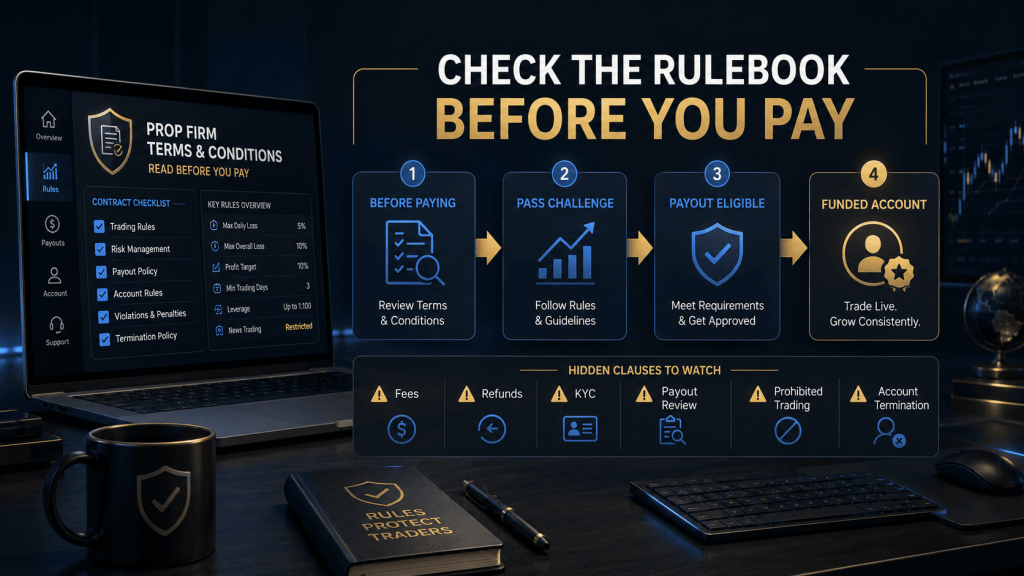



A prop trading firm is a company or programme that gives traders conditional access to trade under firm-defined rules, often after an evaluation or account-access process. In the modern retail market, a prop firm is not simply a company that hands traders money. It usually provides a rule-controlled account path where traders may qualify for payouts or rewards by following the loss, trading-behaviour and payout rules that apply to their selected model.
What Is a Prop Trading Firm? The Direct Answer
This article is the prop firm definition child guide inside the What Is Prop Trading? Hub. Use the Hub for the broader prop trading model, then use this page to understand what a prop trading firm actually does, how retail prop firms work and where the main risks sit.
| Prop firm layer | What it means | What beginners often assume | Better interpretation | Detailed guide |
|---|---|---|---|---|
| Traditional prop firm | A firm trades its own capital through internal traders, desks or strategies | All prop firms work like institutional trading desks | Traditional prop trading and retail funded-account programmes are not the same thing | What is prop trading? |
| Retail prop firm | A firm sells or provides access to evaluations, instant routes, funded-style accounts and payout frameworks | The firm immediately gives live money to every trader | The trader usually receives conditional access under a rule stack | Funded trader account |
| Account environment | The account may be simulated, monitored, copied, hedged or live-routed depending on the firm and stage | “Funded” always means direct live execution | Real payout, simulated trading, live execution and capital allocation are separate layers | Do prop firms use real money? |
| Payout framework | Profit must become eligible, reviewed, approved and settled before the trader receives money | Dashboard profit is cash | Payout-ready profit matters more than visible account profit | Prop firm payouts |
Why the Term “Prop Trading Firm” Causes Confusion
Most confusion comes from mixing institutional proprietary trading with retail funded-account programmes. They share vocabulary, but they do not always share the same operating structure.
| Comparison point | Institutional prop trading | Retail prop firm model | Why the distinction matters |
|---|---|---|---|
| Capital model | The firm deploys its own balance sheet through internal desks or professional traders | The firm usually offers evaluations, instant routes or funded-style account access to external traders | Retail traders may not receive direct live capital from the first stage |
| Trader relationship | The trader may be an employee, desk trader, partner or professional contractor | The trader is often a customer or participant in a programme | The legal and operational relationship is different |
| Account controls | Internal risk limits, desk mandates and firm risk systems | Daily loss, maximum loss, model-specific trading restrictions, account stages and payout review | Retail prop accounts are rule-controlled products |
| What is being sold | Usually not sold as a retail challenge product | Access to a challenge, instant account, funded-style path or reward framework | The user is often buying conditional access, not capital ownership |
What a Retail Prop Trading Firm Actually Does
A retail prop firm does four things at once: it screens traders, standardises behaviour, reviews payout eligibility and decides how trader risk is handled.
| Function | How it works | Trader consequence | Related page |
|---|---|---|---|
| Screening | Challenges, evaluations, instant routes, account objectives or trial paths filter trader behaviour | The trader must prove rule fit before receiving a more advanced account status | How to pass a prop firm challenge |
| Risk standardisation | The firm uses daily loss, maximum loss, holding and restricted-trading rules, plus consistency or concentration controls where applicable | A profitable idea can still fail if the trading path breaks the rules | Prop firm challenge rules |
| Payout control | Profit must pass eligibility, review, KYC and model-specific payout checks | Dashboard profit is not automatically withdrawable profit | First payout rules |
| Risk routing | The firm may keep accounts simulated, monitor behaviour, copy selected flow or route risk selectively | Real payout, live execution and capital allocation must be evaluated separately | Real payout vs real execution |
That is why the real product is not capital on day one. The real product is conditional access under a rule stack.
How the Retail Prop Model Usually Works
Most retail prop firm models run through an account path. The stages may look different across firms, but the logic is usually similar: access, rules, review and payout.
| Stage | What the trader sees | What the firm is checking | Common beginner mistake | Detailed guide |
|---|---|---|---|---|
| Entry fee or account access | Challenge, evaluation, instant route, trial or account purchase | Whether the trader accepts the programme rules and account conditions | Comparing only price or account size | Challenge costs |
| Evaluation or rule test | Profit target, daily loss, maximum loss, trading-day or time conditions and any applicable concentration rule | Whether the trader can generate profit without breaking risk constraints | Sizing from the displayed account balance | Daily vs maximum drawdown |
| Funded-style access | More advanced account status and payout potential | Whether behaviour remains repeatable after passing | Thinking funded always means direct live capital | Funded trader account |
| Payout review | Withdrawal request, KYC, account review, model-specific conditions and payment destination | Whether profit is eligible, rule-clean and payable | Confusing profit generated with payout-ready profit | Why payouts get denied |
| Longer-term retention or routing | Repeated payouts, scaling, account continuation or possible risk routing | Whether the trader is commercially useful and controlled enough to retain | Changing strategy after the first payout | After passing a challenge |
Is AIFO a Prop Trading Firm?
Yes—in the modern retail prop trading sense. AIFO provides simulated trading evaluations and proprietary trading assessment programmes rather than operating as a traditional in-house trading desk or broker. Its current account routes are Instant, 1-Step, 2-Step and Sprint. All AIFO account types, including Free Trial, Challenge and simulated funded accounts, use virtual funds in a simulated environment. Payouts remain subject to the rules and review requirements of the selected account.
Last checked: . The following AIFO model summary reflects the supplied website rule-consistency audit.
| AIFO route | Evaluation or target structure | Loss and behaviour controls | Payout implications |
|---|---|---|---|
| 1-Step | One simulated evaluation phase with a 10% profit target and at least 2 trading days | 3% Daily Loss and 6% Static Maximum Loss; no consistency rule | The corresponding simulated funded account uses an 80% default profit split that may increase up to 95%; standard minimum payout is $100 |
| 2-Step | Two simulated evaluation phases with an 8% Phase 1 target, 5% Phase 2 target and at least 3 trading days | 5% Daily Loss and 10% Static Maximum Loss; no consistency rule | The corresponding simulated funded account uses an 80% default profit split that may increase up to 95%; standard minimum payout is $100 |
| Instant | Direct simulated account access without an evaluation profit target | 3% Daily Loss, 5% trailing high-water-mark loss capped at the initial balance, total floating loss no greater than 2% of the initial balance and best day below 20% of payout-period profit | A $100 minimum payout and a 2% profit buffer apply; a full payout closes the account |
| Sprint | 3% target within 24 hours; the first trade must be opened within 48 hours and starts the countdown | 2% Static Maximum Loss, total floating loss no greater than 1%, one open position and largest single trade below 20% of total profit | One payout: 90% at closed net profit of at least 3% but below 6%, or 95% at closed net profit of at least 6%; request within 30 days, processing target of one business day excluding compliance checks, and account closure after payout |
- Account paths: Compare the confirmed routes through AIFO account models and how AIFO works.
- Trading platform: AIFO currently provides access through MetaTrader 5 across supported desktop, mobile and web options.
- Account environment: Read the AIFO simulated-account explanation for how Challenge and simulated funded accounts use virtual funds.
- Rules and payouts: Review the AIFO trading rules and AIFO payout process before selecting an account path.
- Tools and add-ons: EA use is limited to 1-Step and 2-Step challenge accounts and their corresponding simulated funded accounts. Optional add-ons are available only for eligible 1-Step, 2-Step and Instant purchases; Sprint does not support add-ons.
AIFO’s standard funded-account payout cycle is 14 days, and approved payouts are usually processed within 1–3 business days. Eligible 1-Step and 2-Step accounts may use the Fast Payout add-on. The first payout still requires the initial 14-day wait; later eligible cycles may shorten to 24 hours after the first profit split. Sprint follows the separate one-payout terms shown above.
What Traders Really Get From a Prop Firm
| What traders think they are getting | What they are usually getting in practice | Risk if misunderstood |
|---|---|---|
| Instant access to large capital | A qualification or account-access route with restrictions | The trader sizes from the headline balance instead of the loss floor |
| Freedom to trade a bigger account | Buying power inside maximum loss, restricted-trading and payout gates | A retail strategy may fail under prop rules |
| A pure reward for trading skill | A reward for skill that also fits the firm’s risk architecture | Profit can be delayed, reviewed or denied if the path is not clean |
| A straight path from passing to scale | A filtered path from evaluation to payout, then possibly to deeper retention or allocation | Passing is confused with long-term account stability |
| Profit split on all performance | Profit split only after rule compliance, eligibility and review | Dashboard profit is mistaken for withdrawable cash |
For a deeper account-level comparison, read prop firm account vs personal retail account.
How Prop Firms Make Money
The lazy answer is that prop firms make money because traders fail challenges. That is too shallow.
A prop firm’s economics usually sit across several layers. For the fuller business model, read how prop firms make money.
| Revenue or value layer | How it works | Trader consequence |
|---|---|---|
| Challenge, evaluation or access fees | Traders pay to enter an account path or assessment | The first cost is paid before any payout exists |
| Resets, retries or repeat purchases | Failed traders may buy another attempt | A cheap challenge can become expensive through repeated mistakes |
| Profit split economics | Approved trader profit is shared according to programme terms | The split only matters after profit becomes eligible and approved |
| Retention of controlled traders | Firms may retain traders whose behaviour fits risk and payout economics | The best traders are not just profitable; they are repeatable and review-clean |
| Selective risk routing | Some trader flow may be copied, hedged or routed beyond the internal environment | Live routing is a commercial risk decision, not a universal starting point |
Failure rates, churn and behavioural filtering can all matter. The deeper model is that a prop firm monetises trader participation and tries to retain the subset of behaviour that fits its risk and payout economics.
Why Rules Matter More Than Beginners Expect
Prop firm rules do not just limit losses. They reshape strategy. A daily loss cap compresses recovery room. A trailing drawdown can punish normal pullbacks. A concentration rule can reduce the usefulness of one oversized winning session.
| Rule area | What beginners think | What it actually changes | Detailed guide |
|---|---|---|---|
| Daily loss | A daily loss limit is just a safety rule | It decides how much damage one trading day can absorb before failure | Daily loss reset time |
| Maximum loss | The account size is the usable risk room | The real account is the distance between equity and the failure floor | Daily vs maximum drawdown |
| Consistency or concentration | A big winning day is always good | Where such a rule applies, profit concentration can block payout or require more clean trading | Consistency rule |
| News and holding | A valid market idea should be allowed | Events, resets, weekends, open positions and pending orders can change rule status | News trading rules |
| Execution and tools | If the platform accepts the order, the account accepts the behaviour | EA, copy trading, HFT, scalping and platform tools can still be restricted | Order execution |
This is where many traders break. They use a strategy that works in a personal account, then force it into a prop framework without adjusting holding behaviour, stop placement or risk distribution.
If you are comparing firms, the practical version of the question is what to check before choosing a prop firm before paying for a challenge.
Are Prop Firms Legitimate?
Some prop firms are serious businesses. Some are loose operators. Some market aspiration better than they manage governance. Calling the whole sector a scam is inaccurate. Treating every prop firm as a smart shortcut is equally unreliable.
| Legitimacy check | Clean sign | Warning sign | Detailed guide |
|---|---|---|---|
| Account disclosure | The firm explains whether stages are simulated, monitored, routed or live | “Funded” is used without explaining the account environment | Do prop firms use real money? |
| Rule clarity | Drawdown, payout and prohibited behaviours are defined before payment | Important rules are buried in vague conduct language | Prop firm terms checklist |
| Payout proof | Recent proof is specific, verifiable and supported by payout rules | Only old screenshots, affiliate claims or vague leaderboard proof exist | Verify payout proof |
| Support and governance | The firm can explain rules, review outcomes and account status clearly | Support becomes vague after passing or near payout | Are prop firms legit? |
If those answers are weak, the risk is not only commercial. It is behavioural. The trader ends up trying to optimise around hidden enforcement rather than around market execution.
Alpha Insight: A Prop Firm Rewards a Specific Risk Shape
A prop trading firm does not simply reward profitable trading. It rewards profitable trading that stays inside the firm’s preferred risk shape.
Once you see that, the model becomes easier to read. Challenge fees, payout reviews, account progression and restricted-trading rules all become part of one commercial risk system.
The trader is not being judged only as a speculator. The trader is also being judged as a controllable risk unit.
Who Should Use a Prop Firm, and Who Should Not?
For beginners, this comes back to whether prop trading is suitable for beginners before the first challenge fee is paid.
| Trader type | Fit with prop firm model | Why | Next guide |
|---|---|---|---|
| Repeatable trader with limited capital | Better fit | The trader has a process but wants a larger account framework | Best prop firms for beginners |
| Risk-controlled trader | Better fit | The trader already uses daily stops and can survive loss limits | Risk per trade |
| Wide-recovery trader | Worse fit | The strategy may need more drawdown room than the prop account allows | Drawdown rules |
| News, EA or copy trader | Depends on the exact firm and account rules | The method may be restricted even when it is profitable | Challenge rules |
| Trader who wants guaranteed live allocation | Worse fit unless the firm clearly discloses a live route | Retail prop firms may use simulated accounts instead of handing over direct live capital | Do prop firms use real money? |
Related Guides About Prop Firms
- What is prop trading? — the broader prop trading model.
- What is a funded trader account? — conditional access, simulated capital and rewards.
- Prop firm account vs retail account — ownership, risk and withdrawal control.
- How the prop firm market works — ecosystem, infrastructure, payments and business model.
- Are prop firms legit? — trust checks, red flags and payout proof.
Not sure whether a prop firm model fits your trading style?
Start with the structure first. Review account models, drawdown limits and payout rules before choosing an account path.
FAQ
A prop trading firm is a company or programme that gives traders conditional access to trade under firm-defined rules. In the retail market, this usually means challenges, evaluations, instant account routes, funded-style accounts, payout rules and strict loss limits.
No. Institutional prop trading usually means a firm trades its own balance sheet through professional desks or internal traders. A retail prop firm usually gives external traders conditional account access through a rule-based programme.
All AIFO account types, including Free Trial, Challenge and simulated funded accounts, operate in a simulated trading environment using virtual funds. An approved payout does not mean the account itself used live capital.
Prop traders usually receive an approved profit split after satisfying the payout conditions for their account. At AIFO, the standard minimum payout is $100. The standard funded-account cycle is 14 days, while Sprint uses separate one-payout terms.
No. AIFO 1-Step and 2-Step accounts have no consistency rule, and a 2% payout buffer must not be applied to them. Instant uses a best-day limit below 20% of payout-period profit and requires a 2% profit buffer after payout. Sprint instead uses a largest-single-trade limit below 20% of total profit and its own one-payout rules.
No. Passing a challenge means the trader has cleared an account filter. It does not automatically mean the trader is trading a live firm-funded account. At AIFO, Challenge and simulated funded accounts use virtual funds in a simulated environment.
Some prop firms are legitimate rule-based trading programmes, while others may have weak disclosure, vague payout rules or poor governance. Check the account environment, rules, payout evidence, terms, operating status and whether the model fits your strategy.
A prop firm can fit traders with a tested process, controlled risk and limited personal capital. It is a poor fit for traders who rely on wide recovery, ignore rules, need unrestricted execution or expect guaranteed live capital allocation from the first stage.