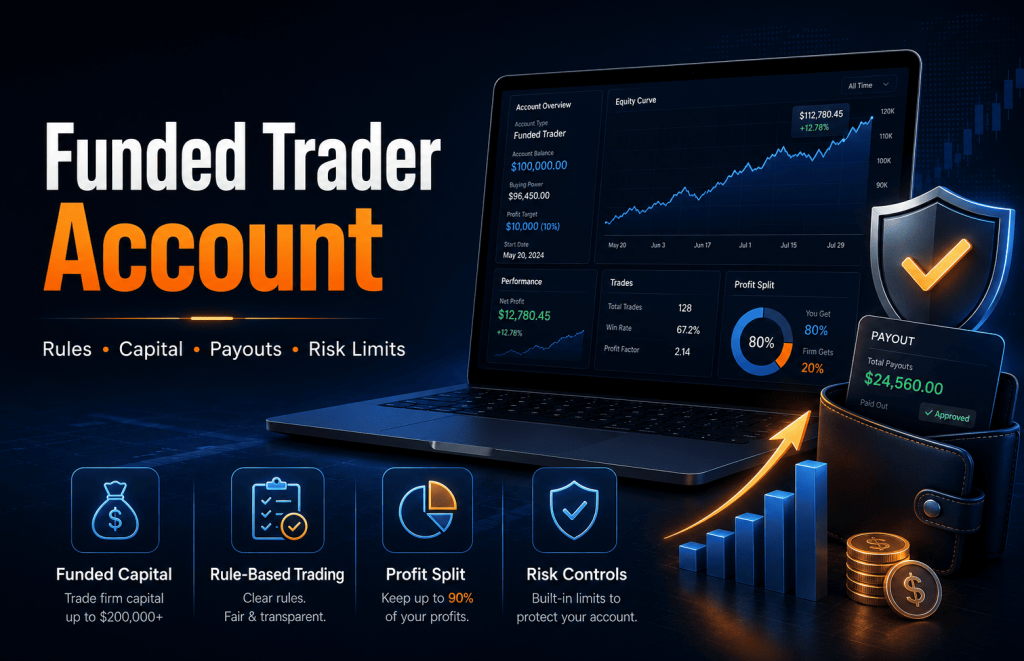



Prop trading, short for proprietary trading, is trading performed within a firm’s own programme and risk framework rather than through an ordinary customer-owned retail account. In the modern retail prop model, external traders commonly use simulated evaluations, direct-access routes or simulated funded accounts, follow programme-specific rules and may request performance-based payouts when the applicable conditions are met.
This page defines the overall prop trading model. The next entity in the hierarchy is the prop trading firm, meaning the company or programme operator. Below that sits the funded trader account, meaning an account product or status inside the programme.
Last checked: . AIFO’s current service structure and account terminology were checked against the latest AIFO rule audit. All AIFO Free Trial, Challenge and simulated funded accounts operate in a simulated trading environment using virtual funds only.
What Is Prop Trading in Plain English?
Prop trading describes a trading relationship organised around a firm’s proprietary rules, accounts and risk controls. Traditional proprietary trading generally involves a firm trading for its own account. Modern retail prop programmes allow external traders to participate through contractual account paths that may include a simulated evaluation, direct simulated access and a simulated funded stage.
The phrase should not be reduced to “trading someone else’s money.” A complete description includes:
- the company or programme operator;
- the trading environment and whether funds are real or simulated;
- the route used to access an account;
- the Daily Loss, Maximum Loss and other account-specific rules;
- the review and progression process; and
- the conditions governing payout requests.
Prop Trading, Prop Firm and Funded Account
These terms describe different layers of the same ecosystem.
| Layer | Meaning | Main question | AIFO guide |
|---|---|---|---|
| Prop trading | The trading and commercial model | How does the overall programme work? | This page |
| Prop trading firm | The company or programme operator that sets the account framework | Who operates and controls the programme? | What is a prop trading firm? |
| Funded trader account | An account product or status within the programme | What account does the trader receive after the applicable process? | What is a funded trader account? |
A broader prop firm account can refer to a Free Trial, Challenge, Instant or simulated funded account. Compare that structure with personal account ownership in the prop firm account vs personal retail account guide.
Traditional Proprietary Trading vs Modern Retail Prop Trading
| Area | Traditional proprietary trading | Modern retail prop programme |
|---|---|---|
| Participant | An employee, owner, contractor or trader working within the firm’s trading operation | An external participant using a contractual programme |
| Capital relationship | Trading profit and loss may sit directly on the firm’s own trading book | The participant may trade in a simulated environment using virtual funds |
| Entry path | Employment, partnership, internal selection or another firm-controlled route | Free Trial, paid evaluation, direct-access account or another published programme |
| Risk controls | Internal desk and portfolio limits | Published account rules such as Daily Loss and Maximum Loss limits |
| Trader reward | Compensation, profit allocation or another internal arrangement | Account-specific performance payout subject to eligibility and review |
The two models share proprietary risk control, but they should not be treated as identical business, employment or capital relationships.
How Does Retail Prop Trading Work?
- Choose an account path. The trader selects an evaluation, direct-access route or practice account.
- Confirm the environment. The trader identifies whether the account uses real or simulated funds.
- Trade within account-specific rules. Daily Loss, Maximum Loss, trading days, floating-loss controls and concentration rules apply only where the selected programme states them.
- Complete the relevant stage. Evaluation models may require one or more targets. Direct-access models may begin without a traditional evaluation.
- Progress where eligible. Passing an evaluation can lead to review before a simulated funded account is issued.
- Generate payout-eligible performance. Funded-stage rules continue after the evaluation target ends.
- Request a payout. KYC, account review and model-specific payout conditions may apply before payment.
Challenge completion, simulated funded status, payout eligibility and live market execution are separate concepts. See How AIFO Works for the AIFO journey.
How Does AIFO Fit the Retail Prop Trading Model?
AIFO operates a modern retail prop programme using simulated trading accounts and virtual funds. Its current main account lineup is Instant, 1-Step, 2-Step and Sprint.
| AIFO path | How access works | Core audited distinction |
|---|---|---|
| 1-Step | One simulated evaluation phase before eligible simulated funded progression | 10% target, 3% Daily Loss, 6% Static Maximum Loss and at least 2 trading days |
| 2-Step | Two simulated evaluation phases before eligible simulated funded progression | 8% Phase 1 target, 5% Phase 2 target, 5% Daily Loss, 10% Static Maximum Loss and at least 3 trading days |
| Instant | Direct simulated account access without a traditional evaluation target | 3% Daily Loss, 5% Trailing Maximum Loss based on high-water-mark equity and capped at initial balance, plus a 2% initial-balance floating-loss limit |
| Sprint | A 24-hour simulated challenge after the first trade starts the countdown | 3% target, 2% Static Maximum Loss, 1% floating-loss limit, one selected instrument and one open position |
Use the current AIFO Sprint FAQ for Sprint product rules, and use the AIFO account models page to compare the full lineup.
What Do Simulated Funds Mean?
Virtual funds are account figures used inside a simulated trading environment. They are not customer deposits and should not be described as personal capital owned by the trader.
A simulated account can still have real commercial consequences. The trader may pay a fee, lose access after a rule breach and receive a real performance-based payout when the account meets its conditions. Those outcomes do not change the virtual nature of the displayed trading funds.
Read Do Prop Firms Use Real Money? for a focused explanation of simulated capital, execution and payouts.
Which Rules Control a Retail Prop Account?
| Rule category | Purpose | Why account-specific wording matters |
|---|---|---|
| Profit target | Defines the objective for an evaluation or time-limited challenge | Instant has no traditional evaluation target, while current challenge targets differ |
| Daily Loss Limit | Caps permitted damage during the applicable trading day | The percentage differs between AIFO account models |
| Maximum Loss Limit | Sets the account’s overall survival boundary | AIFO challenge paths use static limits while Instant uses a trailing high-water-mark method |
| Minimum trading days | Defines the minimum activity required before progression | AIFO 1-Step requires at least 2 days and 2-Step at least 3 days |
| Consistency or concentration | Limits reliance on one profitable result where applicable | AIFO 1-Step and 2-Step have no Consistency Score; Instant and Sprint use different concentration tests |
| Payout rules | Define when simulated performance is eligible for payment | Minimums, cycles, buffers, profit splits and closure rules differ by account |
Review the AIFO trading rules and AIFO payout process before purchasing or trading an account.
What Prop Trading Is Not
- It is not automatically brokerage. A prop programme provides a proprietary account and rule framework rather than an ordinary customer-owned brokerage account.
- It is not automatically asset management. A participant is not necessarily managing outside investors’ portfolios.
- It is not the same as a funded account. Prop trading is the overall model; a funded account is one account-level component.
- It does not guarantee live market execution. Retail programmes can use simulated environments while offering real performance payouts.
- Displayed account size is not personal capital. Usable risk is limited by the account rules.
- A payout is not guaranteed. Profit remains subject to account-specific eligibility, review and settlement requirements.
What Are the Main Risks of Retail Prop Trading?
- Rule risk: a valid market idea can still breach a Daily Loss, Maximum Loss, floating-loss or prohibited-method rule.
- Fee risk: repeated purchases and retries can turn a modest fee into a larger total cost.
- Behavioural risk: targets and payout conditions can encourage overtrading, revenge trading or oversized positions.
- Account-access risk: access can end when contractual conditions are breached.
- Payout risk: dashboard profit must still satisfy the selected account’s payout rules.
- Provider risk: the participant depends on the programme’s terms, infrastructure, support and continued operation.
What Should You Learn Next?
- What Is a Prop Trading Firm? explains the company or programme operator.
- What Is a Funded Trader Account? explains account status, simulated capital and payouts.
- How the Prop Firm Market Works explains the wider commercial ecosystem.
- Prop Firm Account vs Personal Retail Account explains conditional programme access versus personal ownership.
- AIFO Account Models presents the current programme paths.
Frequently Asked Questions
Prop trading is trading performed within a firm’s proprietary programme and risk framework. Modern retail prop programmes commonly allow external traders to use simulated evaluations, direct-access routes or simulated funded accounts.
Prop trading is the activity and commercial model. A prop trading firm is the company or programme operator that defines the accounts, risk rules, review process and payout conditions.
No. Prop trading is the wider model. A funded trader account is one account product or stage that may exist within a retail prop programme.
AIFO Free Trial, Challenge and simulated funded accounts operate in a simulated trading environment using virtual funds only. Real performance payouts do not change the simulated nature of the displayed trading funds.
AIFO’s current main account lineup is Instant, 1-Step, 2-Step and Sprint. Each model uses its own targets, loss limits, progression and payout conditions.