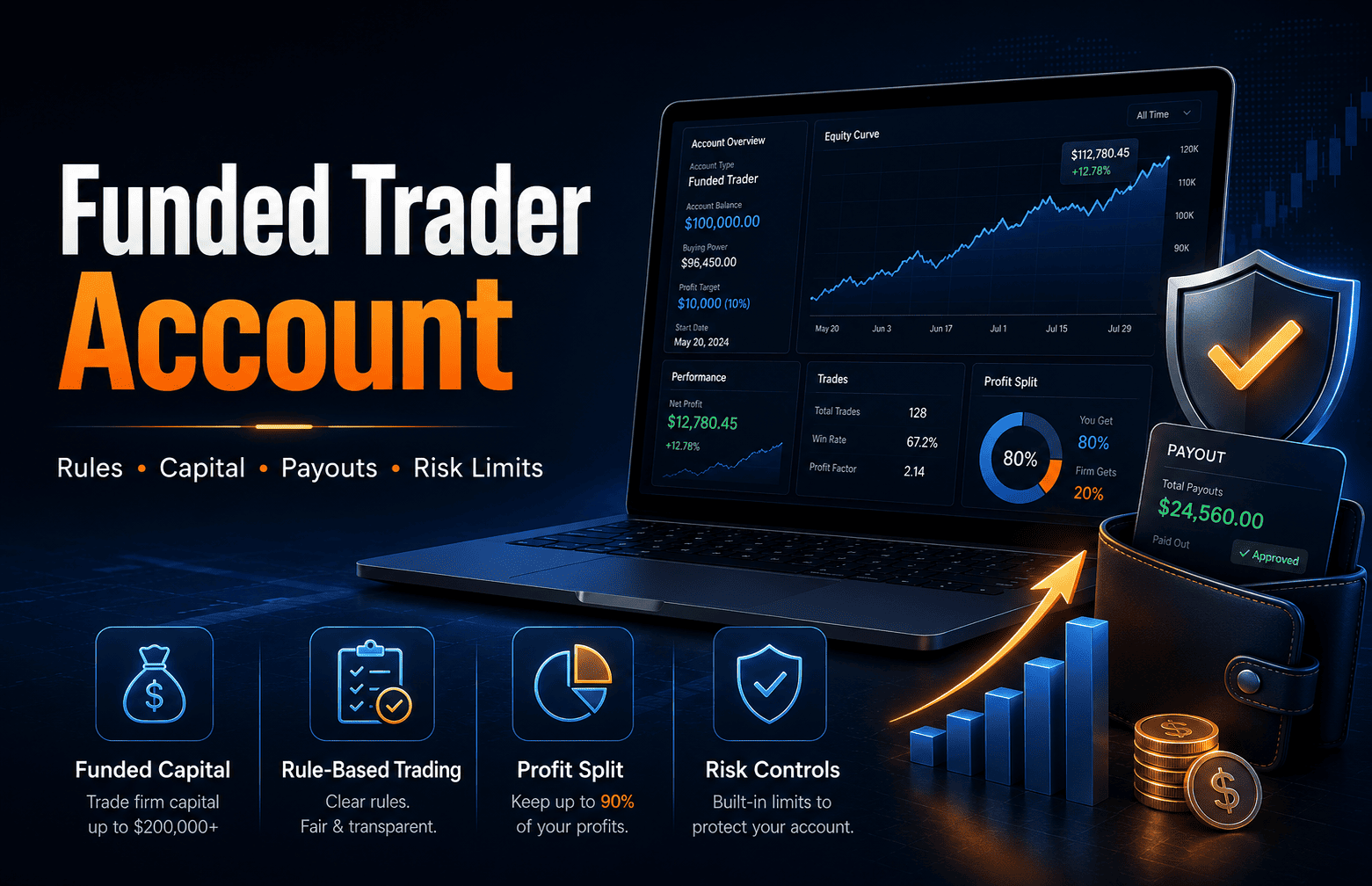



A funded trading account is a rule-controlled account stage or product that lets a trader operate a defined balance and become eligible for performance-based payouts. The trader does not own the displayed balance, and the word “funded” does not prove that trades use live firm capital. AIFO states that its Free Trial, Challenge and Funded Accounts all use virtual funds in a simulated trading environment.
Funded Account Meaning: Key Points
- Funded is a status or product, not ownership of the displayed balance.
- Funded accounts work through programme-specific loss, conduct, verification and payout rules.
- A challenge account, a funded account and a personal retail brokerage account are different products.
- Account size and account cost are different: the first is a trading limit, while the second includes fees and trading friction.
- AIFO currently lists Instant, 1-Step, 2-Step and Sprint, and the rules are not interchangeable.
Reviewed September 22, 2026. Programme facts were checked against AIFO’s Trading Rules and September 2026 rules update.
A funded account should be understood through three separate questions: what account stage the trader has reached, what rules remain active and what conditions must be met before a payout is approved.
This article explains the account-product layer. Start with what prop trading is, then read what a prop trading firm is for the company and programme layer.
Last rule review: . For accounts purchased before 1 September 2026, the challenge parameters displayed on the Dashboard apply.
What Is a Funded Trading Account?
A funded trader account is conditional access under a prop firm’s programme. The trader follows the account rules and may receive a share of eligible simulated trading profit after review.
| Layer | Entity | Function |
|---|---|---|
| Industry model | Prop trading | Defines the wider commercial and trading framework |
| Company | Prop trading firm | Operates programmes, rules, systems and payout review |
| Programme | Challenge or immediate-access route | Defines how the trader enters or progresses |
| Account stage | Simulated funded account | Provides conditional trading access and possible payout eligibility |
The term “funded” describes a programme relationship. It does not transfer ownership of the displayed account balance to the trader.
How Do Funded Trading Accounts Work?
A funded account follows a route rather than one universal sequence. The practical workflow is:
- Choose the programme. Compare the objective, loss limits, holding rules, automation eligibility and payout mechanics before paying.
- Trade the simulated account. Follow the selected route rather than rules remembered from another programme.
- Meet the route-specific condition. Evaluation programmes require their objectives; Instant and Sprint use their own eligibility logic.
- Complete review and verification. Rule checks and KYC can apply before account issuance or payout approval.
- Maintain eligibility. Funded status does not remove loss limits or other account controls.
The route depends on the selected programme:
- 1-Step: complete one simulated evaluation phase under the applicable target, loss and trading-day rules.
- 2-Step: complete two simulated evaluation phases under the applicable rules for both phases.
- Instant: begin through an immediate-access simulated account without a traditional evaluation target.
- Sprint: complete a separate 24-hour challenge for one payout; the account closes after that payout.
The current product paths are Instant, 1-Step, 2-Step and Sprint.
Use the AIFO programme process and AIFO account model comparison to identify the account route. Reaching a target does not automatically issue the next account if open positions, violations or other applicable conditions remain unresolved.
Funded Account Meaning vs “Funding Account”
Funded account and funded trading account are the standard terms in prop trading. Searchers sometimes type “funding account,” but that phrase can also refer to a bank or brokerage account used to transfer money. In a prop-firm context, confirm that the page means a rule-controlled trading account and not a deposit account.
The practical meaning comes from the contract: who owns the balance, whether trading is simulated, which loss limits apply, what creates payout eligibility and what closes the account.
Is a Funded Trader Account Real Money?
The word “funded” does not answer whether an account uses live or simulated capital. Firms can operate different execution and risk structures.
For AIFO, the answer is explicit: all account types use virtual funds in a simulated trading environment. This includes Free Trial Accounts, Challenge Accounts and Funded Accounts.
| Concept | Meaning | What it does not prove |
|---|---|---|
| Displayed account balance | Nominal balance used by the programme | Ownership of that amount by the trader |
| Simulated trading | Trading activity performed with virtual funds | Live-money order execution |
| Funded status | An account product or stage under programme rules | Automatic payout eligibility |
| Profit split | The trader’s share of eligible simulated trading profit | Ownership of the full displayed profit |
| Approved payout | A payment made after applicable checks | That the underlying account traded live capital |
For a deeper explanation, read whether prop firms use real money.
AIFO Funded Account Facts
- The account operates in a simulated environment with virtual funds.
- The displayed balance is not transferred to the trader.
- Account status remains conditional on the applicable programme rules.
- Positive simulated profit is not automatically payout-eligible.
- Payout conditions differ by account type.
- Risk, trading-conduct, identity and account-status checks can remain relevant after progression.
The AIFO Terms and Conditions, Trading Rules and Dashboard should be read together.
What Rules Apply After a Trader Becomes Funded?
Progression does not remove risk controls. The corresponding simulated funded account remains subject to its account-specific requirements.
| Programme | Evaluation or access rules | Funded or payout-stage rule |
|---|---|---|
| 1-Step | 10% target; 3% Daily Loss; 6% Static Maximum Loss; at least 2 trading days | No Consistency Score; 80% default profit split up to 95%; $100 minimum; standard 14-day cycle |
| 2-Step | 8% Phase 1 target; 5% Phase 2 target; 5% Daily Loss; 10% Static Maximum Loss; at least 3 trading days | No Consistency Score; 80% default profit split up to 95%; $100 minimum; standard 14-day cycle |
| Instant | No traditional evaluation target; 3% Daily Loss; 5% HWM-based Trailing Maximum Loss; floating loss not above 2% of initial balance | Best day below 20% of payout-period profit; $100 minimum; retain a 2% profit buffer to continue |
| Sprint | 24-hour challenge; 3% target; 2% Static Maximum Loss; total floating loss not above 1%; one position | Largest single trade below 20% of total profit; one payout followed by account closure |
The matrix shows why “funded account rules” cannot be reduced to one universal percentage.
Loss Limits Remain Active
Daily and Maximum Loss rules protect the account boundary. Traders should distinguish static and trailing limits:
- 1-Step uses a 6% Static Maximum Loss Limit.
- 2-Step uses a 10% Static Maximum Loss Limit.
- Instant uses a 5% Trailing Maximum Loss Limit based on highest historical equity, capped at initial balance.
- Sprint uses a 2% Static Maximum Loss Limit.
A funded-stage account should be managed from the nearest rule boundary, not from its headline balance.
Consistency Requirements Are Account-Specific
AIFO does not apply one consistency rule to every funded or payout-stage account:
- 1-Step and 2-Step funded accounts have no Consistency Score requirement.
- Instant requires maximum single-day profit to remain below 20% of total payout-period profit.
- Sprint requires the largest single-trade profit to remain below 20% of total profit.
For Instant, the test uses the highest-profit day. For Sprint, it uses the largest single trade. The two calculations are not interchangeable.
EA Permission Does Not Apply to Every Funded Account
The current AIFO EA rule permits Expert Advisors only on 1-Step and 2-Step Challenge accounts and on the corresponding simulated funded accounts after passing.
Instant and Sprint are not included in the approved EA eligibility list. Platform compatibility does not extend programme permission.
How Do Profit Splits and Payouts Work?
A profit split is the portion of eligible simulated trading profit distributed to the trader. Funded status by itself does not make every displayed profit immediately withdrawable.
| Account type | Profit split or payout route | Key conditions |
|---|---|---|
| 1-Step funded account | 80% default, potentially increasing to 95% | $100 minimum; standard 14-day cycle; no Consistency Score |
| 2-Step funded account | 80% default, potentially increasing to 95% | $100 minimum; standard 14-day cycle; no Consistency Score |
| Instant | Payout on demand after applicable requirements are met | $100 minimum; best day below 20%; retain 2% of initial balance to continue |
| Sprint | One 90% or 95% payout depending on closed net profit | Request within 30 days after settlement; account closes after payout |
The general AIFO payout minimum is $100, the general maximum is $10,000 per request and processing is usually 1–3 business days. Additional compliance or account checks can extend processing. Sprint follows its specific one-business-day processing rule, excluding additional compliance review.
Use the AIFO payout process and payout rules before submitting a request.
Payout Buffer Rules Are Not Universal
The mandatory 2% retained profit buffer applies to AIFO Instant. After an Instant payout, at least 2% of the initial account balance must remain for the trader to continue using the account.
An Instant trader may request a full payout of available profit, including the buffer, but that choice permanently closes the account.
The approved 1-Step and 2-Step programme sections do not state a 2% payout buffer. Sprint should not inherit the Instant buffer. Apply the rule only to the account type for which it is approved.
Challenge vs Funded vs Personal Retail Account
| Feature | Challenge account | Simulated funded account | Personal retail account |
|---|---|---|---|
| Purpose | Qualification under evaluation rules | Conditional funded-stage access and possible payout | Personal trading with the trader’s own brokerage relationship |
| Displayed funds | Programme-defined simulated balance | Programme-defined simulated balance | Trader’s deposited capital |
| Risk rules | Programme target and loss rules | Funded-stage risk and payout rules | Broker and regulatory requirements plus personal risk limits |
| Payout | Usually progression rather than profit withdrawal | Share of eligible simulated performance | Withdrawal of available personal account funds |
| Ownership | No ownership of displayed programme balance | No ownership of displayed programme balance | Trader owns deposited funds, subject to the account terms |
Read the detailed prop firm account versus personal retail account comparison.
Common Misunderstandings
“Funded means the displayed balance belongs to me.”
No. The trader receives conditional account access. The displayed virtual balance remains part of the programme.
“Funded means every trade is live.”
No. At AIFO, all account types operate in a simulated environment with virtual funds.
“Passing the target automatically creates a funded account.”
Not necessarily. The account must meet every applicable requirement. Open positions, risk violations or other unmet conditions can delay progression.
“Every funded account has the same consistency rule.”
No. AIFO 1-Step and 2-Step funded accounts have no Consistency Score. Instant and Sprint use different concentration tests.
“The 2% payout buffer applies everywhere.”
No. The mandatory 2% retained buffer is an Instant rule and should not be applied to other programmes without an approved account-specific rule.
“EA permission applies to every funded account.”
No. Current AIFO EA eligibility is limited to 1-Step and 2-Step Challenge accounts and their corresponding simulated funded accounts.
Funded Account Checklist
- Which programme and account stage am I using?
- Does the account use simulated or live funds?
- Who owns the displayed account balance?
- What Daily and Maximum Loss rules remain active?
- Is the Maximum Loss Limit static or trailing?
- Does a consistency or concentration rule apply?
- Is my trading method permitted on this programme?
- Does this account permit EA use?
- What profit split and payout minimum apply?
- Does this account require a retained payout buffer?
- Will a full payout close the account?
- Are KYC, account-status and payment details complete?
What Does a Funded Trading Account Cost?
The displayed account size is not the purchase price. A trader’s real cost can include the entry fee, permitted add-ons, retries, spreads, commission, slippage, swap and the time or restrictions between passing and an approved payout. Compare those items with the usable drawdown and payout terms, not only with the nominal balance.
Use the full framework in Prop Firm Challenge Costs: Fees and Real Total Cost before choosing a programme.
Final Takeaway
A funded trader account is a conditional programme account, not a cash transfer to the trader. The trader may become eligible for a share of simulated trading profit after satisfying the applicable rules and payout checks.
At AIFO, every account uses virtual funds in a simulated environment. Apply the specific rules for Instant, 1-Step, 2-Step or Sprint. Do not treat funded status as proof of live execution, immediate payout eligibility or universal EA and payout-buffer permissions.
Frequently Asked Questions
A funded trading account is a rule-controlled account stage or product offered by a proprietary trading firm. The trader uses the account under programme rules and may qualify for performance-based payouts, but the displayed balance does not become the trader's property.
In trading, a funded account means the trader has reached or purchased access to an account with defined loss, conduct and payout rules. At AIFO, Challenge and Funded Accounts use virtual funds in a simulated trading environment.
The trader selects a programme, trades under its limits, completes any required target or review, passes identity checks when requested and then follows the programme's payout rules. The exact path differs for 1-Step, 2-Step, Instant and Sprint.
The label funded does not prove that trades are executed with live firm capital. AIFO states that all of its account types operate with simulated trading and virtual funds.
The cost is the programme fee plus any permitted add-ons, retries, execution costs and payout friction. The displayed account size is a simulated trading balance, not the purchase price or cash owned by the trader.
AIFO currently lists four paths: Instant, 1-Step, 2-Step and Sprint. Each has its own loss limits, objectives, consistency conditions and payout mechanics.
No. Expert Advisors are permitted only on AIFO 1-Step and 2-Step Challenge accounts and on the corresponding simulated funded accounts after passing. Instant and Sprint are not in the approved EA eligibility list.
No. Profit must satisfy the applicable risk, consistency, KYC, account-status, payout-minimum and payment conditions before it becomes payout-eligible. Positive simulated profit and an approved payout are separate states.
No. The mandatory 2% retained profit buffer applies to Instant Accounts. It should not be applied to 1-Step, 2-Step or Sprint unless an approved programme-specific rule says otherwise. Taking the full Instant payout, including the buffer, permanently closes that account.