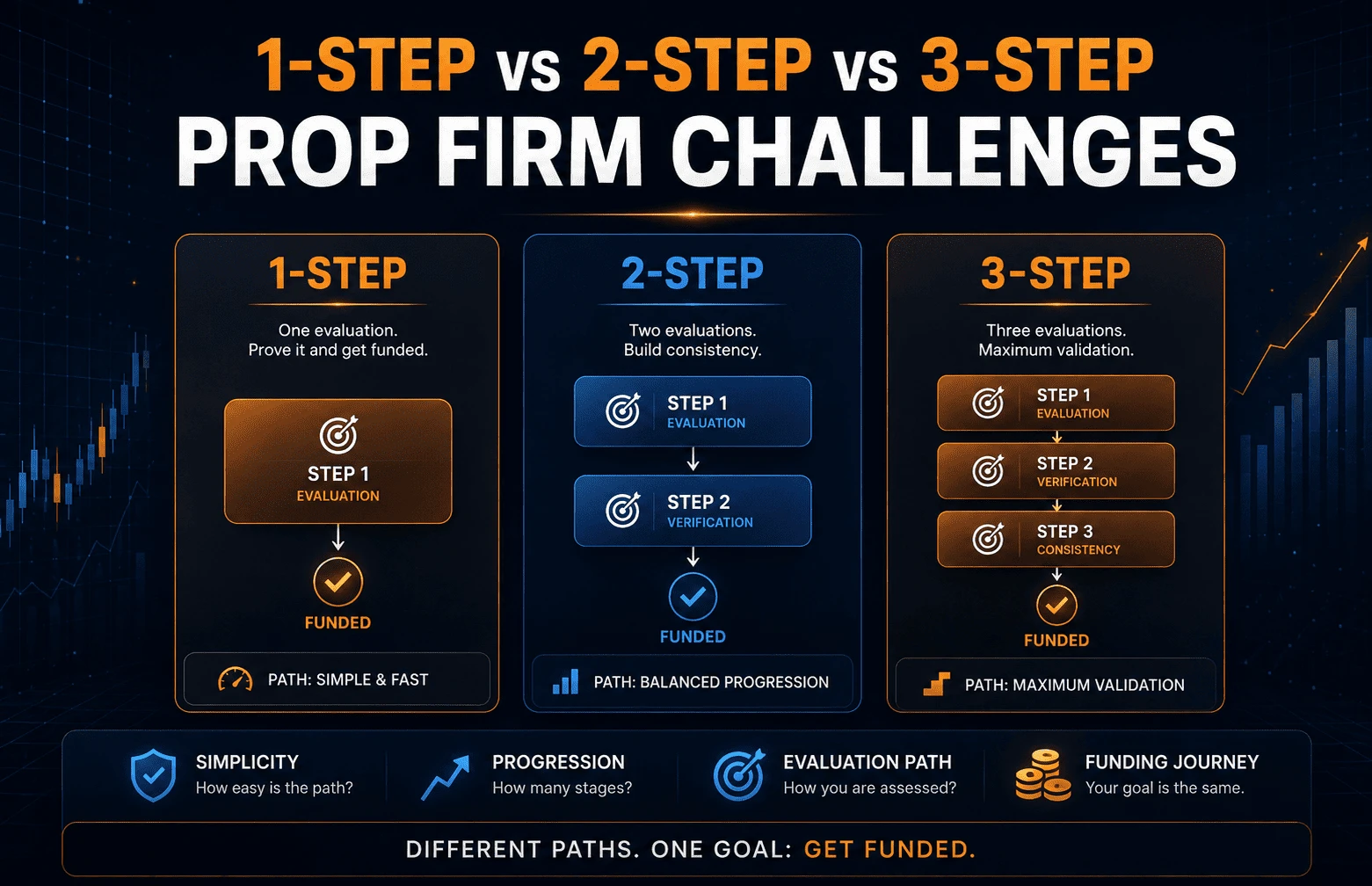



Instant, 1-Step, 2-Step and Sprint solve different trading problems. Instant removes the traditional evaluation but uses a trailing loss structure and payout concentration conditions. 1-Step has one target and tighter limits than 2-Step. 2-Step adds a phase but provides wider stated loss limits. Sprint is a separate 24-hour route with tight open-risk restrictions.
Last FAQ review: . Every AIFO figure below comes from the current FAQ for that programme; no Sprint percentage is inferred from another model.
Instant vs 1-Step vs 2-Step vs Sprint: Quick Comparison
| Model | Entry route | Confirmed risk structure | Other confirmed conditions |
|---|---|---|---|
| Instant | Immediate simulated account access; no traditional evaluation | 3% Daily Loss; 5% trailing Maximum Loss from highest historical equity, capped at initial balance; floating loss no more than 2% of initial balance | Best day below 20% of payout-period profit; $100 minimum; retain 2% after payout to continue |
| 1-Step | One evaluation phase with a 10% target | 3% Daily Loss; 6% static Maximum Loss | At least 2 trading days; no Consistency Score; 80% default split, scalable to 95% |
| 2-Step | Two phases with 8% then 5% targets | 5% Daily Loss; 10% static Maximum Loss | At least 3 trading days before progression; no Consistency Score; 80% default split, scalable to 95% |
| Sprint | 24-hour challenge | Equity must not fall below 98% of initial balance; total floating loss no more than 1% | One open position at a time; 30-day payout window after target; one payout |
The table is a normalisation tool, not a difficulty ranking. A wider stated loss limit can come with another phase. Fewer phases can come with a trailing floor or tighter concentration rule. The best match is the route whose pressure points are already represented in the trader’s tested sample.
What Does the Account Route Change?
Instant: remove the evaluation, keep the rules
AIFO Instant provides access without a traditional evaluation target. That does not mean profit is immediately withdrawable. The account must remain inside the Instant risk structure and satisfy its payout conditions. The absence of a phase changes the entry path, not the need for risk control.
1-Step: one target and one evaluation phase
AIFO 1-Step uses a 10% target, at least two trading days, a 3% Daily Loss and 6% static Maximum Loss. It can suit a process that prefers one qualification phase and can operate within the tighter stated loss room.
2-Step: two targets with wider stated limits
AIFO 2-Step uses an 8% Phase 1 target and a 5% Phase 2 target, at least three trading days before progression, a 5% Daily Loss and 10% static Maximum Loss. The second phase adds a progression step, while the wider stated limits may suit strategies with a larger normal pullback.
Sprint: a short, separate operating format
AIFO Sprint is a 24-hour challenge. Its FAQ confirms one open position at a time, an equity floor at 98% of initial balance and total floating loss no greater than 1% of initial balance. It also confirms one payout and a 30-day payout window after the target is reached. Treat Sprint as its own workflow rather than a faster version of a Step account.
Static vs Trailing Maximum Loss
A static floor remains tied to the initial balance under the programme FAQ. A trailing floor rises when the relevant high-water mark rises and does not move back down. This difference can matter more than the headline account balance.
| Model | Method | Decision effect |
|---|---|---|
| Instant | 5% trailing from highest historical equity; never decreases; capped at initial balance | Gains can move the failure floor upward, reducing later recovery room |
| 1-Step | 6% static from initial balance | The overall floor is easier to map, but the 3% Daily Loss still controls each day |
| 2-Step | 10% static from initial balance | Wider overall room does not remove the two-phase qualification path |
| Sprint | Use the confirmed 98% equity floor and 1% floating-loss rule | Do not substitute an unpublished Maximum Loss label or percentage |
How Do the Payout Paths Differ?
For AIFO 1-Step and 2-Step simulated funded accounts, the current FAQs state a $100 minimum payout and a standard 14-day payout cycle. They also state an 80% default split with the potential to increase to 95% through scaling. Neither Step FAQ applies a Consistency Score requirement.
For Instant, the current FAQ states a 70% default profit share that may scale to 95%. The maximum single-day profit must remain below 20% of payout-period profit. The current payout FAQ states a $100 minimum. To continue the account after a payout, at least 2% of initial balance must remain as profit buffer; requesting all available profit closes the account permanently.
For Sprint, use the current Sprint FAQ: a 30-day payout window after the target is reached and one payout. Do not import the Instant best-day rule, the Step 14-day cycle or a buffer condition unless the Sprint FAQ itself states it.
Which Model Fits Which Trading Process?
| Process need | Model to investigate | Question before choosing |
|---|---|---|
| Immediate access | Instant | Can the strategy manage trailing Maximum Loss and profit concentration? |
| One evaluation phase | 1-Step | Can the tested drawdown remain inside the tighter stated limits? |
| More stated loss room | 2-Step | Can the trader repeat the process through two targets? |
| Short challenge format | Sprint | Can the strategy work with one open position and the confirmed open-risk limits? |
This table narrows the research; it does not tell every trader what to buy. Compare normal holding time, trade frequency, losing streak, open risk and need for automation. If the strategy must be changed dramatically to fit the model, the apparent shortcut may be more expensive than a longer route.
Compare Expected Cost, Not Only Checkout Price
Calculate the purchase fee, selected add-ons, realistic retry probability, platform trading costs and time to reach the relevant account stage. Then divide by usable loss room—not the displayed account balance. Review the full method in Prop Firm Challenge Costs.
A low fee paired with an unsuitable drawdown method can have a higher expected cost than a higher-fee model that fits the tested strategy. Likewise, immediate access has little value if payout conditions conflict with how profit is normally generated.
Seven-Step Model Decision
- Measure normal drawdown and losing streak from a representative sample.
- Choose whether a static or trailing structure is compatible.
- Check the daily and open-risk limits.
- Map targets, trading days and progression steps.
- Map the full payout path, including concentration and account consequences.
- Verify strategy permissions for the exact account.
- Compare total expected cost and choose only after the fit test passes.
Frequently Asked Questions
There is no universal best model. Compare entry path, loss method, trading-day requirement, payout conditions and strategy fit, then select the structure your tested process can follow.
The current FAQ lists a 10% target, 3% Daily Loss, 6% static Maximum Loss, at least 2 trading days, no Consistency Score requirement and an 80% default profit split that may scale to 95%.
The current FAQ lists targets of 8% and 5%, 5% Daily Loss, 10% static Maximum Loss, at least 3 trading days before progression, no Consistency Score requirement and an 80% default profit split that may scale to 95%.
Instant provides immediate simulated account access without a traditional evaluation. It uses a 3% Daily Loss, 5% trailing Maximum Loss, a 2% floating-loss limit and Instant-specific payout conditions.
It confirms a 24-hour challenge, one open position at a time, an equity floor at 98% of initial balance, total floating loss no greater than 1%, a 30-day payout window after the target and one payout.
No. After the evaluation and account review, payout eligibility remains a separate stage with the conditions for the issued account.