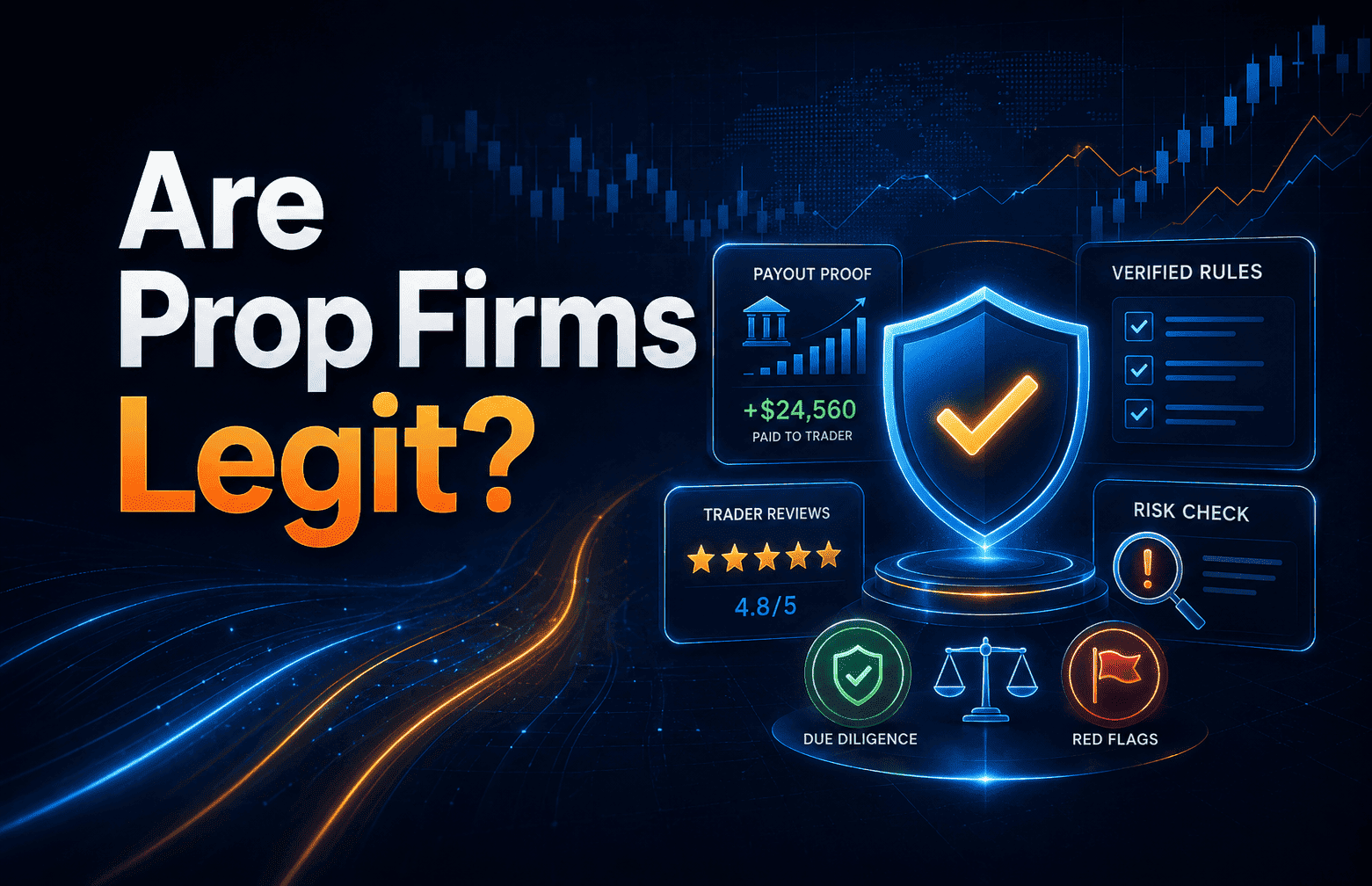



Yes, some prop firms are legitimate, but “legit” is not a single yes-or-no label. A safer answer checks three layers: whether the business model is understandable, whether the firm behaves transparently, and whether the specific account gives your strategy a clean path to payout. Start with the prop firm due-diligence checklist, then use this page to audit scam red flags, payout proof, reviews and shutdown risk.
Are Prop Firms Legit? The Clean Answer
A prop firm can be real, visible and paying some traders while still being a bad fit for your strategy. Legitimacy does not only mean “does the website exist?” It means the firm’s rules, payout chain, operating history and account structure can survive your actual trading path.
This article is the Trust / Legitimacy child Hub under the choosing framework. Use the AIFO Best Prop Firm Decision Center for the broader commercial shortlist after you know what trust signals, payout risks and account rules you need to filter for.
| Legitimacy layer | What to verify | Bad sign | Detailed guide |
|---|---|---|---|
| Business model | How the firm earns money, whether accounts are simulated or live-routed, and how rewards are funded | The firm sells “funded capital” language but does not explain the account environment or reward contract | How prop firms make money |
| Firm conduct | Company identity, terms, rule-change policy, support behaviour, public communication and payout history | Hidden operators, vague abuse clauses, rule changes after payment or support silence near withdrawal | Prop firm terms checklist |
| Account-level payout risk | Daily loss, maximum loss, consistency, news, holding, EAs, copy trading, KYC and payout buffer | The account can make profit but cannot reach payout-ready status under your strategy | Prop firm payouts |
| Evidence quality | Recent payout proof, review patterns, complaint clusters, shutdown signals and independent verification | Only affiliate screenshots, old leaderboards or firm-owned Discord proof are available | Verify prop firm payout proof |
The word “legit” needs pressure. A trader should use it as a due-diligence test, not as a badge that removes risk.
Scam Red Flags That Matter in Prop Trading
The worst red flags are not always loud. Some hide inside payout terms, fee mechanics or account review language.
| Red flag | What it looks like | Why it matters | What to check next | Trading consequence |
|---|---|---|---|---|
| Vague payout terms | Profit split is promoted, but payout eligibility is scattered or unclear | The trader cannot tell which profit is withdrawable | First payout rules | A good trading period can end in review delay or rejection |
| Hidden or late fees | Activation, data, platform, reset, add-on or penalty fees appear after the first payment | The real cost is higher than the account page suggests | Challenge costs | Fee pressure pushes the trader into larger size or faster recovery attempts |
| Rules change between stages | Evaluation rules look clean, then funded rules add payout caps or extra restrictions | The trader passed one contract and trades under another | Challenge rules | Execution changes after the trader is already committed |
| No clear company identity | Weak legal page, hidden operators, no company address, no real support trail | There is no accountable counterparty if a payout dispute starts | Terms checklist | The trader has little practical recourse after shutdown or denial |
| Overly easy offer | Huge capital, tiny fee, loose rules, fast payout and heavy discount pressure | The offer may depend on constant new buyers rather than stable risk control | Bad-deal warning signs | The trader is pulled into repeated purchases instead of stable execution |
| Broad abuse clauses | Terms allow the firm to cancel accounts for undefined trading behaviour | Normal strategy behaviour can be judged after the fact | Why payouts get denied | Profitable trades become review risk rather than payout-ready profit |
| No independent payout proof | The firm shows selected wins but no recent, verifiable payout pattern | Marketing proof is not the same as a reliable withdrawal system | Payout proof verification | The trader may discover payout friction only after passing |
Read every warning sign as a trading consequence. The sharper question is: “what failure path does this create after I have paid?”
Payout Proof: What It Proves and What It Does Not
Payout proof proves that some trader, under some conditions, received money. It does not prove that your profit will pass review.
| Proof type | What it can show | What it cannot show | Better follow-up check |
|---|---|---|---|
| Payout screenshot | A claimed withdrawal event, amount or approved request | Whether the payout cleared, how long it took or whether the account was rule-clean | Check date, trader history, payout method and rule context |
| Bank, card, crypto or wallet receipt | A payment route may have received funds | Whether the payment came from the firm or whether the strategy is allowed for you | Match amount, method, date, network and payout terms |
| Payout leaderboard | Visible payout activity over time | Rejected payouts, KYC delays, hidden review cases or denial rates | Look for recent payout count, median timing and collection method |
| Trustpilot or review platform | Recent trader sentiment and recurring complaint patterns | The full truth of each case or whether the reviewer followed rules | Read the newest payout-specific low-star and mid-star reviews |
| Influencer proof | That a visible trader or affiliate was paid or approved | Whether ordinary traders get the same payout treatment | Separate affiliate content from independent trader evidence |
| Firm-owned Discord proof | Selected payout stories the firm wants to show | Deleted complaints, denied requests or unresolved support tickets | Cross-check with independent communities and rule pages |
The trader needs to audit prop firm payouts as a chain: profit generated, eligible profit, payout-ready profit, approved payout and received payout. Each step can change the result.
If the rules were clear and the trader breached them, that is not automatically a scam. If the rules were vague, changed late, or applied in a way no trader could have predicted, that is a trust problem.
How to Read Trustpilot Reviews Without Getting Trapped
Trustpilot reviews are useful, but they are not a final verdict. Read them like order flow: one print is noise, repeated behaviour is information.
| Review check | What to look for | Why it matters | Bad sign |
|---|---|---|---|
| Newest 1-star reviews | Payout denial, delayed withdrawal, KYC loops, rule changes or support silence | Fresh complaints can show current operating pressure | Several recent traders describe the same payout issue |
| Newest 3-star reviews | Mixed experiences, partial support, delays that were eventually resolved | Mid-star reviews often reveal process friction without pure rage | Many traders say the firm paid but only after unclear review |
| 5-star review pattern | Whether praise is about payout, rule clarity and support after profit | Signup support is not the same as payout support | Most praise mentions discounts, speed or affiliate codes only |
| Time clusters | Sudden waves of praise or complaints around promotions, platform changes or payout issues | Clustered timing can show campaign activity or operational stress | Review bursts replace steady payout-specific evidence |
| Cross-source match | Whether review patterns match Reddit, Discord, payout proof, terms and official updates | One platform can be noisy or moderated | Only one controlled channel shows positive evidence |
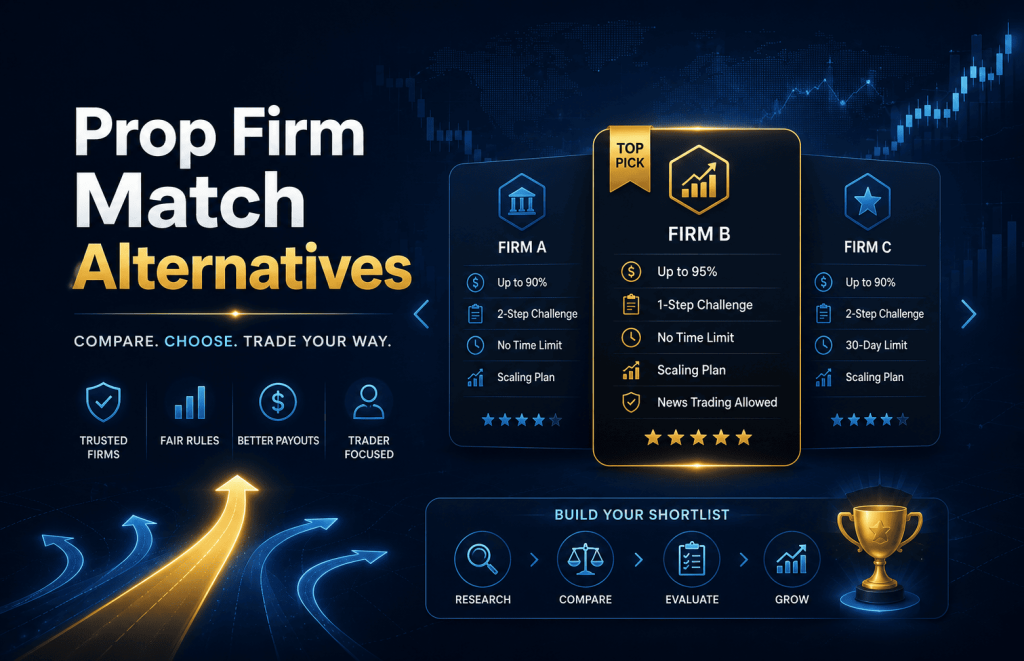
Use Prop Firm Match alternatives to build a wider research stack before you trust a single review source.
Never let a star score overrule the rule sheet. A firm can have strong reviews and still sell an account type that compresses your drawdown, blocks your holding period, or adds payout friction to your trade path.
Shutdown Risk: The Risk Traders Underprice
Shutdown risk is not abstract. If the firm closes, platform access, account data, pending payouts, support tickets and refund claims can disappear, freeze or become difficult to recover.
| Shutdown-risk signal | What it looks like | Why it matters | Trader action |
|---|---|---|---|
| Support slows down | Tickets take longer without a clear reason or timeline | Support weakness often appears before payout reliability breaks | Do not add new fees until support quality is clear |
| Payouts become vague | Payment windows stretch, approval language changes or “under review” becomes common | Pending profit becomes harder to treat as collectible | Save account data and reduce exposure while waiting |
| Payment options change suddenly | Processors, wallets or bank routes disappear without explanation | Payment infrastructure may be under stress | Verify payout routes before buying or upgrading |
| Platform migration is unclear | Login, server, data, pricing or execution changes are announced with weak detail | Account history and order execution can become harder to verify | Export account records before migration dates |
| Rules revise quickly | Terms, payout rules or restricted trading pages change with little notice | Old payout proof may no longer apply | Archive rule pages before trading and before payout request |
| Public communication turns defensive or silent | Announcements answer criticism vaguely or stop addressing trader concerns | Operational trust weakens when the firm stops giving verifiable details | Treat the firm as high-risk until evidence improves |
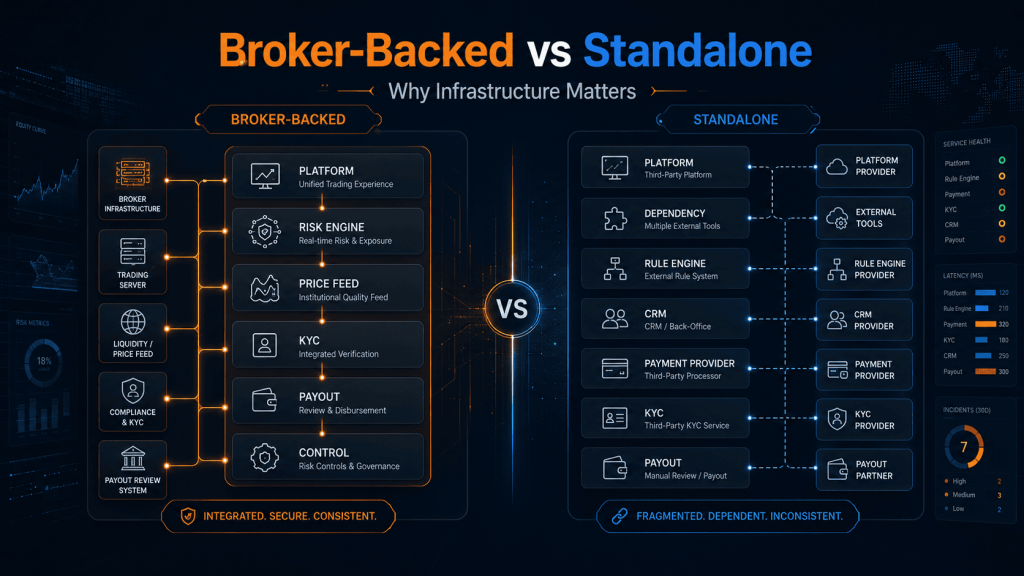
For infrastructure and counterparty analysis, read broker-backed vs standalone prop firms. A label does not make a firm safe, but operational depth can change the risk profile.
Alpha Insight: Legit Is a Failure Path Test
A prop firm is not legit because it has reviews. It is legit enough only when its incentives, rules, payout process and operating durability leave the trader with no hidden failure path.
The first failure path is contractual: the trader breaks or misunderstands a rule. The second is behavioural: fee pressure, payout timing or tight drawdown pushes the trader away from the strategy. The third is operational: the firm delays, changes, restricts or closes before the trader can receive valid profit.
Legitimacy is not a badge. It is a stress test.
How to Run a Due Diligence Audit Before Paying
Run the audit before payment. Once the fee is gone, the trader becomes emotionally attached to making the account work.
| Audit step | What to check | Block purchase if | Useful page |
|---|---|---|---|
| 1. Identify the firm | Legal entity, jurisdiction, website domain, support route and payment processor | The operator or contract counterparty is unclear | Terms checklist |
| 2. Read rules before pricing | Daily loss, max loss, trailing drawdown, consistency, news, holding, EAs, copiers and IP rules | You cannot explain the breach levels in cash terms | Challenge rules |
| 3. Check payout path | Minimum payout, KYC, review, buffer, open-position rules and first withdrawal timing | The firm advertises split but hides eligibility | First payout rules |
| 4. Verify evidence | Recent payout proof, review patterns, community complaints and tracker quality | Only affiliate or firm-owned proof exists | Payout proof verification |
| 5. Stress-test your strategy | Map the last 50 trades against the account rules without cleaning up losses | The normal losing streak breaches the account | Risk management strategy |
| 6. Start small | Use the smallest account that can test the firm, execution and payout path | The trader wants a large account before proving payout reliability | Choosing checklist |
Use AIFO as a Rule-Transparency Reference, Not a Shortcut
Last checked on : AIFO’s public materials separate comparison, terms, trading rules and payout process into different pages. That is the right structure to expect from any firm: the decision page should not replace the contract, the rules or the payout workflow.
| AIFO reference point | What it helps verify | How to use it | Official page |
|---|---|---|---|
| Best Prop Firm Decision Center | Rules clarity, payout confidence, account model fit, real cost and platform execution | Use it as a comparison framework, not as a substitute for due diligence | AIFO Best Prop Firms |
| General Terms | Contract party, simulated services, fictitious demo funds, restricted jurisdictions and fee terms | Use it to understand what “funded” and “account access” actually mean | AIFO General Terms |
| Trading Rules | Daily loss, maximum loss, consistency, holding, execution tools, restricted behaviour and violations | Use it to convert marketing claims into account-state checks | AIFO trading rules |
| Payout Process | Eligibility, review, approval, payout destination and final settlement | Use it to separate dashboard profit from payout-ready profit | AIFO payout process |
Do Prop Firms Use Real Money?
Some traders use “real money” as their only legitimacy test. That creates a false shortcut.
A firm can use simulated accounts and still pay valid profit shares. A firm can mention live capital and still create payout risk through review terms, routing rules or hidden restrictions.
The better distinction is between real payout, real execution, real market routing and real firm solvency. They are not the same thing.
A trader should read do prop firms use real money before trusting phrases like funded account, live capital or trade our money. The phrase may be marketing. The terms decide the trader’s rights.
What Traders on Reddit Are Really Asking
Forum threads are noisy, but the question behind them is sharp. Traders are asking whether they can trust the payout path after paying a fee and following the rules.
That is a better question than “are all prop firms scams?” The answer is not all firms, not all accounts and not all rules.
The practical answer is to read the rules, verify payout evidence, accept that many retail funded accounts are simulated, and pick a structure that matches your trading pattern. Then bring the decision back to your own account path. If the account only works when you change your trade plan, it is not the right firm for you.
FAQ
Some prop firms are legitimate funded trader programmes, while others operate with weak disclosure, unstable payout practices or scam-like behaviour. The safer test is not a brand label. Check company identity, rules, payout terms, review patterns, support quality and whether your strategy can survive the account structure.
The biggest red flags are vague payout terms, hidden fees, unclear company identity, sudden rule changes, broad abuse clauses, unrealistic capital offers, repeated payout complaints, weak payout proof and support silence after traders request withdrawals. A cluster of these signs is enough reason to walk away.
No. Payout proof is useful, but it does not make a firm safe on its own. It shows that at least some traders were paid under certain conditions. You still need to check payout eligibility, review rules, account type, KYC terms, trading restrictions and whether your own strategy could pass the same payout process.
Trustpilot reviews can help, but they should not be used alone. Read recent 1-star and 3-star reviews, check repeated complaint patterns, compare them with forums and official terms, and watch for review bursts around promotions or disputes. The review pattern matters more than the headline score.
Many retail prop firms use simulated accounts, even when payouts can be real under the firm’s reward model. Real payout, real execution, real market routing and real firm capital are separate questions. Read the terms before assuming that “funded” means live firm cash is placed behind every order.
If a prop firm shuts down, traders may lose access to accounts, pending payouts, challenge fees, dashboards, support tickets and account records. Recovery can be difficult, especially where the firm operates in a lightly supervised space. This is why operational history, payment stability and recent payout behaviour matter before payment.
Check the legal entity, terms, trading rules, payout process, KYC requirements, payout proof, recent reviews, shutdown signals, support response and strategy fit. Start with the prop firm due-diligence checklist before paying for any account.