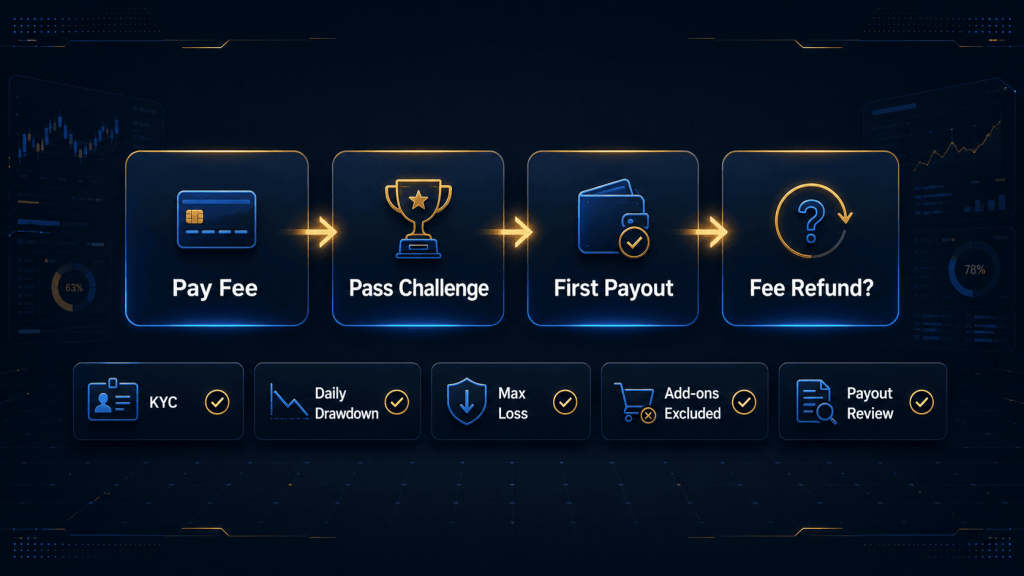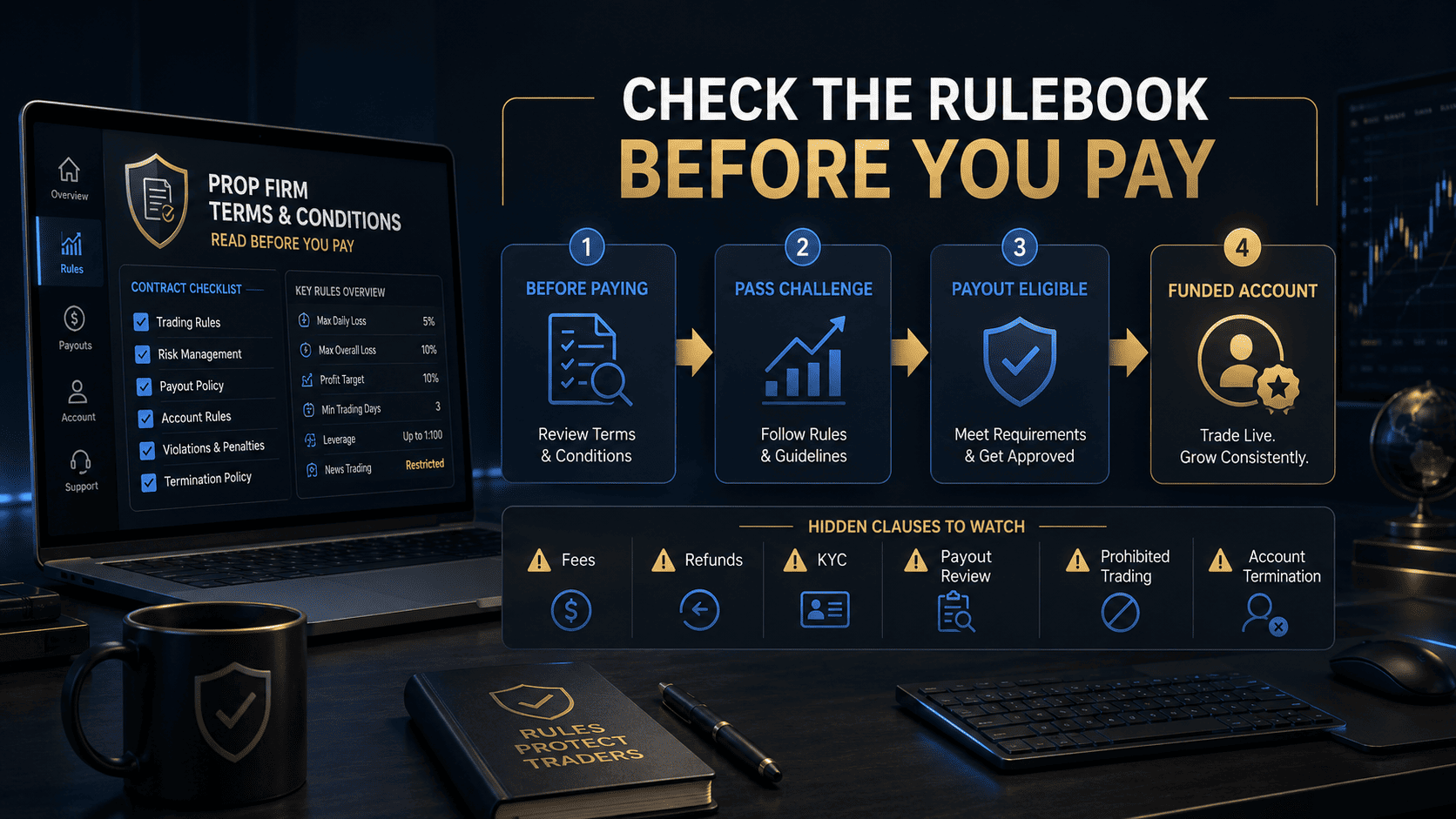



Prop firm terms and conditions are the account’s rule map before you pay. Read the clauses on fees, refunds, KYC, payout approval, prohibited trading, platform risk, account termination and rule changes first. A checkout page tells you the price. The terms tell you when that fee is lost, when a payout is not yet earned, and which trading behaviour can close the account. The safest trader is not the one who reads every legal word. It is the one who knows which clauses can change the trade path.
Use what to check before choosing a prop firm as the wider due diligence page, then use this checklist before paying. A prop firm agreement is not background paperwork. It decides what the firm can enforce when the account reaches a breach, refund request or payout review.
The 15 Clauses Traders Should Read First
Read the terms in the order that money and account risk appear. Start with payment, then account access, then trading rules, then payout and termination.
The table below turns each clause into a trading consequence. That is the only useful way to read prop firm terms.
| # | Clause to read | What it controls | Trading consequence | Question before paying | Where to verify |
|---|---|---|---|---|---|
| 1 | Contract acceptance | When the trader is legally bound by the terms | Creating an account, paying, logging in or trading may count as acceptance | At what action am I treated as accepting all terms? | General terms and checkout acceptance text |
| 2 | Service scope and incorporated policies | Whether the service is simulated and which linked documents form part of the agreement | A trader may misunderstand fictitious account funds, service scope or a rule that sits outside the main terms | Is trading simulated, and which policies control the account? | General terms, risk disclosure, product rules and linked FAQs |
| 3 | Fee and payment terms | What the challenge fee is and how it is paid | The fee may be a service fee, not a deposit or investment | Is this fee refundable, transferable or final? | Checkout page and the fee clause in the general terms |
| 4 | Refund and cancellation | When money can return to the trader | Starting any trade ends eligibility under AIFO’s standard 7-day refund policy; any mandatory statutory consumer right that may apply is separate | Which standard refund rules and statutory rights apply before I trade? | Refund FAQ, refund policy and general terms |
| 5 | Chargeback and payment dispute | How the firm treats payment disputes | A chargeback can suspend access or create additional costs | Do I need to contact support before disputing payment? | Chargeback or payment-dispute clause in the general terms |
| 6 | Account activation and expiry | How long the trader has to start or use the account | An unused account can expire without refund | When does the account activate, and when can access lapse? | Account-model page, order confirmation and expiry/inactivity terms |
| 7 | KYC, KYB and payment identity | Who can trade and receive payout | Name mismatch or failed verification can block access or withdrawal | Do my account, ID and payment method match? | KYC/KYB rules, payment-name rules and payout documentation |
| 8 | One account, account sharing and login security | Who may access the platform | Shared logins, third-party access or multiple client sections can trigger review | Can anyone else access my account or platform login? | Account-security, login and client-section terms |
| 9 | Trading objectives and account stage rules | Profit targets, phases, minimum days and funded-stage differences | Passing one stage does not mean the next stage has the same rules | Do challenge and funded-stage rules differ? | Program model page and account-specific rule page |
| 10 | Daily loss and maximum loss | The account’s hard risk boundaries | Floating loss, swaps and commission can breach the account | Is drawdown based on balance, equity, or both? | Trading rules, dashboard calculation and account-specific limits |
| 11 | Prohibited trading practices | Strategies the firm can reject | A profitable method can still be invalid if the behaviour is banned | Does my exact trading method fit the terms? | Prohibited-trading clause and restricted-trading FAQ |
| 12 | Automation, copy trading and third-party tools | Whether EAs, bots, copiers or signals are allowed | The wrong tool can fail the account even when trades are profitable | Are my tools clearly allowed on this account model? | EA, copy-trading and third-party-tool rules |
| 13 | Platform availability and third-party technology | Who bears platform, data, connection and software risk | Missed exits or login issues may not create compensation rights | Who is responsible if the platform or connection fails? | Platform page, outage wording and third-party software clauses |
| 14 | Payout approval and reward terms | When profit becomes payable | Dashboard profit may require KYC, review, closed positions and model-specific conditions; a 2% retained profit buffer applies to Instant accounts only | When is payout actually earned and approved? | Payout rules, payout process and account-specific withdrawal terms |
| 15 | Rule changes, governing law and dispute process | How terms can change and where disputes are handled | The trader may need to accept updated rules by continuing to use the service | How are updates, complaints and disputes handled? | Terms update clause, complaints process, governing law and jurisdiction in the general terms |
Fees, Refunds and Chargebacks
The fee clause decides the real cost of the challenge. Do not assume the fee is a deposit, investment or account balance.
Refund terms are usually narrow. The refund path can disappear after the account is activated, after trading starts, after a breach or after the trader misses a time window.
Last checked on : Without prejudice to any mandatory statutory consumer withdrawal right, AIFO’s standard refund policy permits a full refund only where the trader has not started any trading and submits the refund request within 7 days of payment. This standard refund policy does not apply to Sprint accounts. Read the AIFO refund FAQ and AIFO general terms and conditions before treating any payment as recoverable.
Chargebacks need care. AIFO’s public terms currently require the customer to contact support and allow at least 14 calendar days for resolution before using chargeback or similar dispute services. A payment dispute can affect account access, future services or additional costs. Treat payment disputes as a legal and account-status issue, not a quick support shortcut.
For the wider fee framework, read prop firm challenge fee refund rules before checkout. A refundable fee is not the same as a free challenge.
Verification note: Refund wording, account eligibility and promotions can change. Save the version shown at checkout and record the date on which you checked it.
KYC, Account Ownership and Payment Name
KYC clauses decide whether the person who bought the challenge can receive the account and payout. The trading result can be clean while the admin path fails.
Name mismatches create avoidable problems. The payment method, account owner, identity document and payout method should line up before money is paid.
Read these clauses before buying through a friend, business account, family card, shared wallet or third-party payment provider. Some firms can request payment ownership proof. Some can block payout or account access when identity verification fails.
The safest action is simple. Use your own account, your own payment method, your own ID and matching payout details. Do not fix identity problems at first payout.
Simulated Account Status and Service Scope
Check whether the account is a simulated evaluation service, a real-money trading account, or a route that may lead to a separate trader agreement. These are different legal and operational relationships.
Last checked on : All AIFO account types, including Free Trial Accounts, Challenge Accounts and simulated Funded Accounts, operate in a simulated trading environment using virtual funds only. Trades do not constitute actual financial-market transactions. That wording changes how traders should interpret account balance, “funded” status and reward eligibility.
Before paying, identify which document controls the simulated account, which conditions apply to any later trader programme, and whether reward or payout eligibility is governed by a separate agreement or rules page. Do not infer service scope from marketing language alone.
Trading Objectives and Drawdown Rules
The trading objectives clause defines how the account fails. This is where profit target, daily loss, maximum loss, minimum days, consistency and stage rules live.
Read the formula, not just the percentage. A 5% loss limit can behave differently depending on balance, equity, reset time and open trades.
AIFO’s rule centre is built around daily loss, maximum loss, risk per trade and allocation. Read AIFO trading rules before choosing size or holding positions across server reset. The rule page matters because it turns the account from a number on a dashboard into a live risk boundary.
Pay special attention to whether challenge-stage rules and funded-stage rules differ. Passing the evaluation does not remove risk limits. It usually moves the account into another rule set. For accounts purchased before 1 September 2026, the challenge parameters displayed on the Dashboard prevail.
Prohibited Trading Practices
This is the clause most traders underestimate. It decides whether a profitable strategy is acceptable.
Prohibited trading clauses often cover more than obvious cheating. They may include latency methods, price-feed exploitation, abnormal spreads, arbitrage, group trading, copy trading, account management, third-party signals or strategies that cannot be replicated under live market conditions.
| Practice area | Why it can trigger review | Trader mistake | Safer action |
|---|---|---|---|
| Latency or quote exploitation | Profit may come from platform delay rather than market risk | Calling technical edge normal execution | Check whether the method would work under live market conditions |
| News spike abuse | Some firms restrict trading around extreme market events | Assuming challenge-stage permission equals payout-stage permission | Read event-window and payout review wording |
| Copy trading or signals | The firm may require independent trading decisions | Copying another trader and treating it as your strategy | Use only methods explicitly allowed in the rules |
| Automation or EAs | Some firms allow tools; others ban them | Assuming all MT5 tools are permitted | Check account-model wording before connecting software |
| Account sharing | The person trading may not match the account owner | Letting another person manage or access the account | Keep account access and execution under the approved trader |
For AIFO specifically, Expert Advisors are allowed only on 1-Step and 2-Step challenge accounts and their corresponding simulated funded accounts. Do not infer EA eligibility for Instant, AIFO One or Sprint accounts.
The question is not whether the strategy made profit. The question is whether the terms allow the way that profit was made.
Platform Risk and Third-Party Software
Platform clauses decide who bears technical risk. Many traders only read this after a missed exit, disconnect or failed copier command.
Terms often place third-party software, internet access, device setup and platform-use risk on the trader. That affects EAs, trade copiers, data feeds, browsers, VPS setups and login management.
If the account relies on a third-party tool, read the tool clause before paying. Ask whether the firm supports the tool, merely permits it, or leaves the risk fully with the trader.
This clause can decide whether a platform problem becomes a firm issue or your account issue. Do not assume support will repair the account after a technical failure.
Payout Approval and Reward Terms
Payout clauses decide when profit becomes money. A green dashboard is not the same as approved payout.
AIFO payout conditions are model-specific. They can include KYC, payment verification, trade review, concentration or consistency rules, minimum amounts, model-specific buffers and open-position requirements.
Last checked on : AIFO’s general payout rule sets a $100 minimum and a $10,000 maximum per request, with requests generally processed within 1–3 business days. The standard payout cycle for 1-Step and 2-Step simulated funded accounts is 14 days; those accounts have no consistency-score requirement and no 2% profit buffer. Instant requires the best single day to remain below 20% of total payout-period profit and requires a 2% profit buffer after a payout to keep trading; a full payout closes the account. AIFO One requires the best single day to remain below 15% of payout-period profit and has no payout buffer. Sprint allows one payout only, requires the request within 30 days and is processed within 1 business day, excluding additional compliance review. Read the AIFO payout rules and AIFO payout process for the conditions that apply to the specific account.
A high profit split is useful only on profit that is eligible and approved. That is the difference between dashboard profit and payout-ready profit.
For the wider industry framework, use prop firm payouts. Payout friction is where many terms become real.
Verification note: Save the payout-rule version, account model and request date. For accounts purchased before 1 September 2026, the challenge parameters displayed on the Dashboard prevail.
Alpha Insight
The hidden pressure is that terms define failure before the trader pays. A trader usually reads the marketing page first, the checkout page second, and the terms last. That order is backwards.
The terms decide whether a fee is refundable, whether a payout is earned, whether a platform problem is your risk, and whether a profitable strategy is allowed. The agreement is not paperwork after the trade. It is part of the trade path.
Red Flags Before You Pay
Bad terms are not always long. Good terms are not always short. The issue is whether the rule consequences are clear.
If a clause can close the account or block payout, it should be easy to identify before checkout.
| Red flag | Why it matters | What to ask before paying |
|---|---|---|
| Rules are split across many pages with no clear hierarchy | You may miss the document that controls the dispute | Which document wins if two pages conflict? |
| Refund wording is vague | The fee may be lost once trading starts | What exact event creates refund eligibility? |
| Payout is called a reward but approval wording is broad | Profit may be reviewed before it is payable | When is payout earned, approved and paid? |
| Prohibited trading wording is wide | A strategy may be profitable but invalid | Does my exact method fall inside any banned category? |
| Platform responsibility is pushed to the trader | Technical issues may not create compensation | What happens after a platform outage or copier error? |
| Terms can change by continued use | Trading after an update may count as acceptance | How will I be notified of rule changes? |
If payout is your main concern, read why prop firm payouts get denied before paying. Most payout disputes start as terms misunderstandings.
Final Pre-Payment Checklist
Before paying, save the rules that matter. Take screenshots or PDFs of the account model, checkout price, refund page, trading rules, payout rules and terms version. Include the visible effective date or version number where available, and record the date on which each page was downloaded.
You do not need to become a lawyer. You need to know what can end the account.
| Check | Question | Do not pay until |
|---|---|---|
| Fee | Is the fee a service fee, deposit, credit or refundable amount? | You know what happens after failure, cancellation and breach |
| Activation | When does the account start? | You know whether opening the first trade changes refund rights |
| KYC | Can your identity and payment details pass review? | Name, address and payment method match |
| Risk rules | What exactly breaches daily loss and max loss? | You can calculate the limits in cash |
| Strategy permission | Is your method clearly allowed? | You have checked automation, copy trading, news and holding rules |
| Payout | What has to happen before profit is approved? | You know the review, buffer, minimum amount and open-position rules |
| Dispute path | How are complaints, chargebacks and legal disputes handled? | You know who to contact and what process applies |
Use a prop firm challenge checklist before placing the first trade. The best time to understand the terms is before the account has something to lose.
Start with fees, refunds, account activation, KYC, trading objectives, prohibited trading, payout approval and termination clauses. These clauses are most likely to affect your payment, account status and withdrawal path.
They usually are treated as binding once the trader creates an account, pays, logs in, trades or otherwise uses the service. The exact acceptance trigger depends on the firm’s wording.
Yes. Payout can be delayed, adjusted or denied if the trader fails KYC, violates trading rules, uses prohibited methods, has open-position issues, misses payout conditions or triggers review concerns.
The prohibited trading clause is often the most dangerous because it can invalidate a profitable strategy. Traders should check automation, copy trading, news trading, arbitrage, latency and account-sharing wording before paying.
Terms can change, and some agreements treat continued use after an update as acceptance. Traders should save the terms version at purchase and check account notices, dashboard updates and email notifications.
Yes. Marketing pages explain the offer. Terms explain what happens when something goes wrong: breach, refund request, payout review, platform issue, KYC failure or dispute.