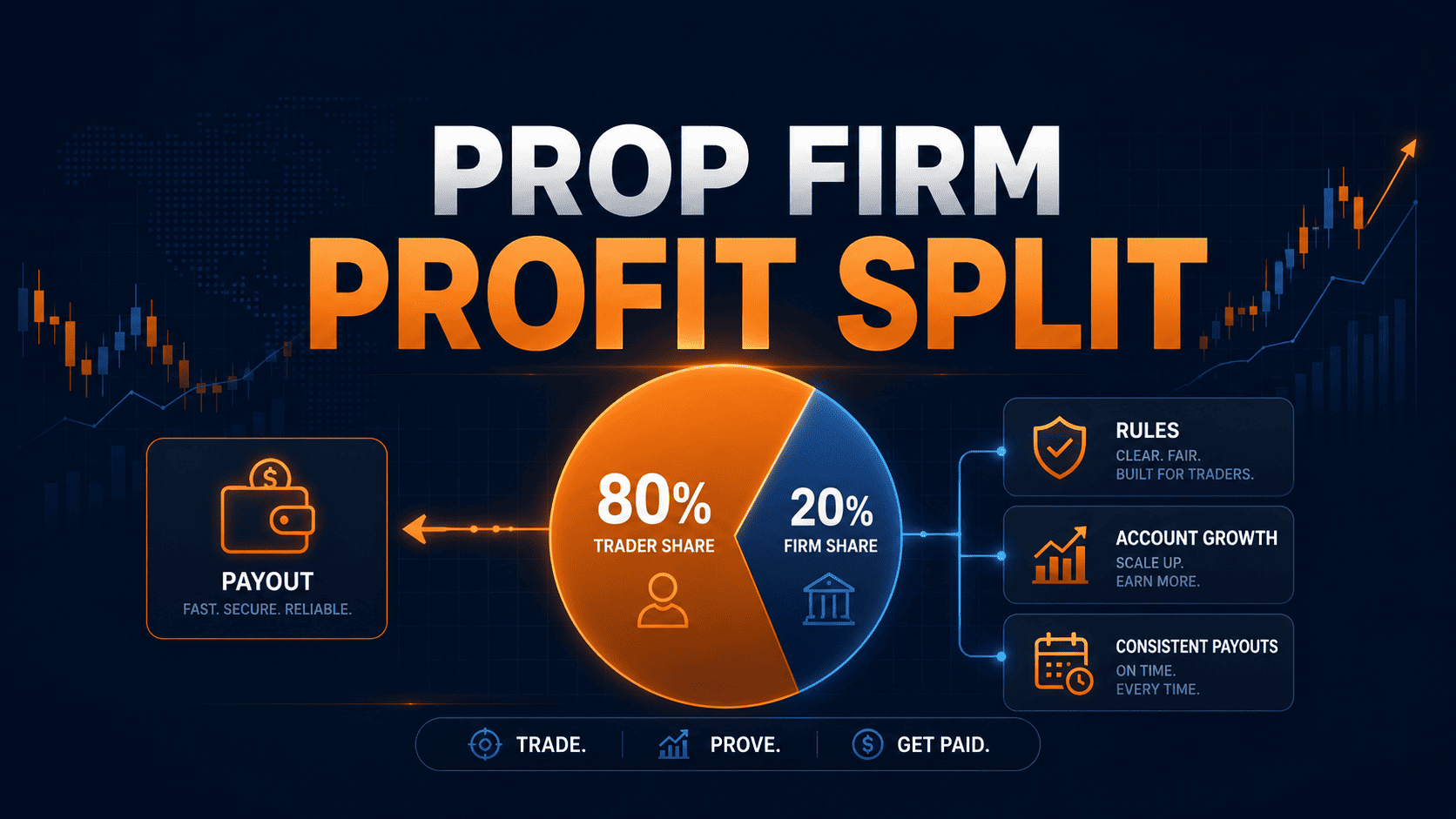



A prop firm profit split is the percentage applied to payout-eligible profit after the account has met the relevant withdrawal conditions. It is not the same as total dashboard profit, payout-ready profit or approved cash received. A higher percentage can still produce a lower usable payout when the offer has a tighter buffer, cap, upgrade path or review gate.
This article is the detailed profit-split guide inside the prop firm payouts hub. Use it to separate the base split, higher-split route, eligible profit, payout buffer and final approved amount. For current AIFO account conditions, check the official payout rules and payout process.
Six Profit and Payout Numbers You Must Keep Separate
The phrase “profit split” makes sense only after you know which amount the percentage is applied to. Keep these six numbers separate:
| Number | What it means | Common mistake | Correct use |
|---|---|---|---|
| Dashboard profit | Total profit currently displayed on the trading account | Treating the full amount as immediately withdrawable | Use it as the starting figure only |
| Payout-eligible profit | Profit that satisfies the account’s withdrawal, consistency, review and compliance conditions | Assuming every profitable trade has already passed payout review | Confirm the exact eligibility rules for the account model |
| Payout-available profit | The amount remaining after any required buffer, cap or non-withdrawable portion | Applying the split before subtracting the amount that must stay in the account | Use the written calculation order shown by the firm |
| Nominal profit split | The advertised percentage, such as 80%, 90%, 95% or 100% | Comparing the percentage without comparing its conditions | Record whether it is the base, upgraded, one-time or maximum split |
| Approved payout | The amount accepted after account and payout review | Confusing a submitted request with an approved payment | Use the approved amount when measuring the real result |
| Effective share of dashboard profit | Approved cash received divided by the dashboard profit used in the comparison | Assuming the advertised split equals the percentage of all visible profit received | Use it to compare the complete payout path |
How Higher Profit Splits Are Structured
Two firms can both advertise “up to 95%” while using completely different routes to reach that percentage. Before comparing the number, identify the structure behind it.
| Profit-split structure | How it may work | What to verify | Main comparison risk |
|---|---|---|---|
| Base split | The standard percentage attached to the account without an upgrade | The exact account model, stage and first eligible payout | Comparing another firm’s maximum split with this firm’s base split |
| Purchased add-on | A higher split is selected or paid for during checkout | Added cost, refund treatment and whether the upgrade applies to every payout | The higher percentage may not recover the extra purchase cost |
| Scaling or performance tier | The split rises after account growth, payout history or another milestone | The milestone, review period and whether the upgrade can be lost | The advertised maximum may not be available at the start |
| One-time enhanced split | One qualifying payout receives a higher percentage | The profit threshold, eligible request and split used afterward | A temporary rate is mistaken for the permanent account split |
| Limited 100% structure | The trader receives 100% of a defined eligible amount, threshold, cycle or account type | Calculation base, duration, cap, account model and remaining payout gates | “100%” is treated as 100% of all dashboard profit forever |
Write the full label in your comparison sheet. For example: “80% base”, “95% after add-on”, “95% one-time enhanced payout” or “100% up to a stated cap”. Do not record only the largest percentage.
Same $7,000 Profit: 80%, 90%, 95% and 100% Compared
The table below uses one identical profit result so the only changing field is the nominal split.
Illustration assumptions: this is an AIFO Instant-account buffer example. A $100,000 Instant account shows $7,000 dashboard profit, $2,000 must remain as a buffer if the trader wants to continue trading, and there are no other caps, fees, or deductions. The payout-available amount is therefore $5,000 before applying the profit split. The mandatory 2% buffer does not apply to 1-Step, 2-Step, or Sprint. The 100% row is a hypothetical comparison and does not state that AIFO offers a 100% split.
Payout-available profit = $7,000 − $2,000 = $5,000
| Nominal split | Dashboard profit | Retained buffer | Amount used for the split | Trader payout | Effective share of dashboard profit |
|---|---|---|---|---|---|
| 80% | $7,000 | $2,000 | $5,000 | $4,000 | 57.1% |
| 90% | $7,000 | $2,000 | $5,000 | $4,500 | 64.3% |
| 95% | $7,000 | $2,000 | $5,000 | $4,750 | 67.9% |
| 100% | $7,000 | $2,000 | $5,000 | $5,000 | 71.4% |
The 20-point difference between an 80% and 100% nominal split creates a $1,000 difference in cash in this example because the split is applied to $5,000, not to the full $7,000 dashboard profit.
How AIFO’s Current Profit Split Is Structured
Last checked on : AIFO’s public pages advertise profit splits of up to 95%, but the route depends on the program and account configuration. Do not assume every AIFO account starts at the same percentage or reaches 95% in the same way.
| Current public AIFO item | Published wording or range | How to interpret it | Where to verify |
|---|---|---|---|
| Overall maximum | Up to 95% profit split | This is a maximum headline, not proof that every account starts at 95% | AIFO payout rules |
| Instant accounts | 80%–95% profit split and payout on demand | Withdrawal, consistency and account-specific conditions still need to be met | AIFO Instant program |
| Profit-split add-on | Profit-split increase capped at 95% | Confirm the exact purchase option, price and account model at checkout | AIFO models |
| Enhanced payout | One-time 95% profit split after closed net profit first reaches at least 6%, under the current published wording | Confirm account eligibility, request timing and the split that applies after the enhanced payout | AIFO payout rules |
| Payout buffer | Instant only: retain 2% of the initial account balance to continue trading after payout; withdrawing the buffer closes the Instant account. | The split is applied to the payout-available amount shown by the applicable rules | AIFO payout buffer FAQ |
AIFO’s payout process also states that the account must meet the relevant trading, consistency, review and withdrawal conditions before the eligible profit split is released. Use the exact account model, checkout configuration, dashboard and current official rules instead of combining separate maximum, add-on and enhanced-payout statements into one universal promise.
Verification note: Save the account model, selected add-ons, rule version and date checked before calculating the take-home amount.
How to Read a 100% Profit Split Claim
A 100% profit split is not automatically false and it is not automatically the best offer. It means 100% of an amount that must be defined by the account terms.
| Question to answer | What a complete answer should identify | What happens if it is ignored |
|---|---|---|
| 100% of what? | Dashboard profit, net profit, payout-eligible profit or an approved payout amount | The trader applies the percentage to the wrong base |
| Which account model? | The exact evaluation, instant, funded-style, futures or promotional account | A rate from one product is copied into another |
| When does it begin? | The first payout, a profit threshold, a scaling level or another milestone | The trader expects the higher rate before qualifying |
| How long does it last? | One payout, a limited number of cycles, a capped amount or all future eligible payouts | A temporary offer is treated as permanent |
| Is there a cap? | A maximum cash amount, lifetime threshold or payout count | The trader overestimates the total value of the offer |
| Which gates still apply? | Buffer, minimum payout, consistency, review, KYC, payment and prohibited-activity checks | The split looks generous but the account is not payout-ready |
Only compare a 100% offer with an 80%, 90% or 95% offer after all six fields are known. Otherwise, the percentages are not describing the same payout product.
Alpha Insight: Compare the Effective Split, Not Only the Nominal Split
Effective share of dashboard profit = approved cash received ÷ dashboard profit × 100
In the $7,000 example above, the effective share is 57.1% at an 80% nominal split, 64.3% at 90%, 67.9% at 95% and 71.4% at 100%. The gap exists because $2,000 remains outside the split calculation.
This metric does not prove that a payout structure is good or bad. It makes the denominator visible and stops the advertised percentage from being confused with the share of all dashboard profit that reaches the trader.
Red Flags in High Profit Split Offers
A high split should make you ask more questions, not fewer. The higher the percentage, the more important the payout path becomes.
Do not choose a funded account only because the split looks bigger in a table.
| Red flag | Why it matters | Question to ask before buying |
|---|---|---|
| “Up to 95%” with no route explained | The highest split may need scaling, add-ons or selected models | What do I need to do to receive the advertised split? |
| 100% payout with vague limits | The split may apply only to certain approved payouts | Does 100% apply to all payouts, first payouts or a capped amount? |
| No buffer explanation | Dashboard profit may not equal withdrawable profit | How much profit must remain in the account? |
| Minimum payout hidden | Small profits may not be requestable | What is the minimum withdrawal amount? |
| Review language is broad | The firm can check how profit was made | Can consistency, news trading or restricted methods delay payout? |
| Open positions not addressed | Floating exposure can block payout requests | Can I request payout with open positions or pending orders? |
Read why prop firm payouts get denied before treating a high split as safe. Payout denials usually start with a misunderstanding of eligibility, not with the split itself.
Final Checklist Before Choosing a Profit Split
Choose the split after reading the payout path. A lower split with cleaner withdrawal rules can be better than a higher split with strict review friction.
Before buying, write down these answers:
| Check | Why it matters | Safe answer |
|---|---|---|
| Current split | Shows the default payout share | You know the base split without add-ons |
| Higher split path | Shows what is needed for 90%, 95% or 100% | You know whether it needs scaling, add-ons or thresholds |
| Eligible profit | Shows what the split applies to | You can separate dashboard profit from payout-ready profit |
| Buffer | Shows how much must remain after withdrawal | You know the post-payout account cushion |
| Minimum payout | Shows when a request can be submitted | You know the smallest requestable amount |
| First payout conditions | Shows the first real cash path | You have read first payout rules in prop firms |
The best profit split is the one you can actually receive without changing your trading behaviour. If a higher split makes you overtrade, hold too long, chase a minimum amount or ignore review rules, the account is training the wrong habit.
Profit split is the percentage of approved eligible profit paid to the trader. An 80% split means the trader receives 80% of the eligible payout amount, while the firm keeps 20%.
Not automatically. A 90% split pays more only if the account reaches payout eligibility cleanly. An 80% split with fewer buffer, review or consistency obstacles can be better in practice.
AIFO’s public pages currently advertise profit splits of up to 95%. The Instant program lists an 80%–95% range, while other routes may use an add-on or a one-time enhanced-payout condition. Exact base split, eligibility, consistency, buffer and review requirements depend on the account model and current terms. Check the official payout rules, account setup and dashboard before calculating the take-home amount.
It means 100% of the amount defined as eligible by that offer. It does not automatically mean 100% of all dashboard profit. Confirm the calculation base, account model, duration, cap, buffer, review and whether the 100% rate is one-time or ongoing.
The calculation order is firm-specific. In AIFO’s current published Instant-account buffer example, the required 2% buffer is subtracted from account profit first when the trader wants to continue the Instant account, and the profit split is then applied to the payout-available amount. This buffer does not apply to AIFO 1-Step, 2-Step, or Sprint. Check the AIFO payout buffer FAQ and do not assume every firm uses the same order.
Check the base split, upgrade conditions, payout buffer, minimum payout, consistency rules, KYC, open-position rules, payout timing and review language. The highest split is not always the best payout path.