


To become a funded trader, build a repeatable trading process, prove that its drawdown fits the selected account rules, practise consistent execution and complete the required evaluation or account review without breaching its limits. Buying an account is only access to the process; strategy quality, risk control, documentation and rule discipline determine whether the trader is ready to operate after funding.
How to Become a Funded Trader: Key Points
- Separate obtaining an account from developing funded-trader skills.
- Prove the strategy with process metrics, not one profitable week.
- Size risk from available drawdown and normal losing streaks.
- Choose a model that fits the strategy’s pace and drawdown pattern.
- Prepare for the funded phase, KYC and payout review before the evaluation ends.
Last AIFO FAQ review: . AIFO model and Free Trial facts in this guide come from the current FAQ articles. No outcome or income is guaranteed.
A funded trader is not simply someone who has paid for a prop firm challenge. The role begins with a tested process and continues after evaluation, when daily risk, account status, documentation and payout eligibility still matter.
If you first need the definition, read what a funded trading account means and how it works. If you want the application sequence, use the step-by-step funded account guide. This page focuses on the skills and 90-day preparation roadmap behind those steps.
What Does a Funded Trader Do?
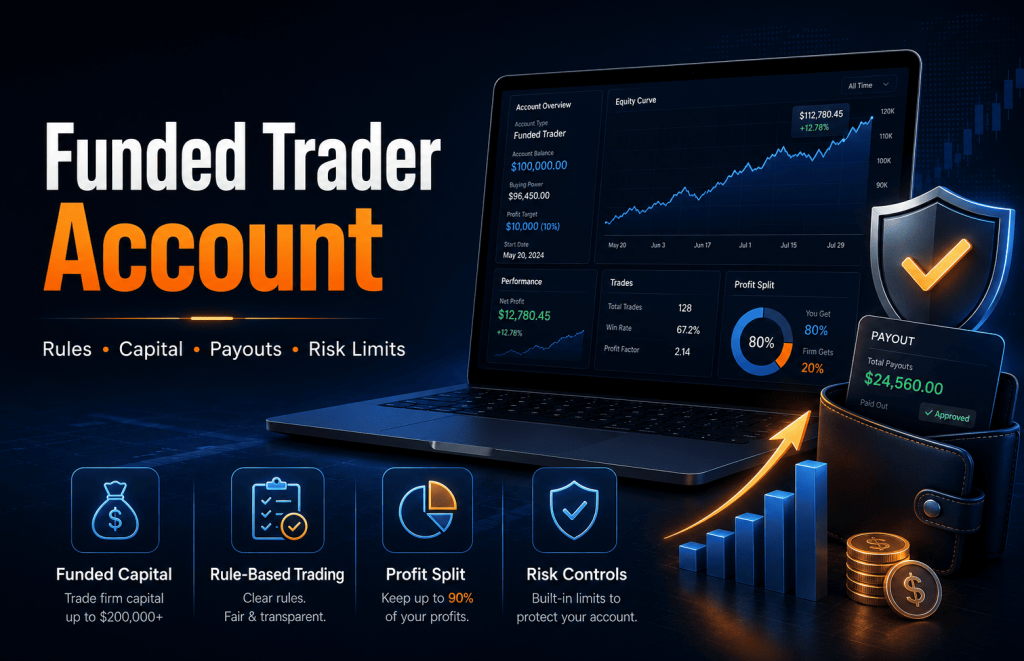
A funded trader operates inside an account framework with defined loss limits, trading permissions and review conditions. The trader’s job is to execute an approved strategy while protecting the account from avoidable rule breaches.
That creates four responsibilities:
- Produce valid trades: take only setups that match the written strategy.
- Control account risk: keep each trade, each day and the total drawdown inside both personal and account limits.
- Preserve evidence: maintain a journal and platform history that explain the trading process.
- Remain operationally eligible: follow account, verification and payout requirements after progressing.
Skills You Need Before Funding
| Skill | Evidence | Common failure signal |
|---|---|---|
| Strategy definition | Written setup, invalidation and exit rules | The entry reason changes after the trade |
| Risk sizing | Planned money risk and position-size calculation | Volume is chosen before the stop distance |
| Drawdown control | Worst tested losing sequence and recovery behaviour | Risk increases after losses |
| Execution discipline | Planned-versus-realised entry, stop and exit | Frequent impulse trades or late stop changes |
| Rule literacy | A one-page account rule sheet | The trader relies on memory or an old review |
| Review process | Complete journal, screenshots and weekly audit | Only winning trades are reviewed |
Build a Verifiable Track Record
A useful track record explains how the result was produced. Net profit alone can hide oversized trades, one exceptional winner or a drawdown that would breach the intended account.
Record at least:
- number of planned and unplanned trades;
- win rate and average win/loss in R;
- expectancy per trade;
- maximum drawdown and longest losing streak;
- risk per trade and daily risk used;
- rule violations, even when the account did not detect them;
- performance by setup, market and session.
The sample should include ordinary losing periods. If the plan only works when every early trade wins, it is not ready for a rules-based account.
Choose the Right Account Model
Account selection is a strategy-fit decision. Compare the profit objective with the total loss room, then check daily loss, phase count, minimum trading days, moving or static drawdown and payout conditions.
The current AIFO FAQs provide examples of different structures:
- AIFO 1-Step: one evaluation phase with a 10% target, 3% Daily Loss, 6% Static Maximum Loss and at least two trading days.
- AIFO 2-Step: 8% and 5% phase targets, 5% Daily Loss, 10% Static Maximum Loss and at least three trading days before progression.
- AIFO Instant: immediate access without a traditional evaluation, with a 3% Daily Loss rule, a 5% high-water-mark Maximum Loss and payout-specific conditions.
Those differences do not create a universal best model. A selective strategy may value time flexibility, while a strategy with deeper normal drawdown may need more total loss room. Read the FAQ for the exact account you intend to use before purchase.
A 90-Day Roadmap to Become a Funded Trader
| Period | Primary work | Exit test |
|---|---|---|
| Days 1–15 | Define one setup, stop logic, exit rules and trading window | Another trader could understand the written rules without verbal explanation |
| Days 16–30 | Collect a clean demo sample with fixed risk | Planned and realised risk are consistently close |
| Days 31–45 | Measure expectancy, drawdown and losing streaks | The normal drawdown fits inside the intended account with a safety margin |
| Days 46–60 | Simulate account rules, daily stops and server-day boundaries | No hard-rule breach and no trade taken after the personal stop |
| Days 61–75 | Stress-test weak market conditions and operational errors | The trader reduces activity instead of forcing setups |
| Days 76–90 | Run a full rehearsal and complete account selection | Strategy, model, risk sheet and review routine agree |
Ninety days is an organising framework, not a promise. Extend any stage when the evidence is weak. Paying for an evaluation does not repair a missing edge or an unstable risk process.
Pass Without Over-Risking
Start with the failure buffer, not the nominal account size. Estimate how many normal full losses the account and the personal daily stop can absorb. Then set risk low enough that a routine losing sequence does not force a behavioural change.
The risk-per-trade guide uses daily-loss room, maximum-loss room and losing-streak survival to size a trade. The risk-reward ratio guide explains how win rate and average payoff combine.
Operate After Funding
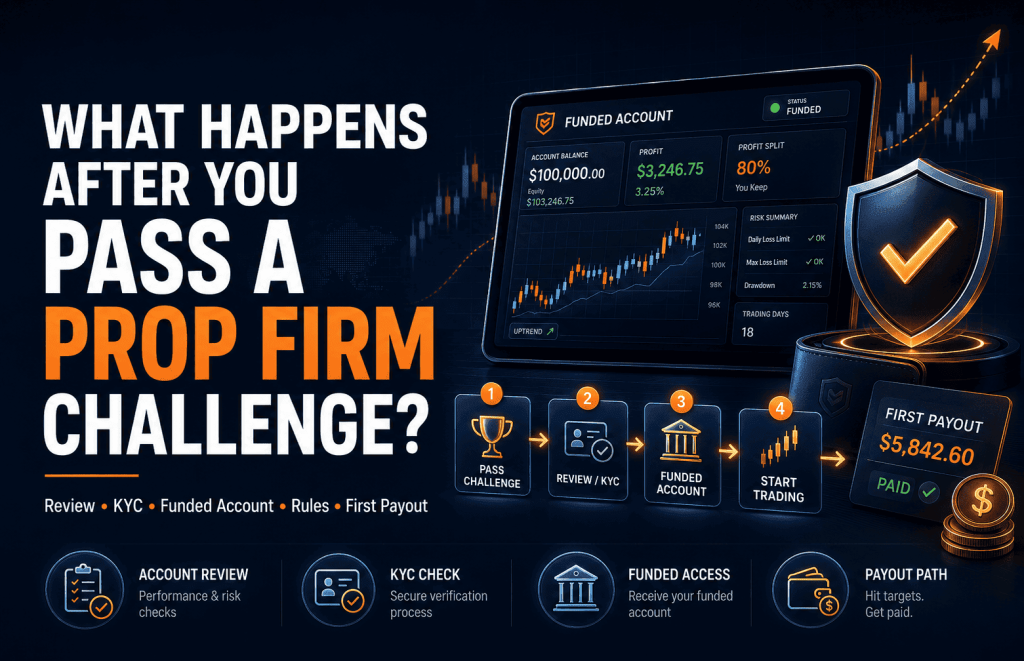
Passing an evaluation is a transition, not permission to increase risk. After funding:
- reconfirm the funded-stage rules and account status;
- keep the same or lower working risk until enough new data exists;
- avoid changing strategy because a payout date is approaching;
- complete KYC and payment details when required;
- close positions and pending orders before a payout request when the relevant FAQ requires it;
- retain journals and screenshots for review.
Funded Trader Readiness Checklist
- I can state my setup, invalidation and exit rules in writing.
- I know my expectancy, maximum drawdown and normal losing streak.
- I calculate position size from stop distance and money risk.
- I have a personal daily stop inside the account’s hard limit.
- I have completed a rule-compliant practice sample without resetting after losses.
- I understand the exact FAQ for the account model I may choose.
- I can continue the same process after a win, loss or near-target day.
Frequently Asked Questions
Build and document a repeatable strategy, control risk, learn the selected account rules, verify the process in a meaningful practice sample, choose an account model that fits the strategy and complete the required review without breaching its limits.
A trader should have evidence that the process has positive expectancy and manageable drawdown before paying for an evaluation. A short winning streak is not enough; review rule adherence, losing sequences and execution consistency.
The core skills are strategy definition, position sizing, loss-limit awareness, controlled execution, emotional discipline, record keeping and the ability to follow account-specific rules under pressure.
There is no reliable universal timeline. It depends on the trader's starting skill, strategy sample, drawdown, account model and ability to follow rules. A 90-day roadmap can organise preparation, but it does not guarantee funding.
No. Buying a challenge only creates access to an evaluation. The trader still needs to meet the relevant objectives, remain within the rules and complete any required review before progressing.
Yes, as a practice tool. The AIFO Free Trial lets registered users test the trading environment and rules with simulated funds. It does not provide a funded account or profit sharing.