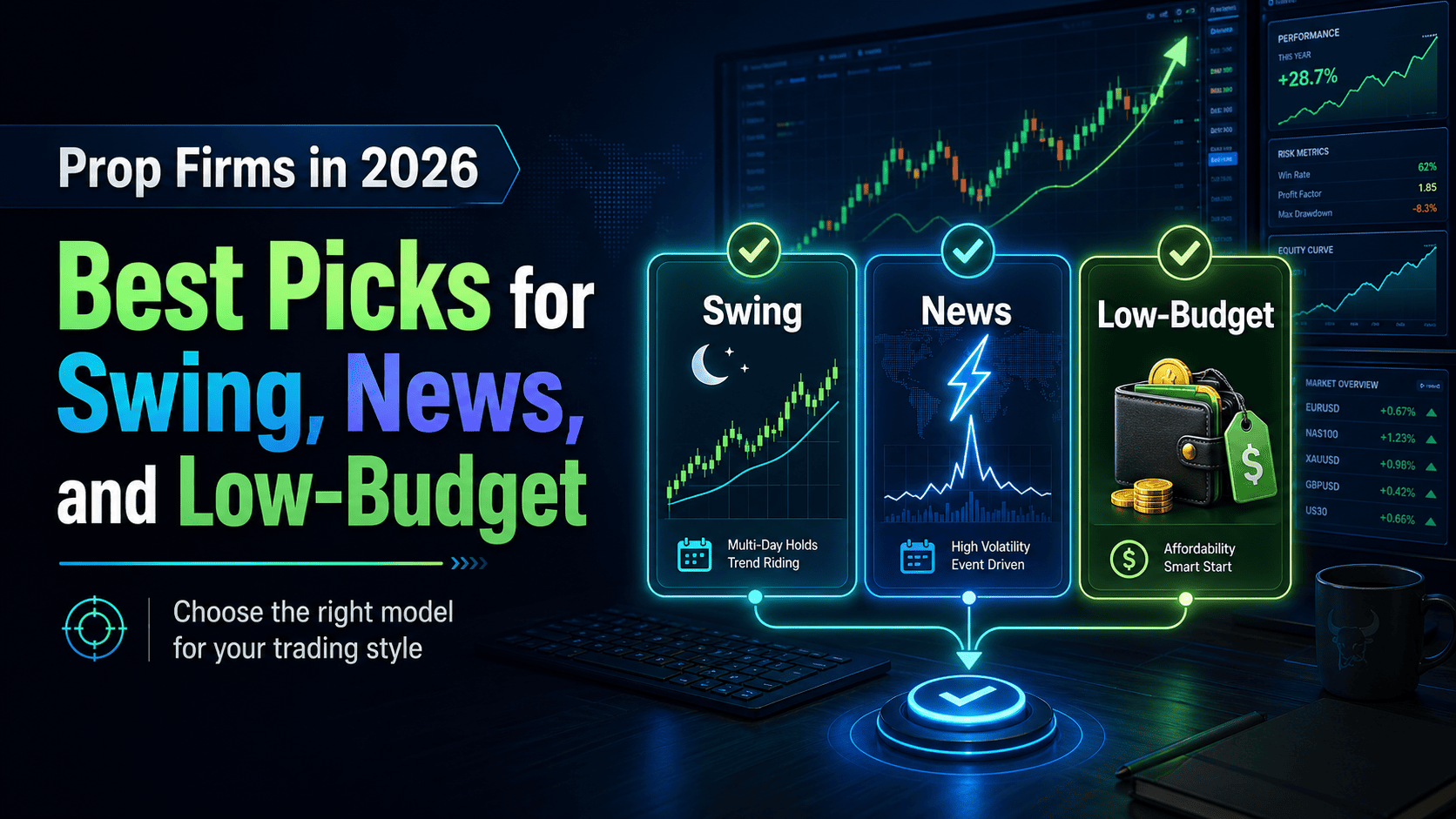


The best prop firm in 2026 depends on the trade path you need to protect. Swing traders should choose a firm with clear overnight and weekend holding rules. News traders need exact event-window rules, including whether entries, exits, pending orders and stop triggers are restricted. Low-budget traders should start with a free trial or small challenge, not the cheapest advertised checkout price. The clean matrix answer is simple: pick the firm that changes your trading behaviour the least.
The 2026 prop firm matrix: the direct answer
The best pick is not one firm for every trader. The best pick is the rule box that lets your strategy behave normally.
A swing trader, news trader and low-budget beginner are not buying the same thing. They may all click on a “best prop firm” article, but they need different protection from the rules.
That is why this matrix starts with trader type, not firm name. A normal ranking asks who has the best rating, discount or payout badge. A trader’s matrix asks a harder question: which firm will not force me to break my own method?
Use AIFO account models as the model layer, then use the rule pages to check whether the account path fits the way you actually trade.
| Trader type | Best pick in 2026 | First rule to check | What to avoid |
|---|---|---|---|
| Swing trader | A firm with explicit overnight and weekend holding permission | Holding rules, daily reset, maximum loss, swap and gap risk | Day-trading accounts that force you flat before the trade develops |
| News trader | A firm with exact news-action rules | Open, close, modify, pending order and profit treatment rules | Vague “news allowed” claims with hidden review language |
| Low-budget trader | A free trial or small structured challenge with clean rules | Total cost, reset risk, payout minimums and consistency rules | Cheap entry fees that lead to repeated failed attempts |
| Futures day trader | A futures-focused day-trading model with clear flat rules | Trading hours, contract limits and end-of-day rules | Using a futures day-trading account for swing behaviour |
| Mixed-style trader | A multi-model firm with clear account-type separation | Model rules, payout path and restricted behaviour | Assuming one account type covers every strategy |
Best pick for swing traders: holding freedom with drawdown room
The best prop firm for swing trading is one that lets positions stay open long enough for the setup to work. Overnight and weekend permission must be written clearly, not assumed.
A swing account is weak if it allows the hold but gives the trade no room to breathe. Holding permission without drawdown room is only a softer way to fail.
Swing traders should start with can I hold trades overnight with prop firms. The problem is not just whether the trade can remain open. The problem is what happens to the account while the trade is open.
A multi-day setup can move against you before it works. That is normal. The account may not treat it as normal if the daily loss, maximum loss or single-trade risk rule is tight.
For swing trading, the matrix looks like this:
- Overnight holding must be allowed.
- Weekend holding must be clear, not buried in support comments.
- Daily loss calculations must make sense for floating positions.
- Gap risk must be sized before Friday, not after Monday open.
- Swap and financing cost must be part of the trade plan.
AIFO is a strong fit for traders who want holding flexibility, because AIFO allows overnight and weekend positions while keeping those positions inside the normal risk and conduct framework. That last part matters. Freedom to hold is not freedom to ignore the loss engine.
Best pick for news traders: rule clarity beats permission
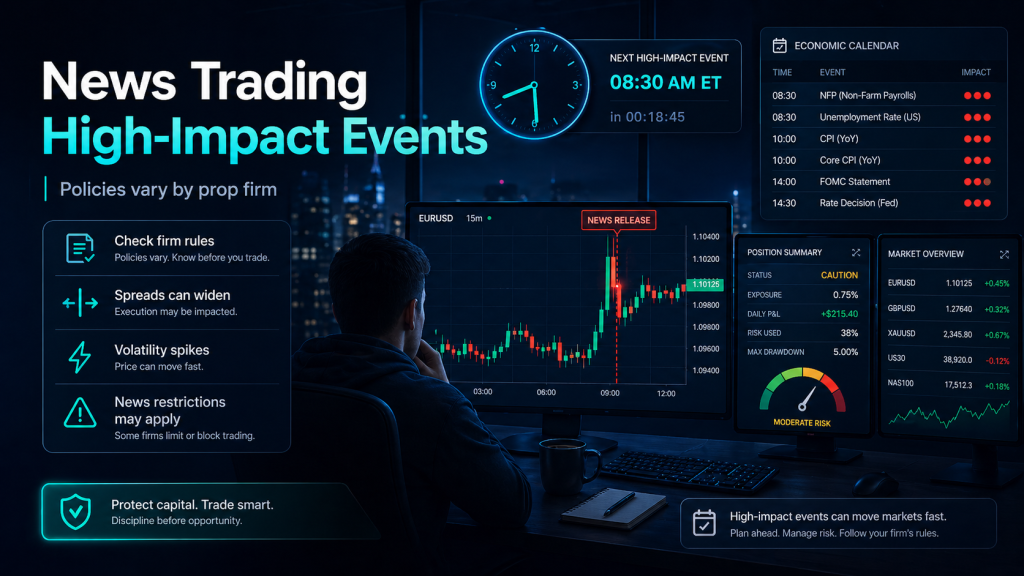
The best prop firm for news trading is not the one that says “news allowed” in the loudest font. It is the one that tells you exactly what you can and cannot do before, during and after a high-impact event.
News trading needs action-level rules. Open, close, modify, hold and pending-order triggers should be separated.
This is where traders get caught. They think they did not “trade news” because they did not click during the release. A stop loss, take profit or pending order can still trigger inside a restricted window. Some firms treat that as execution.
Read do prop firms allow news trading before placing event-risk trades. The phrase “allowed” is too vague by itself.
| News rule field | Clean version | Dangerous version | Execution impact |
|---|---|---|---|
| Event list | Named releases and affected instruments are listed | Broad “high-impact news” wording with no asset mapping | Trader may not know which markets are restricted |
| Restricted window | Exact minutes before and after the event are shown | Support-only or vague timing | Entries and exits become rule guesses |
| Holding | Existing trades can be held if opened before the window | Holding and execution are mixed together | Trader may close or adjust at the wrong time |
| Pending orders | SL, TP and pending activation treatment is written | Only manual orders are mentioned | A triggered order can create a dispute |
| Profit treatment | Profit deduction, breach or review policy is clear | Winning trades are reviewed case by case | Dashboard profit may not become payout-ready profit |
AIFO’s better use case is not blind news clicking. The better use case is rules-aware event exposure: a trader knows the account state, reduces size, respects conduct rules and does not rely on one spike to pass the account.
Best pick for low-budget traders: free trial first, small challenge second
The best low-budget prop firm route is not always the cheapest challenge. It is the path with the lowest total cost of learning the rules.
A cheap fee becomes expensive if it leads to repeated resets, rushed sizing and payout friction.
Low-budget traders usually focus on entry price. That is understandable. It is still incomplete. The real bill includes failed attempts, resets, activation fees, minimum withdrawal thresholds, payout delays, platform restrictions and the emotional cost of starting again.
That is why an AIFO free trial account is a better first step than buying pressure too early. It lets a trader test the challenge process and risk rules without attaching profit-sharing pressure to the first attempt.
After the trial, the next low-budget move is usually a small structured challenge, not instant access. Instant-style accounts may feel faster, but they can come with stricter expectations and higher pressure. For a trader still learning, pressure is not a feature.
Read one-step vs two-step challenges before choosing the cheapest model. A low entry fee is useful only if the model does not push you into bad trading.
The low-budget checklist should include total friction
A low-budget trader should compare total friction, not just price. A firm can look cheap at checkout and costly after the first mistake.
The low-budget matrix should include:
- entry fee;
- reset fee;
- activation fee;
- platform or data cost;
- minimum withdrawal;
- profit split;
- payout buffer;
- consistency rule;
- time limit;
- holding and news rules.
This connects directly to prop firm payouts. A cheap challenge with a messy payout path is not cheap. It only moves the cost to a later stage.
How to read the 2026 prop firm matrix before buying
The matrix should be used before the challenge page, not after the checkout page. Start with your trading behaviour, then filter firms.
Do not start with discount codes. Discount codes are useful only after the account already fits.
Here is the correct sequence:
- Write down your real trading style.
- Mark your normal holding time.
- List the events you trade or avoid.
- Calculate your normal losing streak.
- Check whether the account rules can survive that path.
- Then compare price.
This is where choosing a funded trading firm matters. Most bad choices come from buying the firm first and asking strategy-fit questions later.
Why ordinary prop firm rankings miss the real risk
Ordinary rankings are easy to scan. They are also easy to misread.
A ranking can say a firm is good for futures, fast payouts or low cost. That does not tell a swing trader whether they can hold through a weekend. It does not tell a news trader whether a take-profit trigger inside a restricted window is a breach. It does not tell a low-budget trader how many failed attempts the rules are likely to create.
The missing variable is execution distortion.
Execution distortion is what happens when the account rules force a trader to alter the edge. A swing trader exits too early. A news trader avoids managing a position because the rules are unclear. A low-budget trader sizes too large because they want the fee back quickly.
That is how a “good firm” becomes a bad account for a specific trader.
The article why some prop firms are bad deals in 2026 covers that wider problem. The sticker terms are not the full deal. The rule behaviour is the deal.
The AIFO matrix view: where AIFO fits best
AIFO fits best for traders who want model choice, visible rules and enough structure to test behaviour before putting money into a paid attempt.
That does not mean every trader should use the same AIFO path. The matrix still applies.
A swing trader should look at holding permission, gap sizing and drawdown room. A news-aware trader should read conduct and abnormal-volatility language before trading major events. A low-budget trader should start with trial testing and a small model rather than treating a paid challenge as practice.
Use AIFO trading rules as the master filter. Models are entry paths. Rules decide whether the account can carry your method.
| AIFO use case | Best fit | Watch point | Cleaner trader behaviour |
|---|---|---|---|
| Swing trading | Traders who need overnight or weekend holding | Gap risk and single-trade risk still apply | Smaller size before closed-market exposure |
| News-aware trading | Traders who plan event risk instead of chasing spikes | Conduct and abnormal-volatility review still matter | Pre-defined size and no event-window gambling |
| Low-budget testing | Traders using trial before paid pressure | Trial does not provide profit sharing | Use the trial to test stops, not to prove ego |
| Beginner model choice | Traders comparing staged versus direct paths | Shorter is not automatically safer | Choose the account that makes mistakes survivable |
Alpha Insight: the best firm is the one that does not edit your edge
A prop firm is only “best” if its rules let your edge behave normally.
That is the core of the 2026 matrix.
A swing trader does not need the highest-rated day-trading firm. A news trader does not need a vague permission label. A low-budget trader does not need the cheapest reset loop.
The best firm for you is the one that removes the fewest good trades and adds the fewest bad ones.
That is the practical test. If the firm makes you exit too early, trade too fast, reduce quality, ignore your normal holding period or chase because the fee feels painful, it is not a good fit. It may still be a good firm. It is just not your firm.
This also explains why why traders fail prop firm evaluations belongs in the buying decision. Many failures begin before the first trade, when the trader buys a rule box that was never built for their behaviour.
The final matrix rule for 2026
Use rankings for discovery. Use the matrix for the decision.
A ranking shows what exists. A matrix shows what fits.
For swing, choose holding clarity. For news, choose action-level rules. For low-budget, choose the lowest total friction path. Then apply a written risk management strategy before the first order.
The funded account is not the reward for choosing a famous firm. It is the result of choosing a rule box your strategy can survive.
FAQ: The 2026 prop firm matrix
The best prop firm for swing trading is one with clear overnight and weekend holding permission, enough drawdown room, and rules that do not force premature exits. The firm should let the trade develop without ignoring gap risk or daily loss limits.
The best type is a firm with exact news rules. It should state which events are restricted, which instruments are affected, and whether opening, closing, modifying, holding or pending-order triggers are allowed during the news window.
The best low-budget route is usually a free trial first, then a small structured challenge with clear rules. The cheapest checkout price is not always best if resets, payout minimums, consistency rules or platform costs make the account expensive later.
Use rankings for discovery, not final selection. A ranking can show popular firms, but it cannot decide whether the rules fit your holding time, news behaviour, budget, drawdown tolerance and payout path.
One firm can cover several trader types if it offers multiple models and clear rules, but no firm is best for every behaviour. A swing trader, news trader and low-budget beginner should compare different rule fields before choosing.
Beginners should start with rule fit and trial testing. The matrix helps them avoid buying a challenge that rewards rushing, oversized trades or unclear news behaviour before they have a stable trading process.