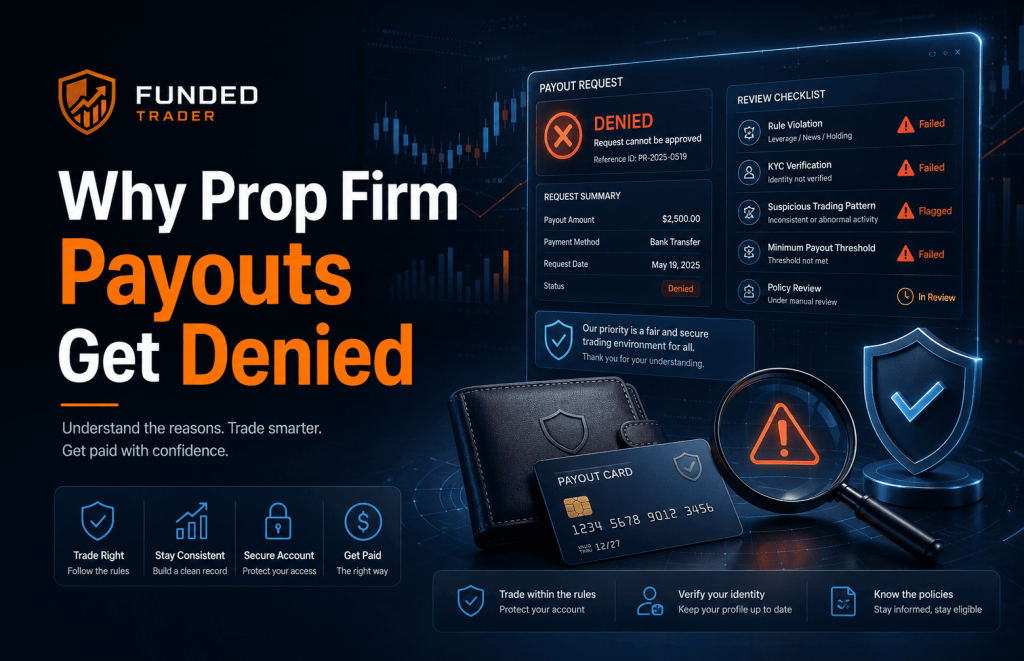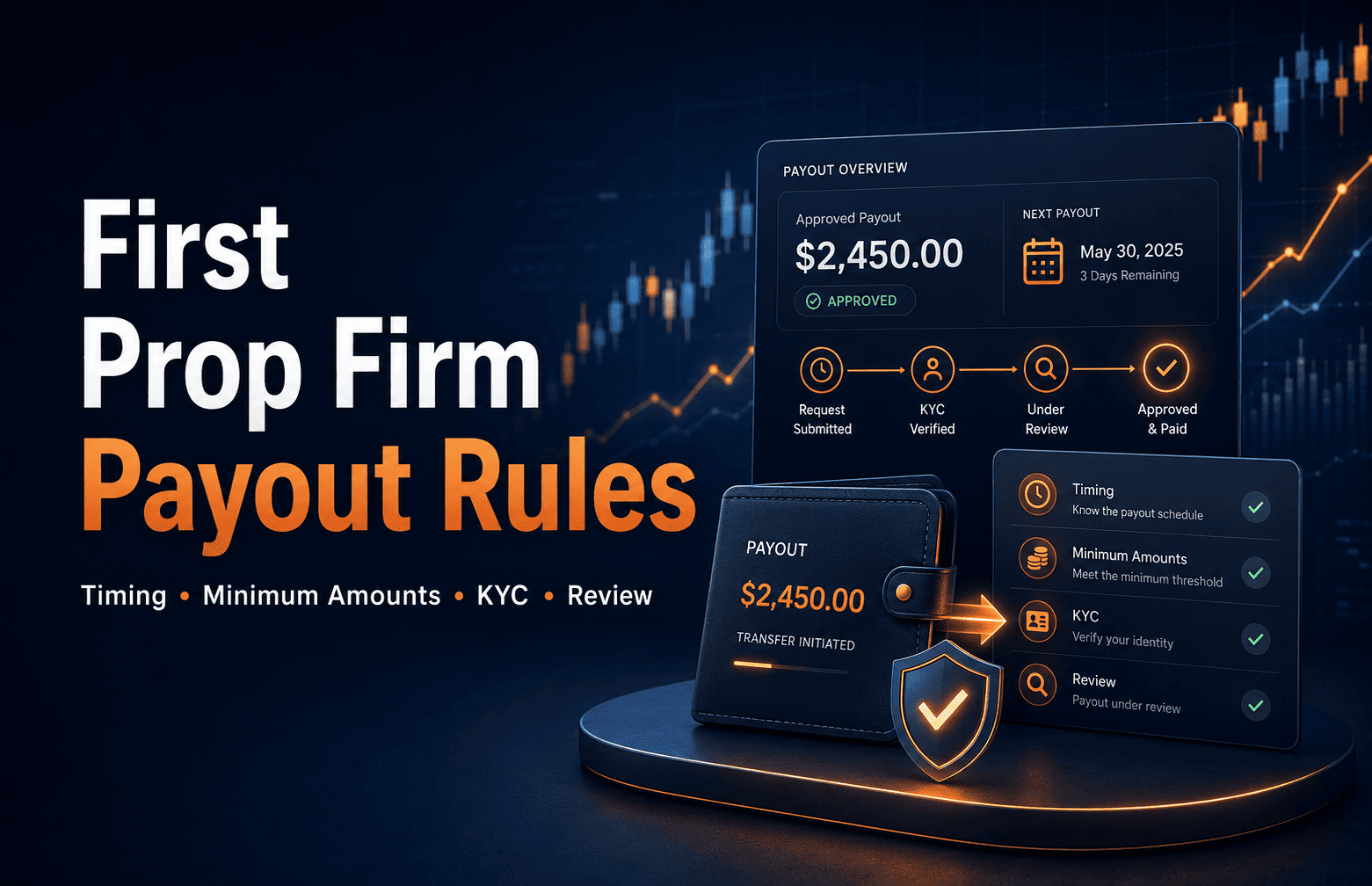


First payout rules decide when prop firm profit can actually leave the account. The trader usually needs more than a positive balance. Timing, minimum amount, trading cycle, KYC, open-position status, consistency checks, payout review and the remaining drawdown buffer all matter. The first withdrawal should be planned before the funded account starts, not after the trader reaches profit. If the payout rule is unclear, do not treat dashboard profit as money yet.
First Payout Rules in Prop Firms: The Direct Answer
The first payout is not triggered by profit alone. A trader must meet the firm’s payout eligibility rules, pass review, complete KYC, choose an approved payment method and leave the account in a valid state for withdrawal.
Use prop firm payout rules as the wider pillar, then use this page for the first-withdrawal layer. The first payout is where most new funded traders discover the difference between profit shown on screen and profit that can be withdrawn.
| First payout gate | What the trader checks | Failure path | Safer action |
|---|---|---|---|
| Timing | First payout day, trading cycle, business days, payout window | Trader expects cash too early and keeps trading while frustrated | Mark the earliest request date before funded trading starts |
| Minimum amount | Minimum profit, minimum withdrawal, account-size thresholds | Trader forces one extra trade to reach the threshold | Stop trading if the next setup is only for payout access |
| KYC | ID, address proof, payment account, name match, country access | Request is delayed while the trader keeps risking the account | Prepare verification before the first payout window |
| Open positions | Whether the account must be flat before request | Trader closes a valid swing trade too early or requests too soon | Plan first payout around strategy holding period |
| Review | Rule history, restricted strategies, consistency, lot behaviour, news trades | Profit enters review instead of withdrawal | Audit trade history before clicking request |
| Buffer | Drawdown room left after withdrawal | First payout weakens the next cycle and account fails after cash-out | Withdraw less if the account needs survival room |
First Payout Timing: Do Not Confuse Eligibility with Processing
First payout timing has two clocks. One clock decides when you are eligible to request. The other clock decides how long the firm or payment provider takes after approval.
Traders get angry when they mix those clocks together. A “fast payout” claim may still require a completed trading cycle, clean rule history and KYC before the processing window starts.
The eligibility clock
The eligibility clock starts from the account rule. Some firms count from the first trade. Some count business days. Some use trading cycles. Futures-style programmes may count winning days, minimum daily profit or a safety net.
This changes behaviour. If the trader thinks the first payout is tomorrow but the cycle ends next week, they may keep taking poor trades just to feel active. The account does not need that.
The processing clock
The processing clock starts after the request is valid. It can still be slowed by KYC, payment method, support hours, internal review or rejected documents.
Do not build trading decisions around the fastest advertised processing time. The first payout is usually slower than later withdrawals because the account, identity and payment path are still being checked.
Why the first payout often feels slower
The first payout carries more checks. The firm has to confirm that the trader is eligible, the trading behaviour is allowed, the account state is valid and the payment identity matches.
That does not mean the firm is bad. It means the trader should not plan rent, taxes or personal cash flow around an unapproved request.
Minimum Amounts: The Rule That Creates Bad Last Trades
Minimum payout amounts look harmless. They are not harmless when a trader is close to the line and starts trading for the withdrawal instead of the setup.
The danger is not the threshold itself. The danger is the final trade taken only because the account is nearly eligible.
Minimum profit threshold
Some accounts require a certain profit level before the first payout request. That can be a fixed amount, a percentage, or a rule linked to account size.
A trader who is just below the threshold should reduce aggression, not increase it. If the next trade is chosen because it reaches the payout number, the account is already being distorted.
Minimum withdrawal amount
A minimum withdrawal amount means the trader cannot request a tiny payout. That can keep operations cleaner, but it also changes the trader’s cash-flow expectation.
Do not chase the minimum with a low-quality trade. If the strategy needs another clean setup, wait for it. The payout window is not a trading signal.
Maximum first payout caps
Some firms cap the first payout or limit the percentage that can be withdrawn. That may feel restrictive, but it can protect the account from being drained too quickly.
The question is not “how much can I take?” The better question is “how much can I withdraw and still keep the account alive?”
KYC: Prepare It Before the Payout Window
KYC is not paperwork after the trade. It is part of the payout path.
For first withdrawals, identity checks can delay approval if the trader waits until the request day. That delay can create a second problem: the trader keeps trading while the payout is pending.
What KYC can include
KYC usually checks identity, address, payment account and sometimes country eligibility. The name on the trading account, payout provider and documents should match cleanly.
Small mismatches can slow the request. Wrong country assumptions can stop it. A trader should not discover that at the first payout desk.
Payment method matters
Crypto, bank transfer, Rise, Plane or other payment providers can each carry their own setup time, fees, limits and verification steps.
A firm may approve the payout quickly while the payment provider still needs time. That difference matters if the trader expects money inside one business day.
Do not trade emotionally while KYC is pending
This is a common failure path. The payout request is submitted. KYC takes longer than expected. The trader keeps trading to “use the time”.
That is not patience. That is account exposure during admin risk. If the account is near payout, risk should usually go down.
Payout Review: What Firms Usually Check Before First Withdrawal
The first payout review is where trading behaviour is tested against the contract. The firm is not only checking profit. It is checking how the profit was made.
This is where traders who ignored restricted strategies, news rules, consistency rules or abnormal lot sizing can run into trouble.
Rule history
The firm may review daily loss, max loss, trailing drawdown, news-window trades, holding rules, EA rules, copy trading rules and prohibited strategies.
A trade can be technically accepted by the platform and still fail the rule review. The platform executes orders. The contract decides reward eligibility.
Consistency and profit concentration
Some firms check whether one trade or one day made too much of the total profit. This is meant to filter unstable risk-taking, but it can also catch traders who rely on a single high-volatility burst.
Read consistency rule in prop firm challenges before assuming a profitable account is payout-ready. Profit concentration can turn a good week into a delayed request.
Open trades and account state
Some firms require the account to be flat before a payout request. Others allow positions to remain open but review equity, drawdown and risk exposure.
This matters for swing traders. If your strategy holds for days, the first payout must be planned around the trade path. Do not close a valid trade early just because the withdrawal button appears.
Alpha Insight: The First Payout Is the Moment to Get Smaller
The first payout is not the moment to become aggressive. It is the moment to become smaller.
Most traders feel the opposite. They get close to withdrawal, see the minimum amount nearby, and want one more trade. That is where accounts get damaged.
A clean first payout is defensive. Reduce risk. Check rule history. Finish KYC. Make sure the account is flat if required. Protect the drawdown buffer. Do not turn the first withdrawal into a new profit target.
The account does not care that the trader is close. The account only cares about rules, equity, drawdown and behaviour. Treat the first payout like a risk event, not a trophy.
Withdrawable Profit vs Payout-Ready Profit
Dashboard profit is not the same as payout-ready profit. This is the first payout mistake that costs traders the most trust.
A trader can be up on the account and still fail one of the payout gates. The profit exists on screen, but it is not yet approved for withdrawal.
The first payout chain
- Profit generated: the account shows a positive result.
- Eligible profit: the account meets timing, minimum amount and rule requirements.
- Payout-ready profit: the account passes consistency, open-position and review conditions.
- Approved payout: the firm accepts the request and payment details.
- Received payout: the money reaches the trader through the chosen payment method.
Use payout-ready profit as the correct language. It keeps the trader from treating every positive balance as cash.
Why profit split can mislead beginners
A profit split tells you how the approved reward is divided. It does not tell you when you can request, what the minimum is, whether KYC is complete or whether the trade history passes review.
A high split with a weak payout path is not better than a lower split with cleaner rules. First payout trust comes from process, not headline percentage.
How First Payout Changes the Account Buffer
The first payout can make the account safer emotionally and weaker mechanically. Cash in hand feels good. Less buffer can make the next trading cycle harder.
Before withdrawing, the trader should check what happens to balance, equity, drawdown and max loss after the request.
Drawdown buffer after withdrawal
Some accounts become more fragile after withdrawal because the cushion between equity and the breach line shrinks. The trader may have money paid out, but the account has less room to recover from the next losing sequence.
This is why the full payout is not always the smart payout. Leaving buffer can protect the account path.
Static vs trailing drawdown
Withdrawal impact depends on drawdown type. Static drawdown, trailing drawdown, balance-based drawdown and equity-based drawdown can react differently.
Use daily drawdown vs max drawdown before requesting the first withdrawal. The question is not only what you can take. It is what the account can survive after you take it.
First payout after a hot run
A strong profit run can hide fragile behaviour. If most of the gain came from one event, one instrument or one oversized trade, the account may not be stable enough for a large withdrawal.
Reduce size after the payout. Do not treat the first cash-out as permission to increase risk.
First Payout Checklist Before You Click Request
The first payout request should be a checklist event. Do not click because you feel relief.
Run the account through timing, rules, KYC, trade history, buffer and payment details. If one item is uncertain, pause.
| Checklist item | Pass condition | Block the request if |
|---|---|---|
| Timing | The payout cycle or first request date is complete | The trader is guessing from marketing copy |
| Minimum amount | The account meets minimum profit or withdrawal threshold | The next trade is needed only to reach the line |
| KYC | ID, address and payment details are prepared | Name, country or payment method may mismatch |
| Open trades | The account matches the firm’s flat or open-position policy | A valid swing trade would be closed only for admin timing |
| Rule history | No known breach, restricted strategy issue or review concern | News, EA, copier or lot behaviour is unclear |
| Consistency | Profit distribution satisfies the account rules | One day or one trade dominates the profit too heavily |
| Buffer | Enough drawdown room remains after withdrawal | The withdrawal would leave the account one normal loss from failure |
| Next cycle plan | Risk per trade is reduced after payout if needed | The trader plans to trade bigger because payout proved confidence |
This checklist should sit beside your prop firm challenge checklist. Day 1 protects the first trade. This checklist protects the first withdrawal.
What to Do While the First Payout Is Pending
The pending window is dangerous. The trader has profit, but no cash yet.
This is where impatience creates poor trades. The account should be treated as exposed until the payout is approved and the post-withdrawal buffer is clear.
Reduce trading frequency
Do not keep trading just because the request has been sent. A pending payout is not a licence to add risk.
If the account is close to the breach line after withdrawal, reduce frequency or stop until the payment state is clear. The trader’s job is to protect the account and the request.
Do not create new review problems
Trading aggressively while payout is pending can create fresh issues. A new news trade, copied trade, oversized trade or drawdown event can change the account state.
Keep behaviour boring. The first payout review should not have to assess a new risk burst.
Keep records clean
Save screenshots of the request, account state, KYC submission, payment method and rule status. Do not rely on memory.
This is not paranoia. It is normal funded-account administration.
How AIFO Traders Should Read First Payout Rules
AIFO traders should read first payout rules before the funded account starts. The payout path is part of the trading plan, not a back-office detail.
The strongest path is simple: pick the account model, trade inside the rules, reach payout eligibility, request only what the account can survive and reduce risk after the first withdrawal.
Start with the payout process
Read the AIFO payout process before planning the first funded cycle. The process tells you what has to happen after profit appears.
A trader who reads payout rules after making profit is already late. The payout rule may change position sizing from the first trade.
Read the account-specific payout rule
Use AIFO payout rules to check account conditions before the first request. The right question is not only “how much do I keep?” It is “what must be true before I can request?”
That question protects behaviour. It stops the trader from turning the first payout into a forced-profit target.
Check what “funded” actually means
Some traders assume every funded account works like a personal broker account. It does not.
Read do prop firms use real money if you are unclear on simulated accounts, reward contracts, payout rights and real execution. First payout trust starts with knowing what contract you are trading.
FAQ
You can request your first prop firm payout only after your account meets the firm’s eligibility rules. That may involve a fixed trading cycle, minimum trading days, minimum profit, winning-day rules, KYC, no open-position requirement and a clean rule history. Processing time starts after the request is valid and approved.
No. Profit split only tells you how approved profit is divided between trader and firm. Withdrawable profit depends on payout eligibility, minimum amount, timing, KYC, review, open-trade policy, consistency rules and remaining account buffer. Dashboard profit is not cash until the payout is approved and sent.
Many prop firms require KYC before or during the first payout request. This can include identity documents, address proof, payment account checks and name matching. Traders should prepare verification before the first payout window because rejected or incomplete documents can delay approval.
A payout can be delayed or reviewed because KYC is incomplete, the payout cycle is not finished, open trades are not allowed, minimum amount is not met, payment details mismatch, or the firm needs to review trading behaviour. News trades, EAs, copy trading, consistency issues and drawdown events can also trigger review.
Not always. A full first payout can reduce the account’s drawdown buffer and make the next trading cycle weaker. Traders should check what happens to balance, equity, max loss and trailing drawdown after withdrawal. Sometimes a smaller payout protects the funded account better.