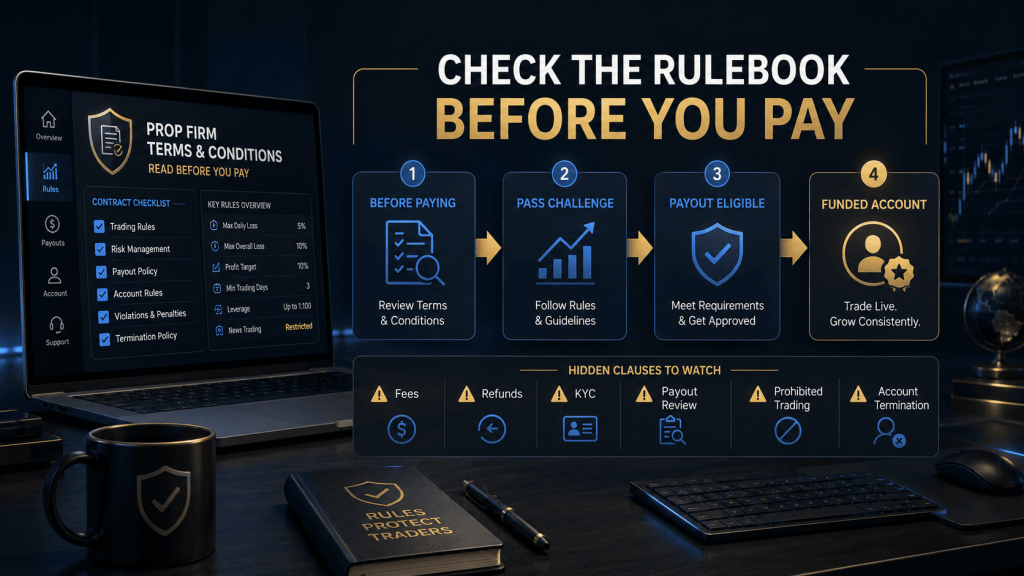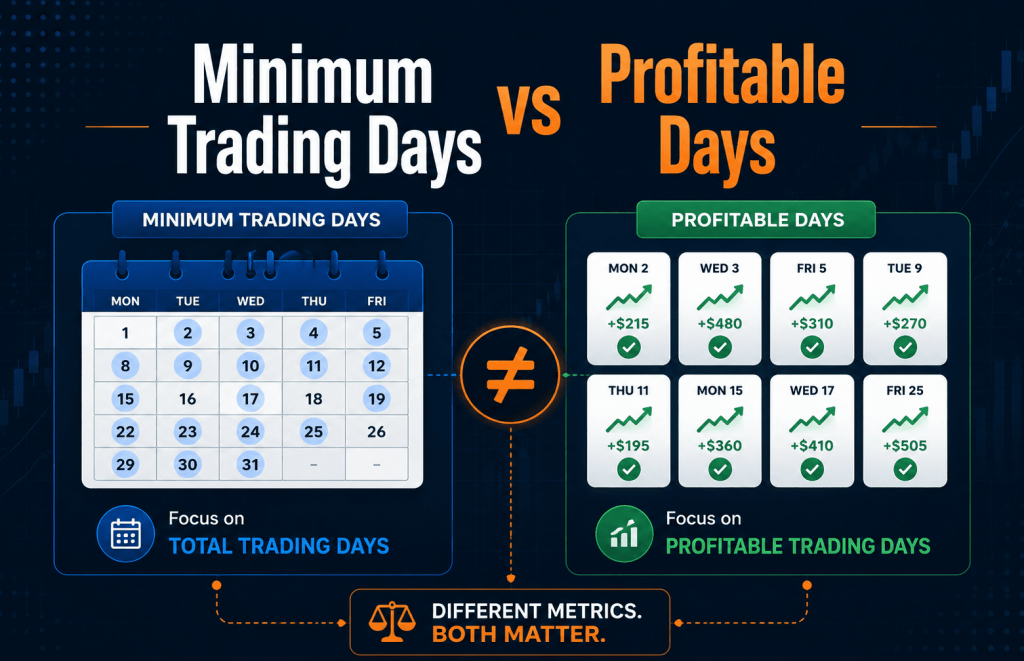



Some prop firms allow overnight and weekend holding, but the two permissions are not the same. Overnight holding means a position can remain open beyond the trading day. Weekend holding means it stays open through market closure from Friday to Monday, adding gap and liquidity risk before the trader can react. Start with the prop firm challenge rules guide to see how holding interacts with daily loss, maximum loss, news restrictions, consistency and payout review. Then verify the current firm- and account-specific holding rule before leaving a position open.
The clean answer is not just “allowed” or “banned”. The useful answer is whether the account can survive the hold. A trade can be permitted by the platform and still be dangerous under a prop firm rule book.
Last checked on : the AIFO overnight and weekend positions FAQ states that traders may carry positions beyond the trading day without forced closure, but they must still follow all risk-management rules and the single-trade risk limit. The AIFO trading rules also explain that holding permission does not override daily loss, maximum loss or conduct-related rules. Permission is only the first check. Survivability is the real check.
Quick answer
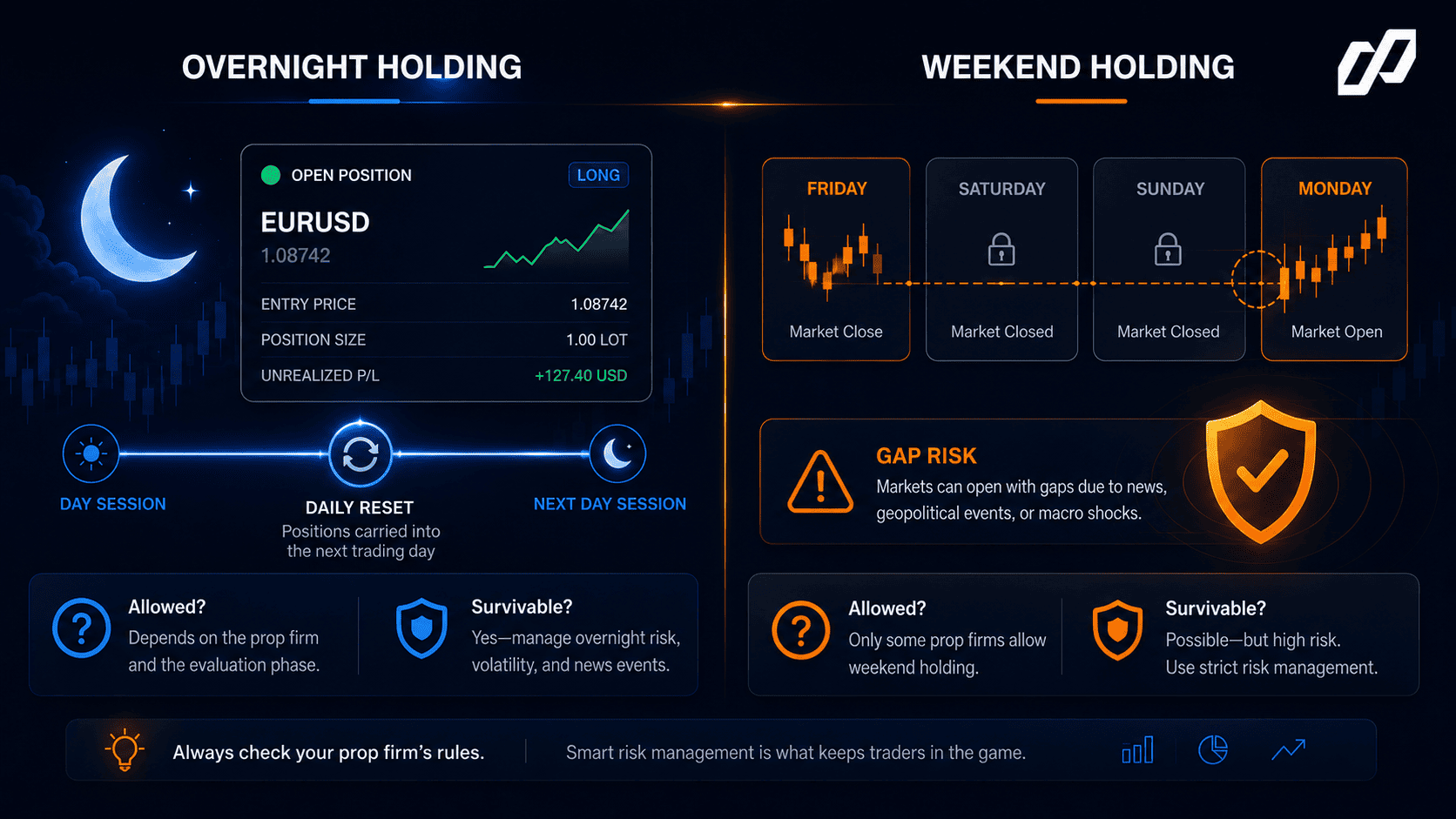
- Overnight holding: a trade remains open past the daily trading session or reset point.
- Weekend holding: a trade remains open through market closure, usually from Friday close to Monday open.
- Main difference: overnight trades can often still be managed when liquidity returns; weekend trades may reopen with a gap before you can act.
- Swing trader issue: swing strategies need multi-day room, but the account must still survive daily loss, max loss, news, swap, gap, and payout rules.
- Best rule: do not hold because the firm allows it. Hold only when the position can survive the worst mark before you can manage it.
Can you hold trades overnight with prop firms?
Yes, some prop firms allow overnight holding. But the rule changes by firm, account type, trading stage, product, and platform conditions.
Overnight permission means the position can stay open beyond the trading day. It does not mean the trade becomes safe. The position is still measured against equity, daily loss, maximum loss, commissions, swap, floating drawdown, and any single-trade risk limit.
This is where traders get careless. They read “overnight holding allowed” and treat the account like a personal retail account. A prop firm account is different because a rule engine sits behind the trade.
A trade that is still valid on the chart can become invalid for the account if floating equity crosses a rule line. The rule does not wait for your swing thesis to mature. It measures the account at the point defined by the programme.
Can you hold trades over weekends with prop firms?
Sometimes. Weekend holding is a separate rule from overnight holding. A firm may allow weekday overnight positions but still require positions to be closed before the weekend.
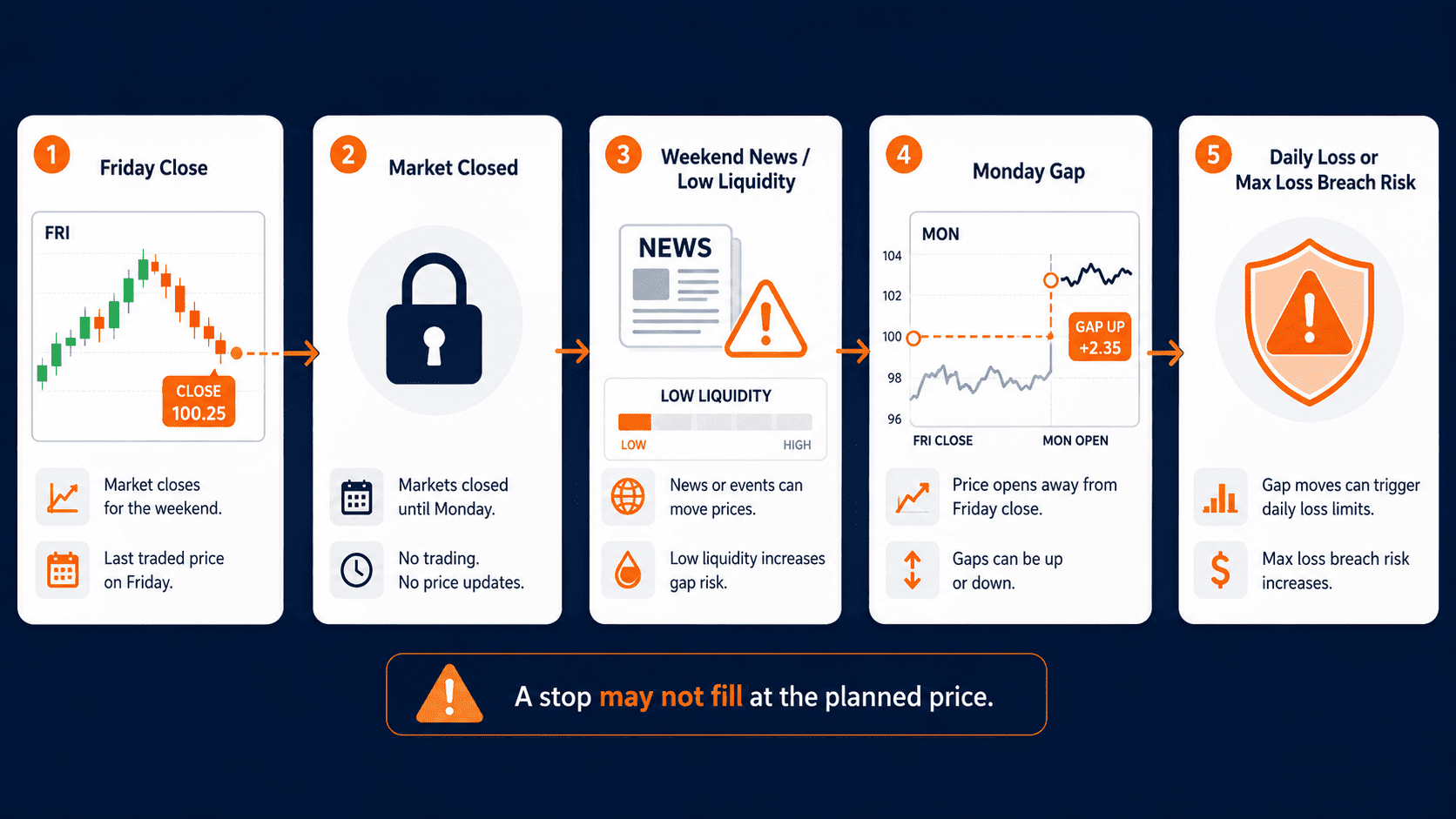
The reason is closed-market risk. Over the weekend, the trader usually cannot exit, reduce size, move a stop, hedge, or respond to new information. If the market opens far away from Friday’s close, the account may be marked at a worse price than the planned stop.
For forex and CFD-style accounts, weekend holding may be allowed on some programmes. For futures-style funded accounts, the structure is often stricter because many programmes are built around intraday flattening. The trader may be expected to end the session flat with no open positions and no working orders.
This does not make one model automatically better. It makes the strategy fit different. A swing trader needs a different rule structure from a short-session scalper.
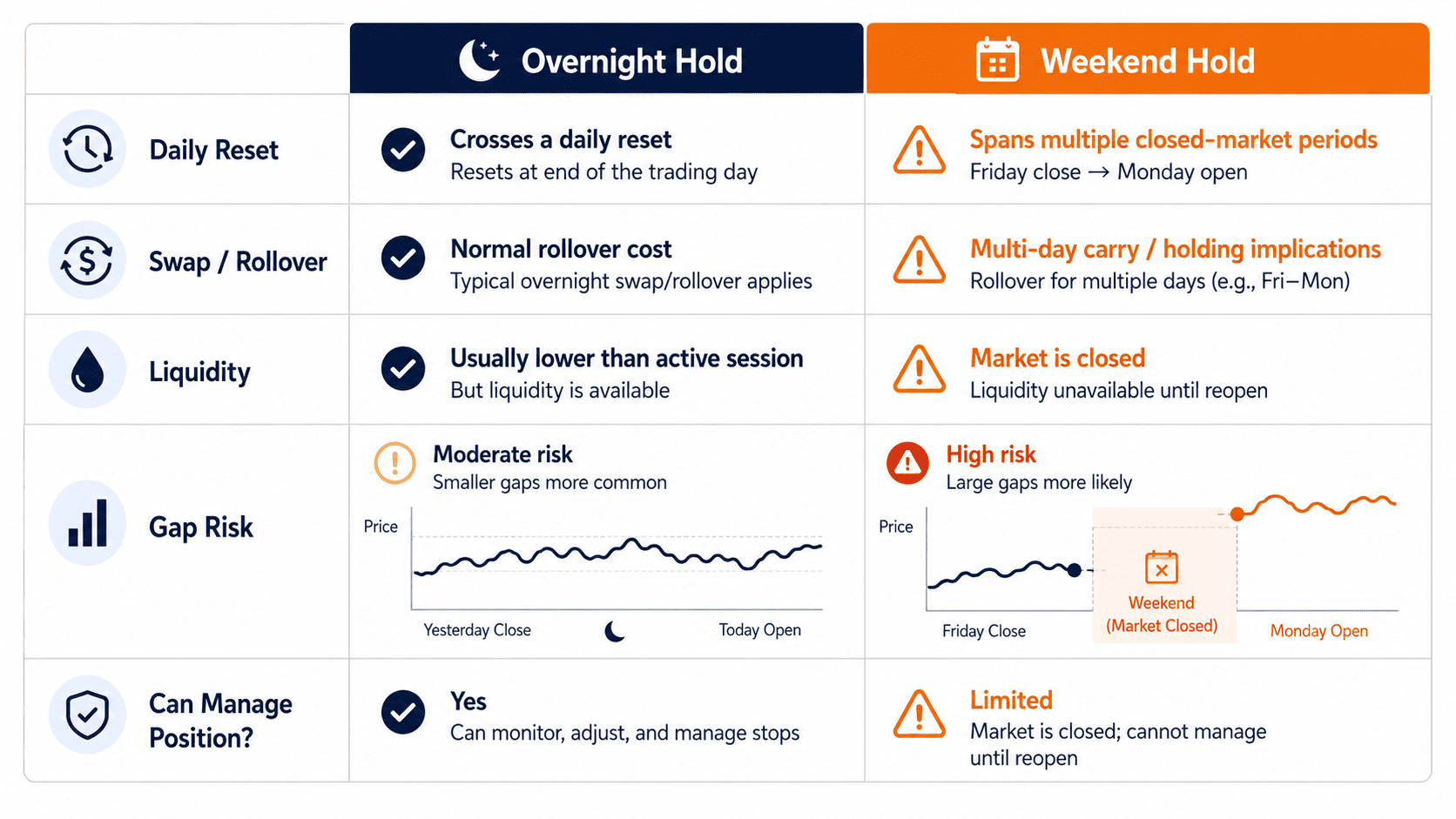
Overnight holding vs weekend holding: the difference traders miss
Overnight and weekend holds both extend exposure, but they do not carry the same risk. A Tuesday night hold is not the same as a Friday-to-Monday hold.
| Holding type | What it means | Main risk | What to check before holding |
|---|---|---|---|
| Overnight holding | The position stays open beyond the trading day or daily reset | Floating loss, daily reset, swap, liquidity change, spread widening | Daily loss limit, max loss limit, swap, commissions, current equity, reset timing |
| Weekend holding | The position stays open through market closure into the next trading week | Gap risk, closed-market exposure, stop slippage, news shock, thin reopening liquidity | Weekend permission, product volatility, event calendar, gap buffer, breach-line distance |
| News holding | The position remains open through a scheduled high-impact event | Fast repricing, slippage, spread widening, restricted-window execution | Whether holding, opening, closing, modifying, or pending orders are allowed around news |
| Swing holding | The strategy normally needs several sessions or days to develop | The account rules may force exits before the strategy’s normal path completes | Whether drawdown rules and holding rules match the strategy’s normal trade path |
The rule matrix to check before leaving a prop firm trade open
Do not check the holding rule by itself. A position can be allowed and still be a poor trade inside that account.
Before leaving any position open overnight or over the weekend, read the holding rule beside the loss rules, news rules, product rules, payout rules, and review rules.
| Rule to check | What it controls | Why it matters for overnight holds | Why it matters for weekend holds |
|---|---|---|---|
| Overnight permission | Whether a position can remain open past the trading day | The trade may stay open, but floating equity still counts | Does not automatically mean Friday-to-Monday holding is allowed |
| Weekend permission | Whether a position can remain open through market closure | Usually less relevant during normal weekdays | Position size must allow for gap movement and reopening liquidity |
| Daily loss limit | How much the account can lose within a trading day | A floating loss after reset can create a breach | A Monday gap can hit the daily loss line before action is possible |
| Maximum loss limit | The whole-account survival line | A multi-day trade can reduce total account buffer | A gap can consume survival room before the trader can reduce size |
| News restrictions | Whether entries, exits, modifications, pending orders, or holds are restricted around events | A held trade may be fine while an order modification is not | Weekend news, election risk, central bank comments, and reopening moves can matter |
| Product and leverage rules | Which instruments and exposure levels are allowed | Swap, spread, and volatility differ by product | Indices, commodities, crypto-style products, and metals may gap harder than major FX pairs |
| Single-trade risk limit | How much risk one position may create | A wide stop can exceed allowed trade risk | Gap-adjusted exposure may be larger than the planned stop risk |
| Payout review | Whether the result is eligible after compliance checks | A large held winner may create concentration or review questions | A weekend winner may still need clean rule history before payout |
Why a permitted overnight trade can still breach the account
The dangerous part of overnight holding is often the account measurement, not just the market move.
A trader may enter a swing setup correctly, hold through the close, and see a temporary floating loss. In a personal retail account, that may simply be part of the trade path. In a prop firm account, the same floating loss may interact with the daily reset or maximum loss rule.
The trader may say, “I have not closed the trade yet.” The account sees equity. If equity touches the breach line, the rule does not wait for the trade to recover.
This is especially important when the daily loss rule is calculated from equity rather than only closed balance. Read daily, maximum and trailing drawdown rules together with the daily loss reset-time guide. For AIFO, trade records and reset references use AIFO server time. A position can move from acceptable to dangerous without the trader placing a new order.
The better question before holding is not “Is my stop logical?” The better question is: “Can this account survive the worst floating mark before my setup has time to work?”
Why weekend gap risk is different
Weekend holding adds a risk that weekday overnight holding usually does not carry in the same way: the market can reopen far away from Friday’s price.
A stop-loss is not a guaranteed exit level in every market condition. If the first available price after the weekend is beyond the stop, the account may be marked at the next executable price. That can produce a larger loss than planned.
This is why a weekend hold needs a gap buffer. If the position only survives when the market opens exactly where expected, it is not sized for the weekend.
News risk: holding through news is not the same as trading news
News rules can make holding decisions more complicated. Some firms separate news holding from news trading.
News holding means a position was already open before a scheduled event and remains open through the release. News trading means opening, closing, modifying, or triggering orders during the restricted event window.
A trader who only asks “Is news allowed?” is asking the question too loosely. The action matters. A firm may allow a position to remain open through CPI, NFP, FOMC, or central bank events, while restricting new entries, pending orders, stop changes, or manual exits during a defined window.
If a held position overlaps with a high-impact event, read the news trading rules before assuming holding permission also means event-execution permission.
How swing traders should read prop firm holding rules
Swing traders should treat holding rules as strategy-fit rules. If the account forces you to close before your normal trade path develops, the account is not matched to the method.
A swing setup often needs time. It may enter before the move is obvious, sit through noise, and then work after the market digests a level, trend, or macro event. A forced-flat rule can cut that method in half.
The result is execution distortion. Stops become tighter than the strategy requires. Targets get pulled closer. Trades are skipped before weekends. Size is changed for compliance rather than trade logic. After a few attempts, the trader is no longer testing the real strategy. The trader is testing a damaged version of it.
| Swing trader question | Good account fit | Bad account fit |
|---|---|---|
| Does the strategy need multi-day holding? | Overnight and weekend rules allow the normal trade path | The trader must close before the setup usually matures |
| Can the position survive floating drawdown? | Daily loss and max loss lines leave enough room for normal volatility | A normal pullback can breach the account |
| Does the strategy overlap with news? | News holding and order-action rules are clear | The trader does not know whether exits, modifications, or triggered stops are restricted |
| Does the strategy hold through weekends? | The account allows weekend exposure and the trader sizes for gap risk | The strategy depends on weekend holds but the account requires flat exposure |
| Does the payout path tolerate lumpy wins? | Large multi-day wins still fit consistency and review rules | One held trade dominates the result and creates payout friction |
Before buying any challenge, compare your normal trade behaviour with the account rules. If the two fight each other, the account is not cheap or flexible. It is badly matched. For a firm-by-firm comparison built around multi-day positions, use the best prop firms for swing trading guide.
How to size an overnight or weekend position in a prop account
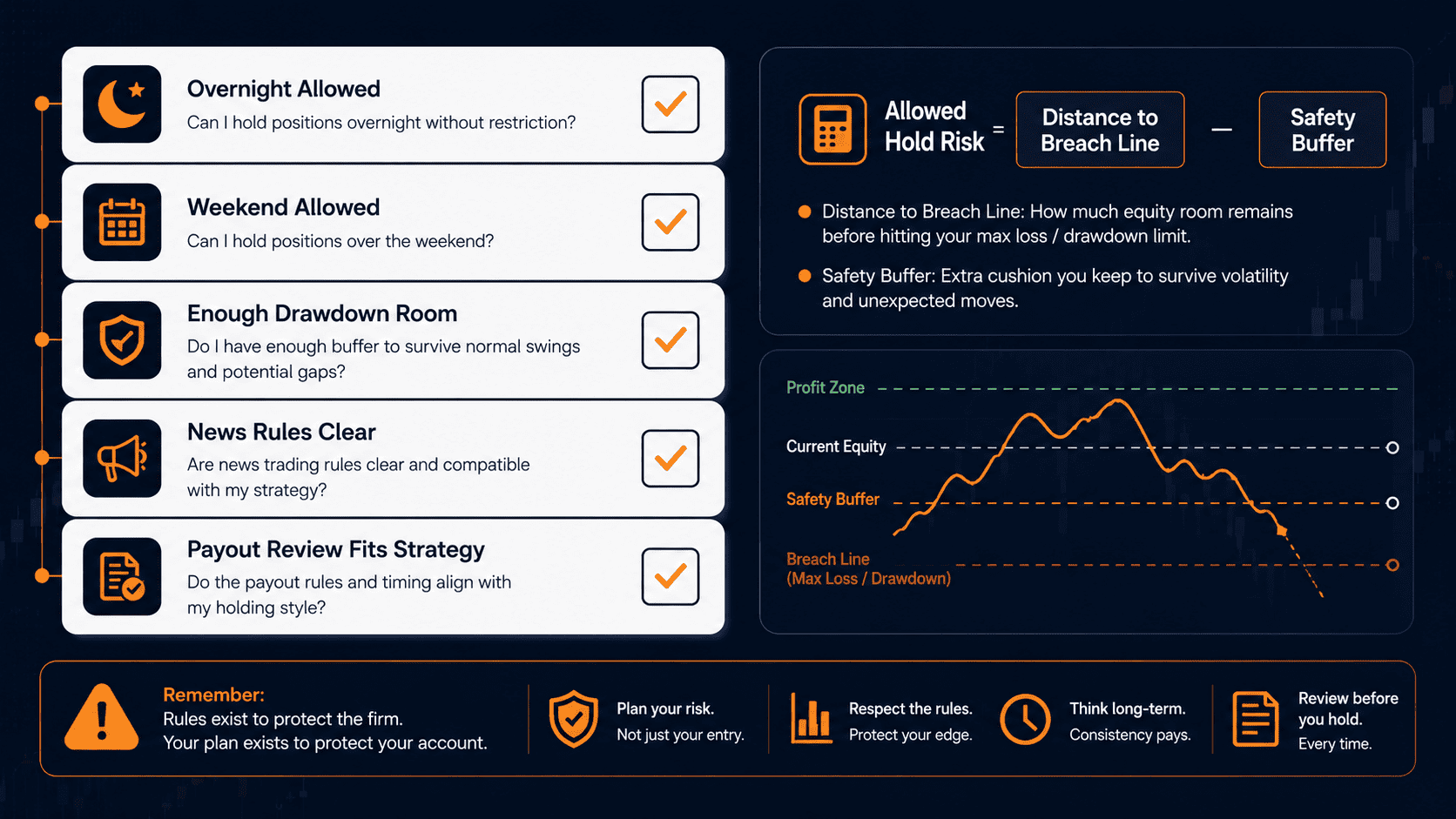
Size from the nearest breach line, not from the headline account size.
The displayed account size may look large, but the usable loss room is much smaller. The real question is how much adverse movement the position can absorb before it touches daily loss, maximum loss, or single-trade risk limits.
A simple pre-hold risk formula is:
Allowed hold risk = distance to nearest breach line − safety buffer
For a normal overnight hold, the safety buffer should include spread widening, commission, swap, rollover behaviour, and expected volatility before the next trading session. For a weekend hold, add a gap buffer.
A clean sizing process looks like this:
- Start with current equity, not the headline account size.
- Mark the daily loss line and maximum loss line.
- Identify the nearest breach line.
- Subtract a safety buffer for spread, commission, swap, slippage, and volatility.
- Add a larger gap buffer before weekend exposure.
- Reduce size if a normal pullback could place the account near breach.
- Do not hold only because the rule allows it. Hold only when the account can absorb the path.
How payout and consistency rules can affect held trades
A held trade can create profit, but profit on screen is not always payout-ready profit.
This matters after a large multi-day winner. If one held trade produces most of the account result, a consistency rule may require more trading before the result is considered clean.
That can turn a winning account into a fragile account. The trader hits the target, then continues trading only to satisfy a rule. The danger is no longer the original swing trade. The danger is the extra exposure after the good trade already worked.
Holding permission and payout rules belong in the same review. A trade path is not complete when the position closes. It is complete when the account remains compliant and the profit can move through the payout process.
Common mistakes with overnight and weekend holding
Most holding-rule failures happen because traders read the permission but ignore the path.
| Mistake | Why it is dangerous | Better approach |
|---|---|---|
| Treating overnight and weekend holding as the same rule | Weekend exposure has closed-market gap risk | Use a separate gap buffer for Friday-to-Monday holds |
| Sizing from account size | The headline account size is not usable loss room | Size from current equity and the nearest breach line |
| Ignoring daily reset timing | Floating loss can become a rule problem after reset | Check how daily loss is calculated before holding |
| Holding through news without checking action rules | Holding may be allowed while entries, exits, or modifications are restricted | Read the news rule by action type, not just by headline |
| Assuming a stop guarantees the planned loss | Gaps and thin liquidity can produce worse fills | Build slippage and gap assumptions into position size |
| Using a day-trading account for a swing strategy | The account forces exits before the method can work | Choose a programme whose holding rules match the strategy |
When overnight or weekend holding makes sense
Holding can make sense when the account rules, trade thesis, position size, and risk buffer all agree.
An overnight hold may be reasonable when the setup needs more than one session, the position is small enough to survive normal volatility, the daily reset is understood, and there is enough distance to the breach line.
A weekend hold may be reasonable only when the strategy genuinely requires weekend exposure, the product has acceptable gap behaviour, the position is sized for a worse-than-stop open, and the trader has checked the event calendar.
Holding is not a badge of sophistication. Sometimes the most professional decision is to close the trade because the account structure does not support the path.
Alpha Insight: permission is not the rule; survivability is the rule
The visible rule asks whether you can hold the trade. The hidden rule asks whether the account can survive the worst mark before you can act.
That hidden rule is what separates a real swing-compatible prop account from an account that merely says weekend holding is allowed.
For a day trader, forced-flat rules may be fine. They match the method. For a swing trader, forced-flat rules can destroy the edge. For a trader who holds too large, flexible rules can be even worse because they allow the position to remain open until the drawdown engine kills the account.
The best holding rule is not the loosest one. It is the one that matches your holding time, risk per trade, product volatility, news exposure, payout path, and emotional behaviour after a floating loss.
Final answer: can you hold trades overnight or over weekends with prop firms?
Yes, some prop firms allow overnight and weekend holding. AIFO allows overnight and weekend positions, but traders must still follow the risk framework, account rules, and single-trade risk limits.
Overnight holding and weekend holding should not be treated as the same decision. Overnight holding mainly adds reset, swap, liquidity, and floating-equity risk. Weekend holding adds closed-market gap risk and the possibility that the next tradable price is much worse than the planned stop.
For swing traders, the best account is not the one with the most relaxed wording. It is the one whose holding rules match the normal trade path. If the position cannot survive the drawdown, gap, news, and payout path, permission is just decoration.
FAQ
Yes, some prop firms allow overnight holding, but the rule depends on the firm, account type, stage, product, and platform conditions. You must still check daily loss, maximum loss, floating equity, swap, commission, and any single-trade risk limit before leaving a position open.
Some prop firms allow weekend holding, while others require positions to be closed before the weekend. Weekend holding is riskier than normal overnight holding because the market can reopen with a gap before the trader can manage or close the trade.
Overnight holding means a trade stays open beyond the daily trading session or reset point. Weekend holding means the trade stays open through market closure into the next trading week. Weekend holding adds closed-market gap risk, which can make losses larger than the planned stop.
Yes. The AIFO overnight and weekend positions FAQ states that positions may be carried beyond the trading day without forced closure, while all risk-management rules and the single-trade risk limit still apply. Holding permission does not remove drawdown, news, gap or payout risk.
Some prop firms ban weekend holding to control closed-market gap risk. If the market opens far away from Friday’s closing price, the account can hit a drawdown breach before normal execution, stop orders, or manual risk management can protect the position.
It can be suitable if the prop firm’s holding rules, drawdown limits, news rules, and payout conditions match the swing strategy’s normal trade path. If the strategy needs multi-day room but the account forces early exits or has tight loss limits, the fit is poor.
Yes. High-impact news can widen spreads, increase slippage, trigger gaps, and create rule issues. Some firms allow holding through news but restrict opening, closing, modifying, or triggering orders during a news window, so traders should read the rule by action type.
Size from the nearest breach line, not from the headline account size. Estimate the distance to daily loss and maximum loss limits, subtract a safety buffer, then add a larger gap buffer for weekend exposure. If a normal gap could breach the account, the position is too large.