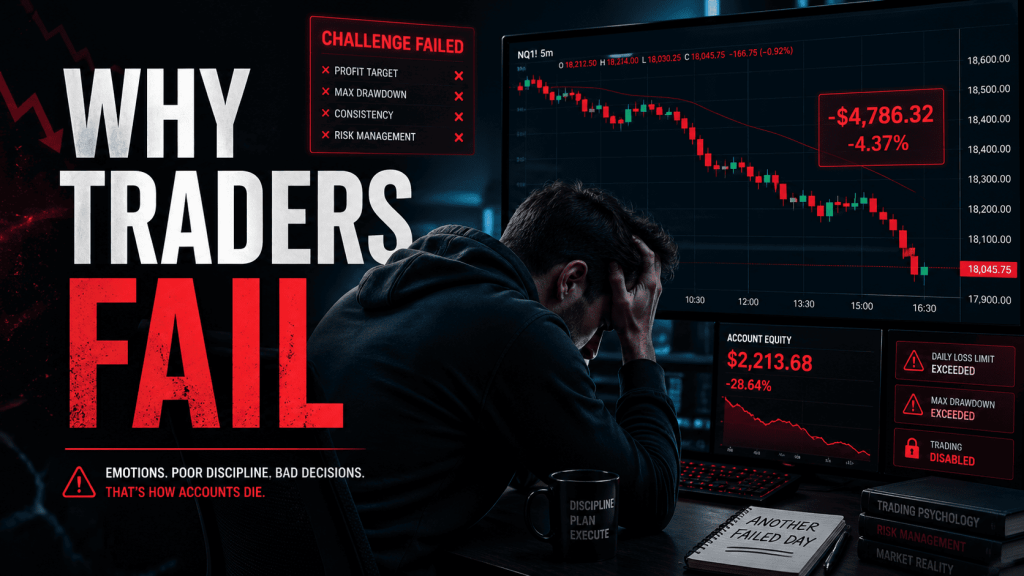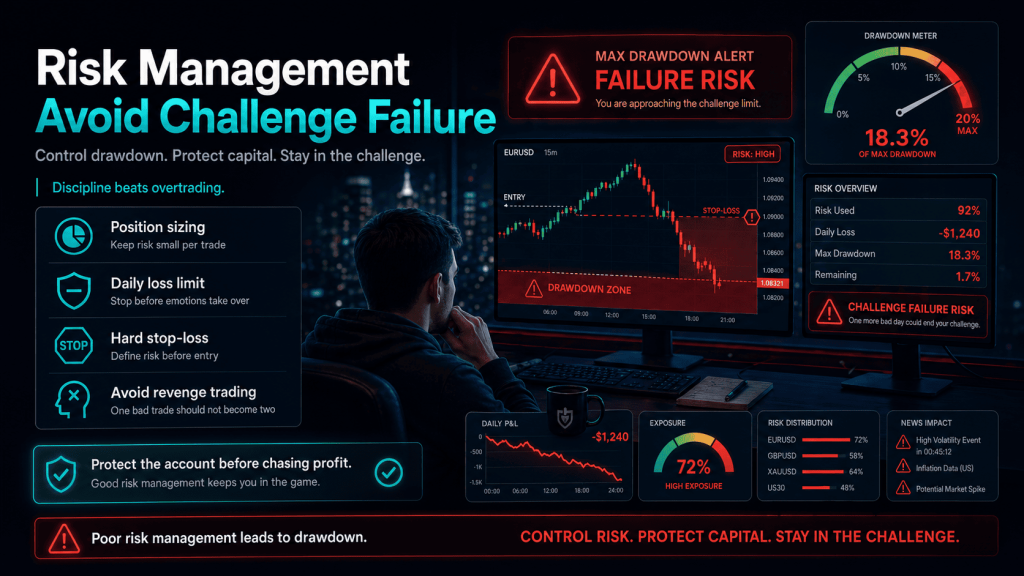


The fastest way to pass a prop firm challenge is to pass it cleanly. That means fewer weak trades, fewer rule repairs, fewer drawdown scares and no payout review mess. Do not try to speed up by adding size or forcing trades. Use five proven controls instead: choose a rule-fit account, size from the failure buffer, trade one tested playbook, rehearse execution before the clock starts, and slow down near the target. Fast is not the number of days on the dashboard. Fast is avoiding the reset button.
What does “pass your prop firm challenge faster” really mean?
Passing faster means reaching the target without creating a rule problem on the way there. A dirty pass that triggers consistency trouble, conduct review or payout delay is not fast.
Most traders hear “faster” and think about more trades. That is usually the wrong instinct.
The real time loss comes from failed attempts, reset fees, emotional recovery, fixing a best-day ratio, or reaching the target and then finding out the profit path is not clean. A trader can hit the number quickly and still be stuck.
So the job is not to trade faster. The job is to remove the trades that slow the account down later.
1. Choose a challenge that fits your trading path
The first way to pass faster is to choose an account whose rules fit the way you already trade. A cheap challenge with the wrong rule set is not a shortcut. It is a paid mismatch.
Start with the rules before the account size. The account label is marketing. The rule book is the real trading environment.
A scalper, swing trader and intraday trend trader should not all buy the same account just because the discount looks good. Each style stresses the rule book differently. Scalpers create frequency and commission pressure. Swing traders need holding permission and gap tolerance. Trend traders may create uneven profit distribution across days.
Use choosing a prop firm as the first filter. The right question is not “Which challenge can I pass fastest?” The better question is “Which challenge needs the least distortion from my normal process?”
If the rules force you to change your holding time, exit logic, session choice or trade frequency, the account is already slowing you down.
| Trading style | Rule to check first | What goes wrong if ignored | Cleaner speed move |
|---|---|---|---|
| Scalping | Execution rules, spread, commission, HFT restrictions | Many small trades turn into cost and conduct pressure | Trade only the session where fills are cleanest |
| Intraday trend trading | Daily loss, news rule, best-day concentration | One strong day can create consistency pressure | Cap daily profit and stop after the plan is complete |
| Swing trading | Overnight, weekend, daily reset and max drawdown logic | A normal floating loss can breach the account | Use smaller size and hold only when the buffer is wide |
| Low-frequency high-R trading | Minimum trading days and consistency rule | The account may need extra trades after the main winner | Pick a rule set that accepts uneven profit shape |
| Beginner discretionary trading | All loss rules and trade count discipline | The challenge becomes practice with a fee attached | Use simulation before buying a paid attempt |
2. Size from the failure buffer, not the account balance
The second way to pass faster is to stop sizing from the displayed account size. Size from the failure buffer instead.
The failure buffer is the space between current equity and the rule that fails, freezes or damages the account.
A £100,000 account does not mean you can trade like you have £100,000 of personal loss room. The real account is the daily loss limit, maximum loss limit, trailing drawdown, risk-per-trade rule and consistency pressure sitting behind the screen.
That is why the risk management strategy should be built before the first order. If the plan changes after a loss, it is no longer a plan. It is stress talking.
The clean risk sequence
Use a simple sequence before every session:
- Mark the firm’s hard daily loss line.
- Set a personal daily stop below that line.
- Check the maximum loss or trailing drawdown line.
- Decide the maximum number of trades for the day.
- Cut size after a poor decision, not only after a large loss.
This is slower for the first five minutes. It is faster for the full challenge because it prevents the rescue sequence.
The rescue sequence is familiar: one loss, one impatient re-entry, one larger position, one rule breach. The market may not even move much. The trader simply runs out of account room.
3. Trade one tested playbook and remove the weak sessions
The third way to pass faster is to trade fewer setups. Not less skill. Less noise.
A prop challenge is a bad place to discover who you are as a trader. It should test a playbook that already has structure.
One playbook means you know the setup, the session, the invalidation point, the normal losing streak and the normal trade duration. It also means you know which conditions damage the method.
This is where many traders lose time. They start with one idea, take two losses, then switch to a different market, a different time frame or a different entry trigger. The account becomes a moving experiment.
Do the opposite. Cut the weak sessions before the challenge starts. If London open is messy for your method, do not trade it just because it offers movement. If Friday afternoon usually causes poor decisions, remove it. If news spikes distort your fills, step aside.
Better execution is often subtraction.
What to measure before paying for the attempt
Track the parts that actually affect the challenge path:
- average loss size;
- largest normal losing sequence;
- drawdown spike by session;
- profit concentration by day;
- trade duration versus holding rules;
- slippage or fill issues around fast conditions.
The article on order execution and account types matters here. A clean signal can still become a poor challenge trade if the fill path, spread, commission or order type does not suit the account.
4. Rehearse the challenge pressure before the clock starts
The fourth way to pass faster is to make the hard decisions familiar before the paid attempt begins. Backtesting alone is not enough.
You need to practise the account state, not just the chart pattern.
Most traders can explain their strategy while calm. The challenge asks a different question. Can you still follow the plan after two losses? Can you stop after a strong morning? Can you leave the screen when the target is close?
Run a prop-style rehearsal. Use the same daily stop. Use the same maximum loss line. Use the same trade count. Track the same payout or consistency condition. Then do not cheat the test.
This is especially useful for newer traders. If the basic process is not stable yet, the paid challenge is early. Read is prop trading suitable for complete beginners? before treating a funded account as a training account.
The rehearsal should include failure states
A good practice run does not only test winning days. It tests the ugly states.
| Pressure state | What to rehearse | Pass-faster benefit |
|---|---|---|
| First loss of the day | Pause, review setup quality, keep or reduce size | Blocks revenge trading before it starts |
| Two losses in a row | Cut risk or end the session | Protects the daily loss buffer |
| Strong early profit | Set a give-back limit and stop if hit | Prevents a winning day turning into a reset day |
| Close to profit target | Trade smaller and accept a slower finish | Reduces late-stage failure risk |
| Best day too large | Stop before ratio repair becomes necessary | Protects consistency and payout readiness |
5. Slow down when the target is close
The fifth way to pass faster is the one traders resist most. When the target is close, slow down.
The final stretch is not the time to press harder. It is the time to protect the clean account.
Near the target, the trader starts seeing numbers instead of setups. “One more trade” becomes a dangerous phrase. The next entry is no longer chosen by quality. It is chosen by distance to the finish line.
This is where daily drawdown vs max drawdown becomes more than theory. A single careless loss near the end can damage both the daily limit and the full account path.
The final phase needs a throttle:
- reduce trade size once the account is meaningfully ahead;
- stop after a strong day instead of trying to finish immediately;
- avoid new markets or new setups;
- check the best-day ratio before taking more trades;
- protect payout readiness, not just the visible profit target.
A trader who finishes one day later with no rule problem is usually faster than the trader who hits the number today and then spends a week repairing the account.
Why consistency can make a fast pass slower
A consistency rule can turn a fast winner into a slow account. The trader is profitable, but the profit is too concentrated.
This is why the consistency rule belongs inside the five-way plan, not in a small note near payout.
Imagine a trader gets a strong move and reaches most of the target in one session. The account looks close. The rule may see a best-day problem. Now the trader has to keep trading to dilute the ratio.
That extra trading is not free. It adds fresh drawdown exposure after the account has already done its job.
The better move is to cap daily profit before the best day becomes a problem. That sounds strange to traders who love pressing winners. Inside a challenge, the goal is not the biggest day. The goal is the cleanest account path.
Keep the payout path inside the pass plan
A challenge is not finished because the dashboard is green. It is finished when the account is clean enough to move through review.
That means payout readiness should be part of the strategy from day one.
The AIFO payout process is a useful way to think about the full path. Profit may need to meet account status, review, eligibility and rule conditions before it can become payout-ready.
This changes the way you trade the last few sessions. You are not trying to squeeze every possible point from the market. You are trying to avoid adding new issues to an account that is already close to doing its job.
The clean pass is boring near the end. That is a good sign.
Alpha Insight: the fastest challenge is the one you do not restart
Speed in prop trading is usually misunderstood. Traders count calendar days. Risk desks count rule path.
The fastest challenge is not the one you rush. It is the one you do not need to restart, repair or defend in review.
That is why these five ways work together. Rule fit removes structural friction. Failure-buffer sizing protects the attempt. A narrow playbook removes weak trades. Rehearsal makes pressure familiar. Final-phase throttling keeps the account clean when the target is close.
None of that sounds exciting. Good. Excitement is often the expensive part.
Read the AIFO trading rules like a risk sheet, not a formality. The trader who understands the rules before trading usually moves faster than the trader who learns them after breaching them.
FAQ: 5 proven ways to pass a prop firm challenge faster
Pass faster by passing cleanly. Choose a challenge that fits your strategy, size from the loss buffer, trade one tested playbook, rehearse the pressure before paying, and reduce risk near the target.
No. More trades usually add noise, cost and rule risk. The faster route is fewer low-quality trades, cleaner execution, and a plan that avoids daily loss, drawdown and consistency problems.
No. Higher risk may move the account faster, but it also brings the failure line closer. Risk should be sized from the daily loss, maximum loss, trailing drawdown and consistency rules, not from the account label.
Slow down. Reduce size, avoid new setups, protect the best-day ratio and stop trading if the next trade is being taken only because the target is close.
Yes, but backtesting alone is not enough. You should also rehearse the challenge rules in simulation, including daily stops, losing streaks, give-back limits and target pressure.
The biggest mistake is treating speed as aggression. Traders force trades, increase size near the target, ignore consistency pressure and then lose time through reset, repair or review.