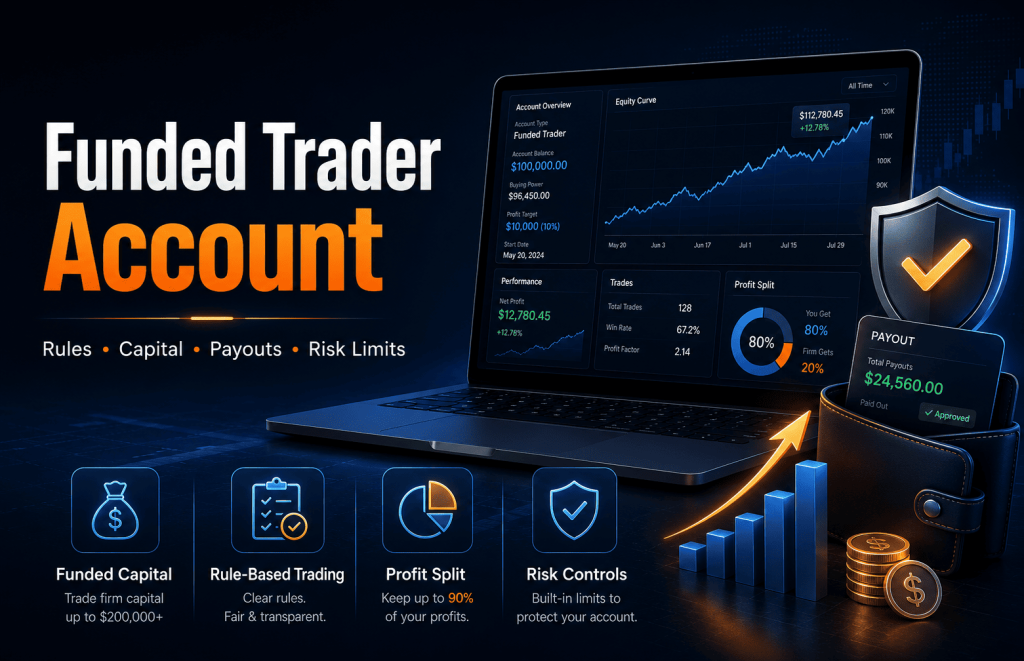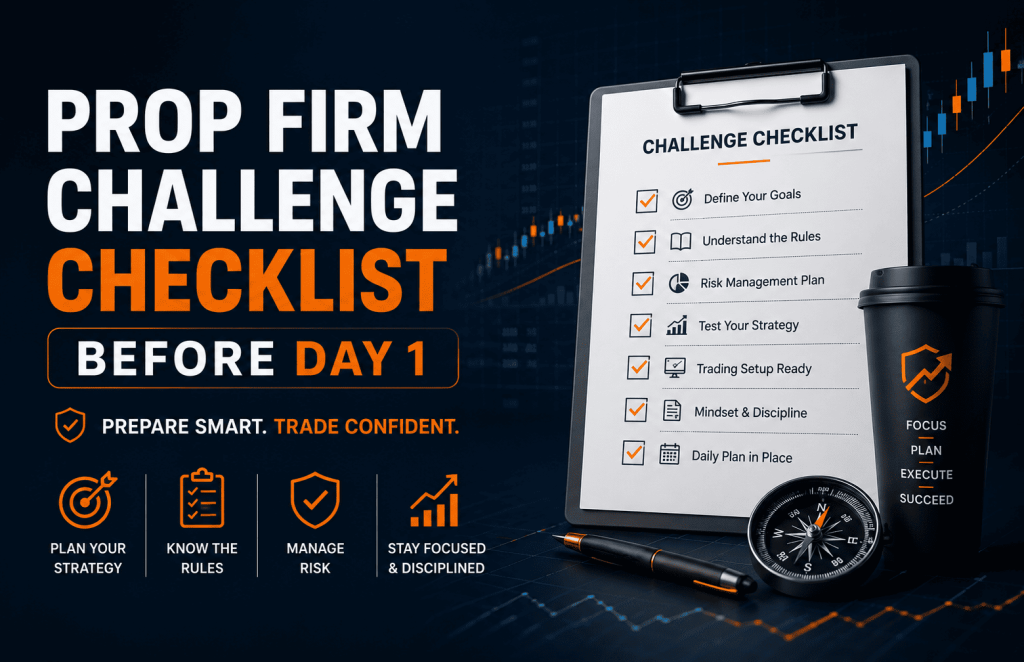


After you pass a prop firm challenge, the account usually enters review before you receive a funded account. You may need to stop trading the challenge account, complete KYC or KYB, sign a funded account agreement, pay an activation fee in some futures models, then wait for new credentials or account activation. Passing is not payout. It is a status change. The smart move is to reduce risk, confirm the funded-stage rules, protect the first payout path and avoid changing the strategy that passed the evaluation.
What Happens After You Pass a Prop Firm Challenge?
After passing, your account moves from evaluation mode into a review and activation path. Use how prop trading works as the wider account-path guide, then treat this page as the post-pass checklist.
The usual sequence is simple: stop trading, wait for review, complete verification, accept the agreement, activate the funded account, read the funded-stage rules, then plan the first payout. The danger is acting like the money is already secure.
| Post-pass step | What it means | Trader mistake | Safer action |
|---|---|---|---|
| Result review | The firm checks that targets and rules were met | Continuing to trade after hitting the target | Stop trading once objectives are marked passed |
| KYC or KYB | The firm verifies identity, address, company or payment details | Waiting until payout day to prepare documents | Prepare ID, address proof and matching payment details early |
| Agreement | The trader accepts funded-stage terms and reward structure | Signing without reading rule differences | Read daily loss, payout, restricted strategy and termination rules again |
| Activation | Some firms issue credentials; some futures firms require an activation step | Missing activation windows or paying for the wrong account | Confirm account name, path, fee and deadline before payment |
| Funded trading | The trader starts the funded-stage account | Increasing size because the challenge was passed | Risk less than evaluation until first payout is secured |
| First payout path | Profit must become eligible, reviewed and paid | Treating dashboard profit as cash | Plan timing, minimum amount, KYC, open-trade rules and buffer |
Step 1: Stop Trading the Challenge Account
Once the challenge objectives are passed, the account should stop being a trading account in your mind. It becomes an account waiting for review.
This is where good traders sometimes do something stupid. They hit the target, keep clicking, and turn a passed account back into a risk event.
Why you should stop immediately
The challenge target has already done its job. More trades do not make the pass cleaner.
More trades can create fresh drawdown, new rule exposure or a trade-history issue before the firm reviews the result. The account no longer needs performance. It needs preservation.
Do not “pad” the pass
Some traders keep trading to build a cushion. That sounds sensible until the cushion becomes a loss cluster.
A passed challenge is not the place to prove extra edge. The cleanest pass is the one with no new damage after the target is reached.
Save your account state
Screenshot the dashboard, objectives, equity, balance, trade history and time of completion. Keep the records before any review starts.
This is not paranoia. It gives you a clean audit trail if the firm asks for clarification or if the dashboard updates later.
Step 2: Wait for Review and Status Confirmation
Passing the profit target does not always mean the funded account is ready. Many firms review the account after market close or after the trading day ends.
The review checks whether the target was reached under the rules. It may include drawdown, minimum days, prohibited strategies, news exposure, platform behaviour and trade history.
Market close matters
Some firms only mark the account as passed after the session closes. Intraday target hit does not always start the next step.
This timing matters if there is an activation window or if the trader expects immediate funded credentials. Do not build plans around intraday emotion.
Review can block the account
If the firm finds a rule breach, the funded account may not be issued. That is why the trading path matters as much as the final number.
A trader should review the account before the firm does: daily loss, max loss, consistency, news, EA, copier, holding and trade frequency.
Support messages are not the rule book
If the firm sends a dashboard message, read it carefully. If it references terms or verification, follow that path exactly.
Do not rely on social media comments or old screenshots. Post-pass workflows change by account type.
Step 3: Complete KYC, KYB and Verification
KYC is often the first real gate after passing. You may need identity documents, address proof, payment details, a selfie, business documents or a video interview.
The rule is plain: no clean verification, no clean funded path.
Keep every detail consistent
Name, email, address, payment method and account holder details should match. Small mismatches can slow the process.
That delay can create a second problem. The trader gets impatient and starts planning trades before the funded account is even live.
KYC can include behaviour checks
Some firms use verification to check more than identity. They may ask for extra documents, account access clarity or explanations around trading behaviour.
This is why a trader should keep the challenge clean. Passing with strange access patterns or copied trades can make the post-pass stage harder.
Prepare documents before passing
Do not wait until the moment you pass to find a valid address document. That is weak planning.
Prepare passport or ID, address proof, payment account details and any firm-specific documents before the final phase. If the account is in a company name, prepare KYB documents too.
Step 4: Sign the Funded Account Agreement
The funded account agreement is not paperwork. It is the contract that changes the account from evaluation to reward stage.
Read it like a trader, not like a bored user clicking through terms. The funded stage can carry rules that did not matter as much during evaluation.
Check rule changes
Some firms keep the same core loss rules. Others add payout rules, holding conditions, news restrictions, consistency requirements, review language or account access terms.
The phrase “funded account” does not mean freedom. It usually means the firm now cares more about reward eligibility.
Check profit split and payout path
Profit split is not the whole payout. You still need timing, minimum amount, KYC, open-position treatment, review and payment method approval.
Use prop firm payout rules before the first funded trade. The payout path should be known before the account turns green.
Check account termination rules
The funded agreement should tell you what closes the account: drawdown breach, restricted strategy, inactivity, account sharing, KYC issue, copy trading, rule violation or payment fraud.
Knowing this early changes behaviour. You stop treating the funded account like a bigger demo.
Step 5: Activation Fees and Funded Account Credentials
Some firms issue funded credentials after review and verification. Some futures-style models require a paid activation step before the funded account opens.
Do not assume “passed” means “activated”. The difference can cost money or lose the opportunity if there is a deadline.
Check whether an activation fee exists
Some programmes charge after passing. Others build the activation into the original path.
The fee itself is not the main problem. The problem is being surprised by it, paying for the wrong account, or missing the deadline while the trader thought the pass was complete.
Check the activation window
If the firm gives a fixed activation window, write the deadline down. Market close timing may decide when that window starts.
A trader who misses the window may need to pass another evaluation. That is not a trading loss. It is an account-process failure.
Do not rush the first login
When the funded account appears, check account size, platform, symbols, server time, daily loss, max loss, payout cycle and rules before placing a trade.
The first funded order should not be a platform test. Run the same discipline you used before Day 1 of the challenge.
Use the prop firm challenge checklist again before the first funded trade. The account state changed, so the checklist resets.
Step 6: Funded Stage Rules Are Not Just Challenge Rules Again
The funded stage is not simply the challenge with a nicer label. The psychology changes, the reward path changes, and the cost of a mistake feels sharper.
You now have something to protect. That can make traders either too defensive or too aggressive.
Risk less than evaluation
A clean funded-stage plan usually starts with lower risk than the evaluation stage. Passing does not mean the trader earned permission to size up.
The first goal is not to prove the pass was deserved. The first goal is to reach a clean first payout with the account intact.
Keep the same setup filter
Do not add new strategies after passing. Do not trade extra sessions because the funded account feels more real.
The method that passed the evaluation is the only method allowed in the first funded cycle. New ideas can wait.
Stop treating the account as a target sprint
During evaluation, the visible goal is the profit target. In funded stage, the real goal is repeatable payout eligibility.
That is a different rhythm. The trader must move from target chasing to account maintenance.
Step 7: Plan the First Payout Before the First Funded Trade
The first payout should not be planned after profit appears. It should be mapped before funded trading starts.
That plan should include first request date, minimum profit, KYC status, payment method, open-trade policy, payout review and post-withdrawal buffer.
Know the first payout gate
Some accounts require minimum days. Some require a minimum amount. Some require winning days, consistency checks, account age, or a clear safety buffer.
Write the gate down. If you do not know the first payout rule, you are trading blind.
Do not force the final trade
The closer the account gets to first payout, the more tempting one extra trade becomes. That trade is often low quality.
A trader who needs one more trade to reach minimum withdrawal should wait for a real setup. Payout pressure is not a signal.
Leave account room after withdrawal
First payout can reduce account buffer. Taking the maximum amount can feel good and leave the next cycle fragile.
Read first payout rules in prop firms before deciding how much to request. The first payout should pay you without weakening the account beyond normal recovery room.
Alpha Insight: Passing Is a Risk Reset, Not a Permission Slip
Passing a challenge does not give you permission to trade bigger. It gives you a reason to trade smaller until the first payout is secured.
The trader who passes and immediately increases size has misunderstood the account state.
The challenge proved that the trader could operate inside one rule box. The funded stage asks a different question: can the trader protect an account that now has reward pressure?
This pressure is subtle. The trader wants to be paid. They want to justify the pass. They may want to recover the challenge fee quickly. That is how position sizing pressure enters the funded stage.
The first funded cycle should be boring. Smaller risk. Cleaner trades. No new strategy. No payout chasing. The account has already survived the test. Now it needs to survive the trader.
What Can Go Wrong After Passing?
Most post-pass failures are not caused by a lack of skill. They come from account-process mistakes and behaviour changes.
The trader who passed the challenge can still lose the funded account quickly if they treat the funded stage as a victory lap.
| Post-pass failure | How it happens | Risk consequence | Prevention |
|---|---|---|---|
| Trading after objectives are passed | The trader keeps trading the challenge account while waiting for review | Fresh losses or rule exposure before account approval | Stop once objectives are marked passed |
| KYC delay | Documents mismatch or are not ready | Funded account activation or payout path slows down | Prepare ID, address and payment details early |
| Activation mistake | Wrong account selected, fee missed, deadline missed | Delayed or lost funded opportunity | Confirm account name, size, path and deadline before activation |
| Oversizing funded stage | The trader feels validated and increases risk | Fast drawdown before first payout | Risk less than evaluation until payout is secured |
| Ignoring funded-stage rules | Trader assumes evaluation rules and funded rules are identical | Payout denial or account termination | Read funded agreement before first trade |
| Payout chasing | Trader forces trades to reach minimum withdrawal | Profit turns into drawdown near payout | Plan first payout and wait for valid setups |
If a payout is blocked after funded trading starts, use why prop firm payouts get denied to separate clean rule breaches from unclear firm review issues.
How AIFO Traders Should Handle the Post-Pass Stage
AIFO traders should treat the post-pass stage as a controlled account handover. The goal is not excitement. The goal is clean transition.
That means account model, rules and payout process need to be checked before the first funded order.
Start with the account model
Use AIFO account models to understand which path you are moving into. The model decides the first funded-stage pressure: evaluation continuity, payout timing, account size, or funded-style drawdown.
Do not assume every model behaves the same after passing. The account route changes the risk route.
Read the rules again
Use AIFO trading rules before first funded execution. Do not rely on memory from the challenge stage.
A funded account is where rule mistakes cost more emotionally. The trader already earned the path, so losing it hurts more.
Plan the payout process
Use AIFO payout process before the first funded trade. Payout timing changes behaviour before traders notice it.
The clean plan is simple: reduce risk, trade the same setup, do not force minimums, protect buffer, request only when the account is payout-ready.
Post-Pass Checklist Before the First Funded Trade
Run this checklist after passing and before placing the first funded trade. It is short because the decision should be clear.
If one item is unclear, the account is not ready for live funded-stage behaviour.
- Stop trading the challenge account once objectives are passed.
- Save dashboard screenshots, objectives and trade history.
- Wait for review or account status confirmation.
- Complete KYC or KYB with matching documents and payment details.
- Read and save the funded account agreement.
- Check whether activation fee or activation deadline applies.
- Confirm funded account credentials, server time, platform and symbols.
- Recalculate daily loss, max loss and drawdown in cash terms.
- Reduce risk below evaluation size for the first funded cycle.
- Read the first payout rule before the first funded trade.
- Trade only the setup that passed the evaluation.
- Stop trading after the first process error.
For the broader account journey, return to prop firm account path. Passing is one step; staying funded is the harder phase.
FAQ
The account usually enters review. The firm checks that the profit target, trading days, drawdown rules and other conditions were met. After approval, the trader may need to complete KYC or KYB, sign a funded account agreement, activate the funded account and wait for new credentials or account access.
No. Once the objectives are passed, the safer action is to stop trading and let the account enter review. Extra trades do not improve the pass. They can create new drawdown, rule exposure or trade-history issues before the firm approves the funded account.
Most prop firms require KYC, KYB or account verification before issuing the funded account or allowing payouts. Traders should prepare valid identity documents, address proof and matching payment details before passing, so the funded-stage setup is not delayed by admin problems.
Some firms, especially futures-style programmes, may require an activation fee or activation step after passing. Others do not. Traders should check the exact account path, activation deadline, fee amount, refund status and account name before paying anything after a passed evaluation.
Trade smaller than you did during evaluation until the first payout is secure. Keep the same setup filter, avoid new strategies, check funded-stage rules, and do not chase the first payout minimum. The funded account needs preservation before scaling.
First payout timing depends on the firm and account model. The trader may need a funded account to be active first, then meet minimum trading days, minimum profit, KYC, payout cycle and review requirements. Profit shown on the account is not withdrawable until it becomes payout-ready.