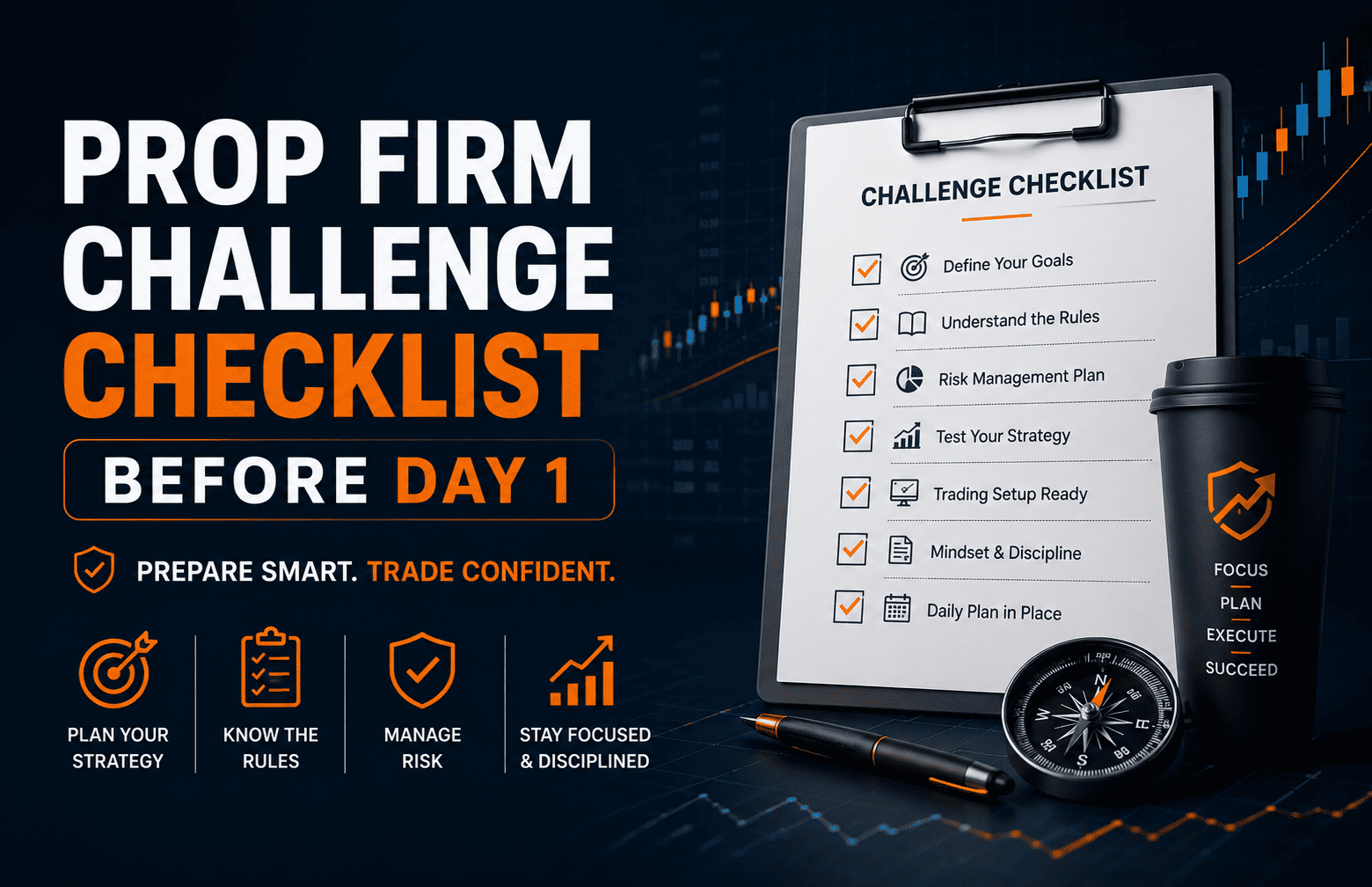



A Day 1 prop firm checklist is the final gate before the first order. Confirm the exact programme, rule version, loss limits, drawdown type, trading-day requirement, permitted tools, platform settings, risk budget and first-trade conditions. If one required item is unclear, delay the trade.
A challenge can fail before the strategy receives a fair test. Wrong position size, wrong account rule, incorrect platform setting or an unplanned first trade can create avoidable risk immediately.
Use the How to Pass a Prop Firm Challenge guide for the full progression plan. This article focuses only on the pre-trade decision for Day 1.
Last rule review: . For AIFO accounts purchased before 1 September 2026, the challenge parameters displayed on the Dashboard apply.
Day 1 Checklist at a Glance
| Gate | Pass condition | Block the trade when | Evidence |
|---|---|---|---|
| Programme | The account type and current rule version are confirmed | The trader is using rules from another programme or an older account | Programme name, purchase date and Dashboard |
| Loss limits | Daily, Maximum and any floating-loss limits are written in account currency | Only headline percentages are known | Loss-floor calculation and account balance |
| Risk budget | Risk per trade, daily stop and maximum trades are fixed | Size will change after a win or loss | Written session plan |
| Trading method | The selected programme permits the intended manual or automated method | Platform capability is being treated as programme permission | Current rule and tool settings |
| Platform | Symbol, contract size, order ticket, stop and server time are checked | The first account order would also be the platform test | Platform specification and test notes |
| Market conditions | Session, spread, volatility and scheduled events fit the plan | The setup depends on abnormal execution conditions | Calendar and pre-trade screenshot |
| First-trade rule | The first order satisfies any programme-specific trigger or instrument condition | The first order changes the account state in a way the trader has not planned | Entry plan and programme condition |
Identify the AIFO Programme First
AIFO’s current account paths are Instant, 1-Step, 2-Step and Sprint. All AIFO accounts use virtual funds in a simulated trading environment, but their targets, loss mechanisms, timing and payout conditions differ.
| Programme | Objective or access | Loss limits | Day 1 condition |
|---|---|---|---|
| 1-Step | 10% profit target | 3% Daily Loss; 6% Static Maximum Loss | At least 2 trading days are required before progression |
| 2-Step | 8% Phase 1 target; 5% Phase 2 target | 5% Daily Loss; 10% Static Maximum Loss | At least 3 trading days are required before progression |
| Instant | Immediate access without a traditional evaluation target | 3% Daily Loss; 5% HWM-based Trailing Maximum Loss; floating loss not above 2% of initial balance | Best single-day profit must remain below 20% of payout-period profit |
| Sprint | 3% target in a 24-hour challenge | 2% Static Maximum Loss; total floating loss not above 1% of initial balance | First trade within 48 hours; it selects the only instrument and starts the countdown |
Use the AIFO account-model comparison and AIFO trading rules to confirm the account shown on the Dashboard.
Write Every Loss Boundary in Account Currency
Percentages are easy to remember and easy to misuse. Convert each boundary into the account currency before opening a chart.
| Field | Question | Common mistake |
|---|---|---|
| Daily Loss Limit | What current balance or equity level creates the daily breach? | Using the percentage without calculating the remaining room |
| Maximum Loss Limit | Is the floor static or trailing? | Expecting a static floor to move, or a trailing floor to stay fixed |
| HWM | If trailing, what highest historical equity controls the floor? | Calculating from current balance instead of the applicable HWM |
| Floating-loss cap | Does the programme impose an additional real-time floating-loss rule? | Checking only closed P&L |
| Personal daily stop | At what smaller loss will the trader voluntarily stop? | Using the firm’s breach line as the normal session stop |
AIFO 1-Step and 2-Step use static Maximum Loss Limits. Instant uses a 5% trailing mechanism based on the account’s highest historical equity, which rises with new highs and is capped at the initial balance. Sprint uses a 2% static limit.
Read Daily Loss versus Maximum Loss before calculating the available room.
Set the Day 1 Risk Budget
The firm rules define failure boundaries. The trader still needs smaller operating limits for normal trading.
- Risk per trade: set the cash loss before choosing position size.
- Personal daily stop: stop before the official Daily Loss boundary.
- Maximum trades: limit how many normal attempts the session can take.
- Re-entry rule: define whether a stopped setup can be traded again.
- Process stop: end the session after wrong size, wrong symbol or another execution error.
A profit target should not determine position size. Size must fit the nearest loss boundary and the trader’s planned stop. Use the risk-per-trade guide and challenge risk-management guide to calculate the session budget.
Separate Trading Days from Consistency
Trading-day requirements and profit-concentration rules answer different questions.
- AIFO 1-Step requires at least 2 trading days before progression.
- AIFO 2-Step requires at least 3 trading days before progression.
- AIFO 1-Step and 2-Step funded accounts have no Consistency Score requirement.
- Instant requires the maximum single-day profit to remain below 20% of payout-period profit.
- Sprint requires the largest single-trade profit to remain below 20% of total profit.
Do not invent a profitable-day threshold for 1-Step or 2-Step. The current rules specify trading days, not a requirement that each counted day reach a separate profit percentage.
See minimum trading days versus profitable days and the consistency-rule guide.
Confirm EA Permission Before Loading Automation
AIFO permits Expert Advisors only on 1-Step and 2-Step Challenge accounts and on the corresponding funded accounts after passing.
Instant and Sprint are not included in that eligibility rule. Software compatibility does not provide programme permission. If the account type is not expressly eligible, do not attach or run an EA.
Review the AIFO EA policy before Day 1.
Sprint Requires a Separate First-Trade Checklist
The first Sprint order changes several account conditions at once:
- It must be opened within 48 hours after purchase.
- It starts the 24-hour challenge countdown.
- Its instrument becomes the only permitted instrument for the account.
- The account may hold only one open position at a time.
Before that first order, confirm the instrument, session, position size and full 24-hour plan. An exploratory trade can lock the account to an unintended instrument and consume the challenge window.
Sprint also uses a 3% target, 2% Static Maximum Loss, 1% total floating-loss limit and a largest-single-trade profit threshold below 20% of total profit.
Check the Platform Before the First Account Order
| Item | Confirm | Risk if skipped |
|---|---|---|
| Symbol | Correct instrument and any platform suffix | Wrong contract or unintended Sprint instrument lock |
| Contract specification | Contract size, minimum lot and lot increment | Incorrect cash risk |
| Order ticket | Order type, volume, stop loss and take profit | Execution does not match the plan |
| Server time | Trading date and relevant account timing | Incorrect day or countdown assumption |
| Dashboard | Programme, balance, equity and displayed limits | Trade uses the wrong account state |
Use the order-execution guide before treating the first account order as a platform test.
Check News and Market Conditions
Scheduled events can change spread, slippage and real-time equity. Mark the event time, affected currencies or instruments and the actions covered by the selected firm’s current rules.
Do not assume a rule about opening trades also answers questions about closing, modifying, holding or triggering a pending order. If the selected AIFO programme does not provide a clear current condition for the intended action, confirm it before trading.
Use the news-trading guide for a general event-risk checklist.
Prepare the Journal Before Entry
A challenge journal should record account rules as well as trade results.
- programme and rule-check date;
- initial balance, current balance and equity;
- Daily and Maximum Loss floors;
- current HWM when applicable;
- risk per trade and personal daily stop;
- number of trades used and remaining;
- setup, instrument, session and event conditions;
- planned stop, position size and maximum cash loss;
- process error and stop-trading decision;
- remaining account room after the trade.
P&L alone cannot show whether a winning trade used excessive risk or whether a losing trade followed the plan.
Final Pre-Trade Sequence
- Open the current programme rules and Dashboard.
- Confirm Instant, 1-Step, 2-Step or Sprint.
- Write all applicable loss limits in account currency.
- Identify Static or Trailing Maximum Loss behavior.
- Set risk per trade, personal daily stop and maximum trades.
- Confirm whether the intended trading method and EA use are permitted.
- Check the symbol, contract details, order ticket and server time.
- Mark scheduled events and abnormal market conditions.
- For Sprint, confirm the first instrument and 24-hour plan before opening the first trade.
- Record the pre-trade account state in the journal.
- Place the order only when every applicable item passes.
- After the trade, recalculate account room before another entry.
Final Takeaway
The first trade is an account-state decision as well as a market decision. Day 1 should begin only after the programme, limits, tools, platform and risk budget are confirmed.
At AIFO, never mix the four current paths. 1-Step and 2-Step use static Maximum Loss Limits and minimum trading days. Instant uses an HWM-based trailing limit and day-level concentration rule. Sprint uses a time-limited, single-instrument structure triggered by the first trade.
Frequently Asked Questions
Confirm the programme, current rule version, loss limits, drawdown type, trading-day requirement, permitted tools, platform settings, market conditions, risk per trade, personal daily stop and any first-trade condition. Delay the trade if a required item is unclear.
The current AIFO paths are Instant, 1-Step, 2-Step and Sprint. All use simulated trading with virtual funds, but their targets, loss mechanisms, timing, consistency and payout conditions differ.
The current rules specify at least 2 trading days for 1-Step and at least 3 trading days for 2-Step before progression. They do not state that each counted day must reach a separate profitable-day percentage.
No. AIFO permits Expert Advisors only on 1-Step and 2-Step Challenge accounts and on the corresponding funded accounts after passing. Instant and Sprint are not included in the current EA eligibility rule.
The first Sprint trade starts the 24-hour challenge countdown and selects the only permitted trading instrument for that account. It must be opened within 48 hours after purchase, and the account may hold only one open position at a time.
Choose risk from the nearest applicable account boundary and a smaller personal daily stop, not from the profit target. The amount should allow a normal losing sequence without reaching the firm’s Daily or Maximum Loss Limit.
No. AIFO 1-Step and 2-Step funded accounts have no Consistency Score requirement. Instant uses a below-20% maximum single-day profit rule, while Sprint uses a below-20% largest-single-trade profit rule.