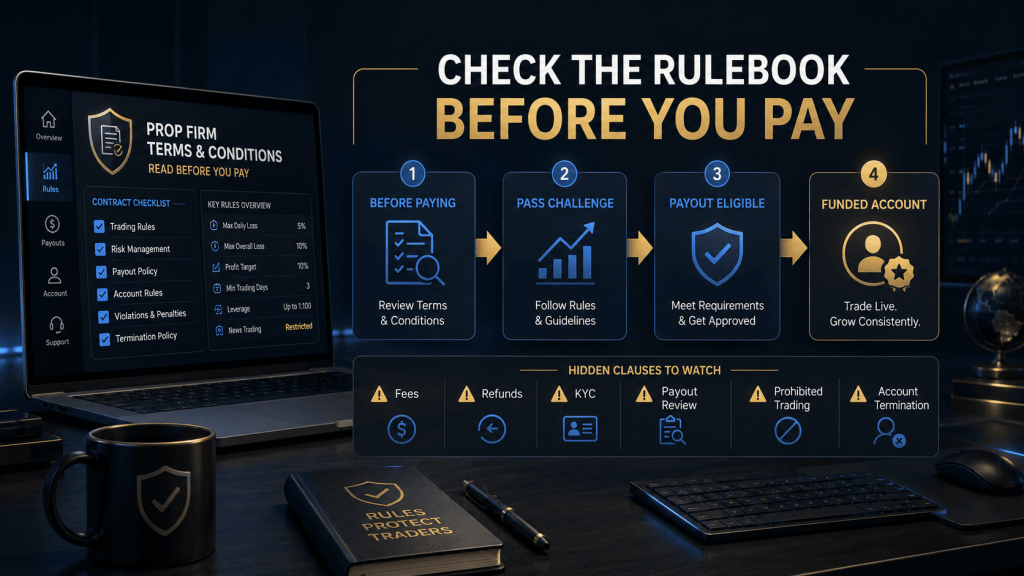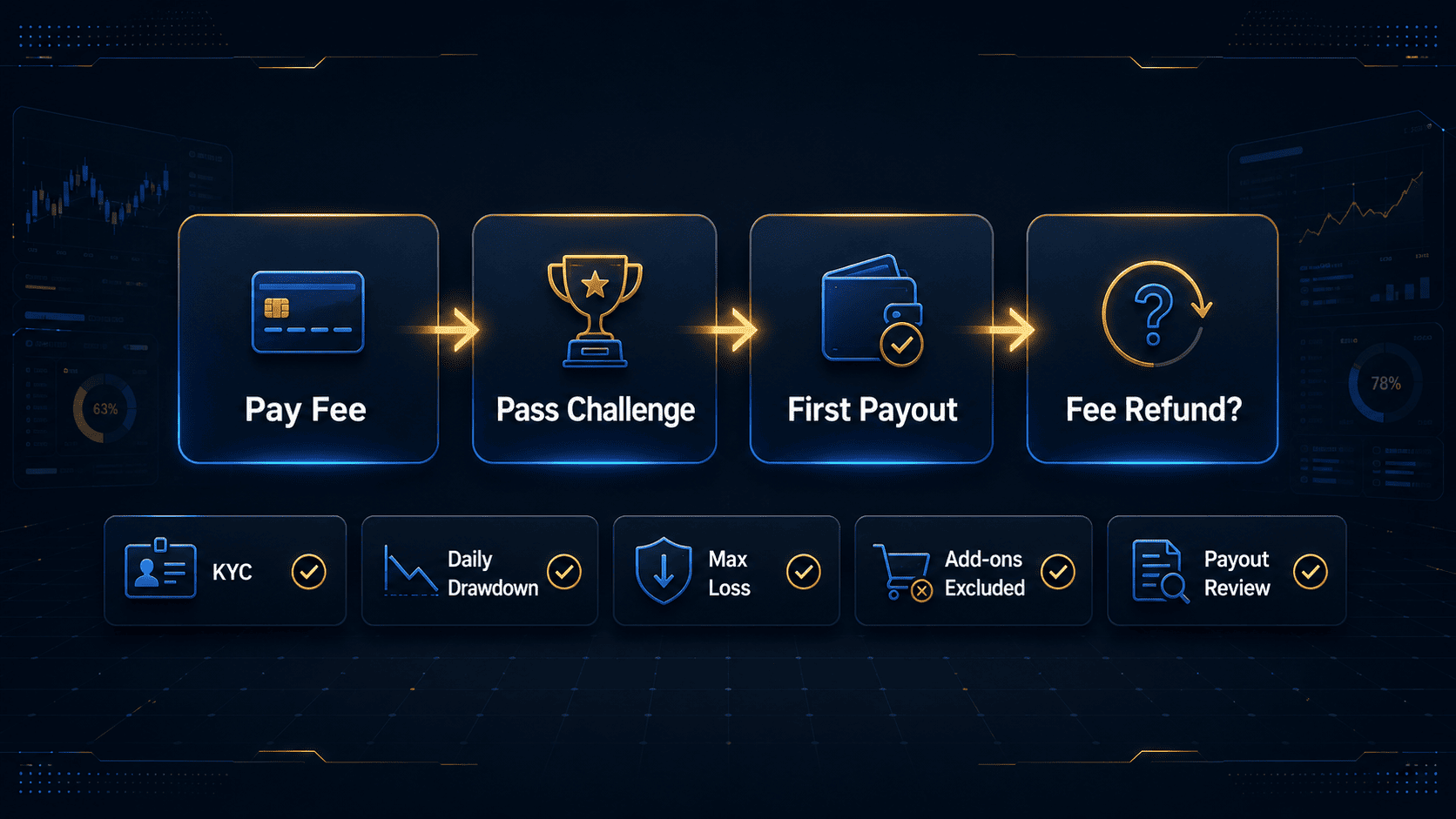



Prop firm challenge fees can be refundable, but the refund is usually conditional. A refundable challenge is not the same as a free challenge. The fee may come back only after a cancellation window, a funded-stage milestone, a first approved payout, a later reward, or another written condition. Refund value also depends on account type, KYC, rule status, add-ons, resets, credits and payment method.
This article is the refund-rules child guide inside the Prop Firm Challenge Costs Hub. Use the Cost Hub for the full cost framework, and use this page to check whether a “refundable” challenge fee is actually recoverable.
What “Refundable Challenge Fee” Really Means
A refundable challenge fee usually means the firm may return your evaluation fee after you complete the required path. It rarely means you can pass Phase 1 or Phase 2 and immediately receive cash back.
This matters because passing and payout readiness are different states. You can pass the evaluation and still need funded-stage review, KYC, trading days, minimum profit, payout approval, consistency checks or rule review before a refund is processed.
| Refund wording | What it usually means | What it does not mean | Main trader risk | What to verify |
|---|---|---|---|---|
| Standard refund | A cancellation-style refund before trading starts, often inside a short time window | A refund after failing, breaching or trading the account | Trader starts trading and loses the cancellation window | Refund window, trading-start definition and account exclusions |
| Refund on first payout | The fee may be returned with the first approved payout or reward | The fee is returned immediately after passing | Trader passes but never reaches payout eligibility | First payout timing, KYC, buffer, consistency and review conditions |
| Refundable fee | The firm may reimburse the original fee, a reset fee or selected base fee under written conditions | Every related cost is refunded | Add-ons, discounts, reset rules or account model exclusions change the amount | Base fee, add-ons, reset fee, discounts and payment charges |
| Credit or hub credit | Credit that may be used toward another challenge or platform purchase | Withdrawable cash | Trader treats non-withdrawable credit as money back | Whether the refund is cash, payout balance, payment-method return or account credit |
| Free challenge | No upfront challenge fee, usually under a campaign, trial or limited offer | A paid challenge with a later refund | Trader ignores rule quality because entry feels free | Whether it creates payout rights, profit sharing or only practice access |
AIFO Refund Rules: Standard Refund, Terms and Checkout Conditions
Last checked on : Without prejudice to any mandatory statutory consumer withdrawal right, AIFO’s standard refund policy permits a full refund only where the trader has not started any trading and submits the refund request within 7 days of payment. This standard refund policy does not apply to Sprint accounts.
AIFO’s standard 7-day refund policy and any mandatory statutory consumer withdrawal right that may apply are separate legal routes. Do not treat the standard policy as removing a mandatory statutory right, and do not assume that a statutory right changes the conditions of AIFO’s standard refund policy. Read the current AIFO Refund FAQ together with the AIFO General Terms and Conditions.
| AIFO refund check | What to verify | Why it matters | Official reference |
|---|---|---|---|
| Standard refund window | No trading has started, and the refund request is submitted within 7 days of payment | Starting any trade ends eligibility under AIFO’s standard refund policy | AIFO Refund FAQ |
| Sprint exclusion | Whether the selected account is a Sprint account | AIFO’s standard refund policy does not apply to Sprint accounts | AIFO Refund FAQ |
| Mandatory statutory rights | Whether mandatory consumer withdrawal rights apply independently of the standard refund policy | The statutory route must not be collapsed into the platform’s 7-day standard refund policy | AIFO General Terms |
| Legal and policy hierarchy | How the standard refund policy, contractual terms and mandatory law apply to the request | Different legal routes can have different triggers and consequences | AIFO General Terms and AIFO Refund FAQ |
| Checkout and promotion terms | Final price, discount, add-ons, reward terms and selected account model | Refundable amount may depend on what was actually purchased | Live checkout / dashboard / support answer |
The practical reading is simple: check the selected account, whether any trading has started, the payment date, the request date, the Refund FAQ and the General Terms before assuming an AIFO fee is refundable. KYC and payout requirements may affect access or a later payout, but they should not be presented as conditions of AIFO’s standard no-trading refund unless the current written policy expressly says so.
Refund Patterns Across Prop Firms: Use Patterns, Not Old Price Tables
Different firms use different refund triggers. The same phrase can mean a first-payout refund, a partial refund, a delayed milestone, a reset-based refund or a non-cash credit.
Because refund policies change quickly, this page should compare refund patterns instead of hardcoding external firm policy rows that may become outdated.
| Refund pattern | When the refund may happen | Main caveat | Rule check before paying |
|---|---|---|---|
| Pre-trading cancellation refund | Before the trader starts trading, inside a short written refund window | Opening the first trade may close the window | Check exact time window, account exclusions and what counts as “started trading” |
| First-payout refund | When the trader reaches the first approved payout or reward | Passing the challenge is not enough | Check first payout timing, KYC, buffer, review, consistency and open-position rules |
| Milestone-based refund | After a later reward, scaling milestone, funded-stage condition or repeated payout event | The refund may be much later than the trader expects | Check milestone number, account stage and whether every model qualifies |
| Reset-based refund | After a reset or repurchase path under selected conditions | Refund may apply to reset fee, original fee or only a reduced amount | Ask how resets change refundable amount and eligibility |
| Credit-based refund | As dashboard, hub, wallet or platform credit | Credit may not be withdrawable cash | Check whether credit can be cashed out, transferred or only used for another purchase |
| Add-on or upgrade exclusion | The base challenge fee may be treated differently from add-ons or upgrades | The trader may recover less than the full checkout amount | Separate base fee, add-ons, discounts, taxes, payment fees and upgrades |
Hidden Rules That Decide Whether You Get the Fee Back
The refund is rarely decided by one event. It is usually decided by a chain of account states.
| Hidden rule | Why it matters | Refund consequence | Safer action | Related guide or page |
|---|---|---|---|---|
| First payout requirement | Many firms do not refund the fee at pass stage | You can pass and still not be refund-ready | Read the first payout rules before buying | First payout rules |
| KYC | A milestone-based reimbursement tied to payout can depend on identity verification | The later reimbursement route may remain unavailable if payout identity review fails | Check whether the firm’s written refund trigger actually depends on an approved payout | AIFO KYC guide |
| Rule breach | Daily loss, max loss, prohibited trading and conduct rules can close the account | Fee refund can be voided under a firm’s written milestone-refund policy | Read the rules before placing the first trade | AIFO trading rules |
| Payout buffer | Some profit may need to remain in the account; at AIFO, the 2% retained profit buffer applies only to Instant after a payout | A milestone-based refund tied to payout may occur later than expected | Check the exact account model and calculate payout-ready profit before sizing for a refund | AIFO payout buffer |
| Add-ons and upgrades | Add-on fees may be treated differently from the base challenge fee | You may recover the base fee but not the full checkout amount | Separate base fee, add-ons, discount and payment charges in your calculation | Challenge costs |
| Reset fee | Some firms change the refundable amount after resets | The refund amount can change | Ask support how resets affect refundable fee before using one | Why traders fail prop firm challenges |
| Credit instead of cash | Credits may only be used for another purchase | You do not receive withdrawable money | Check whether the refund returns to payment method, payout balance or account credit | Cheapest prop firms |
At AIFO, add-ons are available only for 1-Step, 2-Step and Instant accounts. Sprint is excluded. Add-on eligibility does not by itself mean that an add-on fee is refundable.
Alpha Insight: Refunds Are Usually Path-Dependent
The hidden pressure is that a refund is often a later account-path event, not a challenge-stage reward. Passing is only one checkpoint.
The fee becomes recoverable only if the account survives the path after passing: review, KYC, funded-stage trading, payout eligibility and withdrawal approval. That changes how traders should behave after passing. The first payout is not just profit. It may also be the point where the original fee finally becomes real money again.
Why “Free” and “Refundable” Are Not the Same
A free challenge has no upfront fee. A refundable challenge still requires payment first.
Under a firm’s written milestone-refund policy, failing the challenge, breaching the account, missing the payout path, failing KYC, violating the terms or using a non-eligible account type can mean the fee never returns. A refundable fee is still an upfront cost whose recovery depends on completing the written refund path.
The better question is not “is the challenge free?” The better question is “what has to go right before the fee comes back?”
Refund Red Flags Before You Buy
A refund promise should make the cost clearer, not more confusing. If the policy cannot be explained in one short paragraph, treat it as a risk.
| Red flag | Why it matters | Question to ask before buying | Evidence to save |
|---|---|---|---|
| “Refundable” with no trigger date | The firm may delay refund until a later payout milestone | Is the fee refunded after passing, first payout, later reward or another event? | Refund clause and payout-rule screenshot |
| No explanation of add-ons | Add-on fees may not be refunded | Does the refund include only the base challenge fee? | Checkout page, add-on terms and receipt |
| Cash and credit are mixed together | Credit may not be withdrawable | Will the refund return to my payment method, payout balance or account credit? | Refund-method wording and support answer |
| Reset wording is unclear | A reset can change the refundable amount | If I reset the account, what fee is refunded? | Reset terms and account history |
| First payout rules are vague | The refund may depend on payout eligibility | What must be true before the first payout is approved? | First payout rules, KYC rules and payout buffer rules |
| KYC rules are ignored | A failed verification can stop a payout-linked reimbursement route | Does the written refund trigger depend on an approved payout or identity review? | KYC FAQ, refund policy and support answer |
| Refund language conflicts with terms | Marketing copy may be softer than the contract | Which page controls the refund if there is a dispute? | Terms page, promotion page and dated screenshots |
Read why prop firm payouts get denied if the refund depends on first payout. The same issues that delay payout can also delay the fee refund.
Final Checklist Before Paying a Challenge Fee
Before paying, separate the fee into base fee, add-on fee, reset fee, discount, tax, payment fee and credit. Then check which part is actually refundable.
| Check | Why it matters | Clean answer |
|---|---|---|
| Refund trigger | Shows when the refund becomes possible | Passing, first payout, later reward, standard cancellation window or another trigger is clearly stated |
| Refund amount | Shows what part of the payment returns | Base fee, add-ons, discounts, payment charges and reset fees are separated |
| Refund method | Shows whether money is withdrawable | Payment method, payout balance or credit is clearly named |
| Eligibility loss | Shows what voids the refund | Failure, breach, KYC, inactivity, prohibited trading and account-model exclusions are clear |
| Payout link | Shows whether refund depends on first withdrawal | The first payout route is understood before the challenge starts |
| Written confirmation | Reduces dispute risk | You have saved the relevant rule page, terms page, checkout record or support answer |
Use a prop firm challenge checklist before the first order. Refund eligibility is only useful if the trading path stays clean enough to reach it.
Related Cost and Payout Guides
- Prop firm challenge costs — the full cost framework behind fees, spreads, retries and payout friction.
- Cheapest prop firms — low-budget challenges, refund traps and payout safety.
- First payout rules — timing, KYC, review, buffer and settlement.
- Prop firm payouts — how dashboard profit becomes payout-ready profit.
- Why payouts get denied — rule, KYC, review and evidence problems that can also affect refund timing.
FAQ
Some are refundable, but usually only under specific conditions. A refund may depend on a cancellation window, first approved payout, later reward, KYC, account model, rule compliance or written promotion terms. Passing the challenge alone often is not enough.
Without prejudice to any mandatory statutory consumer withdrawal right, AIFO’s standard refund policy permits a full refund only where the trader has not started any trading and submits the refund request within 7 days of payment. This standard refund policy does not apply to Sprint accounts.
Usually no. Many firms require the trader to reach funded-style access and receive an approved payout or reward before returning the fee. Passing the evaluation is often only one step in the refund path.
Not always. Traders should separate the base challenge fee from add-ons, resets, discounts, taxes and payment costs before calculating refund value. The live checkout, promotion wording and terms should say exactly which part of the payment is refundable.
Depending on the firm’s written policy, rule breaches, failed KYC, starting trading before a cancellation window, failing the challenge, failing verification, violating terms, using a non-eligible account model, resets or missing payout conditions can affect refund eligibility. For AIFO’s standard refund, the confirmed conditions are no trading, a request within 7 days of payment and the Sprint exclusion.
No. A free challenge has no upfront fee. A refundable challenge still requires payment first, and the fee only comes back if the trader meets the refund conditions. A refundable fee is recoverable only if the written path is completed.
Save the refund policy, terms page, checkout amount, account model, add-on selections, discount terms, payment receipt, KYC requirements, first payout rules and any support clarification. Dated evidence is important if refund wording changes later.