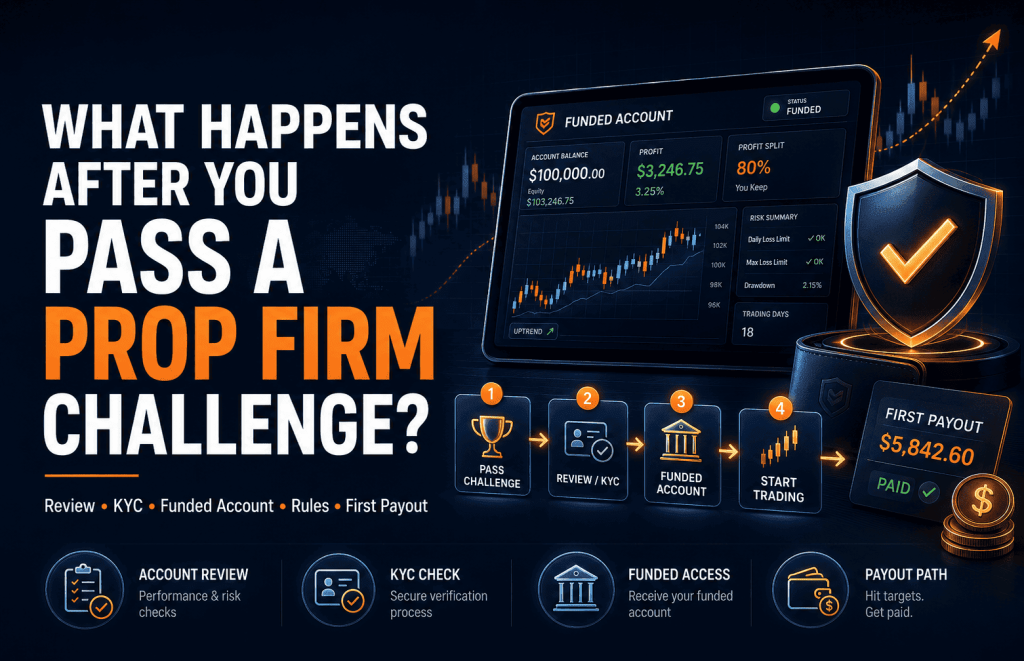



You are ready for a prop firm challenge when your strategy has enough demo evidence, your personal loss limits are stricter than the account’s failure limits, you can explain every relevant rule, and you can execute the plan without forcing trades. Use the 20-point check below. A low score is a signal to practise, not a reason to buy a larger account.
Start with the broader free funded account and practice guide, and verify the current practice route in the AIFO Free Trial FAQ before paying for an evaluation.
Last FAQ review: . AIFO Free Trial details below come from the current Free Trial FAQ.
Readiness in 30 Seconds
- 16–20 yes answers: compare account models and confirm the exact rules before checkout.
- 11–15: fix the weak categories and run another realistic simulation.
- 0–10: stay in demo practice; buying a challenge will not repair an untested process.
- Automatic stop: do not buy yet if you cannot calculate position size, identify the breach floor or accept the fee as a cost.
How to Use the Prop Firm Challenge Readiness Score
Answer each statement with yes only when you have evidence. A written trading plan, journal, account statement, screenshots and rule notes are evidence. A feeling that you will become disciplined after payment is not. Give one point for every yes answer. If a critical item is missing, fix it even when the total score looks high.
This checklist is deliberately stricter than a marketing quiz. A challenge compresses normal trading into a rule-bound environment. The relevant question is not whether you can produce a profitable trade. It is whether the same process can survive losing trades, spread changes, emotional pressure and a period with no valid setup.
1. Strategy Evidence: Questions 1–4
- I can describe my setup in one paragraph. Entry, invalidation, exit and no-trade conditions are written.
- I have tested the setup on relevant instruments and sessions. The sample includes more than one market condition.
- I know the strategy’s normal losing streak and drawdown. I do not size from the best week alone.
- My recent demo results come from the same rules I plan to use. I have not changed the system after every loss.
Record win rate, average win, average loss, largest loss, maximum consecutive losses and maximum drawdown. These metrics do not predict the next trade, but they help expose a mismatch between the strategy and the account’s limits. Review what backtesting can and cannot prove, then validate the workflow in forward practice.
Use backtesting to test the rule set across historical conditions, then calculate trading expectancy from a representative sample rather than a short winning run.
2. Risk and Drawdown: Questions 5–8
- I calculate size from the stop distance. Lot size is not copied from the previous trade.
- I have a personal daily stop. It is reached before the firm’s Daily Loss boundary.
- I reserve a drawdown buffer. Open P&L, commission, swaps and correlated positions are included.
- I can reduce risk after a losing sequence. The reduction rule is written before the sequence begins.
A failure limit is not a recommended operating budget. If a model allows a particular loss percentage, trading directly against that boundary leaves no room for slippage, costs or calculation differences. Build a prop firm risk management plan with an internal warning level, a stop-trading level and a separate hard account boundary.
| Task | Ready evidence | Not ready signal |
|---|---|---|
| Position sizing | Formula or calculator produces the size before entry | Size is chosen by feeling or desired profit |
| Daily stop | Written monetary and percentage limit | Trading continues until the platform blocks the account |
| Correlation | Combined exposure is measured as one risk idea | Three related positions are treated as three independent trades |
| Losing streak | Predefined reduction or pause rule | Risk increases to recover losses |
Place the score inside a complete forex risk management plan. Set the base size with the risk-per-trade framework, then compare the historical drawdown with the current AIFO Maximum Loss Limit.
3. Rule Knowledge: Questions 9–12
- I know the exact Daily Loss reference. I can explain when it resets and what enters the calculation.
- I know whether Maximum Loss is static or trailing. I can calculate today’s breach floor.
- I know the payout conditions for my model. Minimum, timing, concentration, buffer and account consequences are not mixed with another programme.
- I have checked strategy restrictions. Automation, holding, copying, event trading and other relevant behaviours have been verified.
Use the FAQ for the selected account, not a comparison table or an old social post. If you are considering AIFO, compare 1-Step, 2-Step, Instant and the Sprint 24-hour challenge on the conditions that affect your own strategy.
Read the current AIFO Trading Rules and confirm which trading activity is restricted before treating the rules section as complete.
4. Platform and Execution: Questions 13–16
- I can place, modify and close an order without hesitation.
- I know the platform time, symbol specification and cost display.
- I use a pre-trade check for stop, size and combined exposure.
- I know what to do after disconnection, rejection or abnormal execution.
A challenge should not be the first place you discover how the platform calculates volume or displays floating P&L. Review the AIFO trading platform information, rehearse normal order actions and write an incident procedure that avoids repeated clicks or uncontrolled duplicate exposure.
Rehearse login, order entry, stop placement and position closure on the AIFO trading platform so platform friction does not become a Day 1 mistake.
5. Cost and Behaviour: Questions 17–20
- I can lose the purchase fee without financial stress.
- I have not built the plan around an immediate payout.
- I can stop after my daily limit or after an emotional mistake.
- I have a review routine. Every trade is labelled, and process errors are separated from normal losses.
Cost readiness matters because pressure to recover the fee can change trade selection. Budget for the account only after reviewing the real cost of a prop firm challenge. Do not treat a retry, reset or larger account as the solution to the same behavioural error.
Use the prop firm challenge cost guide to compare the full decision cost, not only the advertised entry fee.
Your Next Step by Score
| Score | Decision | Next action |
|---|---|---|
| 16–20 | Potentially ready | Compare AIFO account models, then reread the exact FAQ before checkout. |
| 11–15 | Close, but inconsistent | Choose the two lowest categories and run a focused two-week practice block. |
| 0–10 | Not ready | Use the AIFO Free Trial or another demo environment to build evidence. |
The current AIFO Free Trial is simulated, provides no profit share or funded payout, is valid for 30 days and allows one active trial at a time. Its current FAQ lists a 5% profit target and 5% Maximum Loss, and the trial closes after the target is reached. Use it as practice, not as proof that a paid account will produce the same outcome.
When the score supports a go decision, compare the current AIFO account models. If the score is borderline, use the prop firm challenge difficulty scorecard to identify which rule creates the pressure.
Frequently Asked Questions
You are ready when a tested strategy, personal risk limits, rule knowledge, platform control, cost tolerance and repeatable behaviour support the same plan. Confidence alone is not evidence.
There is no universal number. Use a sample large enough to include winners, losers, different volatility conditions and at least one normal drawdown period, then judge rule compliance and execution quality.
Usually not. One week can be dominated by a small number of trades or a favourable market regime. Readiness requires repeatable execution across a broader sample.
No. The AIFO Free Trial is a simulated practice account and does not provide a profit share or funded-account payout.
The current AIFO Free Trial FAQ states that the trial is valid for 30 days. Only one Free Trial account can be active at a time.
Keep practising, reduce complexity, fix the weakest risk or execution category and repeat the assessment before paying for an account.