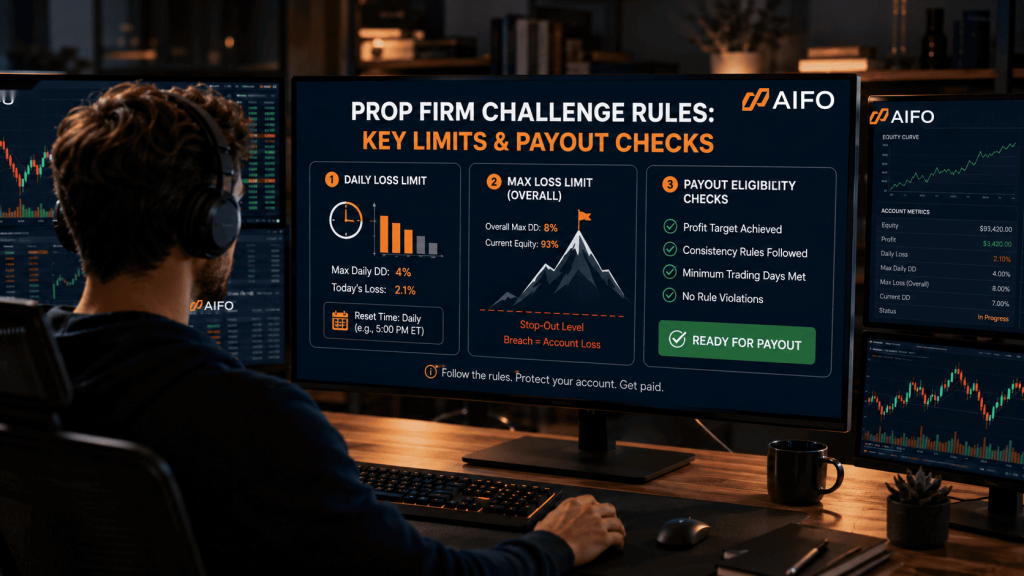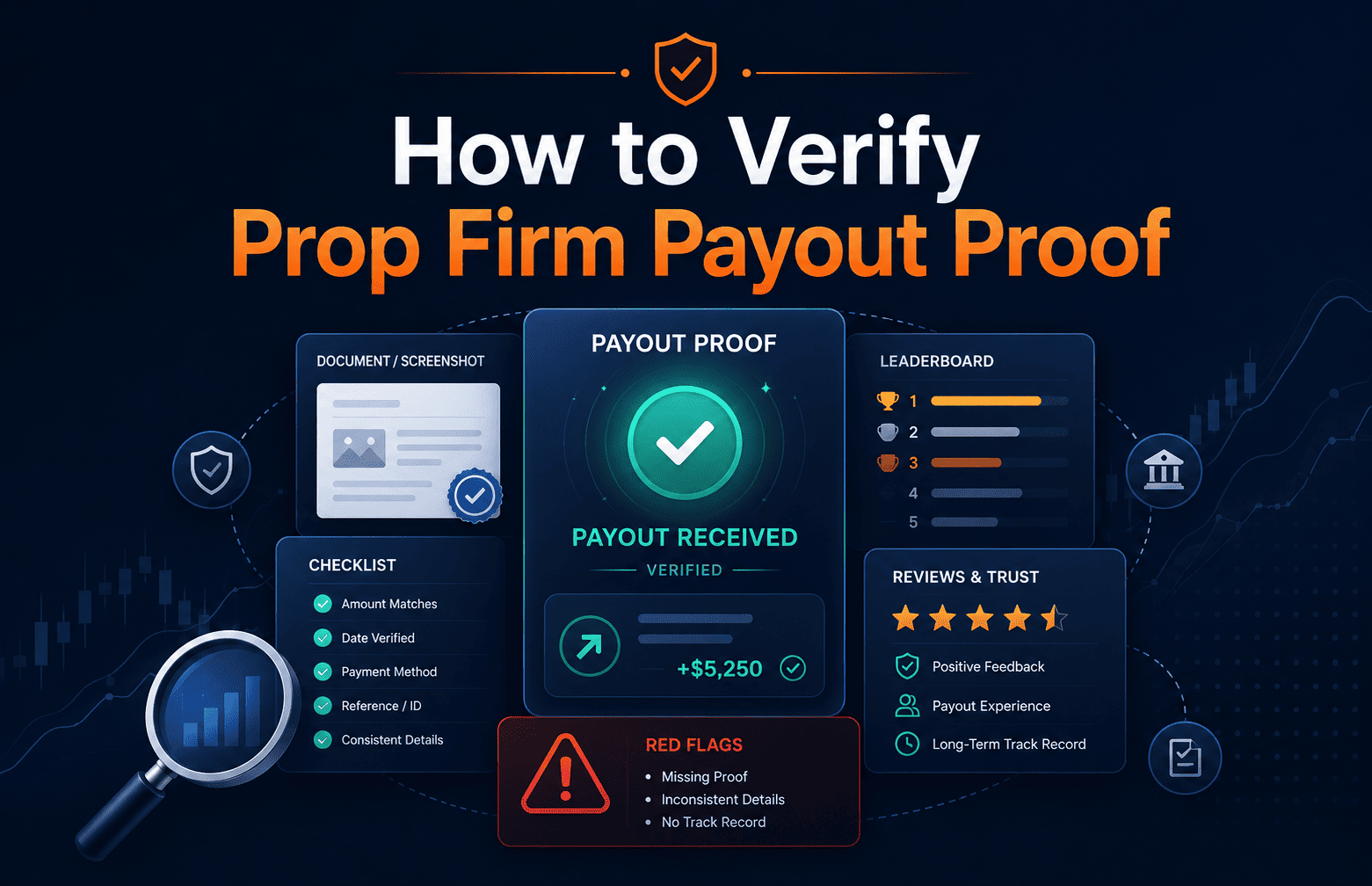



Prop firm payout proof is not one screenshot, one leaderboard number or one influencer post. Stronger proof shows a recent, repeatable and rule-compliant payout path: dated independent evidence, payout tracker quality, payment-route context, current payout rules, KYC process, support behaviour and no recent cluster of denied or delayed withdrawals.
Last FAQ review: . AIFO-specific payout, KYC, restricted-trading and violation statements below come from the current FAQ articles.
This article is the payout-proof child guide inside the prop firm legitimacy and scam-red-flag Hub. Use the Hub to judge the firm’s wider trust profile, and use this page to verify payout evidence before you risk a challenge fee, account time or funded-stage profit.
A single green screenshot can feel convincing. That is exactly why it is dangerous. Payout proof should slow your decision down, not push you into a purchase.
Payout Proof Is a Pattern, Not a Screenshot
Prop firm payout proof is useful only when it shows repeatable payment behaviour under the current rules. One screenshot proves very little. A pattern across independent traders, recent reviews, payout tracker data, current terms and support behaviour tells you more.
The trader mistake is treating proof as a yes-or-no switch. It is not. It is a risk score.
| Evidence layer | What stronger proof looks like | What it cannot prove alone | Risk if ignored |
|---|---|---|---|
| Screenshot layer | Dated, redacted, independent payout proof with firm name, method, status and surrounding context | That most traders are currently getting paid | A reposted image is mistaken for a reliable payout system |
| Payment-route layer | Bank, card, crypto, Deel, Rise, Wise or wallet context that matches the firm’s stated payout methods | That the account was rule-compliant or that future requests will pass | A fake or unrelated payment image is treated as withdrawal proof |
| Tracker or leaderboard layer | Recent payout count, update cadence, payout distribution and median timing, not only a lifetime total | Denied requests, KYC delays or accounts under review | Large historic numbers hide current payout friction |
| Review and community layer | Recent payout-specific reviews and independent community posts that show similar outcomes across time | The full truth of each complaint or the trader’s rule history | Average ratings or viral posts replace pattern analysis |
| Rulebook layer | Clear payout eligibility, KYC, consistency, prohibited-trading, open-position and denial rules | That every review decision will be fair | Dashboard profit is confused with withdrawable profit |
| Support behaviour layer | Specific answers with ticket numbers, rule references and consistent payout-process wording | Guaranteed approval of your future payout | Fast sales support is mistaken for reliable withdrawal support |
The first question is not “has this firm ever paid?” A better question is: “is this firm still paying traders like me, under the current rules, without a rising pattern of denial complaints?”
How to Verify Payout Screenshots Without Being Fooled
Payout screenshots are the weakest proof type when they appear alone. They become more useful when they are dated, contextual and tied to a trader identity that has history outside the firm’s own marketing channels.
You do not need to demand private bank details. You need enough context to know the image was not pulled from a marketing folder, edited, reposted or detached from the real payout process.
| Screenshot field | Stronger sign | Weak sign | What to do |
|---|---|---|---|
| Date | Recent payout date and request or settlement status | No date, cropped date or old proof reposted as current | Check whether the firm’s rules changed after that date |
| Amount | Amount matches a plausible profit split, buffer and payout method | Large number with no account size, split or method context | Ask whether the amount is gross profit, approved payout or settled cash |
| Payment method | Bank, card, wallet, crypto network or payout provider matches the firm’s official methods | Payment route is hidden or inconsistent with the firm’s stated process | Compare against the current payout page or FAQ |
| Trader source | Long-standing trader profile with history before and after the payout | Fresh affiliate account, repost account or discount-code-only profile | Review the account’s older posts, complaints and trading context |
| Rule context | The trader mentions KYC, review time, consistency, payout buffer or account status | Only “paid fast” language with no rule detail | Treat the image as marketing until rule context is available |
| Privacy handling | Personal details are safely redacted while key proof fields remain visible | Everything important is hidden or the image is over-cropped | Do not punish normal privacy redaction; focus on missing verification fields |
The context around the image matters more than the image itself. A screenshot posted by a long-standing trader in a community thread has more value than the same image reposted by an affiliate account with no trade history.
How to Read Payout Leaderboards, Trackers and Reviews
Payout leaderboards, trackers and review platforms are useful only when they show current patterns. They are weak when they display old totals, selected wins or average ratings without payout-specific context.
| Evidence source | Useful signal | Weak signal | What it still cannot show |
|---|---|---|---|
| Payout leaderboard | Recent payout count, recent payout volume, payout distribution and update cadence | Only all-time payout total, record payout or selected influencer wins | Rejected payouts, KYC delays, rule disputes or accounts under review |
| Payout tracker | Collection method, median payout time, payout method and records across many traders | No explanation of how records are collected or verified | Whether unpublished requests are being delayed or denied |
| Review platform | Recent payout-specific reviews across several months | Average score, old praise or sudden five-star bursts during discount campaigns | Whether each reviewer followed the rules |
| Reddit or Discord | Repeated independent reports with similar payout outcomes or support issues | One viral thread, anonymous screenshot or moderated firm-owned community only | Verified identity, full account history or fair rule interpretation |
| X, YouTube or affiliate content | Useful context when the creator shows process, rule checks and follow-up results | Discount-code-only content that shows the win and hides the audit trail | Neutrality, denial rate or firm-wide payout health |
Do not read only five-star reviews. Read the newest low-star reviews and search for words that point to payout friction.
Useful search terms include “payout denied”, “withdrawal pending”, “KYC delay”, “support not replying”, “rule change”, “consistency”, “breach”, “certificate”, “profit split” and “manual review”. The exact words vary, but the pattern is the same: traders stop talking about trading and start talking about access to their money.
For a broader payout mechanics overview, read prop firm payouts. A leaderboard should be read alongside rules, not instead of them.
The Rulebook Is Part of Payout Proof
A payout claim is weak if the rulebook can easily turn profit into non-compliant profit. The terms decide whether dashboard profit is actually withdrawable.
Read payout rules before reading testimonials. Most payout failures happen in the gap between profit shown and profit approved.
| Rule area | What to check | Why it changes payout proof | Detailed guide |
|---|---|---|---|
| Payout eligibility | Minimum amount, timing, payout cycle, profit split, account stage and payout method | A trader can show profit that is not yet eligible for withdrawal | Prop firm payouts |
| First payout workflow | KYC, review, open positions, pending orders, payment destination and settlement timing | A screenshot before final settlement may not prove cash was received | First payout rules |
| Consistency | Best-day, top-two-day, payout-period or profit-concentration rules | A large profit screenshot may hide a ratio problem | Consistency rule |
| Prohibited trading | EA, copy trading, HFT, latency, news, arbitrage, account sharing and rule-abuse wording | Profit can be visible and still fail payout review | Why payouts get denied |
| Violation process | How the firm explains, documents and escalates rule decisions | Vague denial language weakens the value of old payout proof | Terms checklist |
Evidence Matrix: What Each Proof Type Can and Cannot Prove
No proof type is perfect. The job is to match the evidence to the risk question it can actually answer.
| Proof type | Best use | What it cannot prove | Evidence weight | Trader action |
|---|---|---|---|---|
| Approved payout record | Shows that a specific request passed internal review | That the receiving channel completed final settlement | High, if dated and matched to account/rule context | Ask whether this is approved, released or actually received |
| Bank, card, wallet or processor receipt | Shows that funds reached or moved through a payment route | That the trading activity was representative or repeatable | High, if method and date match official payout options | Check amount, method, date, network and redaction quality |
| Crypto transaction or on-chain hash | Can verify a transaction existed on a network | That the wallet belongs to the trader or that the payout came from the firm | Medium to high, only if wallet context is credible | Match amount, time, network and wallet context with the payout claim |
| Payout screenshot | Shows a claimed withdrawal event | Whether the payout cleared, how long it took or whether most traders are paid | Low alone; stronger with independent context | Cross-check trader history and recent community comments |
| Payout leaderboard or tracker | Shows visible payout activity over time | Denied payouts, review disputes, KYC friction or rule-denial rates | Medium, if recent and methodologically clear | Check recent records, payout count and median payout time |
| Review platform or community thread | Shows recurring sentiment, complaints and dispute patterns | Full truth of each case or whether the reviewer breached rules | Medium for patterns; low for one-off claims | Read newest low-star reviews and payout-specific discussions |
| Rulebook and payout terms | Shows whether profit can become eligible for withdrawal | Whether the firm will behave fairly in every review | High for eligibility logic | Read payout and violation terms before buying the challenge |
Red Flags That Weaken Prop Firm Payout Proof
Red flags matter most when they appear together. One weak signal may be noise. Several weak signals around payout timing, support and rule changes create real account risk.
| Red flag | Why it weakens proof | What to check next | Risk level if repeated |
|---|---|---|---|
| Most proof comes from affiliates or firm-owned channels | The incentive structure is not neutral | Independent trader posts, reviews and community threads | Medium to high |
| Old screenshots are used after a rule change | The payout was made under a different rulebook | Current payout rules, consistency terms and prohibited strategy wording | High |
| Recent reviews mention the same payout delay | Clustered complaints suggest a system problem, not one angry trader | Timing, payout method, KYC status and support replies | High |
| Support is fast before purchase but vague during withdrawals | Sales support and payout support are different tests | Ticket response quality and rule-specific answers | High |
| KYC becomes repeated, unclear or last-minute | KYC is normal, but unclear repeated checks can become a delay pattern | Document requirements, provider, review time and rejection process | Medium to high |
| Violation language is vague | The firm may have broad discretion after profit is made | Exact clause, trade IDs, timestamps and calculation method | High |
What to Check Before Paying for a Challenge
Run payout due diligence before paying, not after passing. Once you are funded and waiting for a withdrawal, your bargaining power is lower.
| Pre-purchase check | How to do it | Block purchase if |
|---|---|---|
| Recent payout proof | Search the firm name with “payout proof”, “payout denied”, “withdrawal delay” and “scam”; sort by recent results | Recent results show repeated unresolved payout complaints |
| Newest negative reviews | Read low-star reviews before five-star praise | Several recent traders describe the same delay, KYC or rule-denial issue |
| Screenshot quality | Check date, source trail, payout method, firm name and trader history | Most screenshots are old, over-cropped or affiliate-only |
| Payout rulebook | Read KYC, minimum payout, payout window, consistency, open trades and prohibited strategy terms | Your strategy can easily trigger a denial rule |
| Support test | Ask one direct payout question and save the answer | Support gives vague, contradictory or non-rule-based answers |
| Tracker quality | Check whether leaderboards show recent payout count and median time, not only large totals | The tracker is old, selective or has no visible methodology |
The last point is where traders often get lazy. A scalper, news trader, EA user, copy-trader or high-risk recovery trader should not rely on generic proof from a discretionary swing trader. The payout system will review your behaviour, not theirs.
What to Do if a Payout Is Delayed
A delayed payout should be handled with records, not emotion. The trader’s job is to preserve evidence, stay rule-compliant and create a clean support trail.
Do not start taking revenge trades or breaching rules while the request is under review. A delayed payout can become a denied payout if the account behaviour worsens during the process.
- Freeze the account state: save balance, equity, open positions, pending orders, payout request and dashboard status.
- Build one evidence file: include trade history, KYC submission, payout destination, support ticket numbers and dated rule copies.
- Ask for the exact status: delayed, under review, returned for correction, not yet eligible or formally denied.
- Ask for the exact reason: KYC, payout window, payment processor, rule check, consistency, account status or prohibited behaviour.
- Request rule references: if the firm mentions a violation, ask for the clause, trade ID, timestamp and calculation used.
- Watch for pattern evidence: one delay can happen; a cluster of identical delays across recent traders is a different risk signal.
Review the AIFO restricted trading FAQ and the AIFO violation policy to understand how conduct rules can affect payout eligibility. The same logic applies across the industry: profit is only payable if the account path survives review.
Alpha Insight: Verify the Payout System Behind the Screenshot
Prop firm payout proof is only useful if it survives withdrawal pressure.
A firm can look strong while growth is easy, influencers are posting wins and only a small number of traders are withdrawing. The harder test begins when many traders request payouts, rule reviews stack up, support queues lengthen and business economics are stressed.
That is why proof should be judged by system behaviour, not promotional evidence. The screenshot is the surface. The system behind it is the real risk.
Ask this before paying: does the firm show repeated recent payouts, clear rules, stable review behaviour and a fair path from dashboard profit to withdrawable profit?
If the answer is unclear, the discount is not cheap. It is compensation for uncertainty.
Using AIFO as the Final Rule Check
A payout screenshot should be checked against the current account record and the FAQ conditions that govern whether a request can proceed.
| Evidence layer | What to verify | FAQ reference |
|---|---|---|
| Payout eligibility | Compliant status, permitted trading, completed KYC, no open positions or pending orders, and at least the stated minimum payout | How AIFO payouts work |
| Identity | The account holder completes the required document and liveness checks when the relevant trigger is reached | AIFO KYC FAQ |
| Trading method | The profit came from permitted trading rather than restricted or exploitative behaviour | Restricted trading FAQ |
| Account action | Any warning, restriction, closure or payout decision matches the applicable policy and documented account history | Violation policy FAQ |
Strong proof connects the payment record to the trader, account, request date, approved amount and applicable rule history. Redact private details, but retain enough consistent context to verify the claim.
FAQ
Real payout proof is repeated, recent and independent evidence that traders have moved from eligible profit to approved and settled payout under the current rules. Stronger proof includes dated independent screenshots, payment-route context, recent tracker activity, payout-specific reviews, clear payout terms and no rising pattern of denied withdrawal complaints.
No. A payout screenshot is a weak signal on its own. It becomes more useful when it is dated, safely redacted, posted outside the firm’s own marketing channels and supported by trader history, payout method context, community discussion, payout terms and recent review patterns.
Read payout leaderboards by recent activity, payout count, median payout time, update method and payout distribution. Do not rely only on the largest payout or cumulative total. A leaderboard can show visible payout activity, but it may not show rejected requests, KYC delays, rule disputes or payout-denial rates.
They can support payout proof, but they do not prove the whole case. Use reviews and community posts to find patterns. Recent payout-specific comments across several platforms are more useful than average ratings or one viral screenshot.
Weak payout proof often comes from affiliate-only screenshots, old cumulative payout totals, disabled community comments, vague payout terms, sudden rule changes, late KYC friction, slow withdrawal support or recent clusters of denied payout reviews. Several of these together create serious payout risk.
Before paying, search recent payout proof and denial complaints, read the newest negative reviews, check payout tracker activity, review payout and violation rules, ask support a direct withdrawal question and confirm that your trading style does not trigger prohibited strategy, consistency, KYC or rule-review problems.
Save the payout request, dashboard status, account balance, trade history, KYC record, payout destination, support ticket and rule version. Ask whether the request is delayed, under review, returned for correction, not yet eligible or formally denied. If a violation is mentioned, ask for the exact clause, trade ID, timestamp and calculation.