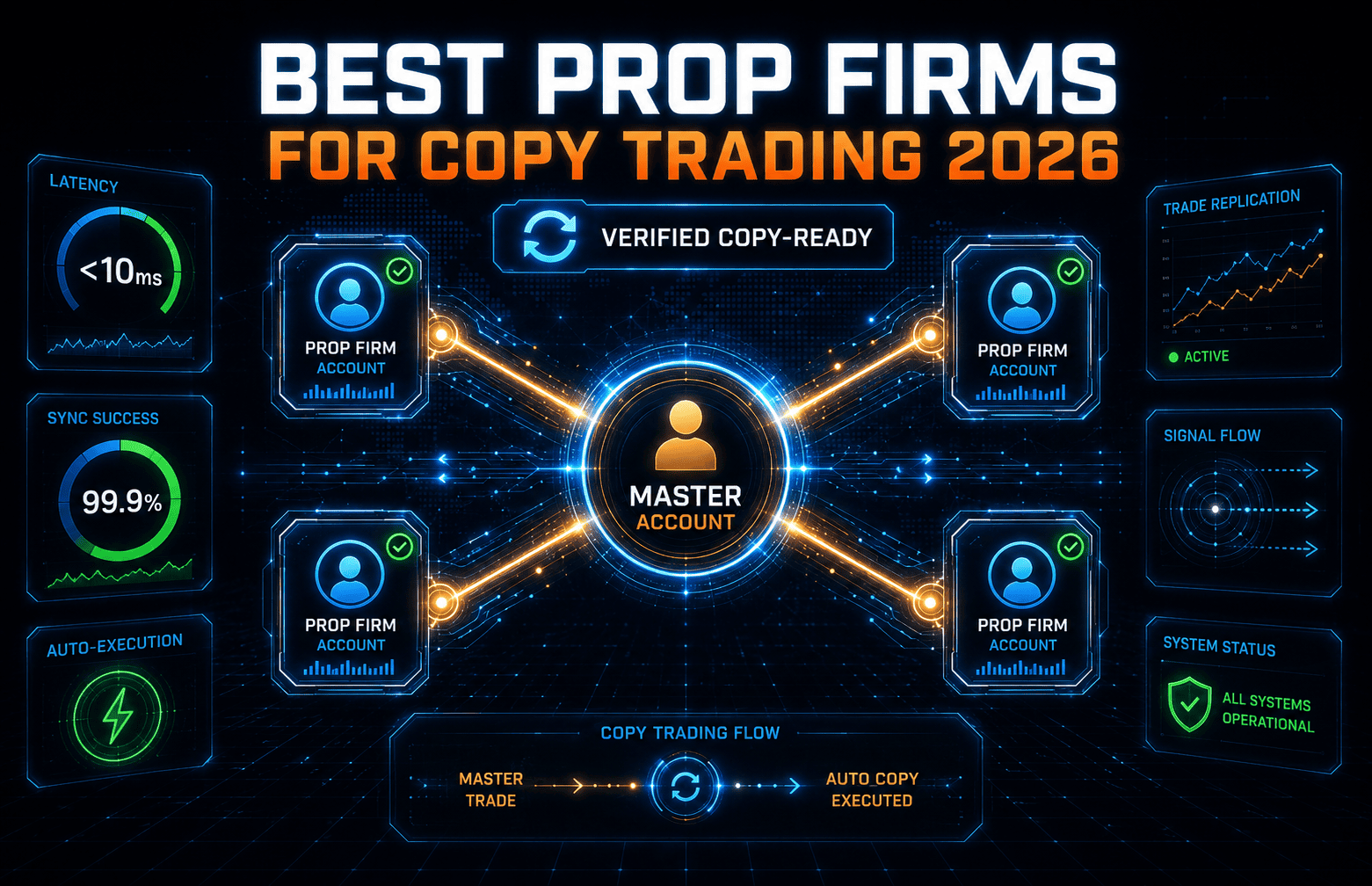



The best prop firm for copy trading depends on the exact copy workflow, not the word “copying” on a sales page. A trader must separate same-owner account copying, platform group trading, external signal copying, third-party copier tools, account management and manual-only accounts. Start with the AIFO Best Prop Firm Decision Center for the wider commercial shortlist, then use this page to check whether copy trading is actually allowed for your account type, platform, ownership setup and payout stage.
A trade copier can reduce repeated order entry, but it can also multiply one mistake across every follower account. The account that looks efficient can become fragile if the copier ignores drawdown, contract limits, consistency, open-position rules or payout state.
Important: AIFO is not a copy-trading account, but it should not be described as manual-only. Copy trading is prohibited, while EA use is governed by a separate programme-specific policy. Eligible traders may use a compliant, independently configured EA on a supported AIFO account model.
Best Prop Firms for Copy Trading 2026: Quick Rule Filter
The best copy-trading prop firm is not the one that simply says “copying allowed”. The better account defines who owns the accounts, which tools are allowed, what happens at payout review and which forms of signal copying are banned.
Use this table as a rule filter, not as permission to connect a copier immediately. Verify the current official policy for the exact account model before buying.
| Route to check | Best for | Copy-trading fit | Main rule risk | What to verify before buying | Avoid if |
|---|---|---|---|---|---|
| Tradeify | Futures traders checking same-owner group trading workflows | Potential own-account futures copying route | External copier errors, account ownership and unsupported setup issues | Current official policy, platform path, account ownership, contract sizing and payout rules | You want to copy other traders or expect the firm to support every external copier |
| Topstep | Futures traders checking supported copier or platform-native workflows | Potential own-account copying route inside supported platform rules | Lead-account mistakes repeating across follower accounts | Current account count, lead/follower setup, contract limits, daily loss locks and payout rules | You follow signals or need copying outside the supported platform path |
| MyFundedFutures | Futures traders checking documented copier compatibility | Potential own-account copy route if the current rules allow the exact setup | The trader owns copier errors and support limits | Current tool support, Tradovate or copier setup, follower risk and payout policy | You expect the firm to fix copier issues or reset accounts after sync errors |
| Apex Trader Funding | Futures traders checking group trading or platform copier workflows | Potential multi-account route when platform and account-stage rules fit | Bracket orders, quantity multiples and platform-specific limitations | Current Tradovate/NinjaTrader setup, contract multiples, brackets and account-stage rules | You need every order type, bracket or flatten command to copy without testing |
| FundedNext Futures | Same-owner futures traders checking cross-account copy permissions | Potential own-account copying route if identity and ownership rules match | Signal services, group trading and identity mismatch | Same-name verification, tool scope, stage rules, group trading bans and payout treatment | You copy signals or coordinate with other traders |
| E8 Markets | CFD or forex-style traders checking same-owner copying rules | Potential own-account copier route if the current terms allow it | Team trading, signals, allocation rules and payout buffer | Account type, allocation cap, payout buffer, profitable days and execution rules | You want shared strategies, team execution or third-party management |
| Instant Funding | Traders checking whether same-owner external-source copying is allowed | Potential route only if the master/follower ownership and source rules are explicit | Ownership proof, external source risk and coordinated-trading flags | Master account source, same-owner proof, collusion wording, payout and platform rules | You want to copy friends, relatives, account managers or paid signal providers |
| AIFO | Traders who do not require copy trading and want independent account execution | Not a copy-trading route; suitable for manual execution or compliant EA use on an eligible account model | Copy trading is prohibited. EA permission is separate and programme-specific, so allowing an EA does not permit replicated orders, external signals or shared strategies | Copy-trading restrictions, exact EA eligibility, EA usage limits, consistency, payout buffer and account conduct | You require trade copiers, copied signals, group execution, third-party account management or replicated orders across accounts |
What Copy Trading Means in a Prop Firm
In prop firm rules, compliant copy trading usually means copying your own trade decisions across accounts you own, under a workflow the firm clearly allows. It does not automatically mean following a signal seller, copying another trader, joining a group entry, using an account manager or paying someone to pass the account.
| Copy setup | What it means | Main compliance question | Risk if misunderstood |
|---|---|---|---|
| Same-owner account copying | The trader copies their own decision across accounts they own | Are all accounts verified as belonging to the same trader and allowed by the firm? | A valid lead trade can still breach a smaller or damaged follower account |
| Platform group trading | A supported platform feature mirrors orders across linked accounts | Does the platform feature work inside the firm’s current account rules? | The tool may work technically while the account setup still fails policy |
| Third-party copier | An outside tool mirrors trades between accounts or platforms | Does the firm permit the exact tool, source, destination and support boundary? | Sync errors, duplicate orders or missed exits remain the trader’s risk |
| Signal copying | Another person or service creates the trade idea | Who owns the decision and who controls the account? | The firm may treat the setup as signal use, group trading or account management |
| Manual-only account | The trader must enter and manage trades manually | Does the firm ban copiers, EAs, bots or automated execution? | Profitable copied trades can still become rule violations |
The difference matters more than the software. A group-trading feature, cloud copier or platform module is only the execution layer. The firm still checks who controls the decision, who owns each account, whether each account follows its own rules and whether the profit can survive payout review.
AIFO separates copy trading from EA use. The AIFO restricted-trading policy prohibits replicating trades across multiple accounts. The AIFO EA FAQ separately permits EAs on 1-Step and 2-Step Challenge accounts and on the corresponding funded accounts, subject to usage restrictions. Allowing an EA does not permit copying another trader, mirroring orders across accounts, using shared third-party systems or duplicating substantially similar strategies across accounts.
Best Prop Firms for Copy Trading Reviewed
The right firm depends on what you are copying, where the accounts sit and how each follower account handles risk. A copier that works well in one futures account can be a poor fit for a CFD account with different drawdown and payout rules.
Each firm below has a different use case. Do not buy the account until the written rule matches the exact copier workflow.
Tradeify
Best for: Futures traders who want Tradovate Group Trading across accounts they own and manage.
Tradeify suits traders who want a platform-native route for copying their own futures trades across owned accounts. The account is not for signal copying or shared strategies. The rule boundary is ownership and control.
Why it fits: The strongest fit is a trader who wants fewer repeated clicks while staying inside the firm’s own-account rule. Group Trading can reduce manual entry errors when each account is sized correctly.
Main caveat: Third-party copiers are used at the trader’s own risk. If an external tool misfires, duplicates an order or fails to close a follower, the account risk still belongs to the trader.
Rule check: Before buying, check Tradovate group setup, account ownership, contract size, copy timing, platform support, payout rules and what happens if a third-party copier creates an error.
Avoid it if: You want to copy another trader, use shared strategy groups or depend on the firm to support an external copier.
Topstep
Best for: Futures traders who want built-in copier tools and platform-level risk controls.
Topstep suits traders who want to copy their own trades across supported accounts while keeping risk controls close to the execution screen. The best fit is a trader who wants smaller repeated “base hit” trades rather than one oversized trade in a single account.
Why it fits: A built-in copier can reduce platform friction. Contract caps, daily loss controls, trade brackets and manual lockout tools can also help a trader avoid repeating the same bad decision across every follower.
Main caveat: The copier repeats losses as quickly as gains. If the lead account is oversized, the follower accounts inherit the same mistake.
Rule check: Before buying, check the current account count, lead account setup, follower account sizing, contract limits, payout rules, trading hours and drawdown treatment.
Avoid it if: You need to copy non-Topstep accounts, follow signals or use a workflow outside the supported platform route.
AIFO
Best for: Traders who do not need a trade copier and want clear account independence, whether they trade manually or use a compliant EA on an eligible AIFO account model.
Last checked on : AIFO is not a copy-trading prop firm. Its restricted-trading policy prohibits replicating trades across multiple accounts. However, AIFO should not be classified as manual-only: its current EA FAQ permits EAs on 1-Step and 2-Step Challenge accounts and on the corresponding funded accounts, subject to usage restrictions.
Why it fits: The clearest AIFO use case is a trader who values an independent decision source and clear account control. AIFO funding programmes offer several account paths for manual traders and for traders using a compliant, independently configured EA on an eligible model.
Main caveat: EA permission does not override the copy-trading restriction. A permitted EA cannot be used to mirror orders across multiple accounts, follow external signals, run a shared third-party strategy or reproduce identical or substantially similar strategies across different accounts.
Rule check: Before buying, check the AIFO copy-trading restriction, the AIFO EA policy, the selected AIFO account model, consistency, daily risk, payout buffer and account conduct. The AIFO payout process should also be read before trading, because payout-ready profit is different from dashboard profit.
Avoid it if: Your workflow depends on trade copiers, external signals, group execution, pass-your-challenge services, third-party account management or replicated orders across accounts.
MyFundedFutures
Best for: Futures traders who want documented copier compatibility and are prepared to own the technical risk.
MyFundedFutures suits traders who already understand futures copier setup and want a clearer tool path. It is a better fit for traders who document their master/follower structure before connecting accounts.
Why it fits: The firm documents copy trading across account types and recognises Tradesyncer as a preferred compatibility route. Tradovate users can also check the built-in group feature.
Main caveat: Support boundaries matter. If a copier causes a missed close, wrong size, duplicate order or platform drift, the trader may not receive technical rescue or account reset treatment.
Rule check: Before buying, check supported platforms, Tradesyncer setup, Tradovate group use, follower account limits, payout rules, drawdown rules and support exclusions for copier issues.
Avoid it if: You want the firm to absorb technical risk from copier software or you do not keep setup records.
Apex Trader Funding
Best for: Tradovate futures traders who want a group copier workflow and can manage platform restrictions.
Apex suits traders who use Tradovate and understand how group trade quantity works across multiple accounts. It is less about broad copy-trading permission and more about using the platform correctly.
Why it fits: Tradovate Group Copier can copy orders across grouped accounts. This can help a trader reduce repeated manual order entry when each account has the correct contract quantity.
Main caveat: Platform restrictions matter. Tradovate Groups do not support bracket orders or ATMs in the same way some traders expect, and Group Trading is not available through every interface.
Rule check: Before buying, check Tradovate group setup, contract multiples, bracket order needs, NinjaTrader alternatives, payout rules, account stage and drawdown treatment.
Avoid it if: You need ATM brackets inside Tradovate Group Trading or expect every platform connection to support the same copier behaviour.
FundedNext Futures
Best for: Same-owner futures traders who want to copy across their own FundedNext and external prop accounts.
FundedNext Futures suits traders who can prove all linked accounts belong to the same person. It is useful for traders who run multiple futures accounts and want a written allowance for own-account copying.
Why it fits: The own-account scope is clear: copying inside FundedNext and between same-owner accounts at other firms can be allowed, while signal services and group trading are not.
Main caveat: Identity and account-name matching can become the issue. A small mismatch between account records can create review risk even when the trader believes the accounts are theirs.
Rule check: Before buying, check name matching, verified ownership, tool scope, signal bans, group trading bans, funded-stage rules and payout treatment.
Avoid it if: You copy signals, share trade ideas in a live group or cannot prove same-owner control across every linked account.
E8 Markets
Best for: Same-owner CFD and forex-style traders who want copier flexibility inside account ownership rules.
E8 Markets suits traders who want to copy between accounts they own while keeping their strategy independent. It is not a fit for teams, signal groups or shared execution.
Why it fits: The own-account wording gives traders room to use a trade copying tool, provided the trades still come from their own strategy and their own accounts.
Main caveat: Copying does not remove allocation, payout buffer, profitable-day or conduct rules. A follower can still fail because it has a different rule state from the lead account.
Rule check: Before buying, check account type, maximum allocation, payout buffer, profitable-day rules, copy-trading scope, team trading ban and signal-service wording.
Avoid it if: You want to run group trades, copy a provider or use multiple profiles to stretch allocation limits.
Instant Funding
Best for: Traders who copy from same-owner personal, broker or prop accounts into an Instant Funding route.
Instant Funding suits traders whose master account sits outside the firm and who want to copy into an owned account. The same-owner rule is the key condition.
Why it fits: The policy can suit traders who use one strategic hub and mirror trades into their own account, provided the setup is not a signal service, account-management scheme or coordinated trading group.
Main caveat: Broad permission does not remove collusion risk. If the same trades appear across accounts owned by different people, or across accounts linked by shared coordination, the account can be breached.
Rule check: Before buying, check same-owner proof, master account source, external tool setup, prohibited collusion, payout review, platform rules and account security.
Avoid it if: You want to copy friends, family members, paid signals or an account manager.
Rule Consequences: When a Copier Creates a Breach
A trade copier copies more than the entry. It copies timing, size, exposure, stop errors and emotional decisions into every follower account.
Before turning one trade into several accounts, map each follower account separately. The lead account is not the risk model for the whole group.
| Copier issue | What it affects | Execution consequence | Payout or review concern | Safer rule check |
|---|---|---|---|---|
| Same entry across accounts | Trade timing, decision origin and account independence | Identical entries can look like signal copying if ownership and control are unclear | Review may ask whether the trades came from the trader’s own decision | Confirm same-owner permission and keep a dated setup record |
| Follower account size mismatch | Position size, drawdown room and account stage | A safe lead trade can be too large for a smaller or damaged follower | The follower can fail before the lead account is stressed | Set risk per follower account, not one size for all accounts |
| Contract or lot cap difference | Maximum open exposure and platform order acceptance | The copier may send a trade the follower cannot legally hold or size correctly | Rejected, partial or oversized orders can weaken payout eligibility | Map lot, contract and exposure limits per account stage |
| Daily loss drift | Remaining daily loss room after earlier trades | The lead may have enough room while a follower is close to breach | A profitable group can still lose one follower account to a copied trade | Use per-account lockout, daily stop and drawdown stop rules |
| Consistency difference | Profit concentration and best-day contribution | One copied winner can over-concentrate a follower’s profit | Profit can become not payout-ready even when the account is green | Track consistency on every follower separately |
| Open-position and payout-state mismatch | Pending orders, open trades and payout request timing | A follower may remain exposed when the trader thinks the group is flat | A payout request can be blocked if positions or orders remain open | Flatten and verify every account before payout submission |
| Platform limitation | Order type, brackets, stop changes, partial closes and flatten commands | Stops or brackets may not copy as expected | Unmanaged exposure can remain during review | Test entries, exits, modifications and flatten commands before size increases |
| External signal source | Trader independence and account-control evidence | The trade may be profitable but still invalid under the firm’s conduct rules | Payout can be delayed, reduced or denied after review | Use only your own decision flow unless the rules explicitly allow otherwise |
Alpha Insight: A Copier Copies Account State, Not Just Trades
The hidden pressure is synchronised rule exposure. A copier does not just copy an entry. It copies timing, size, stop logic and account-state risk into every follower that receives the order.
The lead account may have enough daily loss room, clean consistency and no payout request pending. A follower may be close to breach, near a contract cap, inside a payout window or already carrying open exposure. One decision can be compliant in the lead account and dangerous in the follower. That is why copier setup is a risk model, not a convenience feature.
How to Choose a Prop Firm for Copy Trading
Start with permission scope. Then check platform support, per-account risk settings, account stage and payout review. Use what to check before choosing a prop firm as the base audit, then add copier-specific checks.
| Decision step | Question to answer | Block the account if | Related guide |
|---|---|---|---|
| 1. Permission scope | Does the rule allow same-owner copying, same-firm copying, cross-firm copying, third-party tools or none? | The rule only says “copying allowed” without defining account ownership and account stage | Terms checklist |
| 2. Trade source | Does the trade idea originate from you? | The decision comes from a signal provider, account manager, group room or another trader | Challenge rules |
| 3. Per-account risk | Does each follower have its own position size, daily stop and drawdown stop? | The copier sends the same lot, contract or risk size to every account | Risk per trade |
| 4. Platform test | Have entries, exits, SL/TP changes, partial closes and flatten commands been tested? | The first real copied trade would also be the platform test | Day 1 checklist |
| 5. Payout state | Can copied trades survive consistency, open-position and review checks? | The setup is only tested during evaluation, not funded-style or payout stages | Payouts guide |
| 6. Independent-execution alternative | Would independent execution, either manual or through a permitted EA, be cleaner than copier exposure? | The trader cannot explain where the trade decision starts, who controls each account or whether the EA is eligible for the selected model | AIFO account models AIFO EA policy |
Red Flags Before Using a Trade Copier
A copier can make a disciplined trader more efficient. It can also make a weak risk model fail faster.
| Red flag | Why it matters | Question to ask before buying | If unclear |
|---|---|---|---|
| The rule says “copy trading allowed” but gives no scope | Allowed may mean same-owner only, same-firm only, same-stage only or one platform only | Exactly which accounts can be linked? | Do not connect the copier |
| External signals are mixed with own-account copying | Signal copying can be treated as account management or group trading | Who creates the trade decision? | Use only your own decision flow |
| Follower account size is not scaled | One master order can be oversized for smaller accounts | Does each follower have its own risk setting? | Block the setup until risk is account-specific |
| Platform order types are not tested | Stops, brackets, partial closes or flatten commands may not copy correctly | Have I tested entries, exits, stop changes and flatten commands? | Test in the exact platform path first |
| Payout review is ignored | Copied profit can still be checked for source, consistency and account conduct | Can the firm review copied trades before payout? | Do not copy into a payout-stage account until confirmed |
| Third-party copier support is unclear | The firm may allow the tool but refuse support for its errors | Who is responsible if the copier misfires? | Assume the trader owns the technical risk |
| Manual-only firms are treated as copier-friendly | The account can close even if the strategy is profitable | Does the firm explicitly prohibit copy trading or automation? | Choose a manual account path instead |
Does AIFO Allow Copy Trading or Expert Advisors?
Copy trading and EA use are separate policies at AIFO. AIFO prohibits copy trading across multiple accounts, but permits compliant EA use on specified account models. Allowing an EA does not allow a trader to mirror orders across accounts, follow another trader’s signals or use a shared strategy.
Last checked on : The current AIFO restricted-trading policy lists copy trading as prohibited. The current AIFO EA FAQ separately permits EAs on 1-Step and 2-Step Challenge accounts and on the corresponding funded accounts, subject to usage restrictions. EA eligibility for any other account model should be verified separately against the current official rules.
| AIFO policy area | Current public rule position | Trader decision | Official reference |
|---|---|---|---|
| Copy Trading Policy | Prohibited. Replicating trades across multiple accounts is treated as copy trading and can result in account closure | Do not connect a copier, mirror orders across accounts or replicate one trade flow into multiple AIFO accounts | AIFO restricted-trading policy |
| EA Policy | Programme-specific. EAs are permitted on 1-Step and 2-Step Challenge accounts and on the corresponding funded accounts, subject to the current usage restrictions | Use only a trader-customised strategy. Do not use excessive server-order traffic, challenge-passing bots, rule-circumvention tools, publicly available or shared third-party EAs, or identical or substantially similar strategies across accounts | AIFO EA policy |
| Account model | EA eligibility must be checked against the exact AIFO account model rather than assumed from the platform alone | Identify the selected model before enabling an EA, and verify any model not explicitly covered by the current EA FAQ | AIFO account models |
| Payout review | Visible profit must still meet payout eligibility, conduct and review conditions | Do not treat technically successful EA execution or dashboard profit as proof that a payout is automatically eligible | AIFO payout process |
Final Rule Check Before You Copy Trades
Before connecting a copier, write down the master account, every follower account, ownership proof, account stage, drawdown room, contract or lot cap, consistency status, open-position state and payout state. Then place your last twenty trades into that structure.
If one follower account would have breached, the copier setup is not ready. If a firm does not clearly allow your exact workflow, do not assume the tool makes it compliant. Read the prop firm challenge rules like an execution contract, not a setup guide.
FAQ
The best option depends on the exact copy workflow. Same-owner futures copying, platform-native group trading, third-party copier tools, cross-firm copying and manual-only accounts are different decisions. Use this guide as a rule filter, then verify the current official policy for the exact firm and account model before buying.
No. AIFO’s restricted-trading policy prohibits replicating trades across multiple accounts and states that a copy-trading violation can result in account closure. This does not mean AIFO is manual-only. EA use is governed by a separate programme-specific policy: the current EA FAQ permits EAs on 1-Step and 2-Step Challenge accounts and on the corresponding funded accounts, subject to usage restrictions. EA permission does not allow trade copiers, external signals, shared third-party EAs or duplicated strategies across accounts.
No. A compliant EA executes a trader’s own independently configured strategy on an eligible AIFO account model. Copy trading replicates trades across multiple accounts or follows an external trade source. AIFO permits restricted EA use on eligible models but prohibits copy trading. An EA must not be used to mirror orders across accounts, run a shared third-party strategy or duplicate identical or substantially similar strategies across different accounts.
No. Copying your own trade decisions across accounts you own is different from following another trader’s signals, using an account manager or joining a group-entry service. The trade decision must come from you unless the firm clearly says otherwise.
Only if every firm involved clearly allows the exact cross-firm workflow and every account belongs to the permitted owner. Some firms allow same-owner copying; others restrict copying to their own platform or ban it entirely. Check both rule books before linking accounts.
The biggest risk is synchronised rule exposure. A lead trade may be safe while a follower account is near daily loss, contract cap, consistency limit, open-position restriction or payout review. A copier can repeat one decision into several account problems at once.
It depends on the firm and account model. Some firms may allow copying during evaluations but review it more strictly during funded-style or payout stages. Always check the funded-stage and payout-review wording separately.
Save the official rule page, account ownership proof, master and follower account list, copier settings, per-account risk, platform route, test results, payout-state notes and the date checked. If a payout review asks how trades were created, you need evidence.