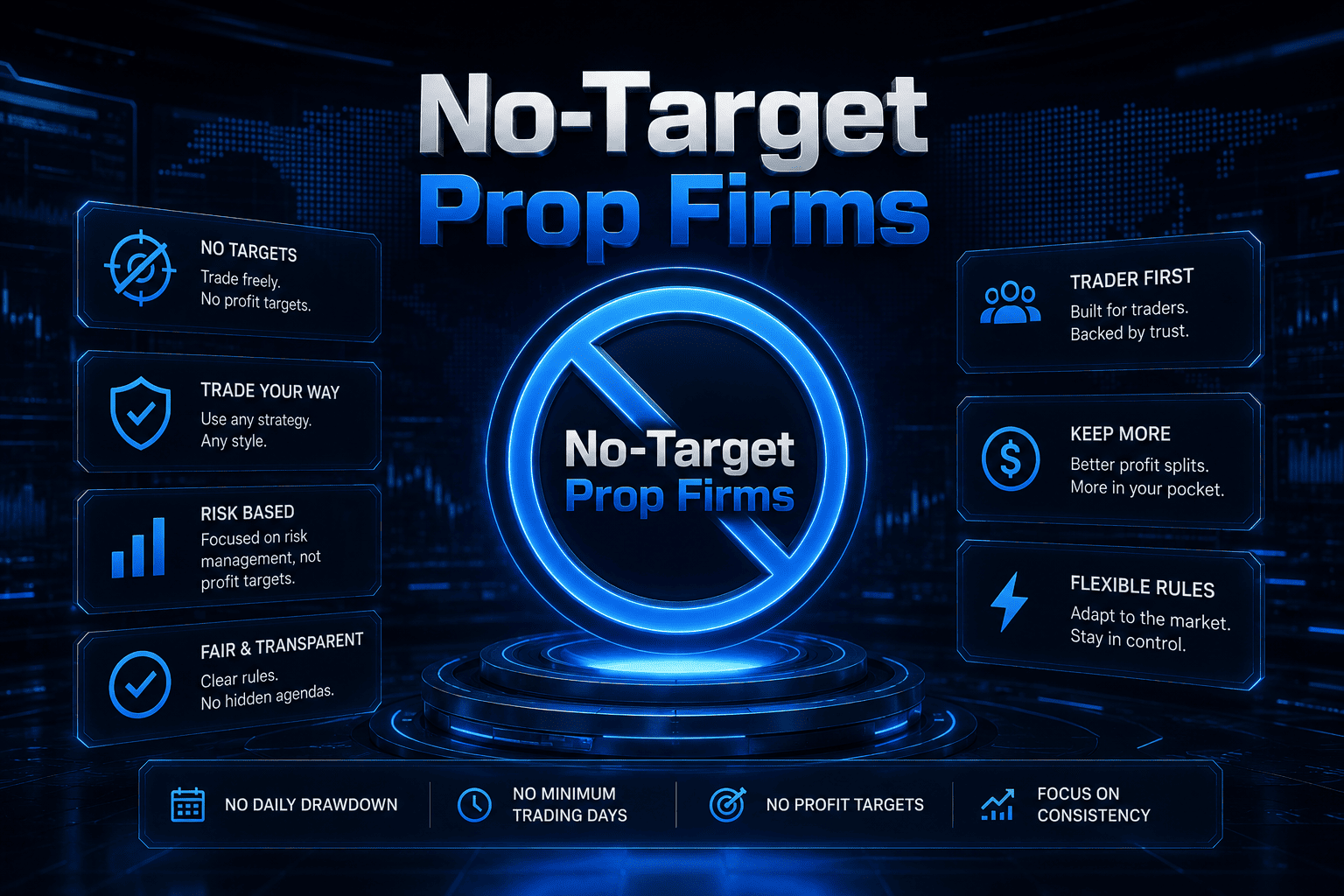



No-target prop firm accounts can provide faster access, but they are not rule-free or automatically safer. Removing a pass target can reduce target-chasing pressure, but the account remains controlled by Daily Loss, Maximum Loss, consistency, payout eligibility, review and the trader’s own stopping rules. AIFO Instant has no traditional evaluation target, while the exclusive AIFO One model also has no profit target.
Use AIFO account models to compare the confirmed account paths. For the risk and payout conditions that still apply after a target is removed, read the prop firm challenge rules guide and the current AIFO payout process.
Last checked: . AIFO Instant currently uses a 3% Daily Loss Limit, a 5% HWM-based Trailing Maximum Loss Limit, a 2% floating-loss limit and a maximum single-day profit below 20% of payout-period profit. Older 2% Daily Loss and 15%/25% consistency figures are not used here.
What Does No Target Mean in Prop Trading?
A no-target account removes a fixed profit target from one part of the account path. It does not automatically remove every target, loss boundary, consistency condition or payout requirement.
| No-target wording | What is removed | What may still apply | Common misunderstanding | Safer interpretation |
|---|---|---|---|---|
| Instant or direct-access no target | A traditional evaluation target before account access | Daily and maximum loss, consistency, payout eligibility, KYC, buffer and review | No target means no pressure | The pressure moves from passing an evaluation to protecting account and payout eligibility. |
| Funded-stage no target | The evaluation target after the challenge has already been completed | Funded-stage risk limits, trading conduct, payout review and withdrawal rules | Funded-stage no target is the same as instant access | The trader may simply be past the evaluation stage. |
| No payout target | A separate target before requesting a payout | Minimum payout, consistency, KYC, buffer, open-position and review conditions | All dashboard profit is withdrawable | Profit must still meet the account’s payout rules. |
| No time limit | The deadline | A profit target, drawdown, trading days and payout conditions | No deadline means no target | The account may still have a target without a fixed calendar deadline. |
The useful definition is narrow: no target means there is no fixed profit number required for that specific stage. It does not mean no rules, no drawdown, no review or instant cash.
No Target Is Not the Same as No Evaluation
No target and no evaluation often appear together, but they describe different things. No evaluation describes the access path. No target describes a requirement inside a stage.
An instant account may combine both features. A trader can receive immediate access without a traditional evaluation and still face strict loss and payout-period rules. A funded-stage account after a challenge may also have no further pass target, even though the trader completed an evaluation first.
| Term | Question it answers | What it does not answer |
|---|---|---|
| No target | Must the trader reach a fixed profit number in this stage? | How the account was accessed or when payout is available |
| No evaluation | Must the trader pass a traditional challenge before account access? | Whether the live account stage has a payout threshold or consistency rule |
| Instant access | Does the trader begin directly under the account’s trading rules? | Whether the rules are easier or payout is immediate |
| No time limit | Is there a deadline for completing a target or stage? | Whether a target still exists |
No-Target Rule Stack to Check
Compare the account rules instead of maintaining a permanent brand ranking. A no-target offer should be checked across the entire account lifecycle.
| Rule item | Question before buying | Why it matters | Detailed guide |
|---|---|---|---|
| Account model | Is this instant access, no evaluation, funded-stage no target or no time limit? | The same “no target” label can describe different structures. | AIFO account models |
| Drawdown | What Daily Loss, Maximum Loss, floating-loss or trailing rule controls the account? | Removing the target does not remove the failure boundary. | Drawdown rules |
| Consistency | Can one day or one trade contribute too much of the period’s profit? | A profitable account may still be ineligible for payout. | Consistency rules |
| Payout eligibility | When can profit be requested, reviewed and settled? | Faster access is not the same as immediate cash. | Instant funding payouts |
| Payout buffer | How much profit must remain after a payout to keep trading? | Available payout may be lower than displayed profit. | Prop firm payouts |
| Trading conduct | Are EAs, copy trading, account sharing or other methods restricted? | A technically accepted trade can still fail account review. | Challenge rules |
AIFO Instant: Current No-Target Rules
AIFO Instant provides direct access without a traditional evaluation target, but the account remains controlled by a detailed risk and payout stack.
| AIFO Instant item | Current rule | How to read it |
|---|---|---|
| Traditional evaluation | No traditional evaluation | The classic pass-target stage is removed, not the account rules. |
| Profit target | No traditional evaluation target | This does not remove payout-period consistency or buffer conditions. |
| Daily Loss Limit | 3% | The Daily Loss boundary still controls account survival. |
| Maximum Loss Limit | 5% Trailing Maximum Loss based on the highest historical equity or HWM | The floor rises with a new HWM, never decreases and is capped at the initial balance. |
| Floating-loss limit | Floating loss must not exceed 2% of the initial account balance. | This is a hard account limit, not a recommended risk-per-trade percentage. |
| Consistency | Maximum single-day profit must be below 20% of total profit within the payout period. | One large day can delay payout eligibility even when total profit is positive. |
| Minimum payout | $100 | Profit below the minimum is not ready for a payout request. |
| Profit buffer | At least 2% of the initial account balance must remain after a payout to continue trading. | The trader must distinguish total profit from profit available while preserving the account. |
| Full payout | A full payout of available profit closes the account permanently. | Account continuity and full withdrawal are different choices. |
| EA eligibility | The current EA baseline permits EAs only on 1-Step and 2-Step challenges and their corresponding funded accounts. | Do not treat Instant as an EA-eligible AIFO account. |
Check the AIFO Instant programme, AIFO trading rules and AIFO payout process before purchasing or requesting a payout.
AIFO One: Exclusive No-Target Account
AIFO One is an exclusive Instant Account model with no profit target. It is separate from the standard AIFO account comparison and is limited to one account per user.
| AIFO One item | Current rule | Planning implication |
|---|---|---|
| Profit target | No profit target | The trader must create a personal stopping and payout plan. |
| Default profit split | 80% | Use the current account terms rather than assuming another model’s split. |
| Maximum Loss Limit | 6% Trailing Maximum Loss based on HWM and capped at the initial balance | New equity highs can move the floor upward. |
| Consistency | Maximum single-day profit must be below 15% of total profit during each payout period. | The AIFO One ratio is different from the Instant 20% rule. |
| Payout | $100 minimum and a standard 14-day cycle | The AIFO One section does not state a post-payout buffer. |
See the existing AIFO One account application guide for the application context. Eligibility or application access should not be assumed from the no-target rule alone.
Which Current AIFO Accounts Are Not No-Target?
| AIFO route | Current target | Why it is not a no-target route |
|---|---|---|
| 1-Step | 10% evaluation target | The trader must complete one target-based evaluation phase. |
| 2-Step | 8% in Phase 1 and 5% in Phase 2 | Both evaluation phases use defined profit targets. |
| Sprint | 3% target during a 24-hour challenge | Sprint is a short target-based challenge, not a no-target account. |
Why No-Target Accounts Can Feel Faster
| Why it feels faster | Potential benefit | Condition required |
|---|---|---|
| No evaluation target to chase | The trader can focus on account state instead of a pass number. | A personal stop and profit-protection rule already exist. |
| Earlier account access | The payout path may begin sooner than on a multi-phase evaluation. | The payout rules, review and buffer are understood before the first trade. |
| Less milestone pressure | The trader can wait for normal setups instead of forcing target progress. | The trader does not overtrade because there is no visible endpoint. |
| Fit with a mature risk plan | The trader can manage by drawdown and payout readiness. | Risk per trade, Daily Loss stops and withdrawal rules are already tested. |
Why No-Target Accounts Can Be Higher Risk
The feature that makes a no-target account attractive can also make it dangerous. Removing the target removes a natural stopping point.
| Risk area | Failure path | Control the trader needs |
|---|---|---|
| Daily Loss | One poor session can close the account without any target being involved. | A personal Daily Loss stop below the firm’s hard limit |
| Maximum Loss | Recovery trading becomes more dangerous after early losses. | Risk based on remaining loss room, not advertised account size |
| Consistency | One large day can make positive profit ineligible for payout. | A best-day limit and profit-distribution plan |
| Payout buffer | A trader requests too much and loses the ability to continue trading. | A payout-available calculation before each request |
| Full payout | An Instant trader closes the account without intending to end it. | A clear choice between full withdrawal and account continuity |
| No finish line | Good profit is given back because the trader never stops. | A personal stop-trading level and payout-review point |
Alpha Insight: No Target Requires a Personal Finish Line
A target-based challenge provides a visible endpoint. A no-target account removes that endpoint and requires the trader to manage account state instead. This can reduce pressure for a disciplined trader and increase drift for a trader who has not defined when to stop, protect profit and request payout.
Who Should Consider a No-Target Account?
| Trader type | Fit | Reason | Alternative when unsuitable |
|---|---|---|---|
| Disciplined manual trader | Potentially strong | Can replace the missing target with personal risk and payout rules. | Use a target-based evaluation if the stopping plan is not yet tested. |
| Target-chaser | Mixed | No target may reduce chasing, but it may also encourage endless trading. | Use a structured 1-Step or 2-Step evaluation. |
| Beginner with weak stop discipline | Weak | Drawdown becomes the main endpoint. | Start with a Free Trial and read the beginner readiness guide. |
| High-volatility scalper | Model-dependent | Floating-loss and consistency limits may be difficult to control. | Compare the scalping rules first. |
| EA-dependent trader | Weak for AIFO Instant | AIFO’s current EA eligibility covers only 1-Step and 2-Step challenges and their corresponding funded accounts. | Use only an account whose current rules allow the exact automation method. |
Read no evaluation vs Instant vs 1-Step when the choice is between direct access and an evaluation account.
Red Flags Before Buying a No-Target Account
| Red flag | Why it matters | Question to ask |
|---|---|---|
| No target but vague payout conditions | The account may still need specific profit and compliance conditions. | What makes profit eligible for payout? |
| Unclear drawdown formula | A trailing floor can rise after profit. | Does Maximum Loss use initial balance or HWM? |
| Hidden consistency rule | One strong day may delay payout. | How much profit can come from the best day or trade? |
| Buffer not explained | Withdrawable profit may be lower than total profit. | How much must remain after payout? |
| Full payout changes account status | The account may close after the request. | What happens to the account after a full payout? |
| Unclear execution rules | An EA, copied strategy or another method may fail review. | Is my exact execution method allowed on this account? |
| No personal stopping rule | The account has no natural finish line. | At what profit or risk state will I stop trading? |
Run a challenge checklist before Day 1. Replace the missing target with a personal stop, payout threshold and account-state review.
Final Decision Framework
| Decision question | Acceptable answer | If unclear |
|---|---|---|
| What model is this? | Instant, no evaluation, funded-stage no target, no time limit or another clearly defined path | Do not buy from the “no target” label alone. |
| What replaces the target? | Daily Loss, Maximum Loss, consistency, payout and personal stop rules are written down. | Use a target-based evaluation or Free Trial first. |
| When do I stop? | A personal profit stop, Daily Loss stop and payout-review point are set before trading. | No target may create overtrading. |
| When is profit payout-ready? | The consistency rule, minimum amount, buffer, KYC and review are known. | Displayed profit may be mistaken for available payout. |
| What happens after payout? | The post-payout buffer and full-payout account status are understood. | Do not submit a request until the account consequence is clear. |
Use a target-based route when these answers are unclear. A target can create pressure, but it also provides structure. A no-target account requires the trader to create a better stopping rule.
FAQ
A no-target account does not require a fixed profit target for a specific account stage. It may provide instant access without a traditional evaluation target or describe a funded stage after an evaluation. Daily Loss, Maximum Loss, consistency, payout and review conditions can still apply.
Not always. Instant describes how the trader accesses the account, while no target describes one requirement inside an account stage. An Instant account can combine both features, but a funded-stage account after a normal evaluation may also have no further pass target.
AIFO Instant has no traditional evaluation target. It still has a 3% Daily Loss Limit, a 5% HWM-based Trailing Maximum Loss Limit, a 2% floating-loss limit and a rule requiring maximum single-day profit to remain below 20% of total payout-period profit.
Yes. AIFO One is an exclusive Instant Account model with no profit target and a default 80% profit split. It uses a 6% HWM-based Trailing Maximum Loss Limit, requires maximum single-day profit below 15% of payout-period profit and is limited to one account per user.
No. To continue trading after an Instant payout, the account must retain a profit buffer equal to at least 2% of the initial balance. A trader may request a full payout of available profit, but a full payout permanently closes the account.
Not automatically. Removing a target can reduce target chasing, but it also removes a natural stopping point. A no-target account is suitable only when the trader already has tested risk, profit-protection and payout rules.
Most complete beginners should practise first. A no-target account places more responsibility on the trader’s personal stopping rules, drawdown control and payout planning. A Free Trial or structured evaluation can expose weak risk habits before direct account access.