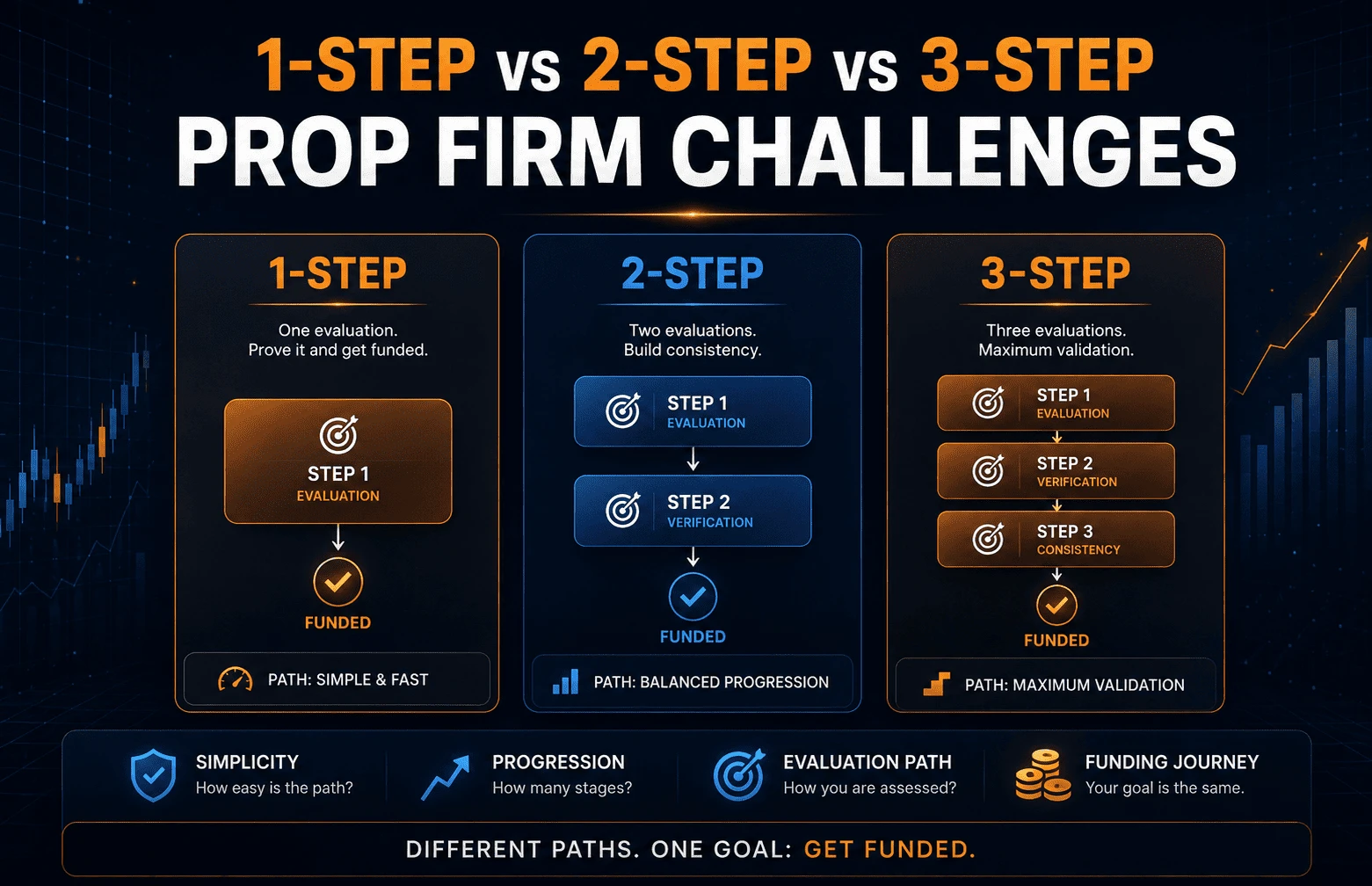



There is no universal best choice between AIFO Instant, 1-Step, 2-Step and Sprint. Instant provides direct simulated account access without a traditional evaluation phase. 1-Step concentrates the evaluation into one phase. 2-Step tests repeatability across two phases. Sprint is a 24-hour challenge with a one-time payout path. Choose by target structure, loss-limit method, time pressure, concentration rules and payout conditions rather than by the shortest route alone.
Use AIFO account models for the current commercial overview. Beginners deciding between the standard evaluation routes can also read the 1-Step vs 2-Step beginner guide. Traders comparing evaluation with direct access should use No Evaluation vs Instant Funding vs One-Step.
Last checked: . The comparison below follows the latest supplied AIFO rules for Instant, 1-Step, 2-Step and Sprint. All AIFO account types operate in a simulated trading environment using virtual funds only. For accounts purchased before 1 September 2026, the challenge parameters displayed on the Dashboard prevail.
Instant vs 1-Step vs 2-Step vs Sprint: Quick Comparison
The four routes solve different problems. Instant removes the traditional evaluation phase, 1-Step and 2-Step use standard evaluation structures, and Sprint combines a short countdown with stricter position and payout conditions.
| Model | Entry path and objective | Current risk limits | Trading or concentration conditions | Payout path |
|---|---|---|---|---|
| AIFO Instant | Direct simulated account access without a traditional evaluation phase | 3% Daily Loss Limit; 5% Trailing Maximum Loss based on the highest historical equity and capped at the initial account balance; floating loss must not exceed 2% of the initial balance | Maximum single-day profit must remain below 20% of total profit in the payout period | $100 minimum payout; retain a 2% profit buffer after a payout to continue trading; requesting all available profit closes the account |
| AIFO 1-Step | One simulated evaluation phase with a 10% profit target | 3% Daily Loss Limit and 6% Static Maximum Loss Limit | At least 2 trading days; no consistency-score requirement | Default 80% profit split, with the potential to increase to 95% through scaling; $100 minimum and a standard 14-day payout cycle |
| AIFO 2-Step | Two simulated evaluation phases: 8% target in Phase 1 and 5% target in Phase 2 | 5% Daily Loss Limit and 10% Static Maximum Loss Limit | At least 3 trading days; no consistency-score requirement | Default 80% profit split, with the potential to increase to 95% through scaling; $100 minimum and a standard 14-day payout cycle |
| AIFO Sprint | A 24-hour challenge with a 3% profit target; the first trade must be opened within 48 hours of purchase and starts the countdown | 2% Static Maximum Loss Limit and total floating loss of no more than 1% of the initial balance | The first trade fixes the only permitted instrument; one open position at a time; largest single-trade profit must remain below 20% of total profit | One payout only: 90% split if the account ends the 24-hour challenge with closed net profit of at least 3% but below 6%, or 95% early payout at closed net profit of at least 6%; request within 30 days; account closes after payout |
What Does the Account Route Actually Change?
The route changes when performance is tested and which rules control the payout path. It does not turn the displayed account balance into real funds. Every route remains simulated.
- Instant starts with direct access. There is no traditional evaluation phase, but the trailing Maximum Loss, floating-loss rule, best-day condition and payout buffer apply from the beginning.
- 1-Step concentrates evaluation pressure. The trader has one 10% target and must protect a 6% Static Maximum Loss boundary across at least 2 trading days.
- 2-Step tests repeatability. The trader must complete an 8% Phase 1 target and then a separate 5% Phase 2 target while respecting the 5% Daily and 10% Static Maximum Loss limits.
- Sprint tests execution under time pressure. The first trade fixes the instrument and starts the 24-hour clock, while the account is limited to one open position and a one-time payout.
Completing an evaluation objective does not by itself make a payout immediately available. The wider sequence is explained in how AIFO works and what happens after passing a prop firm challenge.
How Does Static vs Trailing Maximum Loss Change the Choice?
The drawdown method can matter more than the number of evaluation phases. A Static Maximum Loss floor remains tied to the initial account size. A Trailing Maximum Loss floor moves upward after new equity highs until it reaches its cap.
| Model | Starting loss floor | What happens after gains | Decision consequence |
|---|---|---|---|
| Instant | 5% Trailing Maximum Loss starts at $95,000 | The floor follows new High-Water Marks and is ultimately capped at the initial $100,000 balance | Recovery room can tighten after gains. The separate 2% floating-loss limit must also be respected. |
| 1-Step | 6% Static Maximum Loss sets the floor at $94,000 | The floor remains $94,000 even if the account grows and remains unchanged after payout | The fixed boundary is easier to map, but 6% is a failure limit rather than a recommended risk budget. |
| 2-Step | 10% Static Maximum Loss sets the floor at $90,000 | The floor remains $90,000 even if the account grows and remains unchanged after payout | The wider fixed boundary may better absorb normal strategy pullbacks, but the 5% Daily Loss Limit still controls each trading day. |
| Sprint | 2% Static Maximum Loss sets the floor at $98,000 | The floor remains fixed regardless of account growth | The narrow account-level limit and separate 1% total floating-loss rule require conservative exposure during the 24-hour challenge. |
Use the Daily Loss vs Maximum Loss guide and the current AIFO trading rules before converting these hard limits into a working risk plan.
Which AIFO Model Fits Which Trader?
The right model is the one that allows a tested strategy to operate normally without rewarding the trader’s weakest habit.
- Consider Instant when direct simulated account access matters and the strategy can stay comfortably inside a trailing drawdown, a 2% floating-loss cap and the best-day payout rule.
- Consider 1-Step when the strategy is tested, the trader wants one evaluation phase and a 10% target does not create target-chasing behaviour.
- Consider 2-Step when the trader wants a staged evaluation and can repeat the same risk process after completing Phase 1.
- Consider Sprint only when the strategy can operate within one instrument, one open position, a 24-hour window, a 2% Static Maximum Loss and a 1% total floating-loss limit.
- Low-frequency traders should check whether the minimum trading-day requirement on 1-Step or 2-Step fits their normal signal frequency. Read minimum trading days vs profitable days.
- Complete beginners should practise execution before using a paid challenge as a learning environment.
Which AIFO Models Allow Expert Advisors?
AIFO permits Expert Advisors only on 1-Step and 2-Step challenge accounts and on the corresponding simulated funded accounts after passing the challenge. Instant and Sprint are not included in the approved EA account list.
EA permission does not permit shared strategies, duplicate trading or other prohibited conduct. The account owner remains responsible for ensuring that every tool and trading method complies with the current rules.
What Is the Main Failure Pattern in Each Model?
Each route exposes a different first mistake. Identifying that mistake is more useful than calling one model easy or difficult.
- Instant: ignoring the moving floor. The trader sizes from the headline balance without recalculating the Trailing Maximum Loss or controlling total floating loss.
- 1-Step: target chasing. The trader sees one finish line, increases size near the 10% target and gives back progress.
- 2-Step: relaxing after Phase 1. The trader treats Phase 2 as a formality and abandons the process that produced the first pass.
- Sprint: time-pressure overtrading. The trader forces entries because the clock is running, forgets the one-position rule or allows one trade to dominate total profit.
The broader control framework is covered in the prop firm risk management strategy.
How Do the Payout Rules Differ?
AIFO’s general payout framework sets a $100 minimum and a $10,000 maximum per request, with requests generally processed within 1–3 business days. Product-specific cycles and conditions still apply.
| Model | Consistency or concentration rule | Buffer | Timing and account consequence |
|---|---|---|---|
| Instant | Maximum single-day profit must remain below 20% of total payout-period profit | Retain 2% of the initial account balance after payout to continue trading | A full payout of available profit closes the account and it cannot be restored |
| 1-Step funded | No consistency-score requirement | No 2% payout buffer | Standard 14-day payout cycle |
| 2-Step funded | No consistency-score requirement | No 2% payout buffer | Standard 14-day payout cycle |
| Sprint | Largest single-trade profit must remain below 20% of total profit | The supplied Sprint rules do not state a continuing-account buffer; only one payout is available and the account closes afterward | Request within 30 days; processing within 1 business day excluding additional account checks or compliance review; account closes after payout |
Final Rule Check Before Choosing an AIFO Model
Choose only after the following facts are written in account currency and connected to the strategy’s actual trade history:
- Entry path: decide whether the strategy needs direct access, one evaluation phase, two phases or a 24-hour challenge.
- Target: record every applicable target instead of comparing only the first number.
- Daily Loss: calculate the current daily boundary and understand the server-day reset.
- Maximum Loss: confirm whether the floor is Static or Trailing and how it behaves after gains.
- Additional exposure limits: include Instant’s 2% floating-loss rule or Sprint’s 1% total floating-loss and one-position rules where applicable.
- Trading days and time limits: confirm the 1-Step or 2-Step minimum days, or Sprint’s first-trade and 24-hour deadlines.
- Consistency or concentration: 1-Step and 2-Step have no consistency score; Instant uses a best-day rule and Sprint uses a best-trade rule.
- Strategy permissions: Expert Advisors are limited to 1-Step, 2-Step and their corresponding simulated funded accounts.
- Payout path: understand the minimum, timing, buffer, profit split and account-closure consequence for the selected model.
For position sizing, start with risk per trade in a prop firm challenge. The displayed account balance is not the usable failure buffer.
Frequently Asked Questions
There is no universal best model. Instant suits traders who want direct simulated account access and can manage trailing drawdown and payout concentration rules. 1-Step suits traders who want one evaluation phase. 2-Step suits traders who want a staged evaluation. Sprint suits traders whose strategy can operate within a 24-hour window, one instrument and one open position.
Not automatically. AIFO 1-Step has one 10% target, a 3% Daily Loss Limit, a 6% Static Maximum Loss Limit and at least 2 trading days. AIFO 2-Step separates the evaluation into 8% and 5% targets, with a 5% Daily Loss Limit, a 10% Static Maximum Loss Limit and at least 3 trading days.
Instant uses a 5% Trailing Maximum Loss based on the highest historical equity and capped at the initial account balance. AIFO 1-Step uses a 6% Static Maximum Loss, AIFO 2-Step uses a 10% Static Maximum Loss, and Sprint uses a 2% Static Maximum Loss.
No. AIFO 1-Step and 2-Step simulated funded accounts do not require a consistency score. Instant instead requires the maximum single-day profit to remain below 20% of total payout-period profit, while Sprint limits the largest single-trade profit to below 20% of total profit.
Sprint is a 24-hour challenge with a 3% profit target, a 2% Static Maximum Loss Limit and a 1% total floating-loss limit. The first trade must be opened within 48 hours of purchase, fixes the only permitted instrument and starts the countdown. Only one position may be open at a time, and the account is eligible for one payout before closing.
No. Completing the evaluation objectives is followed by account review and eligible simulated funded progression. Payout eligibility remains a separate stage with the risk, identity, account-status and request conditions that apply to the selected model.