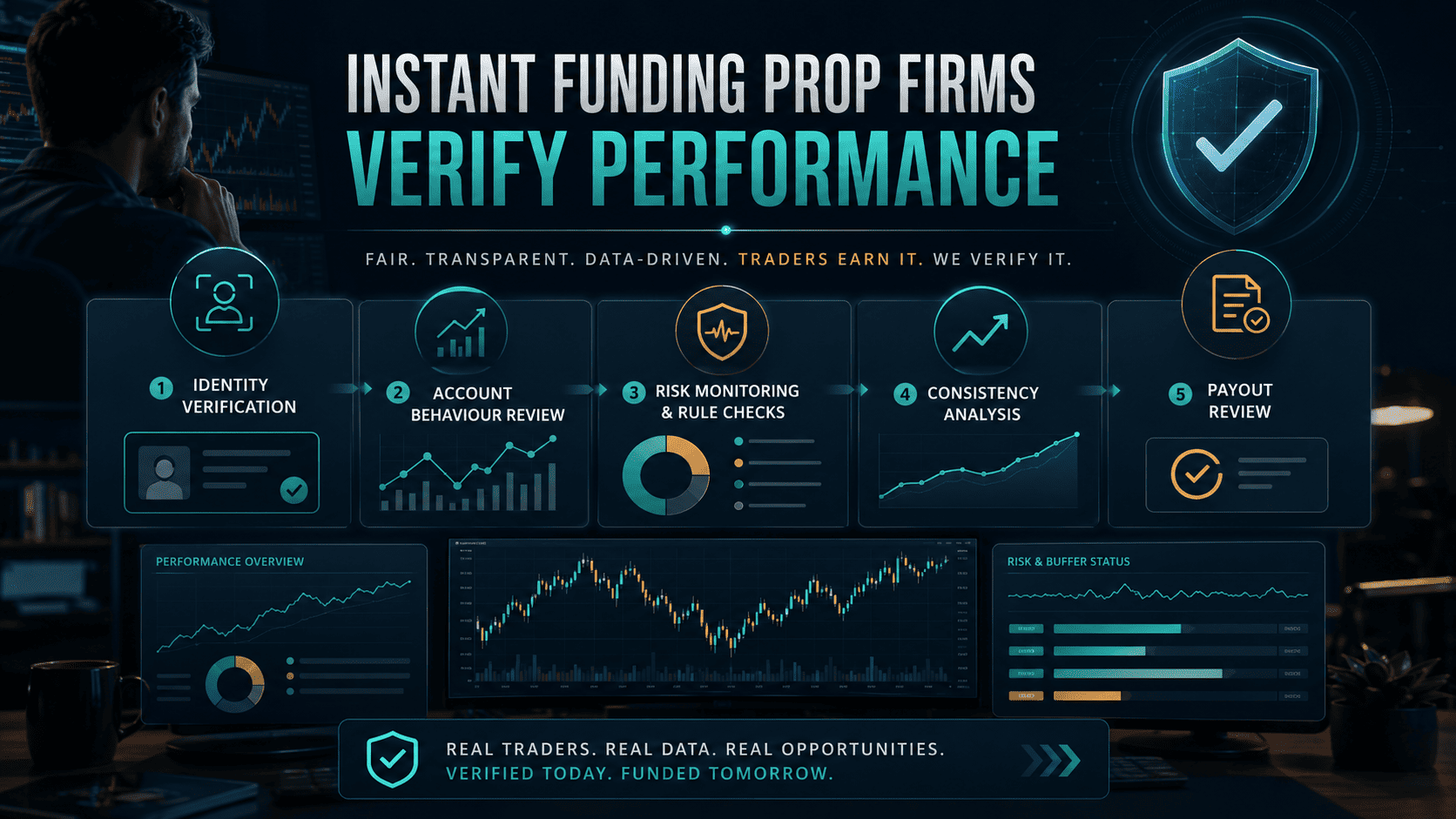



Instant funding firms verify performance through the complete account record, not only the final profit. The review can include identity and account ownership, rule compliance, drawdown history, open and closed positions, profit concentration, restricted trading, account status and payout eligibility. At AIFO, Instant is an immediate-access simulated account model, but every payout still depends on meeting the applicable risk, consistency, KYC and account-status requirements.
Instant access means the traditional evaluation phase is removed. It does not mean verification disappears. The evidence is collected after account access, from the first trade through the payout request.
Start with the AIFO Instant Funding programme for the product path. This guide explains what can be reviewed and how traders can keep their account history clear and auditable.
Last rule review: . AIFO-specific requirements below follow the latest approved rule set. For accounts purchased before 1 September 2026, the parameters shown on the Dashboard apply.
Instant Funding Verification: Access First, Review Continues
| Stage | What can be checked | Why it matters |
|---|---|---|
| Account activation | Selected model, account ownership, rule acceptance and Dashboard status | Fast activation does not approve future profits in advance |
| Ongoing monitoring | Daily loss, maximum loss, floating loss, positions and account state | A profitable closing balance cannot erase an earlier rule breach |
| Behaviour review | Trade timing, order history, account links and restricted methods | The route used to create profit must comply with the rules |
| Profit-distribution review | Highest single-day profit compared with total payout-period profit | AIFO Instant requires the result to remain below 20% |
| Payout review | KYC, account status, eligible profit, payout amount and retained buffer | Dashboard profit becomes payable only after applicable checks are satisfied |
The important distinction is between access and payout approval. Instant access starts trading sooner. Payout approval evaluates whether the resulting profit is eligible under the account’s current rules.
AIFO Instant Uses Simulated Trading
All AIFO account types operate in a simulated trading environment using virtual funds. An AIFO Instant account therefore does not prove that a trader has managed a live brokerage account or investor capital.
The relevant evidence is simulated performance under the applicable AIFO rules. Statements about “funding” or “funded performance” should not imply ownership of, or direct trading with, live capital.
The First Verification Layer Is Identity and Ownership
Before a payout can be completed, the firm may need to establish that the account, trading history and payout destination belong to the verified user.
| Check | What the trader should prepare | Possible issue |
|---|---|---|
| Legal identity | Accurate profile details and accepted identity documents | Name or identity information does not match |
| Account ownership | Evidence that the verified user controls the account | Third-party access or account sharing is suspected |
| Payout destination | Correct and complete payment information | Payment details are incomplete, incorrect or inconsistent |
| Account links | A clear explanation of devices, networks and authorised access | Unusual links require additional review |
Use the AIFO KYC verification FAQ for the current process. Complete the required profile and payout information before requesting withdrawal.
The Risk Engine Verifies the Entire Account Path
The account record shows more than net profit. It also shows whether balance or equity reached a rule boundary and whether open exposure remained compliant.
Current AIFO Instant risk parameters are:
- Daily Loss Limit: 3%.
- Maximum Loss Limit: 5% Trailing, based on the highest historical equity or high-water mark.
- Trailing behaviour: the Maximum Loss Limit rises after a new HWM, never decreases and is capped at the initial account balance.
- Floating-loss limit: floating loss must not exceed 2% of the initial account balance.
If balance or equity reaches the Maximum Loss Limit, the account is considered failed. A later recovery or profitable closing balance does not rewrite the earlier account state.
| Record | Question answered | Trader action |
|---|---|---|
| Balance and equity history | Did the account reach a loss boundary? | Monitor both figures instead of closed P&L alone |
| Highest historical equity | Where should the trailing Maximum Loss Limit sit? | Recheck the loss floor after a new equity high |
| Open-trade loss | Did floating loss remain below 2% of initial balance? | Size positions from the floating-loss boundary backwards |
| Daily account history | Did activity remain inside the 3% Daily Loss Limit? | Use a personal daily stop inside the official limit |
The Instant Funding drawdown guide explains how these boundaries interact.
Position Size and Exposure Show How Profit Was Created
Two accounts can finish with the same profit but have very different risk histories. A steady series of planned trades is different from a sharp position-size increase used to recover a loss.
A review can examine:
- position size relative to account and loss-limit room;
- changes in size after losses or near payout;
- multiple positions that create one correlated exposure;
- floating loss before trades are closed;
- trade timestamps and order sequence;
- whether the history matches the account owner’s stated strategy.
Traders should use a repeatable risk process. The risk-management strategy guide provides a framework that can also be used for an Instant account.
Profit Concentration Is Part of AIFO Instant Verification
AIFO Instant applies a payout-period consistency condition. The maximum single-day profit as a percentage of total profit within the payout period must be below 20%.
The calculation is:
Highest single-day profit ÷ total payout-period profit × 100
| Highest-profit day | Total profit | Result | Status under a below-20% rule |
|---|---|---|---|
| $300 | $1,200 | 25% | Not eligible |
| $300 | $1,500 | 20% | Not below 20% |
| $300 | $1,600 | 18.75% | Below 20% |
Exactly 20% does not satisfy a requirement that says below 20%. The ratio can change as total payout-period profit changes, so it should be tracked before a payout request. See the AIFO consistency FAQ and the consistency-rule guide.
Restricted Trading Review Checks the Method, Not Only the Result
Order acceptance on a trading platform does not prove that the method is permitted. A payout review can compare the account history with restricted-trading and account-conduct rules.
Important distinctions include:
- a trade being technically executable versus permitted under the programme;
- independent trading versus copied or shared execution;
- a normal strategy versus a method designed to exploit latency, system weaknesses or rule gaps;
- the verified user controlling the account versus third-party control;
- EA eligibility on an approved programme versus assuming automation is allowed everywhere.
The current AIFO EA rule permits Expert Advisors only on 1-Step and 2-Step Challenge accounts and the corresponding simulated funded accounts after passing. AIFO Instant is not included in that approved EA eligibility list.
Instant traders should therefore not interpret a general discussion of automated-trading review as permission to use an EA. Check the AIFO EA policy, restricted-trading policy and violation policy.
Dashboard and Trading-Platform Records Must Reconcile
The trading platform records individual orders and account values. The AIFO Dashboard applies the programme’s rule and payout logic. A difference between views should be investigated before additional trading or a payout request.
Record the following if a discrepancy appears:
- account identifier;
- time and timezone;
- balance and equity shown in both systems;
- open positions and pending orders;
- recent deposits, adjustments or payouts;
- screenshots and order identifiers.
Do not assume that the more favourable number controls the account. Use the Dashboard balance reconciliation FAQ and obtain clarification when required.
Payout Review Is the Final Performance Check
For AIFO Instant, a payout may be requested on demand once all applicable risk, consistency, KYC, account-status and payout conditions are met. There is no traditional evaluation profit target in the current Instant rule set.
The main payout figures are:
- Minimum payout: $100.
- Maximum general payout request: $10,000.
- General processing time: usually 1–3 business days, subject to additional compliance or account review.
- Instant profit buffer: at least 2% of the initial account balance must remain after payout to continue trading.
- Full payout: withdrawing all available profit, including the buffer, permanently closes the account.
| Check | Question |
|---|---|
| Risk history | Did balance and equity remain inside every applicable limit? |
| Profit concentration | Is the highest-profit day below 20% of total payout-period profit? |
| KYC | Are identity and account-ownership requirements complete? |
| Account state | Are there unresolved violations or other unmet account requirements? |
| Payout amount | Does the request meet the applicable minimum and maximum? |
| Profit buffer | Will at least 2% of initial balance remain if the account is to continue? |
| Full-payout choice | Does the trader understand that including the buffer closes the account permanently? |
Review the AIFO payout process, Instant Funding payout rules and first-payout guide before submitting a request.
Why a Profitable Instant Account Can Fail Review
Net profit answers only one question: whether the account finished above its starting point. Payout eligibility asks more:
- Was the profit created in a simulated account under the correct programme?
- Did balance and equity remain within the loss limits?
- Did floating loss stay within the separate Instant boundary?
- Was the highest-profit day below 20% of total payout-period profit?
- Did the verified account owner control the account?
- Did the trading method comply with restricted-trading rules?
- Are KYC, payment and account-status checks complete?
- Does the payout request preserve the required Instant buffer unless the trader chooses account closure?
A failure in any applicable layer can delay or prevent payout even when the headline P&L is positive. The payout denial guide explains common causes.
How to Prepare Before the First Trade
- Confirm the account model. Read the current AIFO account model comparison and Dashboard.
- Record the current Instant rules. Note the 3% Daily Loss Limit, 5% HWM-based Trailing Maximum Loss and 2% floating-loss cap.
- Set personal risk limits. Keep them inside the official boundaries.
- Use only permitted methods. Do not assume Instant is EA-eligible.
- Keep ownership clean. Use the verified account and accurate profile information.
- Track profit distribution. Recalculate the best-day percentage after each profitable day.
- Plan the payout. Account for the $100 minimum and 2% retained buffer.
- Save evidence. Keep trade notes, order identifiers and relevant support clarifications.
AIFO Instant Performance Record
| Field | Purpose | Update frequency |
|---|---|---|
| Balance and equity | Measure current account state | Before and after each trading session |
| Highest historical equity | Track the trailing Maximum Loss reference | After every new equity high |
| Current Maximum Loss Limit | Measure remaining lifecycle room | Before each trade |
| Daily P&L | Monitor the 3% Daily Loss Limit | During the trading day |
| Maximum floating loss | Monitor the 2% initial-balance cap | For every open trade |
| Highest-profit day | Calculate the below-20% payout test | After each profitable day |
| Total payout-period profit | Provide the denominator for the best-day test | Daily |
| Required profit buffer | Plan the retained 2% after payout | Before payout |
Final Takeaway
Instant funding changes when performance is verified, not whether it is verified. At AIFO, Instant trading takes place with virtual funds in a simulated environment. The account record must comply with a 3% Daily Loss Limit, 5% HWM-based Trailing Maximum Loss, 2% floating-loss cap and a best-day result below 20% of payout-period profit.
Payout also requires the applicable KYC, account-status and payment checks. A minimum request of $100 applies, and an Instant account that remains open must retain a 2% profit buffer. A full payout including that buffer permanently closes the account.
Related Guides for Instant Funding Verification
- Instant Funding Drawdown Rules
- Instant Funding Payout Rules
- Prop Firm Challenge Rules
- Consistency Rules
- Why Prop Firm Payouts Get Denied
- Best Instant Funding Prop Firms
FAQ
Instant funding firms can review identity, account ownership, balance and equity history, drawdown, floating loss, position size, order history, profit distribution, restricted trading, account status and payout eligibility. Fast account access does not approve future profit in advance.
No. All AIFO account types, including Instant Accounts, operate in a simulated trading environment using virtual funds. Instant performance is therefore simulated performance under AIFO’s applicable rules.
AIFO Instant uses a 3% Daily Loss Limit, a 5% Trailing Maximum Loss Limit based on the highest historical equity or HWM, and a floating-loss limit of 2% of the initial account balance. The trailing limit never decreases and is capped at the initial account balance.
The maximum single-day profit as a percentage of total profit within the payout period must be below 20%. Exactly 20% does not satisfy a requirement that says the result must be below 20%.
No approved EA eligibility is stated for AIFO Instant. The current AIFO rule permits Expert Advisors only on 1-Step and 2-Step Challenge accounts and on the corresponding simulated funded accounts after passing.
Positive net profit is only one requirement. Payout can be delayed or denied if an applicable risk, floating-loss, consistency, KYC, ownership, account-status, restricted-trading, payment or payout-buffer condition is not met.
To continue trading, the Instant Account must retain a profit buffer equal to at least 2% of the initial account balance. The minimum payout is $100. If the trader withdraws all available profit including the buffer, the account closes permanently.