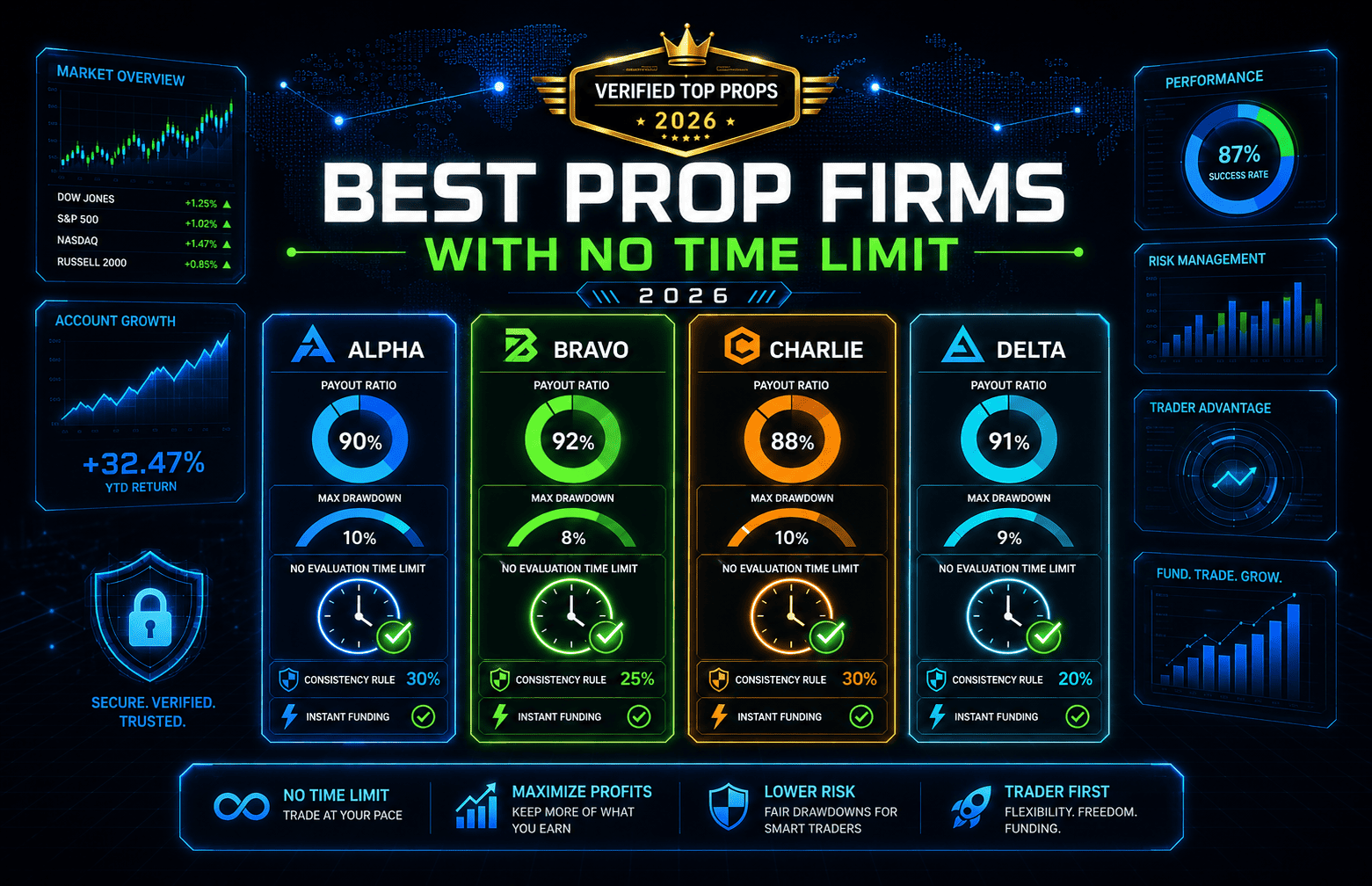



The best prop firm with no time limit is the one where removing the deadline allows the trader to wait for valid setups without creating pressure elsewhere. A no-deadline challenge can still have minimum trading days, inactivity rules, Daily Loss and Maximum Loss limits, execution restrictions and payout conditions. Start with the AIFO Best Prop Firm Decision Center for the wider shortlist, then use this page to check no-time-limit claims.
No time limit does not mean no rules. Once the maximum evaluation deadline disappears, another condition may become the real clock: inactivity, minimum trading days, payout cycles or the trader’s own attempt to finish quickly.
Last checked: . External firms can change their evaluation periods and account rules. Verify the exact current model before purchasing. For AIFO accounts purchased before 1 September 2026, the challenge parameters displayed on the Dashboard prevail.
Best Prop Firms With No Time Limit: Quick Filter
| Route to check | Potential fit | What replaces deadline pressure | What to verify |
|---|---|---|---|
| FTMO | Traders comparing established evaluation routes | Objectives, minimum days, news rules and post-pass review | Current model, evaluation period, loss rules and payout terms |
| FundingPips | Active traders who want time flexibility but trade regularly | Inactivity and account-stage rules | Current challenge model, activity window, reset rules and payout cycle |
| FundedNext | Traders comparing no-time-limit wording across several models | Minimum days, model differences, KYC and funded-stage conditions | The exact selected model rather than brand-wide claims |
| The5ers | Swing or position traders who need more time for setups | Programme-specific activity and trading-day rules | Current programme version, inactivity, holding and payout terms |
| Audacity Capital | Traders comparing a structured two-phase route | Minimum trading days, phase objectives and payout timing | The current challenge and funded-stage rules |
| Alpha Capital Group | Traders who want to evaluate at their own pace | Execution style, news rules and risk review | Current plan, assessment rules and funded-stage conditions |
| FundedFast | Traders comparing immediate and evaluation-based routes | Model-specific drawdown, consistency and payout rules | The exact purchased route and its current terms |
| AIFO | Traders who want to compare risk structures before checking the account’s time conditions | Programme-specific targets, loss limits, trading days, EA eligibility and payout rules | Instant, 1-Step, 2-Step or Sprint terms and the applicable Dashboard |
What “No Time Limit” Actually Means
A genuine no-time-limit claim normally means there is no maximum calendar deadline for completing the evaluation objective. It does not automatically remove any other rule.
| Rule | Removed by no-time-limit wording? | Why it still matters |
|---|---|---|
| Maximum evaluation deadline | Potentially yes, if the selected model explicitly says so | The trader can wait longer to reach the target |
| Minimum trading days | No | The trader may still need several trading days before progressing |
| Inactivity rule | No | An unused account may still be closed or restricted |
| Daily Loss Limit | No | A single bad day can fail an unlimited-time account |
| Maximum Loss Limit | No | The account’s total recovery room remains limited |
| Consistency requirement | No | Some firms may still limit profit concentration |
| Execution restrictions | No | EA, copy trading, news and holding policies still apply |
| Payout conditions | No | Passing the evaluation is separate from payout eligibility |
No Time Limit Is Not No Minimum Trading Days
Maximum duration and minimum trading days answer different questions:
- Maximum duration: how long the trader has to complete the objective.
- Minimum trading days: how many separate trading days must be completed before progression.
- Profitable days: days that must satisfy an additional profit threshold, if the account uses one.
- Inactivity period: how long the account may remain unused.
AIFO’s current 1-Step rule requires at least 2 trading days. Its current 2-Step rule requires at least 3 trading days. Neither rule adds a 0.5% profitable-day threshold. Read minimum trading days versus profitable days before comparing account duration.
Best No-Time-Limit Prop Firms Reviewed
FTMO
Potential fit: Traders comparing established evaluation structures without wanting a short completion deadline.
Main caveat: Minimum days, account objectives, news rules and post-pass review can still create pressure.
Rule check: Verify the selected model’s current deadline, Daily Loss, Maximum Loss, trading days and payout terms.
FundingPips
Potential fit: Active intraday or swing traders who can keep the account in use.
Main caveat: An inactivity condition can become the practical deadline even when the evaluation has no maximum duration.
Rule check: Verify the activity window, reset mechanics, account-stage rules and payout schedule.
FundedNext
Potential fit: Traders who want time flexibility and can compare model-specific conditions.
Main caveat: One model’s time wording should not be applied to every account offered by the firm.
Rule check: Verify the exact target, minimum days, loss rules, KYC and funded-stage payout terms.
The5ers
Potential fit: Patient traders whose systems need time between valid setups.
Main caveat: Programme-specific activity, profitable-day or holding rules may still control the schedule.
Rule check: Verify the current programme, inactivity window, trading days, news and weekend policies.
Audacity Capital
Potential fit: Traders comparing a structured evaluation without a short maximum deadline.
Main caveat: Phase objectives and minimum days still determine progression.
Rule check: Verify current phase rules, drawdown, payout schedule and permitted execution methods.
Alpha Capital Group
Potential fit: Traders who need more calendar time but can follow execution and risk conditions.
Main caveat: News, trade-duration or risk review may affect the strategy even without a deadline.
Rule check: Verify the selected assessment and funded-stage rules.
FundedFast
Potential fit: Traders comparing immediate-access and evaluation routes.
Main caveat: The account’s drawdown, consistency and payout rules may differ across routes.
Rule check: Verify the complete selected model rather than relying on a general no-time-limit claim.
AIFO
Potential fit: Traders who want to compare several programme-specific risk structures before choosing the account’s pace.
Main caveat: AIFO does not have one universal time or risk rule. Instant, 1-Step, 2-Step and Sprint must be checked separately. Sprint is a 24-hour time-limited challenge and is not a no-time-limit route.
Rule check: Review the current AIFO account models, trading rules and payout process. Confirm any maximum duration or inactivity condition on the selected account and Dashboard.
Current AIFO Models and Time Pressure
All AIFO account types use virtual funds in a simulated trading environment. The latest audit confirms different risk and progression structures for the current product set.
| AIFO programme | Current core rules | Time or progression pressure | EA eligibility | Confirmed page |
|---|---|---|---|---|
| 1-Step | 10% target 3% Daily Loss 6% Static Maximum Loss |
At least 2 trading days; confirm current maximum-duration and inactivity terms on the account | Allowed with restrictions on the Challenge and corresponding simulated funded account | 1-Step rules |
| 2-Step | 8% Phase 1 target 5% Phase 2 target 5% Daily Loss 10% Static Maximum Loss |
At least 3 trading days; confirm current maximum-duration and inactivity terms on the account | Allowed with restrictions on the Challenge and corresponding simulated funded account | 2-Step rules |
| Instant | 3% Daily Loss 5% trailing Maximum Loss based on HWM Floating loss must not exceed 2% of the initial balance Best day must be less than 20% of payout-period profit |
No traditional evaluation phase; payout access still depends on the applicable rules | Not included in the current EA-eligible account list | Instant rules |
| Sprint | 3% target 2% Static Maximum Loss Total floating loss must not exceed 1% of the initial balance |
First trade within 48 hours of purchase; first trade starts the 24-hour challenge countdown | Not included in the current EA-eligible account list | Confirm the current Sprint terms supplied with the account |
A no-time-limit comparison should therefore separate the AIFO models. Sprint has a defined 24-hour trading window. Instant has no traditional evaluation phase. For 1-Step and 2-Step, confirm the current duration and inactivity wording on the account rather than inferring it from the phase structure.
Payout Rules Still Apply Without a Deadline
Removing an evaluation deadline does not make profit immediately withdrawable. Payout rules remain account-specific.
| AIFO payout field | 1-Step and 2-Step | Instant | Sprint |
|---|---|---|---|
| Minimum payout | $100 | $100 | Follow the Sprint settlement rules |
| Standard cycle | 14 days | On demand after applicable conditions are met | One-time payout |
| Consistency | No Consistency Score | Best single day must be less than 20% of payout-period profit | Largest single trade profit must be less than 20% of total profit |
| Mandatory 2% buffer | Does not apply | Required after payout if the account remains active | Not specified as a requirement |
| Account closure | Follow the funded-account terms | A full payout closes the account | The account closes after its one payout |
Use the prop firm payout guide and first payout rules when comparing evaluation time with the actual withdrawal path.
Alpha Insight: Another Rule Becomes the Clock
Removing the calendar deadline reduces one source of pressure, but the trader can still create a private deadline by watching the target every day. Inactivity, minimum days or payout timing can also replace the original clock.
The benefit of unlimited evaluation time appears only when the trader continues to reject weak setups and keeps risk unchanged after a slow week.
How to Choose a No-Time-Limit Challenge
1. Confirm what “no time limit” applies to
Check whether the wording covers only the evaluation deadline or also applies to another account stage.
2. Find the inactivity rule
A no-deadline account can still require periodic trading. Compare the inactivity window with the normal gap between valid setups.
3. Separate minimum days from duration
The trader may have unlimited calendar time but still need a fixed number of trading days before progressing.
4. Compare the loss method
Use the Daily Loss and Maximum Loss guide to distinguish static and trailing floors.
5. Match the execution method
AIFO permits compliant EAs only on 1-Step and 2-Step Challenge accounts and their corresponding simulated funded accounts. A platform’s technical capability does not create permission for every model.
6. Plan payout before the first trade
Record the cycle, minimum payout, profit split, applicable consistency rule and any account-specific buffer.
Best Fit by Trader Type
| Trader type | Useful feature | Main risk | Next check |
|---|---|---|---|
| Low-frequency swing trader | More time to wait for qualified setups | Inactivity or weekend-holding restrictions | Holding rules |
| Active intraday trader | Less calendar pressure during a losing period | Daily Loss reset and overtrading | Daily reset |
| EA trader | Time to let the system produce enough valid trades | Account-specific EA restrictions | EA rules |
| Beginner | Reduced pressure to force trades | Using the extra time without a risk plan | Beginner comparison |
Red Flags Before Buying
- “No time limit” is shown without the inactivity rule.
- Minimum trading days and profitable days are treated as the same condition.
- The Daily Loss and Maximum Loss calculations are missing.
- A universal consistency percentage is applied across every model.
- A 2% payout buffer is presented as a rule for all AIFO accounts.
- EA permission is assumed to apply to Instant or Sprint.
- Sprint is included in a no-time-limit shortlist even though it is a 24-hour challenge.
- Passing the evaluation is described as immediate payout eligibility.
Complete the prop firm challenge checklist before placing the first trade.
Final Check
- Confirm the exact account model and its maximum evaluation period.
- Record the inactivity window.
- Separate minimum trading days from profitable-day conditions.
- Identify the Daily Loss and Maximum Loss calculations.
- Check EA, copy trading, news and holding permissions.
- Write down the funded-stage payout cycle, minimum and account-specific buffer.
- Save the current rules and Dashboard parameters.
FAQ
No time limit normally means the selected evaluation has no maximum calendar deadline for reaching its objective. It does not automatically remove minimum trading days, inactivity rules, Daily Loss, Maximum Loss, execution restrictions or payout conditions.
No. A maximum evaluation period controls how long a trader has to finish, while minimum trading days control how many separate trading days must be completed. An account can have no maximum deadline and still require minimum trading days.
AIFO 1-Step requires at least 2 trading days, and AIFO 2-Step requires at least 3 trading days. The current rules do not require each trading day to generate a 0.5% profit.
No. Sprint is a 24-hour time-limited challenge. The first trade must be opened within 48 hours of purchase, and that first trade starts the 24-hour countdown and selects the account’s only permitted instrument.
No. Compliant Expert Advisors are allowed only on AIFO 1-Step and 2-Step Challenge accounts and on the corresponding simulated funded accounts after passing. Instant and Sprint are not included in the current EA-eligible account list.
No. Evaluation duration and payout eligibility are separate. Traders must still satisfy the selected account’s payout cycle, minimum amount, consistency, KYC, account-status and buffer rules where applicable.