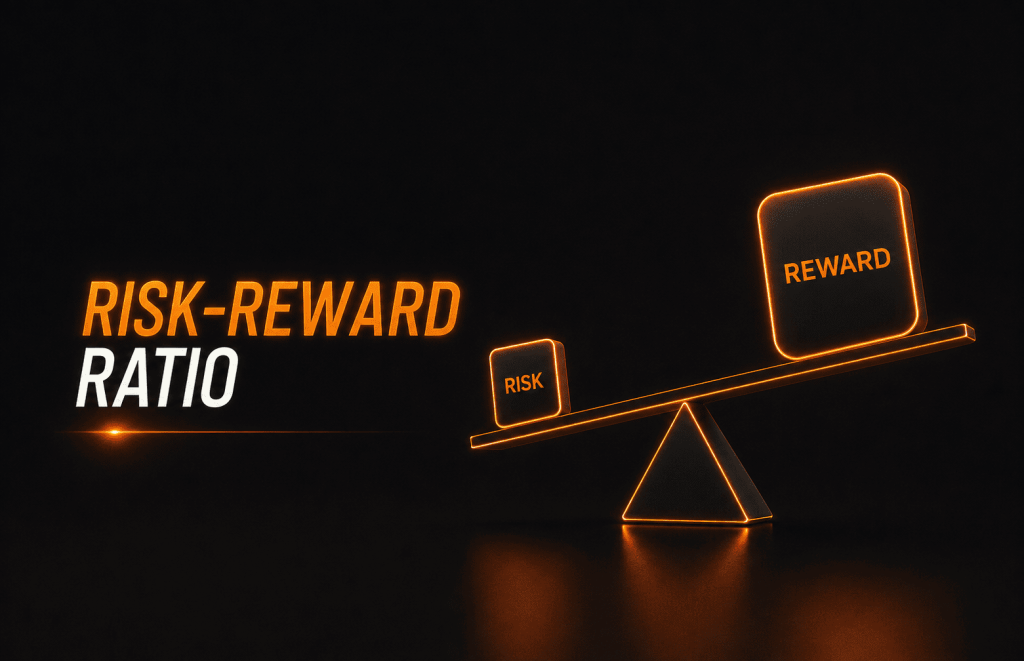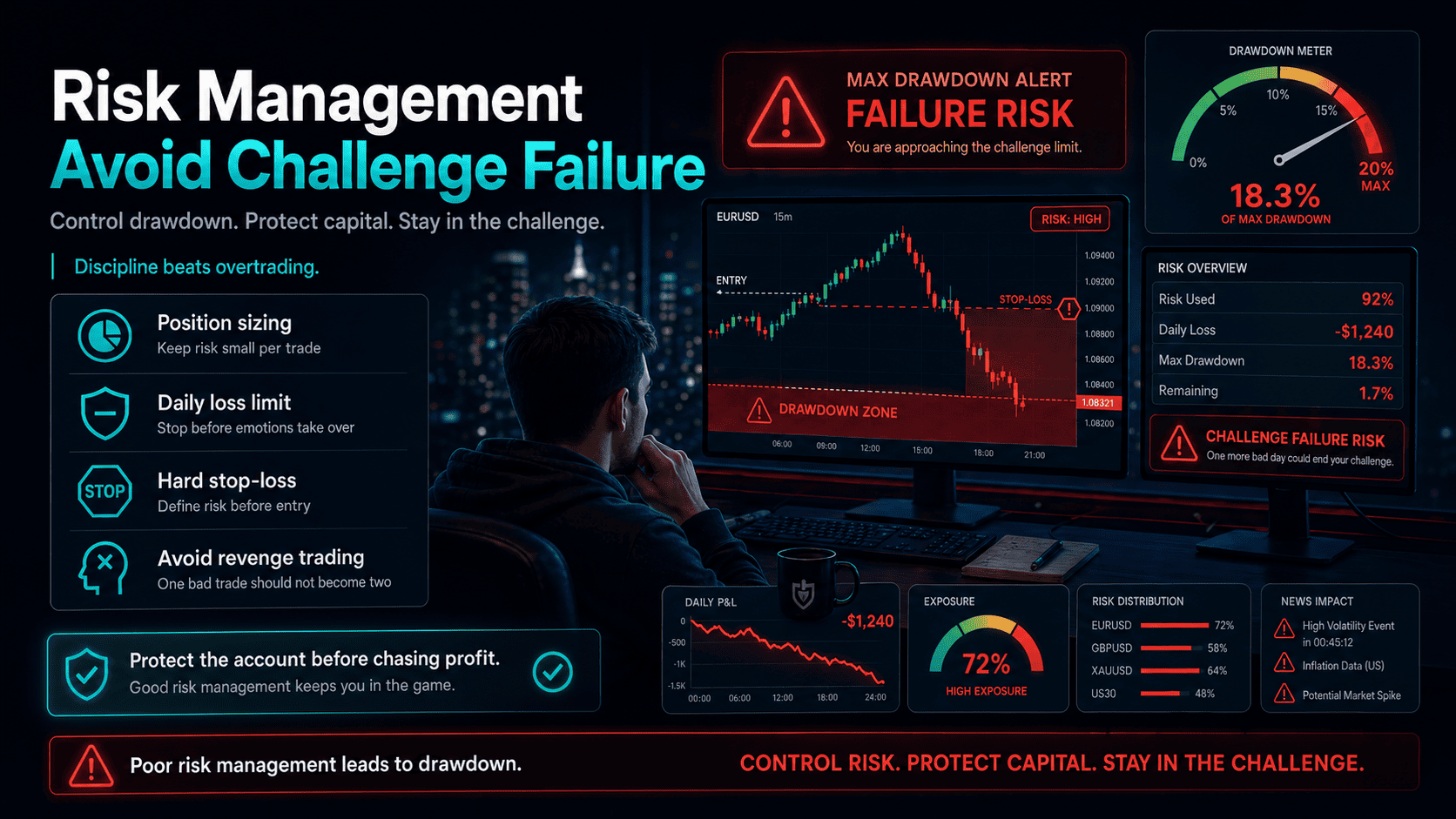



A prop firm risk management strategy should be state-based, not fixed-percentage. Start with the account’s real failure buffer, set a personal daily stop before the firm’s hard limit, reduce risk after losses, cap give-back after strong profit days and slow down near the target. The goal is not to avoid every losing trade. The goal is to make sure a normal losing sequence cannot turn into a daily-loss breach, maximum-loss breach, consistency problem or payout-review issue.
Prop Firm Risk Management Strategy: The Simple Framework
This article is the risk-management child guide inside the How to Pass a Prop Firm Challenge Hub. Use it after you understand the full challenge roadmap and before you place the first trade.
The strategy has five parts:
| Risk layer | What it controls | Main question | Detailed guide |
|---|---|---|---|
| Failure buffer | The distance between current equity and the rule that can fail the account | How much room does the account really have? | Risk per trade in a prop firm challenge |
| Personal daily stop | The trader’s stop-before-the-firm-stops-you rule | Where do I stop before the official daily loss limit matters? | Daily loss reset time |
| Risk ladder | How trade size changes after losses, profits and account-state changes | What does the next trade size become after this result? | Daily, maximum and trailing drawdown |
| Consistency protection | How profit distribution affects review and payout readiness | Is one day becoming too large relative to total profit? | Prop firm consistency rule |
| Finish-line discipline | How risk changes near the target, review or payout stage | Am I trading a valid setup or forcing the account to finish? | Why traders fail prop firm evaluations |
A normal retail account and a prop firm account do not fail in the same way. A retail account usually fails when the trader loses too much capital. A challenge can fail while the strategy still has long-run potential because the account touched one rule boundary too soon. Read prop firm account vs retail account if you need that difference first.
Start from the Failure Buffer, Not the Account Balance
The account balance is not the risk budget. The failure buffer is the smallest remaining distance between current equity and the rule boundary that can stop, freeze, fail or review the account.
Use these formulas before calculating position size:
Remaining daily-loss room = current equity − current daily-loss floor
Remaining maximum-loss room = current equity − current maximum-loss floor
Effective failure buffer = lowest of remaining daily-loss room, remaining maximum-loss room, remaining personal daily stop and any account-specific hard cap
| Risk boundary | What to write down | Why it matters | Where to check |
|---|---|---|---|
| Daily loss | The current daily floor, reset time, included costs and open P&L treatment | This is the boundary that can stop the trading day or fail the account quickly | Daily loss reset guide |
| Maximum loss | The lifecycle floor and whether it is static, trailing or equity based | This is the account-survival boundary across the full challenge path | Drawdown rules guide |
| Personal daily stop | The point where you stop before the firm’s hard limit is reached | This turns the official rule into a practical trading plan | Your written risk plan |
| Single-trade or floating-loss cap | Any rule limiting one trade, one open position, or total floating exposure | A trade can be too large even if the daily loss limit has not been reached | Official trading rules |
| Consistency or payout gate | Best-day, top-two-day or payout-review concentration limit | A profitable account can still become not payout-ready if profit is too concentrated | Consistency rule guide |
Last checked on : AIFO’s public rules describe daily loss, maximum loss, consistency, restricted activity and payout conditions as connected account controls. For AIFO accounts, use the live AIFO trading rules, the Daily Loss Limit FAQ and the Maximum Loss Limit FAQ before setting the trade size.
Build a Personal Daily Stop Before the Firm Stops You
A personal daily stop is the trader’s safety fence. It should trigger before the firm’s daily loss limit, maximum floating-loss rule or behaviour review becomes the problem.
| Stop type | Rule to write before the session | Example trigger | Why it prevents challenge failure |
|---|---|---|---|
| Money stop | Maximum amount the trader is willing to lose today | Stop for the day after losing 30%–50% of the firm’s daily limit | Stops the trader before the official daily-loss line becomes relevant |
| Trade-count stop | Maximum number of trades or failed attempts allowed in the session | Stop after two normal losses or one broken-process trade | Prevents overtrading and revenge sequences |
| Behaviour stop | Actions that immediately end the session even if the money limit is not reached | Moving a stop, chasing an entry, doubling size or ignoring the plan | Stops the trade after the trader is no longer following the system |
| Time stop | Sessions or conditions where the trader does not continue | Stop after the planned trading window or before a high-impact event | Prevents trades caused by fatigue, boredom or calendar risk |
| Account-state stop | Account conditions that force smaller size or no trade | Near the target, after a new equity high, after a strong day or near consistency pressure | Protects the account when the emotional reward is highest |
Do not wait until the dashboard is flashing red. By then the trader is usually emotional, rushed and tempted to make it back. Many challenge failures are not caused by the first loss. They are caused by the trade after the trader already knows they are no longer calm. That pattern is covered in why traders fail prop firm evaluations.
Use a Risk Ladder After Wins, Losses and Account-State Changes
A risk ladder changes position size based on the current state of the account. It is stronger than a fixed “risk 1%” rule because challenge accounts do not all have the same remaining loss room.
| Account state | Position-size action | Account check | Failure it prevents | Trader mistake it blocks |
|---|---|---|---|---|
| Fresh account, no pressure | Use base size only after setup quality is clear | Daily loss, maximum loss, server time and account rules are written down | Early account damage | Trying to make the first week impressive |
| One normal loss | Keep size stable or reduce slightly | The next loss still fits inside the personal daily stop | Loss escalation | Increasing size to recover quickly |
| Two losses or one poor decision | Cut size, narrow the setup list or stop for the day | The behaviour trigger has not been violated | Daily loss breach | Calling revenge trading “confidence” |
| Correlated positions are open | Treat the group as one risk idea | Total floating loss and same-direction exposure remain inside the risk budget | Several small positions combining into one account-level loss | Counting correlated trades as separate low-risk setups |
| Strong profit day | Lock a give-back limit, reduce pace or stop | The best-day result does not create consistency pressure | Profit give-back and concentration risk | Using profit as permission to loosen rules |
| Near the challenge target | Trade smaller or stop unless a written condition still requires activity | Target, trading days, consistency and review state agree | Late-stage failure | Forcing trades to finish the challenge |
The ladder does not need to be complicated. It needs to be written before the session. If the rule is invented after a losing trade, it is no longer risk management. It is negotiation.
Control the Drawdown Path, Not Just the Stop Loss
A stop loss controls one trade. Drawdown control protects the whole account path. A trader can use stops on every trade and still fail if several small losses, spread, commission, swap, floating loss or a moving drawdown floor compress the remaining buffer.
| Account path event | Risk-plan response | Guide to review |
|---|---|---|
| Daily loss room becomes smaller after losses or costs | Reduce size or stop before the official daily limit is threatened | Daily loss reset time |
| Maximum-loss floor trails after a new equity high | Recalculate the remaining lifecycle buffer before the next trade | Daily, maximum and trailing drawdown |
| Open positions remain active through reset, news or weekend exposure | Check equity, gap risk and account-specific holding rules before carrying the trade | Overnight and weekend holding rules |
| A strong day creates give-back temptation | Lock a maximum give-back amount and stop when it is reached | Why traders fail evaluations |
After a strong run, decide how much of the day’s open or closed profit can be surrendered before you stop. Without that rule, profit can become the reason the account fails.
Manage Consistency Before It Forces Extra Trading
A consistency rule is a risk-management rule, not only a payout detail. It changes how much profit should be allowed to come from one day, one trade or one short period.
Use this process before continuing after a strong session:
- Record today’s closed profit and total account profit.
- Calculate whether today is becoming the best day or part of the top-two-day concentration.
- Compare the result with the exact account formula and threshold.
- Set a best-day cap before the next trade.
- Stop if the next valid setup would make the account harder to pass, review or withdraw.
This is why the prop firm consistency rule belongs inside the risk plan. It should not be discovered after a large winning session.
The practical move is simple: stop before the best day becomes a problem. That can feel unnatural because traders like to press when they are right. In a challenge, pressing too hard can create a new obligation: keep trading until the ratio looks acceptable. The account is green, but now it is exposed for longer.
Slow Down When the Challenge Is Nearly Passed
The final part of a challenge should usually be traded more carefully than the first part. Most traders do the opposite because the target becomes emotionally visible.
| Late-stage situation | Wrong reaction | Risk-management response |
|---|---|---|
| The account is close to the profit target | Increase size to finish quickly | Reduce size and take only setups that would still be valid without the target |
| The target is reached but a trading-day rule remains | Take random small trades to complete the count | Use the written trading-day rule and avoid unnecessary exposure |
| One big day created most of the profit | Keep trading aggressively to “lock in” the pass | Check consistency before adding risk |
| The account looks ready for review | Continue trading because confidence is high | Save the account state and read what happens after passing |
The phrase “I only need one more good trade” is dangerous inside a challenge. It turns a rules-based account into a countdown. The trader begins choosing trades by distance to target, not by quality.
After the required conditions appear complete, read what happens after you pass a prop firm challenge before changing the account state.
Keep Payout Readiness Inside the Risk Plan
A challenge is not finished when the account is green. It is finished when the result is rule-clean enough to move through review, verification, funded progression or payout conditions.
The AIFO payout process separates account eligibility, review, approval and final settlement. That means visible profit is not automatically approved payout. For the full education framework, read the prop firm payouts guide.
This changes risk management after a strong run. The account should not be traded like spare money just because the target is visible. It still has a job: remain clean.
- No low-quality trades after the target appears complete.
- No revenge trading after a review or payout delay.
- No oversized trade to make the payout larger.
- No new strategy, EA, copier, market or holding style because confidence is high.
- No payout request until open-position, consistency, KYC and account-status conditions have been checked.
Use first payout rules when the account moves from passing logic into withdrawal planning.
The Pre-Trade Risk Checklist That Prevents Most Challenge Failures
The best risk strategy is boring before the trade and strict after the trade. Use this checklist before every session, then use it again after the first losing trade.
| Checklist item | Question | Action if answer is unclear | Related guide |
|---|---|---|---|
| Rule version | Do I have the current account rules, program page and dashboard values? | Do not trade until the account-specific rules are saved | Challenge checklist before Day 1 |
| Failure buffer | How far is current equity from the daily and maximum loss lines? | Reduce size until the planned loss sequence cannot fail the account | Risk per trade |
| Server time | When does the daily loss rule reset for this account? | Do not hold or add exposure through reset without recalculating the floor | Daily loss reset time |
| Personal daily stop | Where do I stop before the firm forces me to stop? | Write the money, trade-count and behaviour stop before the first order | This article |
| Correlated exposure | Are several positions actually one risk idea? | Count them as one combined exposure and resize | Drawdown rules |
| News and holding risk | Will the trade remain open through a restricted event, reset, overnight session or weekend? | Check the holding and news rules before entry | News trading rules |
| Consistency exposure | Could today’s profit become too large relative to total profit? | Stop before the best day becomes a problem | Consistency rule |
| Late-stage pressure | Am I taking this trade because it is valid, or because the target is close? | Do not trade if the target is the reason | How to pass a prop firm challenge |
| Readiness | Have I tested this behaviour outside a paid attempt? | Use a free, simulated or lower-pressure route first | Prop trading for beginners |
Alpha Insight: Every Trade Changes the Account State
A challenge is not usually failed by one normal losing trade. It is failed when the next trade is still sized as if nothing changed.
After a loss, the account has less room. After a win, the account may have consistency pressure. After floating profit, a trailing or equity-based rule may have moved. After reaching most of the target, the trader is more likely to force the finish.
The next trade must respect the new account state. That is the real risk management strategy: not smaller size for the sake of sounding disciplined, and not a fixed percentage copied from someone else. It is a state-based risk ladder that makes the account harder to fail after stress, excitement, profit, drawdown or target pressure.
If the account survives your normal bad sequence, the challenge becomes a trading test. If it does not, the challenge becomes a fee paid for one emotional week.
FAQ
The best strategy is a state-based risk ladder. Size trades from the real failure buffer, set a personal daily stop below the firm limit, reduce risk after losses, cap profit give-back after strong sessions, check consistency and slow down near the target.
Not automatically. A fixed 1% rule can be too large if the account has tight daily loss, trailing drawdown, single-trade limits or consistency pressure. First calculate the failure buffer, then use risk per trade in a prop firm challenge to set the final money risk.
Set it below the firm’s daily loss limit. The personal stop should include a money limit, trade-count limit, behaviour trigger and account-state trigger. It should end the session before the official rule boundary is threatened.
A stop loss controls one trade, but it does not automatically control the account path. Several small losses, slippage, commissions, floating loss, daily reset, trailing drawdown, give-back and consistency pressure can still push the account toward failure.
Recalculate the remaining daily-loss room, maximum-loss room and personal daily stop before the next trade. Keep size stable only if the next normal loss still fits the plan. After two losses or one broken-process decision, stop or move to a much smaller risk state.
A consistency rule can turn one strong day into a forced extra-trading problem. If the best day becomes too large relative to total profit, the trader may need more trading before payout or review readiness. Check the consistency rule before continuing after a large winning session.