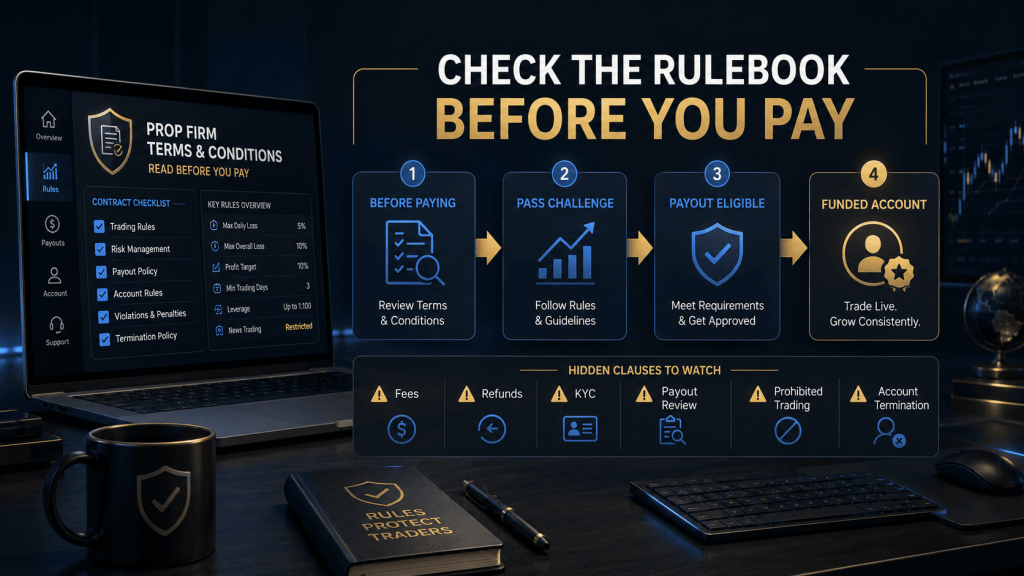



Not all prop firms are bad. Some are bad deals. A bad prop firm deal is an account where the fee model, rule design, payout governance, execution environment or strategy fit makes a clean payout path unlikely. The sharper question is not “are all prop firms scams?” It is “does this firm create avoidable contract risk before market risk even becomes the main issue?”
Why Some Prop Firms Are Bad Deals: The Direct Answer
This article is the bad-deal child guide inside the Prop Firm Trust / Legitimacy Hub. Use the Legitimacy Hub to check scam red flags and payout proof, then use this page to identify firms that may be real, operating and even paying some traders, but still poor value for your strategy.
The internet version of this topic is usually too blunt. One side says prop firms are scams. The other says traders only fail because they lack discipline. Both arguments miss the structure underneath.
| Bad-deal signal | What traders usually notice | What the mechanism often is | Why it matters | Related guide |
|---|---|---|---|---|
| Fee-first economics | Too much emphasis on challenge sales, discounts, resets and retries | The business may benefit more from repeated failed attempts than long-term funded retention | The trader’s success may not align tightly with the firm’s best economics | How prop firms make money |
| Rule opacity | Unexpected failures, unclear breach outcomes or vague “abuse” language | Rules are path-dependent, vague, scattered or interpreted after the fact | Contract risk rises before market risk becomes the main problem | Terms checklist |
| Payout governance | Delays, denials, review loops or unclear evidence standards | The firm keeps wide discretion over eligibility, review and payout approval | Profits on screen do not always become money received | Why payouts get denied |
| Execution mismatch | A strategy works in retail but fails in prop | Rule design punishes certain holding paths, recovery profiles, news exposure or platform behaviour | The account may be structurally incompatible with legitimate trading styles | Order execution |
| Trust gap | Support gets vague after profit, payout proof is weak or public complaints repeat | The fairness layer is too thin for disputes | The trader cannot audit what happens when the account becomes profitable | Verify payout proof |
A bad deal is not always a fake firm. It can be a real firm with an account structure that makes the trader pay for access, take rule risk, reach payout friction and discover strategy mismatch too late.
The Real Problem Is Contract Risk
This is the layer most negative articles still under-explain. Many traders think they are taking market risk. In weaker prop models, they are taking contract risk first.
| Risk question | Retail-style trading question | Weak prop deal question | Why it changes the decision |
|---|---|---|---|
| Trade survival | Can the position survive normal market movement? | Can the position survive the firm’s daily loss, max loss and floating-equity logic? | The same trade path can be acceptable in retail and fail in prop |
| Strategy validity | Is the thesis still valid? | Will this behaviour be read as abuse, over-risk, copy trading or prohibited execution? | The firm may judge conduct, not only outcome |
| Profit quality | Did the trade make money? | Did the profit path meet consistency, news, tool, holding and payout-review rules? | Profit can exist before payout readiness exists |
| Dispute evidence | Can I explain the trade? | Can I map the firm’s denial to a written rule, trade ID, timestamp and calculation? | A weak evidence process turns review into trust risk |
If you want the rule side of that problem in more detail, read daily drawdown vs max drawdown. Many “bad prop firm” stories are really stories about misunderstood or poorly governed rule architecture.
Bad Rules and Strict Rules Are Not the Same Thing
A strict rule is not automatically a bad rule. Serious risk control is normal. A bad rule is different. A bad rule is commercially useful for the firm while being weakly justified from a trading-risk perspective.
| Rule type | What it looks like | Why it can be fair or unfair | Trader action |
|---|---|---|---|
| Strict but legitimate daily loss | The daily loss limit is clear, calculated with examples and reset timing is visible | It limits account damage and gives the trader a measurable stop line | Size trades from a personal stop below the firm limit |
| Strict but legitimate maximum loss | The max loss floor, trailing logic and floating-loss treatment are documented | It protects account lifecycle risk | Map the last 20–50 trades against the rule before buying |
| Bad or vague abuse clause | The firm can reject profit for broad “abuse”, “suspicious activity” or “inconsistent trading” language | The trader cannot predict how the clause will be used | Ask support for concrete examples and save the answer |
| Bad payout review process | Denial decisions are not tied to rule clauses, timestamps, trade IDs or calculations | The account becomes hard to audit after profit appears | Avoid firms that cannot explain payout review clearly |
| Bad path-dependent restriction | A normal recovery, swing hold or news-adjacent action becomes a violation only after review | The trader discovers the real rule after doing the work | Check terms, payout rules and restricted trading before paying |
The difference is not tone. It is purpose. Good risk control protects the account. Bad commercial friction increases failure velocity. This is why what to check before choosing a prop firm should start with rules and payout governance, not account size.
Execution Compatibility Is the Most Ignored Layer
Many complaints about prop firms sound emotional until you translate them into execution terms. Then they become very precise.
| Trading style | What a weak prop structure often punishes | Real trading consequence | Better fit check | Specialist guide |
|---|---|---|---|---|
| Swing trading | Overnight floating loss, delayed recovery, weekend exposure and open-position payout rules | Valid trades can die before the thesis matures | Check holding, reset, swap, gap and payout-state rules before buying | Swing trading prop firms |
| Mean reversion | Temporary drawdown paths and multi-entry recovery behaviour | The account may fail even if the setup later works | Test the normal drawdown path against daily and max loss | Drawdown rules |
| Intraday momentum | Aggressive size into volatile windows, slippage and give-back after fast profit | Daily loss rules can end the session quickly | Use a personal daily stop and account-state checklist | Risk per trade |
| News trading | Event-window entries, exits, pending triggers and spread shocks | A valid event idea can become a rule dispute | Check open, close, modify, pending-order and affected-symbol wording | News trading rules |
| EA, copy or tool-based trading | Automation, signal copying, VPS/IP patterns, account linking and duplicated trades | The platform may accept the order while payout review rejects the behaviour | Confirm tool rules before running the strategy | EA-friendly prop firms |
This matters because a trader may conclude “prop firms are fake” when the more accurate conclusion is narrower: the account model is incompatible with the way the strategy behaves under pressure.
This is also why fee-only rankings are weak. A cheaper account can become expensive if the rules force repeated resets, delayed payouts or poor strategy fit. For the cost layer, review prop firm challenge costs. For the payout layer, review prop firm payout rules.
Alpha Insight: “Prop Firms Are Bad” Is the Wrong Level of Analysis
The phrase is too broad to help anyone. A sharper question is whether the firm has built a weak fairness layer around its commercial model.
When that layer is weak, the trader is exposed to contract risk, payout discretion and execution incompatibility before the market itself becomes the decisive factor.
| Framework layer | Question to ask | Bad-deal warning | What to read next |
|---|---|---|---|
| Fee model | Does the firm look built for repeated challenge intake or long-term funded retention? | The route keeps pushing resets, retries, add-ons or upgrades before the trader fixes failure causes | Challenge costs |
| Rule model | Are the limits clear, justified and stable, or commercially biased and vague? | Key restrictions appear only in terms, payout rules or support replies | Challenge rules |
| Payout governance | Is denial evidence-based, auditable and reviewable? | The firm cannot show the exact rule, timestamp, trade ID or calculation behind a denial | Payout denial reasons |
| Execution fit | Does the account structure allow legitimate trading styles to function normally? | The trader must shrink stops, close early, overtrade or avoid normal holds to fit the account | Order execution |
| Trust evidence | Can the firm’s payout proof, reviews, terms and support behaviour be verified? | The firm relies on old screenshots, affiliate claims or vague “we pay traders” language | Are prop firms legit? |
The more useful judgment is not “good or bad firm” in the abstract. It is “good or bad deal once structure, risk and fairness are all visible.”
Most traders do not need stronger opinions. They need a cleaner way to filter bad prop deals before paying for another challenge.
Start by checking model type, rule logic, payout governance and platform behaviour in that order. Once those are clear, the offer becomes easier to judge.
The same framework explains how prop firms make money. A firm can rely on challenge fees, resets, subscriptions, payout economics and selected trader flow. The question is whether that business model still creates a fair account path for the trader.
What a Trader Should Actually Avoid
| Avoid this pattern | Why it is dangerous | Cleaner test before paying |
|---|---|---|
| Revenue logic stronger than trader logic | If every path leads back to another fee, reset, add-on or unclear restriction, the firm may be monetising churn better than talent | Ask whether the firm’s economics still support long-term funded retention |
| Rules clear at checkout but vague at payout | The challenge rules may look specific while payout review becomes interpretive | Ask for the exact payout denial criteria before buying |
| Account structure punishes normal execution | Legitimate trading paths can be treated as suspicious or commercially inconvenient | Run your last 20–50 trades through the rules before paying |
| Old payout proof without current context | A payout screenshot does not prove the current rulebook, KYC path or payout review quality | Check recent proof, terms, support behaviour and complaint patterns |
| Cheap fee with expensive failure loop | A low challenge fee can become expensive through repeated attempts | Calculate retry-adjusted cost and cost to first clean payout |
For a broader commercial comparison, use the AIFO Best Prop Firm Decision Center as a discovery page, but do not stop at the ranking. A firm can look good in a table and still be a bad deal for your strategy if the rule box distorts your execution.
Final Answer: Why Some Prop Firms Are Bad Deals
Some prop firms become bad deals because they turn trading into a weakly governed contract instead of a transparent account relationship.
The bad ones are not defined only by price. They are defined by misaligned incentives, opaque rule design, weak payout governance and account structures that punish normal execution paths more than genuine recklessness.
So the smarter question is no longer “Are prop firms bad?” It is “Which firms become bad deals once the rulebook, payout layer, execution fit and trust evidence are all visible?”
Related Trust and Due-Diligence Guides
- Are prop firms legit? — trust signals, scam red flags, payout proof and shutdown risk.
- What should you check before choosing a prop firm? — full due-diligence checklist before paying.
- Prop firm terms and conditions — clauses that affect access, payout and dispute risk.
- Why prop firm payouts get denied — rule, KYC, consistency, review and evidence problems.
- How prop firms make money — fee model, payout economics and lifecycle incentives.
FAQ
Both can be true, but the better question is whether the firm is a bad deal. A trader can misuse a good structure, but some firms also create avoidable contract risk through vague rules, payout discretion, weak evidence standards or poor execution fit.
Because payout stage exposes the governance layer. Challenge rules are usually visible and fixed at the start, but payout reviews can reveal how much discretion the firm keeps over abuse clauses, evidence standards, eligibility decisions, KYC, consistency and account-state checks.
Yes. A legitimate firm can still be a poor fit if its drawdown logic, holding restrictions, execution conditions or payout rules conflict with the way your strategy behaves under normal market conditions.
The biggest red flag is usually vague governance. If breach interpretation, payout denial or behavioural restrictions feel broad enough to be used after the fact, the trader is taking contract risk before taking meaningful market risk.
Not automatically. A cheap challenge can be fair if rules, execution, payout and support are clear. It becomes a bad deal when the low entry fee hides tight drawdown, repeated resets, add-ons, unclear payout rules or poor strategy fit.
Check the firm’s terms, payout proof, rule clarity, drawdown logic, cost path, support behaviour, execution conditions and recent complaint patterns. Then run your last 20–50 trades through the account rules before paying.